Art of Advent Day 21
By Megan Waugh
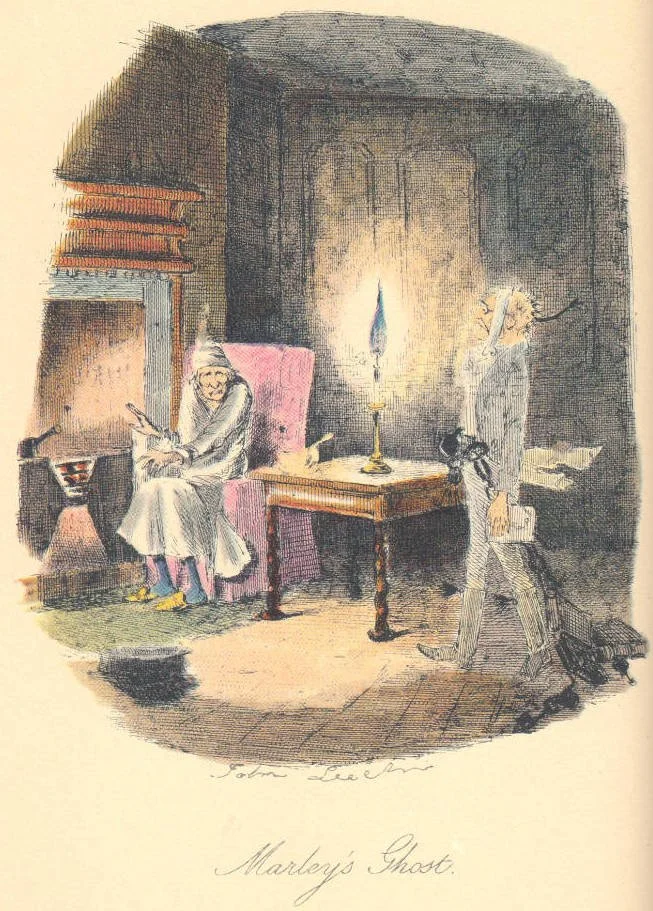
John Leech, Marley’s Ghost [facing p.25 in Stave One: Marley’s Ghost, from Charles Dickens’ ‘A Christmas Carol, First Edition], 1843, hand-coloured steel engraving, 9.9 x 8.2 cm (vignetted). Scanned image by Philip V. Allingham.
Image courtesy of Dan Callinescu.
As you get ready to sleep this Christmas Eve--or every Christmas before now--what have you expected from your night of dreams? That fervent buzz of anticipation has long been associated with the coming of Santa Claus during the night, but what if something even more fantastical could occur? What if you were to be encountered by visitors who specialise in presents not of the material kind—but of spirit?
In 1843, Charles Dickens wrote of such a story in A Christmas Carol, which he prefaced: ‘my purpose was, in a whimsical kind of masque which the good humour of the season justified, to awaken some loving and forbearing thoughts, never out of season in a Christian land. I have the happiness of believing I did not wholly miss it.’
Dickens’ tale takes advantage of reading when understood as a mode of enchantment. While his ambitions for social welfare were initially met by plans for a non-fiction pamphlet, he quickly realised another form of writing was much more effective, one that may ‘come down with twenty times the force—I could exert by following out my first idea’. Instead, he wrote a novella depicting the supernatural so that readers ‘cannot miss’ the haunting ideas he wished to highlight.
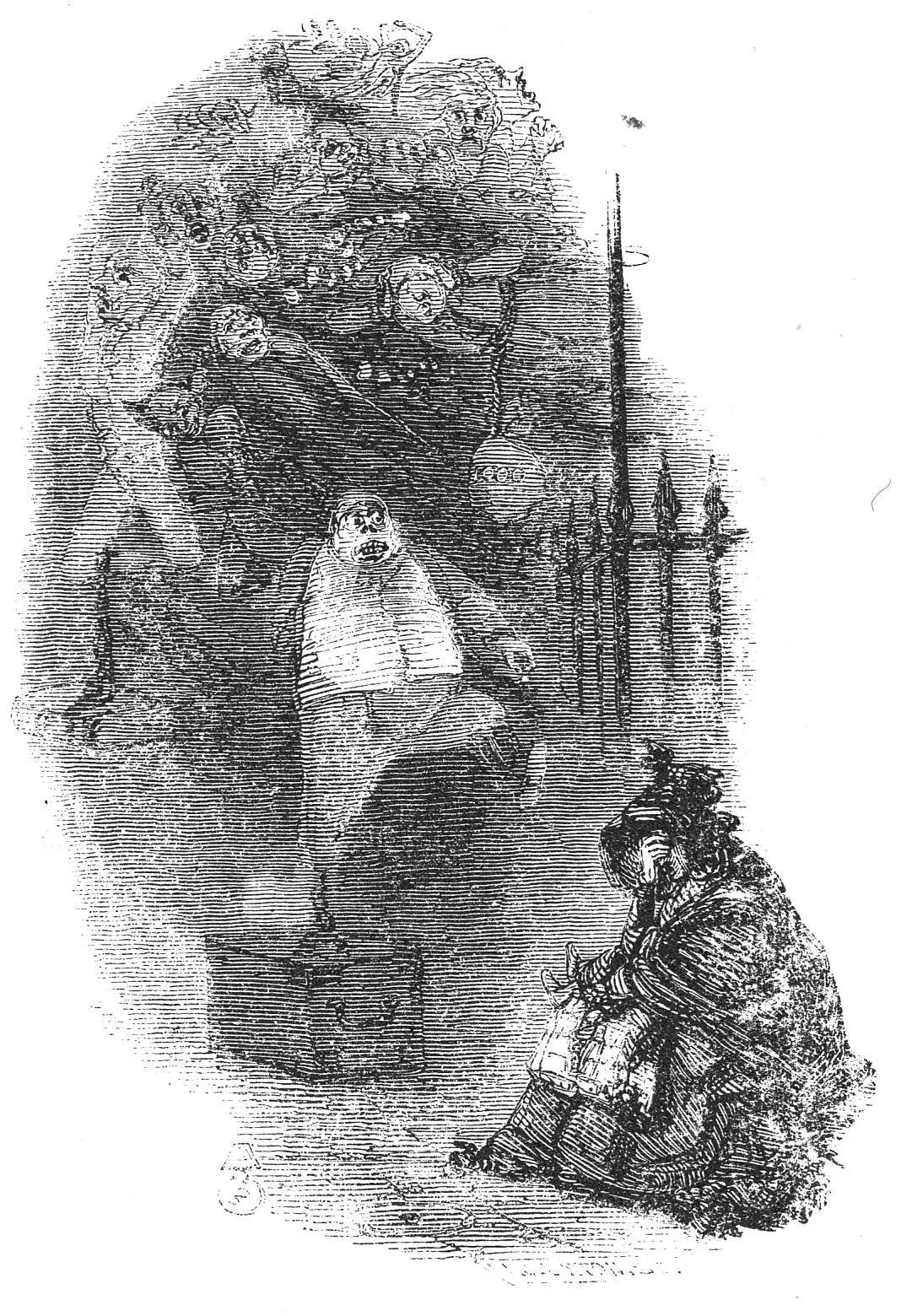
John Leech, The Ghosts of Departed Usurers, (p.37, from Charles Dickens’ ‘A Christmas Carol], 1843, wood engraving dropped into letterpress, 9.5 x 6.3 cm (vignetted). Scanned image by Philip V. Allingham.
Image courtesy of Dan Callinescu.
John Leech’s illustrations further intensify the work’s revelatory effect, turning the phantasmal into intense visuals. Here, a dying woman huddles in the gutter as a cloud of ghastly businessmen loom over her figure. Through illustration, the injustice of the wealth divide can be made into something concentrated and experiential.
The Victorian Age has been marked as one of ‘rationalisation and intellectualisation’ as modernisation altered the world from one of ‘mysterious incalculable forces’ (Weber, 155) to one of technical means and calculations. Dickens’ story, with the accompaniment of Leech’s illustrations, challenges this.
As Christmas is a time where ‘the good humour of the festive time’ may justify such entertainment of fancy, its choice as a setting befits this cause. The magic which permeates the air this time of year is not necessarily conditional to frosted panes, twinkling lights, and hanging berries. These are just ‘excuses’ to awaken ourselves to a greater sense of enchantment. Moreover, Dickens’ text reminds us that while we fawn over gifts and baubles and the like, there is something we must not miss: spirit.
Bibliography
Dickens, Charles. A Christmas Carol and Other Stories. London: Marshall Cavendish Ltd., 1987.
Plourde, Aubrey. “Another Man from What I Was’: Enchanted Reading and Ethical Selfhood in A Christmas Carol." Victorian Review 43. no. 2. 2017. 271-286.
Taft, Joshua. “DISENCHANTED RELIGION AND SECULAR ENCHANTMENT IN A CHRISTMAS CAROL.” Victorian Literature and Culture. 43. no. 4. 2015. 659–73.
Weber, Max. “Science as a Vocation.” From Max Weber: Essays in Sociology. Ed. Gerth, H. H. and Mills, C. Wright. New York: Oxford UP. 1946. 155.
The Letters of Charles Dickens. Edited by Madeline House, Graham Storey, and Kathleen Tillotson. vol. 3. Clarendon, 1974.