
Art of Advent Day 4
By Clara Kenny
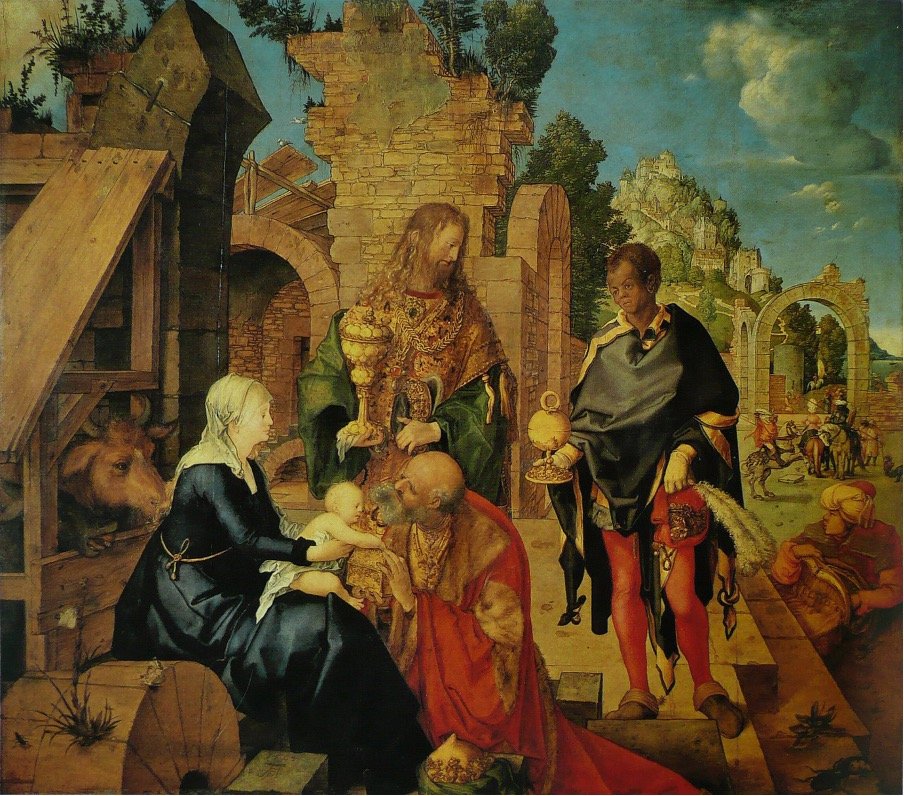
Albrecht Durer, Adoration of the Magi, 1504, oil on wood, 99 x 113.5 cm, Florence.
Image courtesy of Uffizi Gallery.
The Magi, or three kings, who bore gifts of gold, frankincense and myrrh to the new-born baby Jesus are central to the Nativity story. Yet one of them, Balthazar (the youngest of the three) came to represent much more than this, becoming one of the earliest representations of a black figure in Renaissance painting.
The integration of Black representation into the Nativity painting occurred gradually, beginning with the depiction of black attendants. In 1266-68, Pisano carved two Black African retainers to three white Magi in his marble pulpit for the Duomo of Siena, and the convention of the black attendant was gradually adopted throughout Italy. This is seen in the Neapolitan follower of Giotto’s The Adoration of the Magi (1343). Here, the three magi are depicted adorned in gold, and the three black attendants have been downsized and reduced to the bottom-left corner.
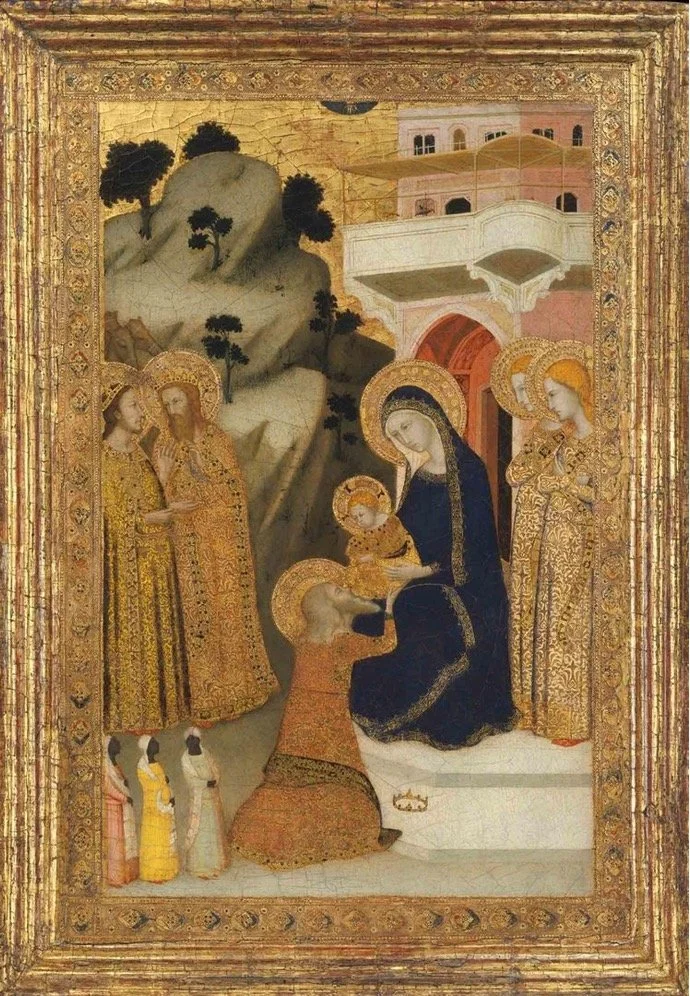
Neopolitan follower of Giotto, The Adoration of the Magi, 1340-43, Tempera on wood, 66.4 x 46.7 cm, New York.
Image courtesy of the Metropolitan Museum of Art.
The convention of the Black Magus first caught on properly in Southern Germany, where Hans Multscher’s 1437 altarpiece combined a central Black Magus with several black attendants, pioneering the trend of German artists depicting dark-skinned Magi in their paintings, which was aided by the dissemination of prints of the ‘Adoration’ from German artists like Martin Schonguaer, which spread the convention of the Black Magus far beyond Germany. By 1520, the Black Magus had taken hold in Italy too, and by the 1700s the rise of the elaborate Christmas scene in Naples had even led to a new surge of Black figures depicted, a crowd of attendants surrounding Balthazar.
So, what explained the emergence of this revolutionary convention? Arguably, the Black Magus was symbolic of the growing visibility of other races and peoples beyond Europe, following on from the great Portuguese and Spanish expansion and discovery in the New World. Furthermore, Humanist thinking of the Renaissance endowed people with a new curiosity about the wider world. Each of the Magus came to represent separate continents, symbolic of Christianity’s growing global reach, and Balthazar became symbolic of Africa. Dürer wrote of ‘the subtle ingenuity of people in foreign lands,’ and the Balthazar in Hieronymus Bosch’s Adoration of the Magi (1494) exemplifies this ‘ingenuity.’ Bosch’s Black Magus is dressed in a fantastical white, almost reminiscent of ivory, perhaps linking to the ivory artworks the Portuguese brought back from Western Africa, further highlighting the symbolically global dimension of the Black Magus.
In tracking Balthazar’s transformation, we glimpse how Renaissance artists reimagined the Nativity not only as a sacred moment, but as a meeting point of worlds newly coming into view.
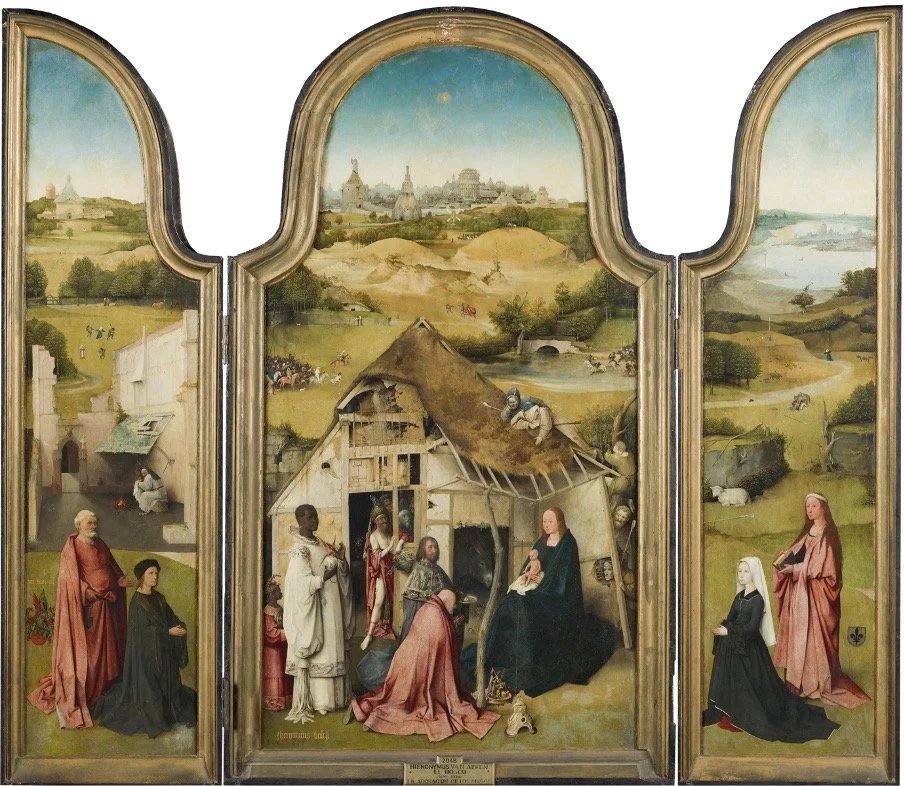
Hieronymus Bosch, The Adoration of the Magi,1494, Oil on oak panel, 138 x 144 cm, Madrid. I
mage courtesy of Museo Nacional del Prado.
Bibliography
Erickson, Peter. “Representations of Blacks and Blackness in the Renaissance.” Criticism 35, no. 4 (1993): 499–527. http://www.jstor.org/stable/23116561.
Johnson, Shania. “Exploring Representations of the Black Magus in European Art - the Metropolitan Museum of Art.” Metmuseum.org, May 13, 2021. https://www.metmuseum.org/perspectives/exploring-black-magus-in-european-art.
Jones, Jonathan. “Myrrh Mystery: How Did Balthasar, One of the Three Kings, Become Black?” The Guardian, December 21, 2020. https://www.theguardian.com/artanddesign/2020/dec/21/christmas-cards-star-baby-jesus-myrrh-mystery-balthasar-three-kings-black-art.
Kaplan, Paul H. D., and Henry Louis Gates. “Geographies of the Black Magus Tradition.” In Balthazar: A Black African King in Medieval and Renaissance Art, edited by Kristen Collins and Bryan C. Keene, 34–39. Getty Publications, 2023.
Kaplan, Paul H. D., and Henry Louis Gates. “The Black Magus in the Public Sphere.” In Balthazar: A Black African King in Medieval and Renaissance Art, edited by Kristen Collins and Bryan C. Keene, 96–101. Getty Publications, 2023.