By Audrey O’rafferty
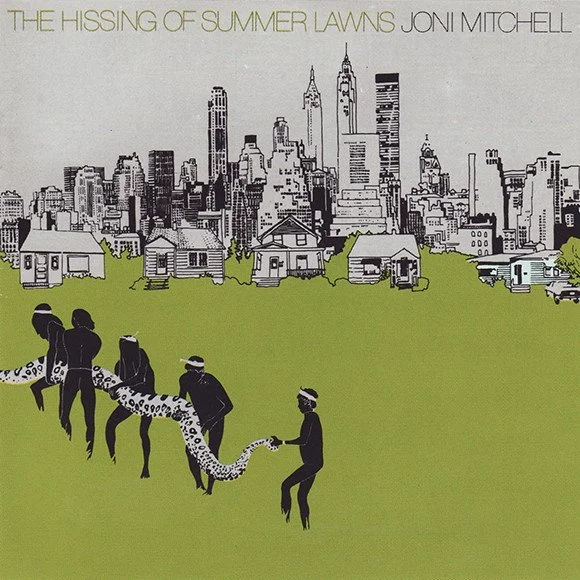
Joni Mitchell, The Hissing of Summer Lawns, 1975, painting, 31.4 x 31.4 cm. Image courtesy of Jonimitchell.com.
At the age of nine, Roberta Joan Anderson, who would come to be known as Joni Mitchell, contracted severe polio, prompting a long and isolated period of convalescence that Mitchell would later credit with the birth of her artistic creativity. Born on November 7, 1943, in Alberta, Canada, Mitchell has frequently discussed how she first became involved in the arts through painting rather than songwriting. It was not until her seventh-grade English teacher, Mr. Kratzmann, encouraged her to ‘paint’ with her words that Mitchell began writing. She went on to attend the Alberta College of Art for a single year before dropping out to pursue music. Despite this shift in focus, drawing and painting have remained central to Mitchell’s artistic expression, notably as a space where she has explored her identity and place in the world. The album covers she created exemplify this.
One such cover, for her 1975 album The Hissing of Summer Lawns, features a city skyline juxtaposed with a Beverly Hills-inspired suburb, with a group of figures carrying a large snake across a field of grass. The snake can be read as a metaphor for the predatory nature of capitalism. Combined with the album’s interior image of a bikini-clad Mitchell floating in a Bel Air pool, this suggests that the cover art also engages with Mitchell’s own artistic identity. By the mid-1970s, Mitchell had achieved a commercial success that allowed her to live luxuriously, so the cover art may be viewed as an exploration of the tension between two identities: her otherwise bohemian artistic nature and the fame that followed. The album’s songs criticize middle-class consumerist values, particularly for their suppression of individuality. Mitchell’s visual contribution enhances the palpability of this message and demonstrates her awareness of the contradictions within her success.

Norman Seeff, Hissing of Summer Lawns I, 1975, photograph. Image courtesy of San Francisco Art Exchange.
It was during her rise to fame that Mitchell’s music came to be dismissed as feminine and virginal, while, paradoxically, her sexuality also came under increased media scrutiny. For instance, in a 1972 Rolling Stone article tracing the relationships among members of the rock community, nearly everyone included was connected by music or industry interests, except Mitchell. The article featured her name in the silhouette of a lipstick stain surrounded by the words ‘kiss, kiss,’ effectively reducing her to her romantic relationships and sexuality.
Mitchell’s artistic response to the misogyny of her era would be considered by some to be in poor taste. In 1976, Mitchell dressed as a pimp, donning blackface and an afro wig, thereby giving birth to her Black male persona ‘Art Nouveau,’ whom she would sporadically dress as until the early 1980s. Biographers of Mitchell have often glossed over this period of her work, either omitting her characterisation of ‘Nouveau’ as a pimp or treating it as permissible because of her later collaborations with prominent Black musicians such as Charles Mingus.
For the 1977 cover of Don Juan’s Reckless Daughter, Mitchell created a photo collage featuring ‘Art Nouveau’ beside a photograph of herself. On the cover, ‘Nouveau’ can be read as representing Don Juan, the famed womaniser of Spanish folklore, and Mitchell as his ‘reckless daughter,’ as the title suggests. Such positioning uses the womanising tropes of Juan and the pimp to legitimise Mitchell’s personal sexual liberation as a form of birthright. Scholars such as Miles Parks Grier have suggested that ‘Nouveau’s’ masculinity functioned to insulate Mitchell against music industry misogyny, while also using Blackness’s association with jazz to bolster her activity within the jazz-rock genre. At the time, Mitchell’s musical innovation within jazz-rock was to some extent marginalised, and performing a Black male persona suggests an attempt to take advantage of the ‘classic white male rocker’s desire for brotherhood with black men,’ as Parks Grier asserts.
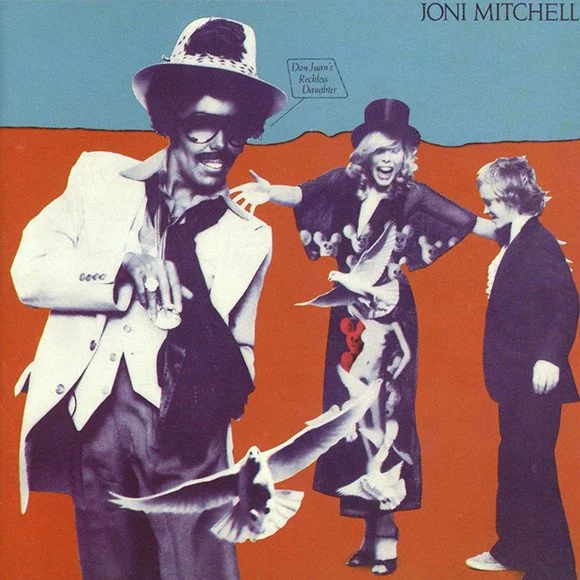
Joni Mitchell, Don Juan’s Reckless Daughter, 1977, photo collage, 31.4 x 31.4 cm. Image courtesy of Jonimitchell.com.
Mitchell has never publicly apologised for the persona and has defended it as an artistic and spiritual affinity with Black men. Although Mitchell was responding to sexist structures, and her intentions may have been critical or subversive, ‘Art Nouveau’ can be read as drawing on racialised tropes in its pursuit of artistic legitimacy. In doing so, the work risks reinforcing stereotypes that associate Black masculinity with criminality and hypersexuality, with potentially harmful consequences.
Though best known for her soulful albums, Joni Mitchell considers herself ‘a painter first, and a musician second.’ Her 2000 solo exhibition showcased eighty-seven works from a collection of over 500 pieces, speaking to the persistence of her personal artistic production. The covers she contributed to many of her albums are a testament to how her visual and aural arts can work in tandem. However, Mitchell’s use of blackface within her self-representation is perhaps one aspect of her work that invites further critical reflection, and it may be worth approaching her oeuvre with this in mind.
Bibliography
Bergman, Brian. ‘Both Sides Now.’ Maclean’s, June 19, 2000. https://jonimitchell.com/library/originals/jmOriginal_525.pdf.
Brooke, James. ‘For Joni Mitchell, Artist, Singing Was Not Enough.’ New York Times, August 22, 2000. https://archive.nytimes.com/www.nytimes.com/library/arts/082200joni-mitchell-art.html.
Green, Denise Nicole, et al. ‘“Both Sides Now”: Articulating Textiles and Fashioned Bodies
in the Works of Joni Mitchell, 1968–1976.’ Clothing and Textiles Research Journal, 37, no. 3 (2019): 171-186. https://doi.org/10.1177/0887302X19830203.
Parks Grier, Miles. ‘The Only Black Man at the Party: Joni Mitchell Enters the Rock Canon.’ University of Colorado Boulder, November 1, 2012. https://www.colorado.edu/gendersarchive1998-2013/2012/11/01/only-black-man-party-joni-mitchell-enters-rock-canon.
‘When Joni Mitchell wore blackface for Halloween.’ BBC, October 28, 2016. https://www.bbc.com/news/magazine-37781800.