Kanō Tan’yū (1602-1674)
By Dane Moffat
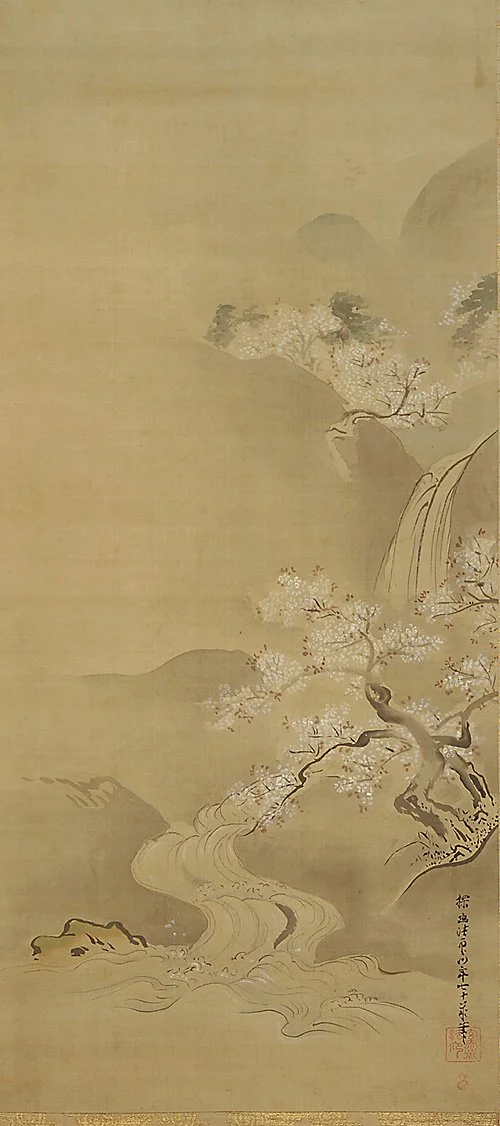
Kanō Tan’yū, Spring Landscape, 1672, ink and colour on silk, 82.5 x 37.7cm. National Museum of Asian Art, Freer Gallery of Asian Art Collection. Gift of Charles Lang Freer.
Start with this, with empty space. Then a stroke of ink ripples across the surface, constructing a mountainous landscape. A minka sits atop its peaks; a waterfall rushes nearby. (The painting could be real, but it could also be a fiction.) The boy is twelve years old, showcasing his painting skill before the shogun Tokugawa Hidetada (r. 1605-23). Tokugawa praises him as a reincarnate of his grandfather, the master painter Kanō Eitoku. The boy is Kanō Tan’yū, born 4 March 1603. He is considered one of the ‘three famous brushes’ of the Kanō family, whose influence extends across 200 years of Japanese (art) history.
—
In 1617, aged fifteen, Kanō was appointed the official painter of the Tokugawa shogunate as power shifted toward Edo (modern-day Tokyo). He was politically astute, having secured his family’s generational wealth for over 250 years, due in part to his painting skill. Four years later, in 1621, Kanō was also gifted a large sweep of land near the Kajibashi gate of Edo Castle, where he built a house and art studio. His two brothers, Naonobu and Yasunobu, too, were gifted land and constructed houses and art studios upon it. Kanō and his brothers later merged their art studios to form a local school which trained several generations of artists.
Afforded by his close relations to the Tokugawa shogunate, Kanō served as the shogunal art advisor and produced most of their art commissions. Across the 1620s and 1630s, Kanō produced several large-scale paintings for residences like the Edo, Nagoya, and Osaka Castles; these commissions were typically folding screens and panels featuring his signature style: local, natural subjects with gold leaf or silver pigment. These large-scale ink paintings were often completed in collaboration with students of the Kanō school, though are typically attributed to Kanō himself.
Kanō’s artistic career is divided according to his age, as identified by his changing inscriptions and seals. In the first phase, as a teenager, he signed his work as ‘Uneme’, having adopted Kanō Tan’yū, a temple name, in his thirties. Few objects attributed to Kanō remain extant from his adolescence, with a singular work dating back to 1613, when he was eleven. The second phase was signed with his own and his studio’s name. In the third, and final, phase of his career, Kanō signed all works with his name and age.
Kanō’s enigmatic artistic identity extended further as a multimedia artist during a period when Japanese artists often committed to a single medium or genre. Aside from this, Kanō was an avid collector and connoisseur of Chinese art. He kept extensive records, both visual and written, of all the works which passed through his studio for authentication. Kanō passed away, aged seventy-two, on 4 November 1674.
Bibliography
Brittanica. “Kanō Tan’yū.” Accessed March 2, 2026. https://www.britannica.com/biography/Kano-Tanyu
The Metropolitan Museum of Art. “Landscapes of the Four Seasons Catalogue Entry." Accessed March 2, 2026. https://www.metmuseum.org/art/collection/search/53009