
Odilon Redon (1840-1916)
By Daphne Richard
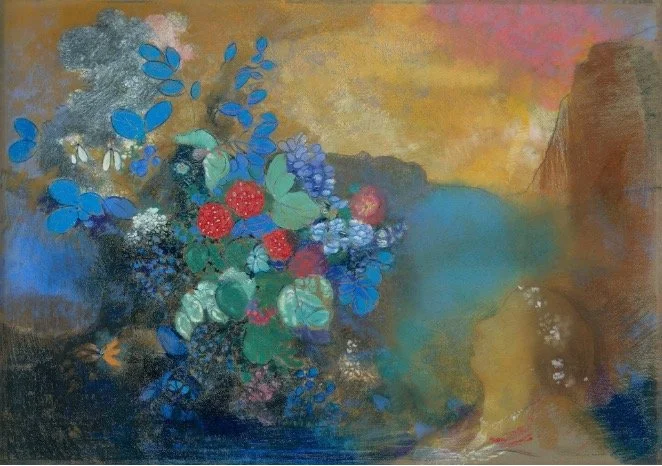
Odilon Redon, Ophelia among the Flowers, 1905/08, pastel on paper, 64 x 91 cm, The National Gallery, London.
Image courtesy of The National Gallery, London.
Tucked away from the grand halls of London’s National Gallery rests room forty-two. This small, dark room feels like an afterthought in the gallery’s grand halls. Filled with pastels, a museumgoer may turn to the realistic works by Georges de la Tour or those by Edgar Degas set around the room. Situated on its own rests Ophelia among the Flowers (1905/08), and this brings us to the life of the artist Odilon Redon.
Born 22 April 1840 in Bordeaux, France, Redon spent his childhood years between Bordeaux and Peyrelevade, a nearby commune. Redon’s early artistic period is characterised by a romantic look with soft watercolours. However, by 1870, Redon was sent to fight in the Franco-Prussian War. By the end of the war, his life seemed to have been taken over by solitude and darkness. This ushered in the age of what he called his ‘Noirs’. Redon cited black as being ‘the most essential colour’ yet the Noirs operate as a fascinating transition period. Head within an Aureole (1894/95) encapsulates the tensions of black and the reintroduction of colour into his style. While less grotesquely black than some of his earlier Noirs, this artwork’s central figure is shrouded and obscured by darkness. The light medium of charcoal is granted a heft by its bold, dark strokes, yet it is also given a light, aural quality. The black emanates into the pastel blue and pink. Perhaps this aureole acts as a conduit into an introspective dreamscape into the soul.
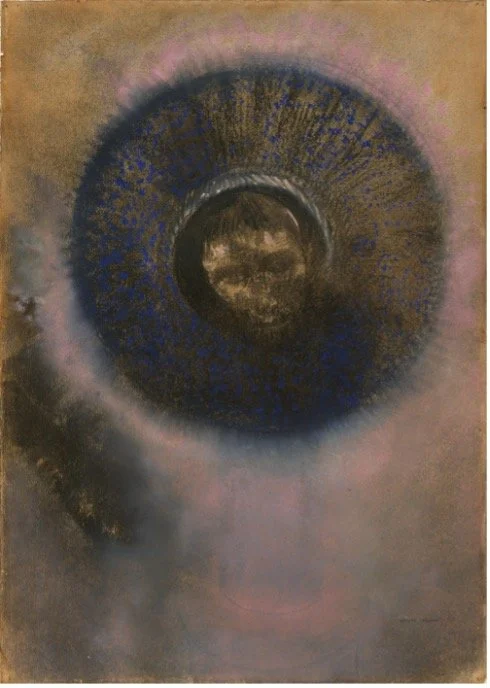
Odilon Redon, Head within an Aureole, 1894/95, charcoal and pastel, 52 x 36 cm, J. Paul Getty Museum.
Image courtesy of J. Paul Getty Museum.
By the turn of the twentieth century, Redon transitioned into a full bloom of colour. My personal favourite piece from this period is one I had the pleasure of seeing in the National Gallery, too. Ophelia among the Flowers (1905/08) recalls Hamlet and the tragedy of Ophelia. The work is bright and lively. Dominated by sharp flowers set against a haze of pink, yellow, and blue, Ophelia lies in the foreground at the bottom. The background appears to be the main scene, though as we look at Ophelia we are unsure if she is still alive. Her colouring matches that of the sky, or perhaps the heavens, as the pastels are smudged up into the water.
There is no real sense of perspective in this piece. The colouring acts as separation of spatial registers but the painting seems to float up and blend into each other. The colour and spatial ambiguity twists an iconic, borderline cliché, scene into a contemporary exploration of tragedy and life.
Throughout his career, Redon examined the solitude and luminosity of the world around him. Drawing on dreams and spirituality, he employed the weightlessness of charcoals and pastels to capture the dream-like effervescence of our souls and minds. I will end this by saying to not take any of my interpretations from this to heart as Redon himself would say that, ‘[his] drawings inspire and are not to be defined. They place us, as does music, in the ambiguous realm of the undetermined.’
Bibliography
Nardi, Alessandra. “‘Black Is the Most Essential Color’: Odilon Redon’s Noirs.” Getty.edu, March 5, 2016. https://www.getty.edu/news/black-is-the-most-essential-color-odilon-redons-noirs/.
“Odilon Redon,” n.d. https://www.odilon-redon.org/biography.html.
The Art Story. “Odilon Redon Paintings, Bio, Ideas,” n.d. https://www.theartstory.org/artist/redon-odilon/.
Tate. “Odilon Redon 1840–1916 | Tate,” n.d. https://www.tate.org.uk/art/artists/odilon-redon-2243.
The National Gallery, London. “Odilon Redon | Ophelia Among the Flowers | NG6438 | National Gallery, London,” n.d. https://www.nationalgallery.org.uk/paintings/odilon-redon-ophelia-among-the-flowers.