Carol Rhodes (1959-2018)
By Dane Moffat
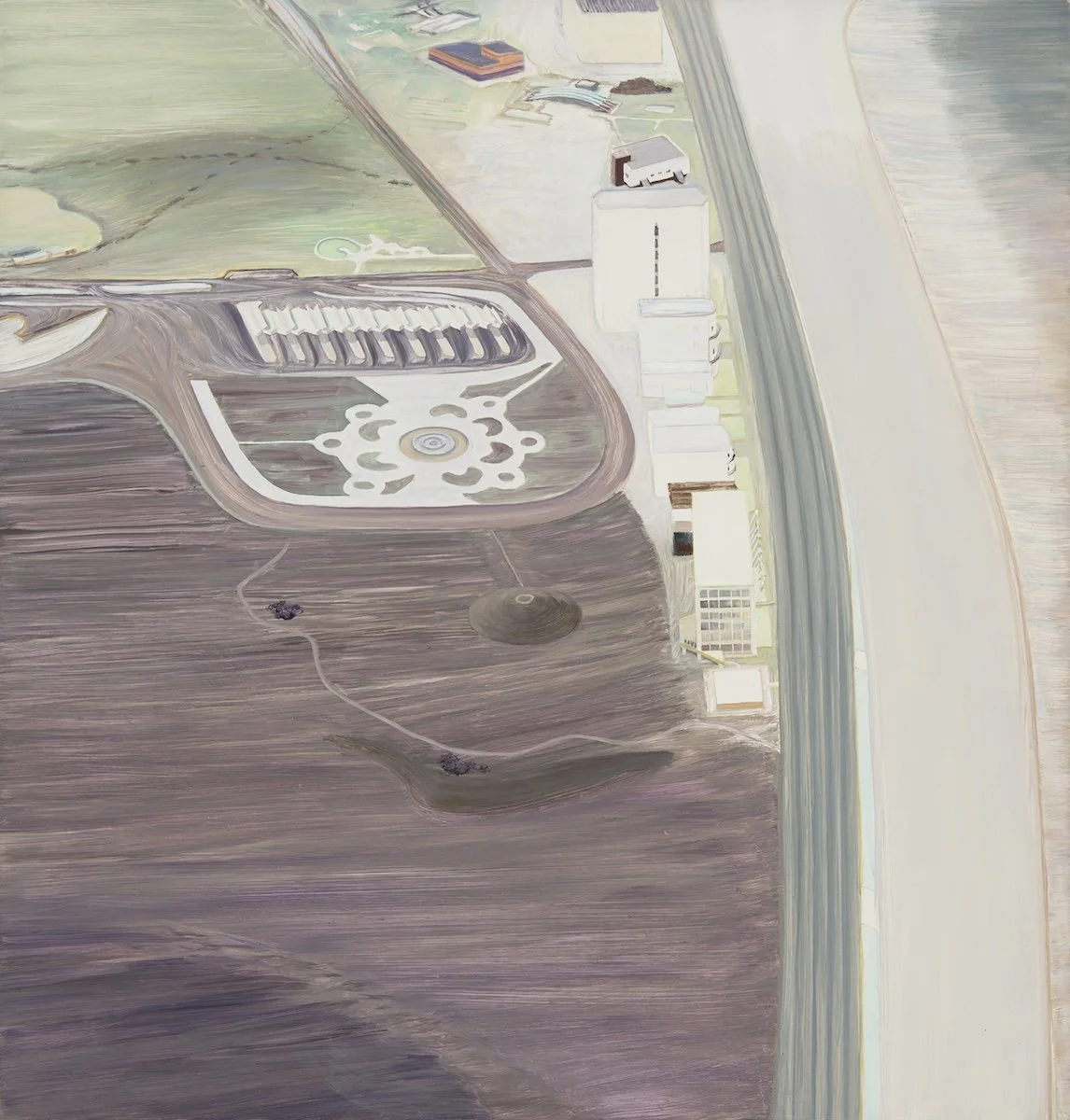
Carol Rhodes, Sea Front, 1998, oil on board, 47 x 45cm. Image courtesy of the Carol Rhodes Estate.
As my final contribution to HASTA, I am bringing it back to Scotland with the artist Carol Rhodes, whose paintings ask us to consider our environment and our personal contributions to it. A somewhat fitting sentiment to end my editorship as I take stock of the last two years. Rhodes was born 7 April 1959 in Edinburgh, though she spent her youth in Serampore, India, where her parents were posted on missionary by the Church of Scotland. Rhodes’ parents sent her to the Woodstock School, a missionary boarding school, in the Himalayan foothills. Here, Rhodes and her friends embraced pacifist politics, which would later prove fundamental to her environmentalist paintings: quiet criticisms that explored personal and corporate complicity, morality, and social responsibility in (post-)industrial sites and ‘edgelands’, like motorways and waterways.
Rhodes returned to the United Kingdom, aged fourteen, where she completed her education, first in Sussex, and later Dumfries. She moved to study painting at the Glasgow School of Art (GSA) under the Scottish realist painter Alexander ‘Sandy’ Moffat in 1977. At GSA, she painted amongst a buzzy, new generation of ‘Glasgow Boys’ who worked on dense, sprawling canvases, though Rhodes did not take interest in this, nor Moffat’s realism, rather opting for a restrained manner of painting. An outsider in her own community, Rhodes struggled to adapt to the Scottish climate (like most of us St Andreans), and returned to India during the semester breaks; she made annual pilgrimages to India during her twenties. Graduating in 1982, Rhodes stopped painting shortly thereafter and directed her attention to political activism.
Rhodes was committed to an intersectional politics and involved herself various protests like Reclaim The Night (against gender-based violence) and Greenham Common Women’s Peace Camp (for nuclear disarmament). Still, Rhodes remained committed to Glasgow-based arts organisations in the face of her own artistic inactivity: she was a committee member of the artist-run gallery Transmission, a co-founder of the Glasgow Free University, and an assistant at the Third Eye Centre and Tramway.
The Tramway inspired Rhodes to uptake painting again, and she held a joint studio there with the little-known artist Rowan Mace. Rhodes’ signature landscape paintings emerged during this time, in 1994, with a desire to combine her political and environmental activism through painting. Art was no longer ancillary, but indeed necessary, to her practice. Her paintings were primarily characterised by semi-fictional industrial landscapes that explored environmental destruction and decay, which seems antithetical to the genesis of this article, but I find rich potential for change and renewal in their muted, clean palettes and brushwork.
Rhodes was a slow, calculated painter, due in part to her wet-on-wet mode, and to her preparatory drawings which defined the scale, perspective, and colour of each painting. She would trace these drawings onto board, then paint. Later in her career, Rhodes exhibited these preparatory drawings as artworks in their own right.
Notably, there are no horizon lines in her paintings, situating the viewer both inside and outside of the landscape: a totalising, bodily experience of, and connection to, the land. As such, Rhodes employed an aerial perspective to capture the land top to bottom, and front to back, extending behind the buildings so that nothing was unaccounted for. It seems that risk defined her practice: she abandoned art for activism, found inspiration in aerial photographs which she took herself (and found in geography books, too), and strayed far from her mentor’s and classmate’s styles to produce artworks uniquely her own.
Rhodes was diagnosed with motor neurone disease in 2013 which brought her painting practice to an end three years later. Still, her paintings were exhibited, and continue to be, in Britain and elsewhere. One of the final exhibitions in Rhodes’ lifetime was at the Metropolitan Arts Centre in Belfast, curated by Andrew Mummery, who represents the artist’s estate jointly with Alison Jacques Gallery.
—
It is hard to take an aerial view of the work I have produced over the last two years as a writer and editor, but I would like to thank this year’s writers — Annabel, Audrey, Daphne, and Toby — for their insightful articles, and to our readers for your support.
Bibliography
Alison Jacques Gallery. “Carol Rhodes.” Accessed April 6, 2026. https://alisonjacques.com/artists/carol-rhodes
Jenkins, David Fraser. “Carol Rhodes Obituary.” The Guardian, December 13, 2018. https://www.theguardian.com/artanddesign/2018/dec/13/carol-rhodes-obituary
Mummery, Andrew. “Carol Rhodes Estate.” Accessed April 6, 2026. https://www.carolrhodesestate.com/