Painting the Threshold: Contemporary Art and the Vienna State Opera's Safety Curtain
By Hanna Yoon
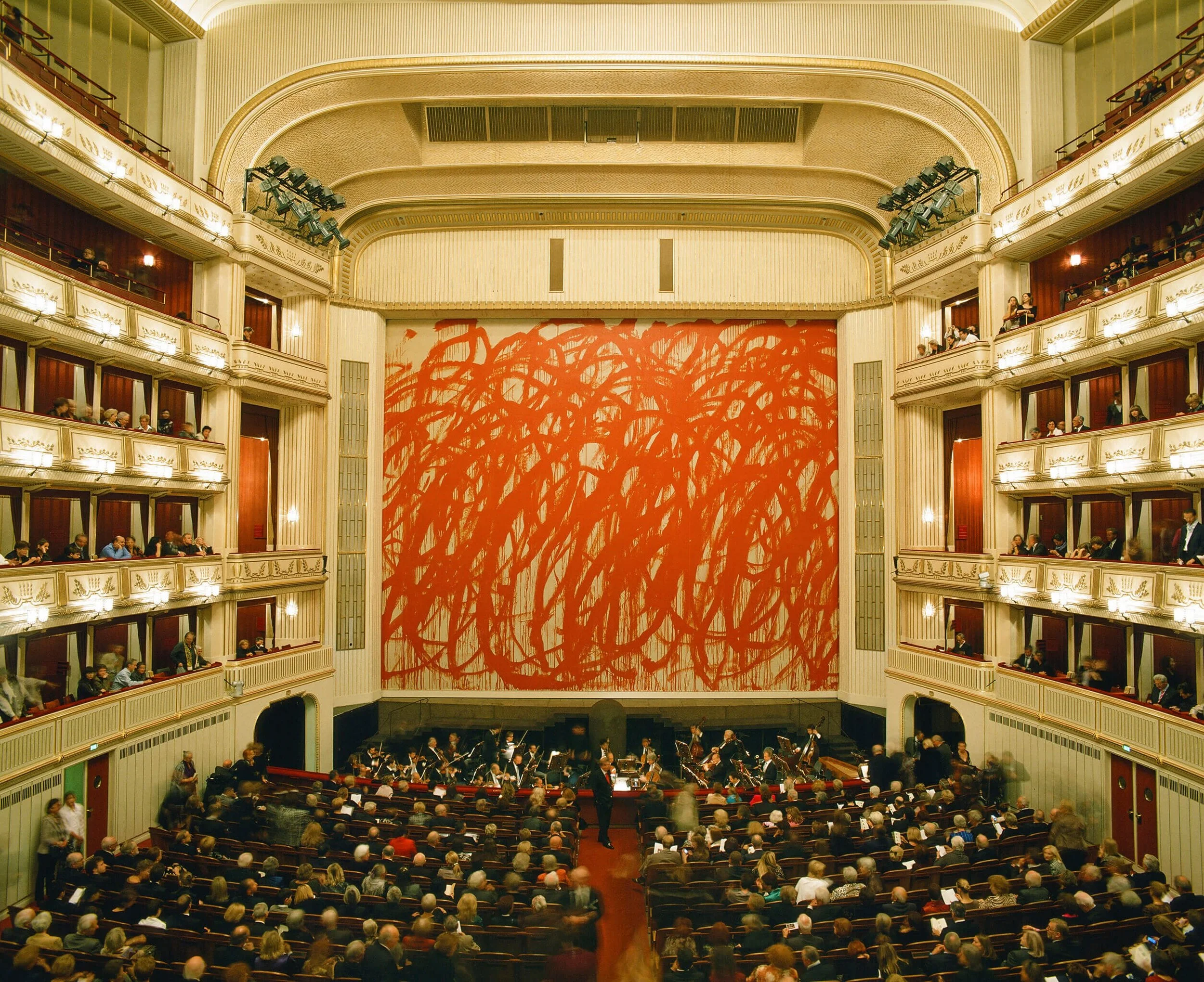
Cy Twombly, Bacchus, 2010.
Image courtesy of the Museum in Progress.
In most opera houses, the safety curtain is a matter of building regulation – a heavy sheet of iron or asbestos descending between stage and auditorium in the event of flames, separating the spectacle from its audience with precisely the bureaucratic bluntness the situation demands. At the Vienna State Opera, it has been a painting since 1998. Not a decorative gesture, not a remnant of some previous production's scenography, but a commission: one in a rotating series of artworks made specifically for the safety curtain, that most unglamorous of architectural necessities, transformed into one of Europe's most unusual exhibition formats. The image stops you before the evening can - insistently contemporary and deliberately at odds with a house that old and that certain of its own importance.
The programme, known simply as Safety Curtain and organised by the Museum in Progress, has by now accumulated a roster that reads like a survey of late twentieth and early twenty-first-century art – Kara Walker, Cy Twombly, Maria Lassnig, among many others. Each artist is invited not to illustrate an opera, not to decorate a room, but to respond to the curtain itself: a surface that exists in a condition of permanent deferral, always about to become something else, always on the verge of either revealing or concealing what lies behind it. It is a strange brief. It is also, when you follow it into the specific commissions, an extraordinarily rich one, because the artists who have risen most interestingly to it are those who understood that the curtain is not merely a surface but a threshold, and that what happens at thresholds is never quite as simple as either side of them.
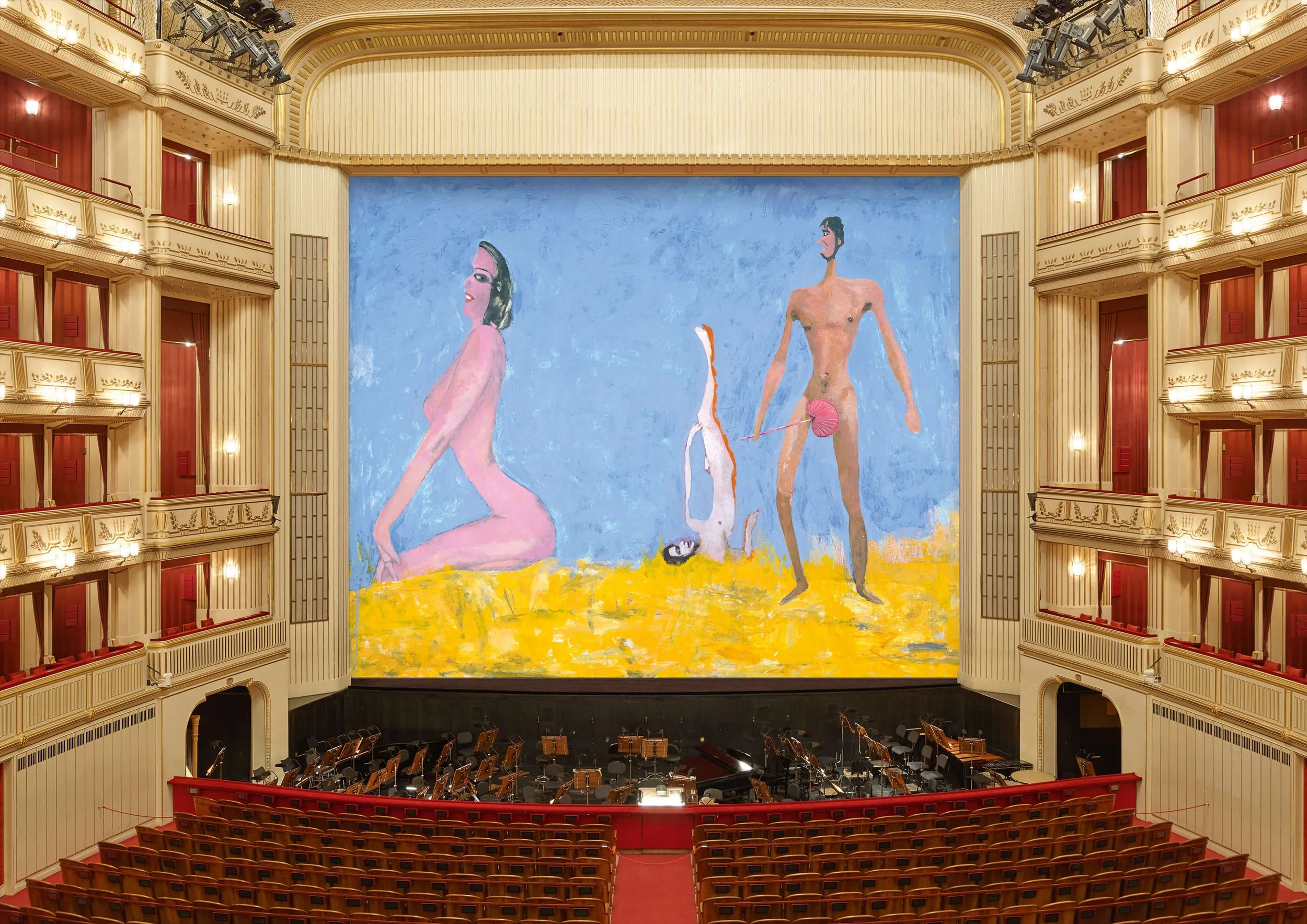
Franz West, Drei (Vom Vorgang ins Temperament), 2009.
Image courtesy of the Museum in Progress.
Franz West's contribution for the 2009/2010 season – Drei (Vom Vorgang ins Temperament) – is, at first glance, the most unlikely artwork this stage has ever hosted. West gave the curtain a collage of tempera works from the 1970s and 1980s, painted during stays in Greece: three figures in carefree nudity, arranged in near-statuesque poses that have, on the surface, nothing whatsoever to do with opera. West, whose entire practice was built on a kind of productive mischief – the Passstücke (objects designed to be awkwardly held, that made the audience's own body the subject) – imported that same logic into the opera house. The nudity is not accidental; it was, by West's own account, originally conceived as a way of covering the existing curtain decoration, widely considered unworthy of the house. But it does something more interesting than cover - it strips. The opera, that most elaborately clothed of art forms, is returned here to its barest skeleton: desire, rivalry, and the three bodies that make a plot. As Egon Friedell and critic Michael Mautner observed, the theatre is the one place the curtain comes up – where human beings, otherwise committed to concealment, are finally permitted to flash up unhooded. West took him at his word.
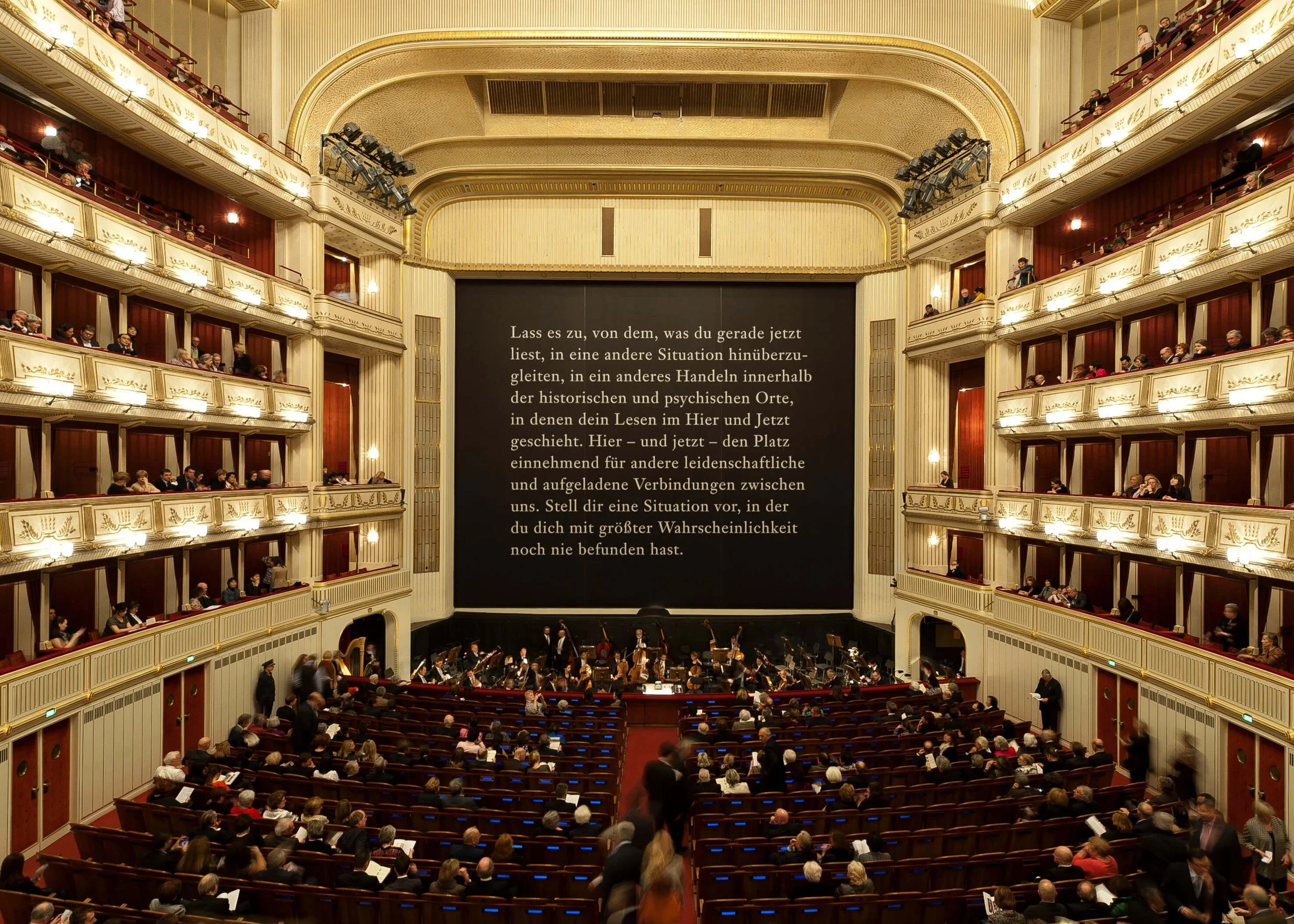
Cerith Wyn Evans, Safety Curtain, 2011.
Image courtesy of the Museum in Progress.
Cerith Wyn Evans, whose 2011/2012 commission followed two seasons later, operates in an entirely different register – and poses, in doing so, the programme's most formally daring question. His curtain bears not an image but text: a written instruction, a request addressed directly to the viewer standing in the auditorium before the evening begins. The full passage runs as an invitation to drift, to abandon the act of reading in favour of imagining another situation entirely. It is, in other words, an instruction to stop looking at what is in front of you and imagine yourself elsewhere, which is, one might argue, precisely what opera will do to you in twenty minutes anyway. The relationship this creates between the art on the curtain and the art behind it is one of the most genuinely strange things the programme has achieved. Wyn Evans is one of the defining figures of contemporary conceptual art. His Venice Biennale installation of 2003, a searchlight broadcasting an early Welsh text in Morse code across the city's night sky, is exemplary of a practice in which the message is always partly unavailable - always just beyond legible, drawing the viewer into a heightened state of attention that the content alone could never produce. His curtain works identically. The text is a threshold within a threshold – an image that asks you to stop reading it, in a room designed to make you surrender to something you cannot control. It pulls you toward the stage even though it is still hidden. Evans empties the curtain in order to fill the room.
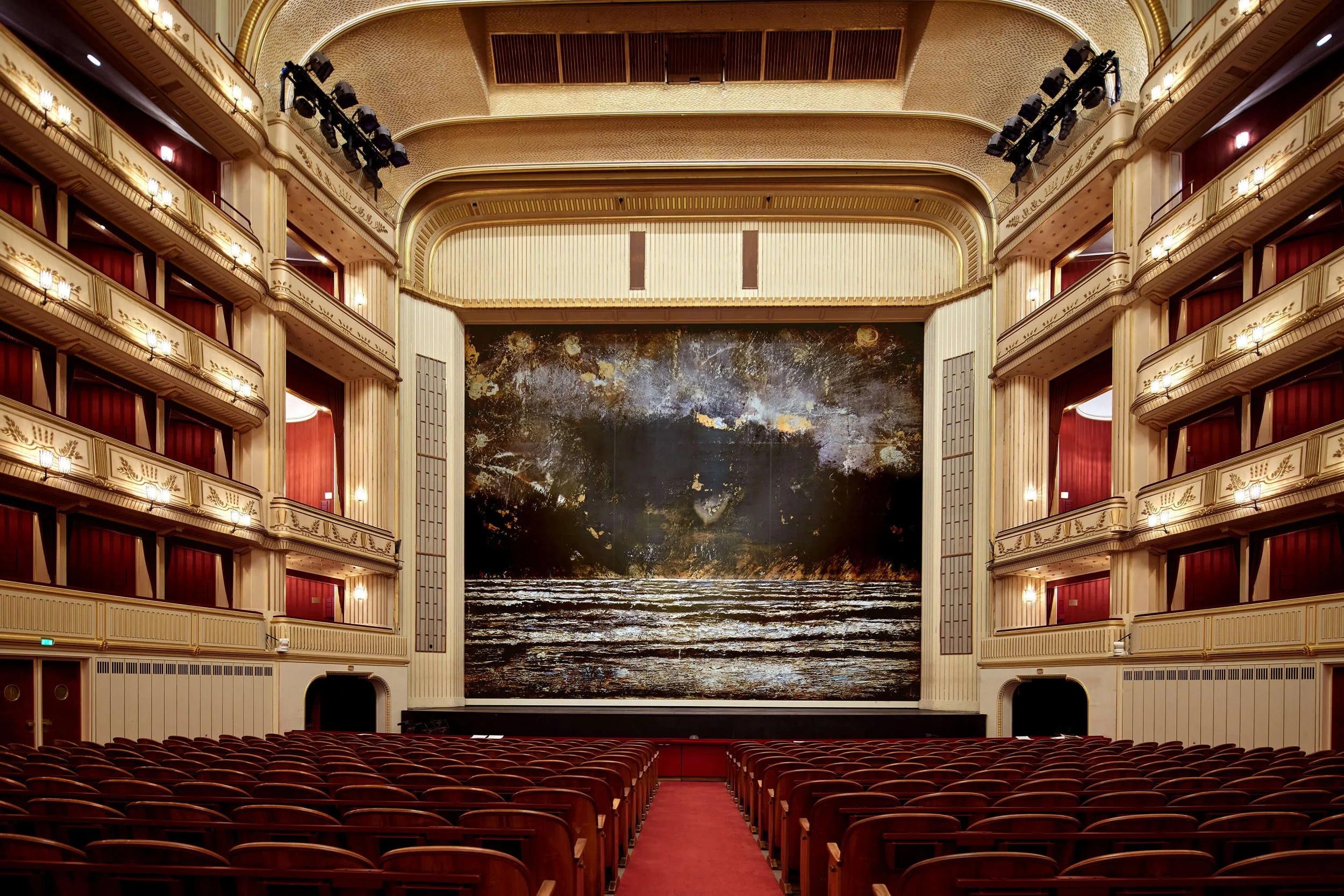
Anselm Kiefer, Solaris (for Stanislaw Lem), 2023.
Image courtesy of the Museum in Progress.
The gravitational force of the programme, at least for me, is Anselm Kiefer's Solaris (for Stanislaw Lem) of 2023/2024. Kiefer has spent his career working with material that is almost too heavy to move – with lead, with straw, with the accumulated weight of German history and mythological time – and the curtain he produced for the Vienna State Opera is no different. Its source is Stanisław Lem's 1961 novel Solaris, in which an ocean covering an alien planet functions as a mirror of human consciousness: producing, from the deepest memories of the astronauts who study it, physical manifestations of lost loved ones, of grief made briefly and unbearably material. It is a novel about the impossibility of contact between fundamentally different orders of intelligence – and about the cruelty of a kind of knowledge that can recreate what you mourn but cannot restore it. Kiefer's painting renders this ocean in the visual language he has made unmistakably his own: vast, turbulent, geological in its sense of time, beautiful in the way that things are beautiful when they are also terrifying. Christoph Ransmayr, writing in the programme essay, traces the material history of iron itself – from meteorite to weapon to curtain – noting that the very safety curtain on which this painting hangs was once a gift from the sky and has since become a symbol of separation between worlds. It is a reading that Kiefer, with his instinct for the mythological density of materials, would surely endorse. What strikes me most about this commission, though, is its implicit argument about the opera house itself. Lem's ocean, as Ransmayr describes it, can swallow whole worlds and recreate them – can produce from the astronauts' memories something more vivid and more present than the original. This is, of course, exactly what opera does. The curtain drops. The ocean rolls in. An audience arrives expecting to see a performance, only to find the image of a force capable of recreating everything they have ever lost.
What connects these three commissions – and what makes the Safety Curtain programme worth taking seriously as an art-historical phenomenon, rather than merely an interesting institutional experiment – is their shared understanding of what the curtain actually is. It is not a wall. It is not a screen. It is the moment at which the space you are sitting in decides to become something else, and the moment, when the evening ends, at which it reverts. West puts three bodies there and makes you notice the skeleton of every plot you are about to watch. Wyn Evans puts language there, making you notice your own act of looking. Kiefer puts an ocean there and makes you wonder whether the thing you came to see – the opera, the performance, the collective surrender to feeling – is not, in the end, a mirror of yourself. Each artwork is temporary, lowered for one season and then rolled away, replaced by the next. None of them is permanent. None of them is meant to be. The curtain rises, and the painting disappears, and the evening you actually came for begins.
This is the condition the programme understands, and the gallery cannot replicate: the artwork that exists in the moment before the thing we think we want. That lives at the threshold, and insists we stay there, just long enough to notice where we are.
Some surfaces are simply more interesting than we give them credit for. And some fire doors, it turns out, have always had something to say.
Bibliography
“Anselm Kiefer at the Vienna State Opera.” 2023. White Cube. October 31, 2023. https://www.whitecube.com/news/anselm-kiefer-at-the-vienna-state-opera.
“Anselm Kiefer Creates»Safety Curtain«for Vienna State Opera.” 2023. Thaddaeus Ropac. 2023. https://ropac.net/news/1531-anselm-kiefer-creates-safety-curtain-for-vienna-state/.
“Safety Curtain.” 2024. Museum in Progress. 2024. https://www.mip.at/en/projects/safety-curtain/.
“Safety Curtain.” 2025. Wiener-Staatsoper.at. 2025. https://www.wiener-staatsoper.at/en/architecture/safety-curtain/.