Facing Absence: Reimagining Performance, Presence, and the Audience-Performer Binary from MoMA to St Andrews
By Grace Liang

Isaac Chirnside and Rowan Liddel, still from Five Hundred Thousand projection, 2026, performance and video, St Andrews Heritage Museum.
Image courtesy of Rowan Liddel.
Performance art as a form of conceptual artistic expression relies on the bodies of the artists themselves, the ephemerality of the act, and the immediacy of their presence to the audience. Yet the idea of true presence within the performance piece has been continuously contested, deconstructed, and mediated since the practice gained traction in the 1970s. In New York’s Museum of Modern Art, a pioneer of the medium, Marina Abramović, performed her landmark piece The Artist is Present (2010), centered on radical, face-to-face energetic immersion with audience members. To explore the ways in which performance art negotiates visibility today, I would like to juxtapose Abramović’s monumental work, with a hyper-local St Andrews performance, Five Hundred Thousand (2026) in which eight student musicians performed from behind a screen, stripping their audience of visual access to the band. St Andrews is far removed from the bustling metropolises with which performance art is associated, and thus there is a stark contrast in scale and institutional weight. Yet, beneath this discrepancy in prestige lies a shared inquiry into human connection. Five Hundred Thousand’s deconstruction of the face and the performer/audience relationship provides an interesting counterpoint to Abramović’s visceral, almost sacred construction of presence.
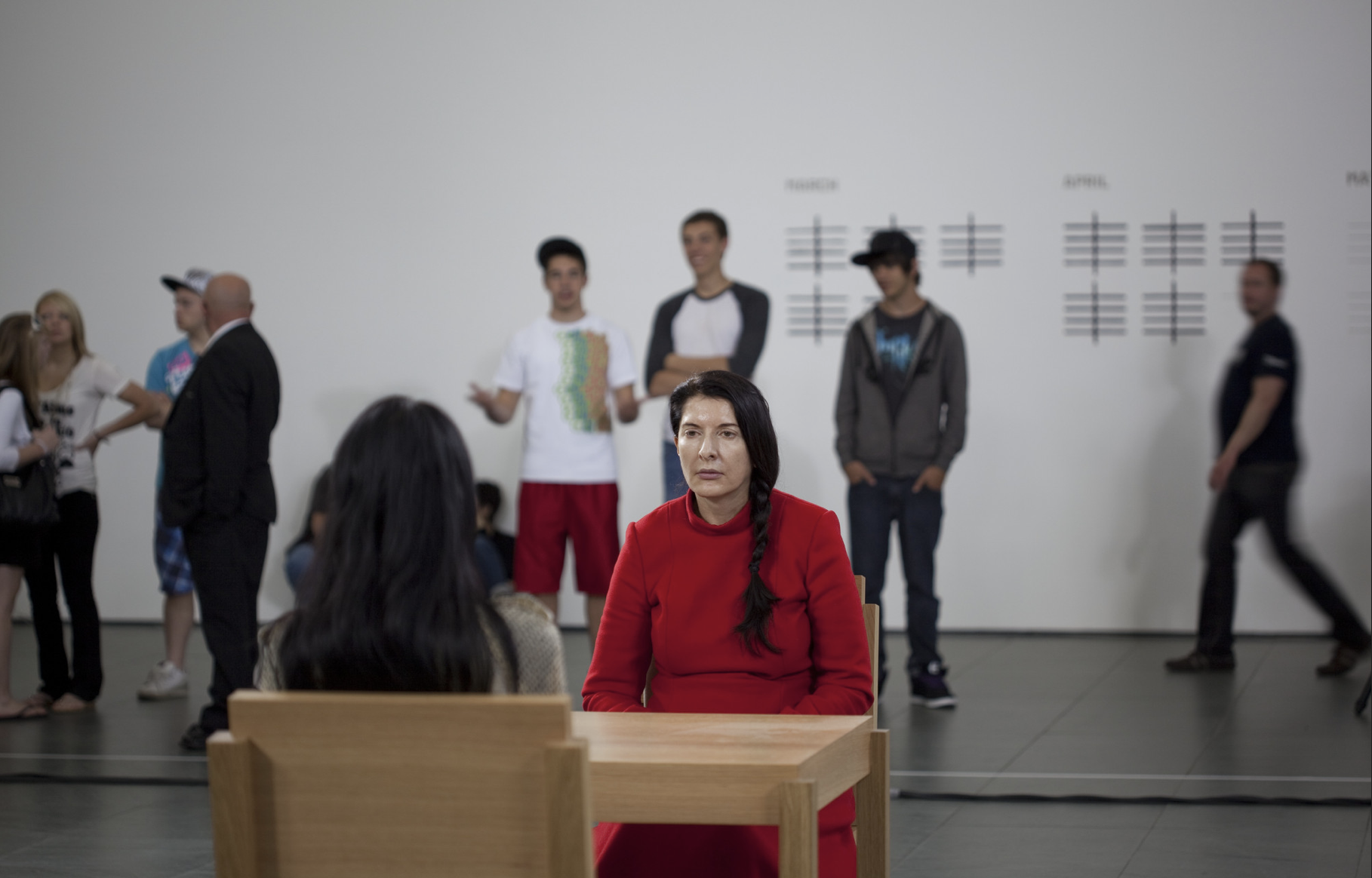
Marina Abramović, The Artist is Present, 2010, performance, Museum of Modern Art.
Image courtesy of MoMA.
The Artist is Present remains Abramović’s longest continuous performance, occurring every day that the museum was open for the entire run of her MoMA retrospective, from March 14 to May 31, 2010. The performance staged Abramović in a conservative dress that showed only her face and hands, seated at a table for all open hours that the museum with no breaks. Audience members lined up to silently sit across from her for a duration of their choosing, all monitored, photographed, and filmed by the institution. This stripped-back performance relied on Abramović’s spartan discipline, holding unbroken eye contact and facial composure for up to ten hours a day. To prepare, she trained for a year, eating and drinking only at night and executing repetitive, slow-motion exercises like opening and closing a door for three consecutive hours. This endurance conditioning served to fortify the emotional core of the performance, allowing Abramović to provide each audience member with the same degree of attention and connection. By removing any form of movement, speech, or physical touch, from The Artist is Present, Abramović reduced the medium of performance to its most fundamental components: the sharing of time, space, and gaze. The immediacy of prolonged eye contact, which often feels too intimate in everyday society, breaks down social defenses, with many audience members experiencing deep catharsis and shedding tears. The artist often refers to her body as a conduit for a certain kind of nearly supernatural energy exchange between her and the audience, an ambitious attempt at capturing raw human connection.
Excerpt from Five Hundred Thousand video projection, 2026.
Video courtesy of Rowan Liddel.
Where Abramović constructed presence through exaggerated exposure, other contemporary performance strategies seek connection through the inverse. On Saturday March 28th, 2026, amid the mid-term assignment rush, the student band Thrush hosted a performance titled Five Hundred Thousand at the St Andrews Heritage Museum. Unlike the typical university band concert venue, the audience filed into a stage-less, and seemingly band-less space, populated only by a projector, a hanging white sheet spanning the width of the space, and the immovable accoutrement of the museum. The architects of the Five Hundred Thousand performance were then-second-years Isaac Chirnside and Rowan Liddel, who were supported by their bandmates Rufus Powell (drums), Lila Kikuchi (trumpet), Toni Williamson (flute), Amy Lam (flute), along with Liv Willis (flute), and Jamie Mitchell (saxophone). Signaling an immediate departure from conventional St Andrews student band performances, the music began with a discordant droning and pained moaning coming from the other side of the sheet. The physical barrier between the audience and the artists rendered each party visually absent from the other, converting the performers’ presence into a dethatched voice and soundscape. The goal of this acoustic isolation as to “break the line” between audience and performer, Chirnside explained, “[centralizing] the audience but also disillusioning them with their own physicality”. Simultaneously, a video of flashing faces, celebrities, film clips, Hellenistic sculptures, and esoteric YouTube videos was projected onto the audience side of the barrier sheet. Crucially, this disorienting sensory environment was experiences on both sides of the curtain at once; the musicians themselves performed without seeing the video or knowing its contents beforehand, further breaking down performance expectations and placing both the performer and the audience is a state of mutual deprivation and discovery.
This deliberate destabilization of the visual access that audience members take for granted ties into theoretical inquiries of how human identity is staged. Liddel, who compiled the footage for the video, cites philosophers Gilles Deleuze and Félix Guattari’s idea of faciality as the primary inspiration for the video. Through the disembodied faces intercut with flashes of text, Liddel hoped to explore “the ways [in which] the face is constructed and destroyed”, particularly as an social mechanism. According to Liddel, “the performer becomes a performer only insofar as they are seen by the observer” and vice versa, but “the performer’s identity as someone with a face is questioned by your inability to see them”. Moving beyond abstract philosophy, Chirnside and Liddel particularly sought to question this phenomenon of identity construction and constant social performance within the St Andrews University cultural landscape. Thus, two contrasting methodologies emerge across theese two works. Where Abramović employs extreme visibility to enforce her presence, Chirnside’s use of sonic disembodiment served to explore what remains when physcial presence is stripped away. Due to the improvised soundscape, decoupled visuals, and lack of face-to-face access the Five Hundred Thousand audience and performers were united in their parallel navigations of fear, desire, and expectation. Chirnside and Liddel reject the idea of pure live presence that Abramović’s performance clings to heavily to, explicitly incorporating mediation through the projection to create mirrored subjective experiences and ask both artist and audience to surrender control.
Ultimately, both projects seek to test and redifine the boundaries of the performance space, albeith thorugh opposing tactics. Abramović’sThe Artist is Presentelevates the body and the face to create a sacred site of presence and connection whereas Chirnside and Liddel’sFive Hundred Thousanddeconstructs the necessity of the face, demonstating how absence, sound, and visual obstruction expose our fragile preconceptions of identity and performance. When examined together, both works explore the power of performance art to test and expose the raw, delicate boundary between performer and audience.
Bibliography
Fashion Neurosis. “Marina Abramović on Climaxing for Art and the Power of a Yamamoto Suit | Fashion Neurosis.” YouTube, April 30, 2025. https://www.youtube.com/watch?v=wFDW6nGH5lI.
Jones, Amelia. “‘The Artist Is Present’: Artistic Re-Enactments and the Impossibility of Presence.” TDR/The Drama Review 55, no. 1 (209) (2011): 16–45. https://doi.org/10.1162/DRAM_a_00046.
MoMA. “Marina Abramović. Rhythm 0. 1974 | MoMA.” Www.Moma.Org, 2024. https://www.moma.org/audio/playlist/243/3118.