Timeline Discoveries: The archaeological findings reshaping our perception of history
By Millie Barker
On Monday 19th of January, a press conference unveiled the archaeological discovery of a 2,000-year-old basilica designed by Vitruvius. The basilica, completed in nineteen BCE at Fanum Fortunae, is the only known building that can be definitely attributed to Vitruvius. The structure was unearthed during excavations for the redevelopment of the Piazza Andrea Costa in the town of Fano along the coast of the Adriatic Sea.
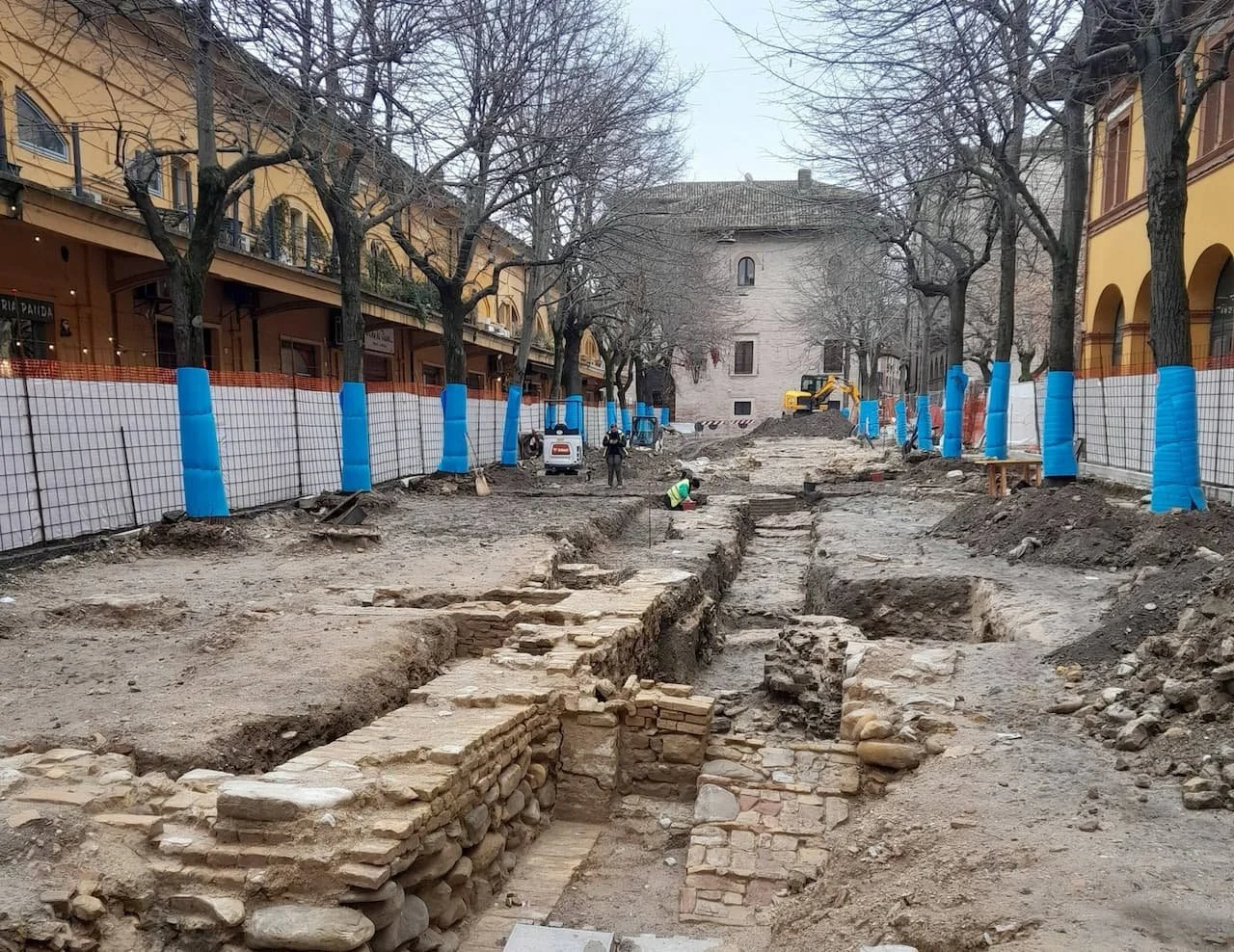
Remains of Vitruvius' basilica.
Image Courtesy of the Ministry of Culture via Art News.
Referenced in his De Architectura, the structure corresponds directly to Vitruvius’ description – lending the work a rare archaeological certainty. The precision of Vitruvius’ description became pivotal to understanding the orientation and extent of the basilica. After the first four columns of the short side were identified, the excavation team used the description to calculate where the top right corner column should be placed.
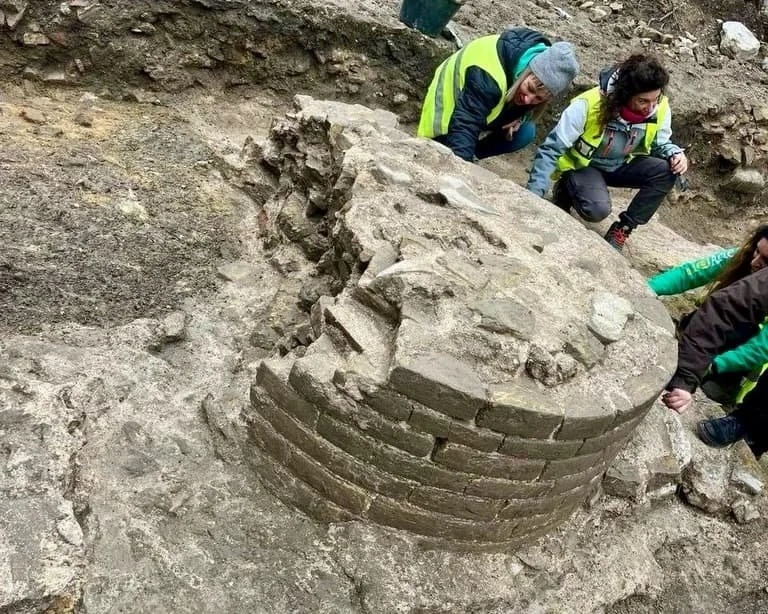
The column that identified and correctly oriented from precise description by Vitruvius.
Image courtesy of the Ministry of Culture via La Brújula Verde.
De Architecture, familiar to many art history students, is the only complete treatise on architecture to survive from antiquity and is regarded as the first book on architectural theory. It provides instruction on classical proportion, underpinning artists work for centuries, and its ideals immortalised in Leonardo da Vinci’s Vitruvian Man. Thus, it marks a momentous occasion in the field of art history for the work of such a significant architect to be uncovered. The excavated basilica has transformed the written word, which has been foundational to Western art history, into a concrete and tangible reality.
Italy’s Cultural Minister Alessandro Giuli underscored the cultural significance of the find by likening it to the discovery of Tutankhamun’s tomb. This claim was attested by the Mayor of Fano, Luca Serfilippi, who stated it was the discovery of the century after scientists and researchers have been searching for the basilica for over 500 years.
On a similar vein, four oceans away, a red claw hand painting uncovered on the Indonesian island of Sulawesi has been named the world’s oldest cave art. The hand is dated to at least 67,800 years ago, around 1,100 years older than the previous record of a hand stencil at a Neanderthal site in Northern Spain. The stencil of a red hand has been elongated and narrowed to create a claw like image, giving the hand an animalistic quality. The alteration suggests the unique creativity of the modern man, implying the imagination of a human not just reacting to but representing the world.
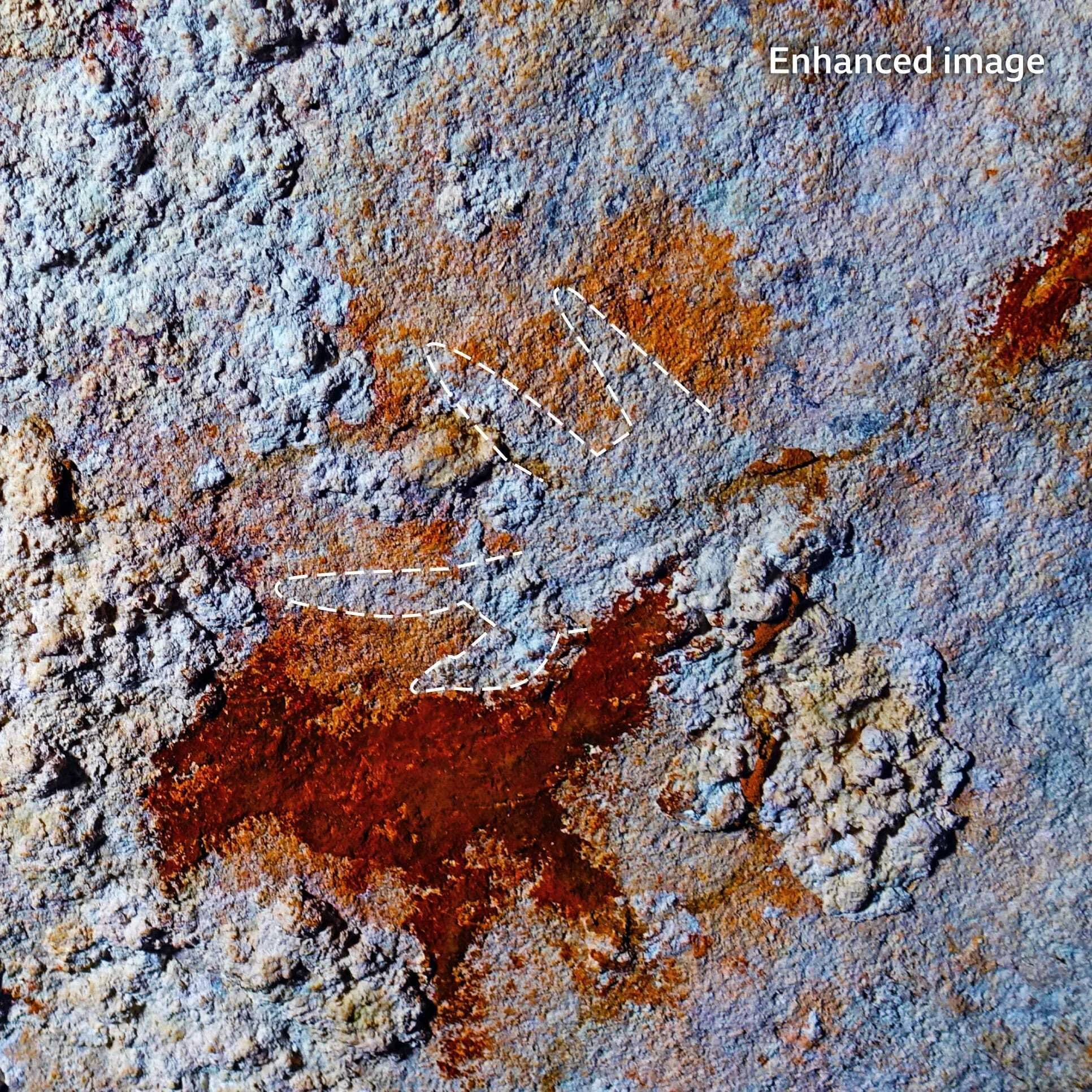
Enhanced image of the cave handprint.
Image Courtesy of Maxime Aubert, BBC News.
The art historical find also has significant geographical implications as it provides evidence for the argument that Homo-sapiens reached the wider Australia-New Guinea landmass 15,000 years earlier than the mainstream view. Thus, Professor Maxime Aubert of Griffiths University, has underscored that the finding ‘shapes a much deeper and more widespread story of creativity.’
Such discoveries challenge our perspectives and serve as a reminder to keep questioning our understanding of human history, subverting what we believe to be true.
Bibliography
Armellini, Alvise and Bernadette Baum. “Italy uncovers basilica designed by Vitruvius, the ‘father of architecture.’” Reuters. January 19, 2026. https://www.reuters.com/science/italy-uncovers-basilica-designed-by-vitruvius-father-architecture-2026-01-19/
Carvajal, Guillermo. “Archaeologists Confirm Remains Found in Fano Belong to Vitruvius’ Legendary Basilica, Built in 19 BC.” La Brújula Verde, January 19, 2026. https://www.labrujulaverde.com/en/2026/01/archaeologists-confirm-remains-found-in-fano-belong-to-vitruvius-legendary-basilica-built-in-19-bc/
Durón, Maximilíano. “Archeologists Uncover 2,000-Year-Old Basilica Designed by Vitruvius: ‘The Tutankhamun of the 21st Century.’’ Art News, January 20, 2026. https://www.artnews.com/art-news/news/archeologists-uncover-vitruvius-basilica-italy-1234770292/
Ghosh, Pallab. “Oldest cave painting of red claw hand could rewrite human creativity timeline.” BBC News, January 21, 2026. https://www.bbc.co.uk/news/articles/czx1pnlzer5o
Hughes, Rebecca Ann. “Italy's 'Tutankhamun's tomb': Archaeologists hail discovery of sole Vitruvius Basilica.” Euronews, January 21, 2026. https://www.euronews.com/culture/2026/01/21/italys-tutankhamuns-tomb-archaeologists-hail-discovery-of-sole-vitruvius-basilica
Thorsberg, Christian. “Archaeologists Say They’ve Finally Found a Long-Lost Basilica That Matches the Description the Architect Wrote 2,000 Years Ago” Smithsonian Magazine, January 22, 2026. https://www.smithsonianmag.com/smart-news/archaeologists-say-theyve-finally-found-a-long-lost-basilica-that-matches-the-description-the-architect-wrote-2000-years-ago-180988038/
Woodford, James. “Oldest known rock art is a 68,000-year-old hand stencil with claws.” New Scientist, January 21, 2026. https://www.newscientist.com/article/2512357-oldest-known-rock-art-is-a-68000-year-old-hand-stencil-with-claws/