Museums and the Legacy of Slavery: The Dave the Potter Legacy Trust’s Bid for Restitution
By Avani Woosley
In recent years, the American museum sector has found itself at the forefront of debates over the restitution of artefacts that were illegally and unethically acquired from other nations. Now, one man’s legacy has reframed the conversation by highlighting the possibility of domestic restitution.
Born in 1801 in Edgefield, South Carolina, Dave the Potter was an enslaved man who created ceramic vessels used to hold household goods such as meat and oil. His jars were skilfully constructed and bear inscriptions of both his signature and short poetic verses. Given that it was illegal for enslaved people to be literate in the antebellum South, Dave’s inscriptions are an act of deliberate, intelligent defiance that provide a rare glimpse into a community that was largely excluded from the historical record.
Dave the Potter’s jars are currently on display at institutions across the United States, including the Philadelphia Museum of Art (PMA). The specific vessel in their collection, made in 1859, is inscribed: “good for lard or holding fresh meat, / blest we were when Peter saw the folded sheet.” This poem references a New Testament story in which God tells Paul to accept people regardless of their race or religion (Acts 10:10-16). In his own words and by his own hand, Dave’s worldview has been preserved for centuries. In the words of his fourth-generation granddaughter Daisy Whitner, “He wanted the world to know that he was a human being.”
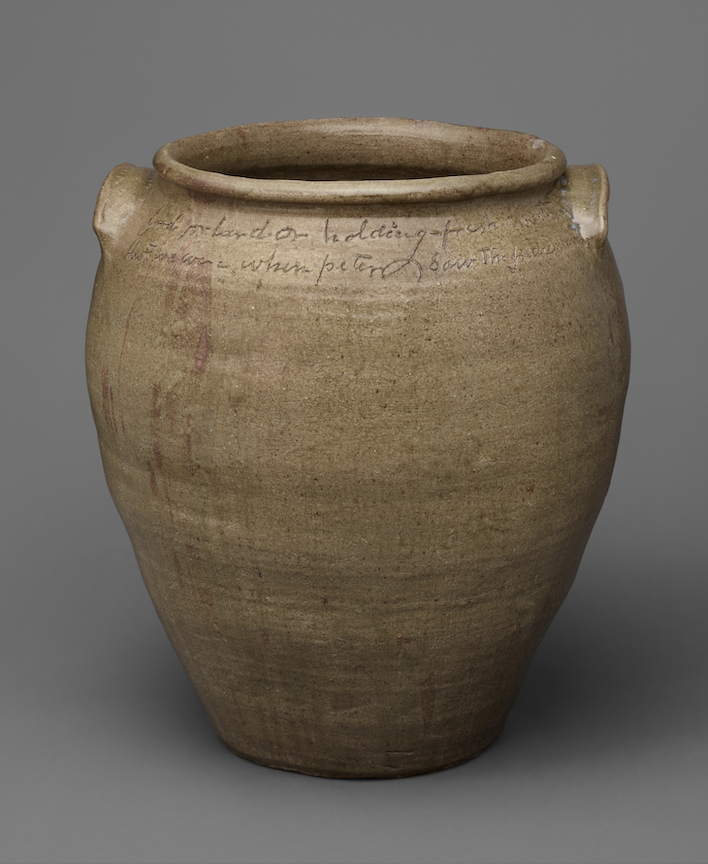
Dave the Potter, storage jar, 1859, ceramic, Philadelphia Museum of Art.
Image courtesy of the Philadelphia Museum of Art.
The jar held by the PMA is currently on display in an exhibition titled A Nation of Artists, curated to celebrate the country’s 250th birthday. It sits in the centre of a room decorated to mimic antebellum Southern sitting rooms. The choice to exhibit his work in this way shifts the focus away from Dave’s voice and autonomy and towards the systems of racial hierarchy and inequity that persist into the current day. For this reason, Dave’s descendants, organised as the Dave the Potter Legacy Trust, have requested that ownership of his work be returned to them.
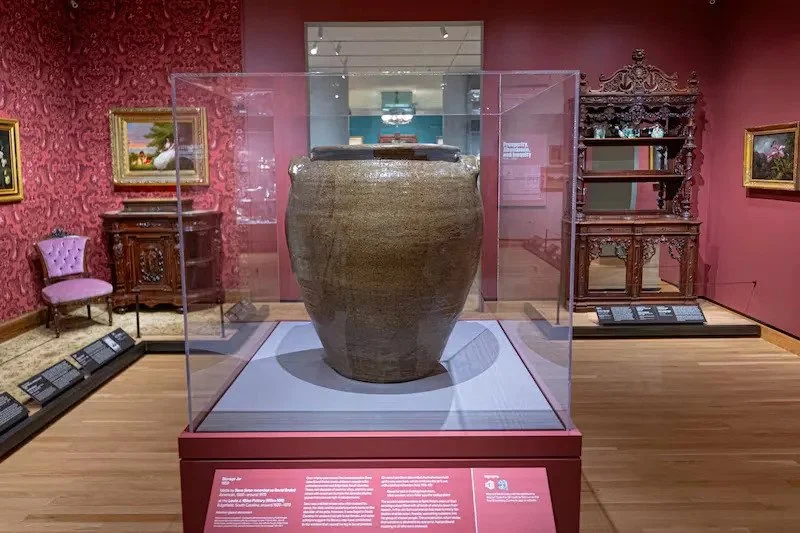
Dave the Potter’s storage jar at the PMA’s A Nation of Artists exhibition.
Image courtesy of the Philadelphia Inquirer.
Since October of 2025, the Trust has successfully achieved restitution of their ancestor’s work from the Boston Museum of Fine Arts (MFA) and, as of last month, the Milwaukee Museum of Art. Now, they urge the PMA to follow suit. As it stands, talks between the Trust and the museum are ongoing but have been noncommittal and passive at best. The Trust intends to take legal action against the museum in the coming months if they fail to cooperate in accordance with their own restitution and repatriation guidelines that have been applied to other restitution and repatriation cases.
In the words of Dave’s descendants, continuing to retain ownership over the jar “extends the legacy of injustice” that began when he was first “denied the right to own what he made” as an enslaved labourer. Recently, one of Dave’s pots was sold at a private auction for $1.4 million. Pauline Baker, his fourth-generation granddaughter, summed up the impact of this issue on her family in a public statement given to PBS News: “What is now an asset for your family should’ve been an asset for my family.” Today, people continue to wrongfully benefit from Dave the Potter’s stolen labour. His family has not yet been granted reparations; the issue of restitution goes beyond ceramics, exposing systemic racial inequity that impacts African American communities both emotionally and financially.
The MFA’s return of two pots to the Trust marked the first instance of repatriation of an enslaved person’s work in American history. The PMA’s recent choice not to take immediate action highlights how much work is left to be done and emphasises the tangible legacy of slavery in American institutions. Looking forward, the Trust’s ongoing conversation with the PMA has kickstarted dialogue across the wider museum industry that will hopefully lead to the restitution of works made by other enslaved people to their rightful owners by the volition of institutions across the nation.
Bibliography
A Better Life For U. 2025. Dave the Potter’s Descendants: Discovering Family Ties to an Enslaved Artist. YouTube. Video. https://www.youtube.com/watch?v=8GF7VZvMpqw.
ArtForum. 2026. “Family Demands Return of Work Made by Enslaved Potter David Drake.” October 13. https://www.artforum.com/news/return-of-work-made-by-enslaved-potter-david-drake-1234761289/.
Dave the Potter Legacy Trust. n.d. Accessed October 21, 2026.
https://davethepotterfamily.org/#press.
PBS NewsHour. 2026. Descendants of Enslaved Potter David Drake Work to Reclaim Ancestor’s Art. YouTube. Video. https://www.youtube.com/watch?v=9iaDbJnDKMQ.
Philadelphia Museum of Art. n.d. “Represent: 200 Years of African American Art.” PDF. Wellington, Elizabeth. 2026. “Family Demands ‘Ethical Restitution’ of a Jar Owned by PMA.” Philadelphia Inquirer, October 10. https://www.inquirer.com/arts/dave-potter-philadelphia-museum-of-art-20261010.html.