Where does a crouching child belong? The story behind Édouard Manet's newly discovered drawing.
By Linara Umiryayeva
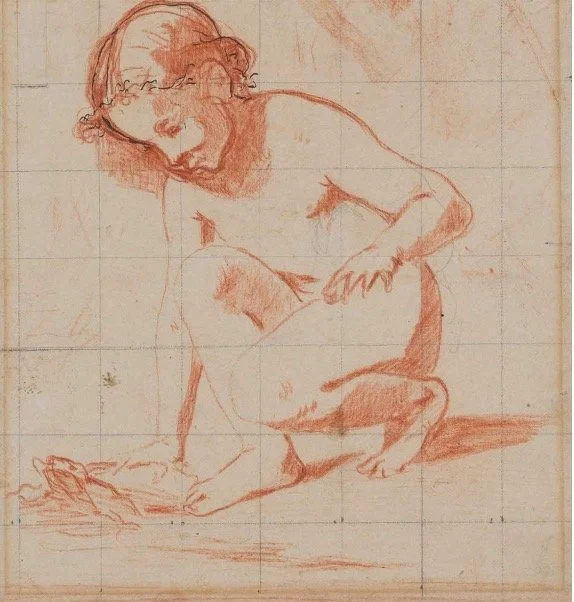
Édouard Manet, The study of a Crouching Child c. 1858–60, Private Collection. Image courtesy of the Fine Arts Museums of San Francisco.
Ever had a collection of old, undocumented drawings gathering dust on a shelf? Do not be too quick to dispose of them, since one of them could be the next major discovery in the art world.
Every piece of art holds a story. A story many choose to ignore or discard as meaningless because of a work's formal complexity. In actuality, the old pieces of art, small graphite studies, or the so-called objects of curiosity we often encounter at charity shops might just be the next discovery to shake the art world. That is exactly what happened with a previously unknown red chalk drawing of a crouching child, held in a private collection in northern Italy for many years and now identified as the work of Édouard Manet.
The drawing, Study of a Crouching Child (c.1858-60), was noticed by Francesco Baccanelli, an expert in seventeenth- and eighteenth-century Italian painting. Baccanelli told The Guardian it was “a small and little-known collection” that had never been properly studied by an art historian. Although physical evidence of the sheet instantly pointed to the possible attribution to the French modernist painter, Baccanelli shared a photograph of the chalk design with Emily Beeny, specialising inManet’s artistic career at the Legion of Honour in San Francisco.
The formal qualities of the drawing, discernible even to an untrained eye, helped Beeny and Baccanelli reveal some context for its production. The figure’s pose, its firm contours, bold, dense patchwork, and the mixed media employed by the artist recall Manet’s early artistic practices, specifically those from his visit to Italy and upon his return to France in 1857. Accordingly, a connection was established between the drawing and Manet’s 1860s red chalk figure studies from the Musée d’Orsay collection as well as some of his major works, like the Old Musician (1862), the lost Finding of Moses (c.1858-60), Le Déjeuner sur l’herbe (1863) and Olympia (1863). The former features both direct copies of the Renaissance draughtsmanship he studied in Florence and figures from live models, whereas the latter indicates a commonality in the artist’s art-making process. Manet regularly created squared drawings in graphite for transfer; some of those made it into his larger, infamous compositions. Beeny and Baccanelli speculate that it might have been the case for the crouching girl, destined for one of his major works.
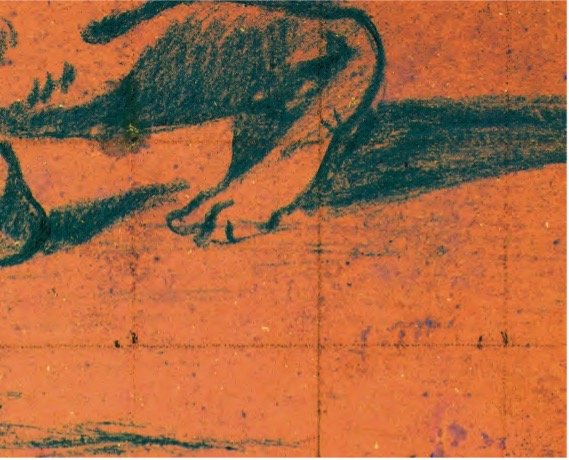
Detail of Édouard Manet, Study of a Crouching Child, c. 1858–60, showing the studio stamp under ultraviolet light with heightened colour and contrast.
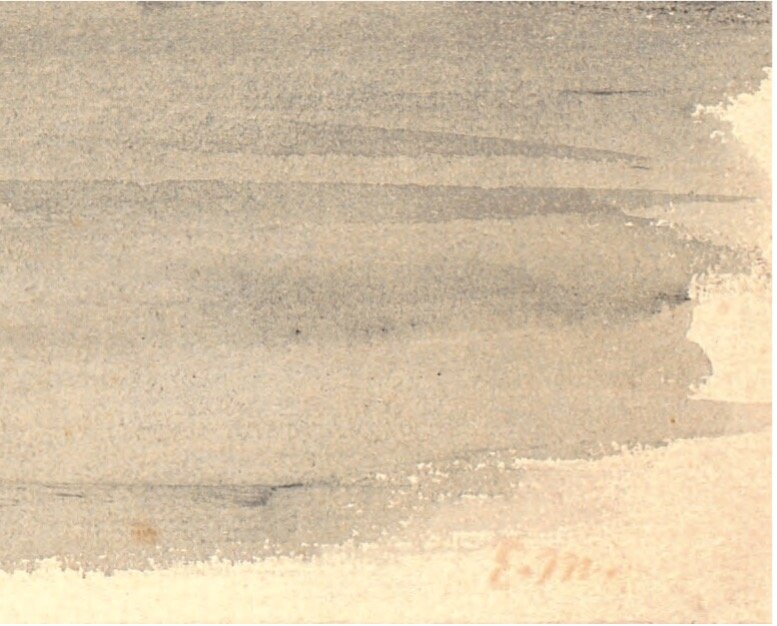
Detail of Édouard Manet’s Annabel Lee's caption, showing the studio stamp, 1881, black chalk, ink and wash on paper. Statens Museum for Kunst, Copenhagen.
The process of a studio stamp identification using technical evidence solidified Manet’s authorship. Beeny and Baccanelli’s professional instinct prompted them to generate a high-contrast image of the drawing with Photoshop and to conduct an ultraviolet illumination analysis of the work, revealing the traces of almost invisible initials “E.M.”. Its stylistic qualities “precisely match those of the stamp found on so many of Édouard Manet's drawings”. Additionally, the reverse of the mount also helped the experts to track the drawing’s market movement. According to Beeny and Baccanelli, the study of a Crouching Child “remained with Manet’s heirs upon his death”; however, it soon entered the 1933 auction catalogue at the Buch- und Kunstantiquariat Max Perl in Berlin under lot 918 and then resurfaced two years later at Gutekunst und Klipstein’s auction in Bern.
Nevertheless, the drawing’s original function and purpose remain one of its greatest mysteries. In the meantime, Emily Beeny told The Guardian she hoped to see the sheet featured in subsequent Manet catalogues and studies produced by the Wildenstein Plattner Institute. As for the rest of us, we are left to reflect on the role drawing practices played in Manet’s shift from copying the old masters to fusing their influence with modern life.
Bibliography:
Alberge, Dalya. "Rediscovered Chalk Drawing of Child Attributed to Édouard Manet." Guardian, September 28, 2026. https://www.theguardian.com/artanddesign/2026/sep/28/drawing-child-attributed-edouard-manet.
Beeny, Emily A., and Francesco Baccanelli. "A New Drawing by Édouard Manet." Burlington Magazine 168 (October 2026): 970–79. https://www.burlington.org.uk/archive/article/a-new-drawing-by-douard-manet.
"Chalk Drawing Found in Private Collection Attributed to Manet." Artforum, [date]. https://www.artforum.com/news/drawing-found-in-private-collection-attributed-to-manet-1234759952/.
"Mysterious Drawing Hiding in Private Collection Finally Identified as Work of 19th-Century Painter." People, [date]. https://people.com/mysterious-drawing-hiding-in-private-collection-finally-identified-as-work-of-19th-century-painter-12145748.
Whiddington, Richard. "Mysterious Drawing Identified as Early Manet Work." Artnet News, September 28, 2026. https://news.artnet.com/art-world/rediscovered-crouching-child-drawing-manet-2816951.