Pavilion Battle: Can art be apolitical in times of war?
By Aglaïa S. Rozental
After 131 years as one of the world’s most prestigious art events, the Venice Biennale faces controversy once again as the EU threatens to withdraw its two-million euro grant over Russia’s return.
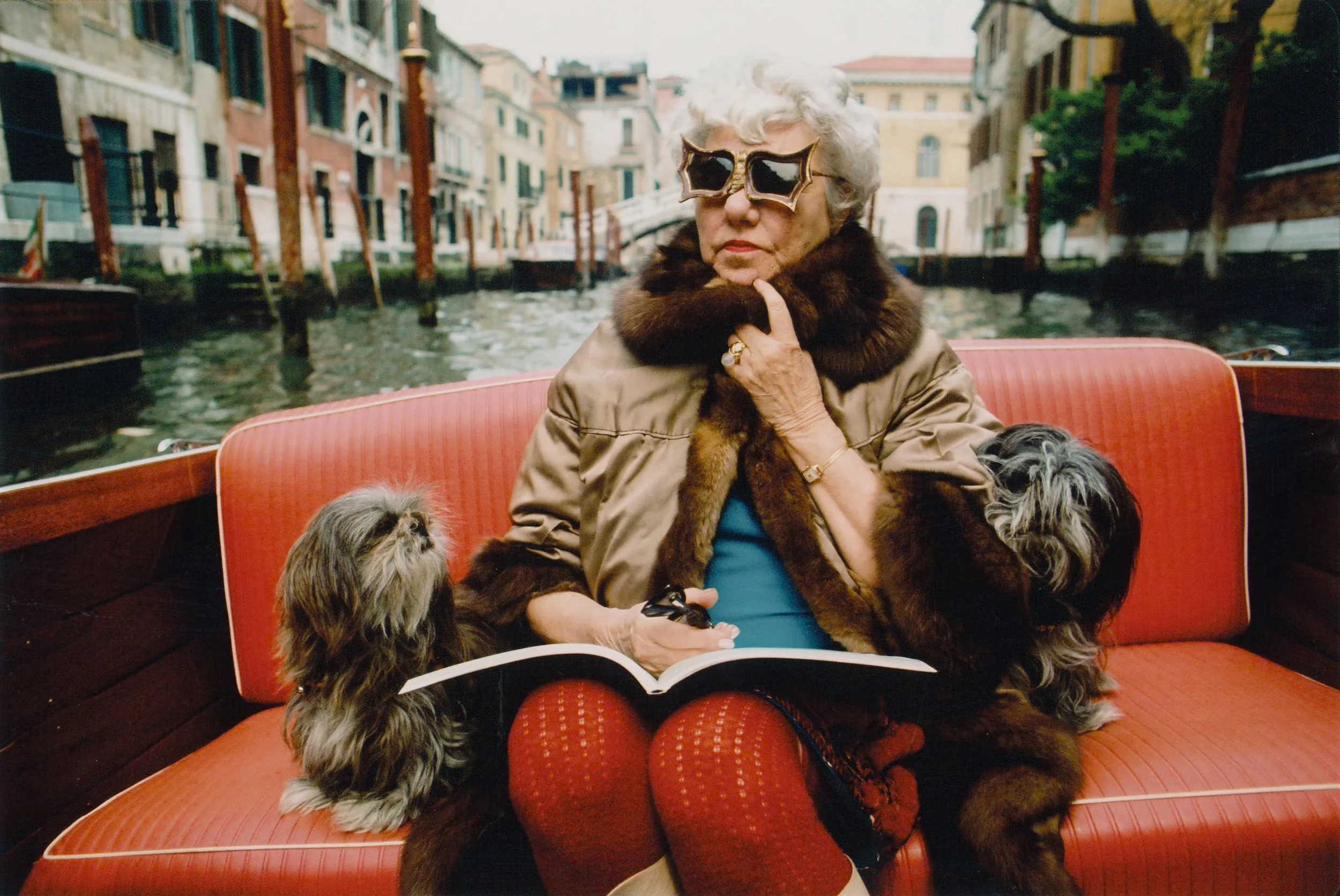
Peggy Guggenheim, key persona of the Biennale since 1948
Image Courtesy of The Guardian
Pietrangelo Buttafuoco, president of the Biennale, decided - suddenly and after years of exclusion - to reintegrate Russia into the event’s programme. The announcement triggered political backlash. European cultural ministers signed a protest letter condemning the decision, arguing it undermines the collective cultural stance adopted since Russia’s invasion of Ukraine. Art has long been imagined as a space of escape from political realities yet in today’s geopolitical climate, culture itself has become a battleground. Can art truly remain apolitical during war?
History suggests otherwise. Totalitarian regimes often use cultural platforms to normalise and legitimise their power, and the Venice Biennale has never been entirely insulated from politics. In 1934, Hitler and Mussolini famously visited the exhibition together. By 1942, the Biennale was dedicated to military art, however the official catalogue did not contain a single mention of the ongoing Second World War. Given such a history of political insturmentalisation, the European Commission issued their concern in a recent statement that insisted culture cannot be separated from the realities societies face. ‘Culture shapes how people understand the world, what they value, and how they choose to act,’ the statement read. Cultural institutions, therefore, carry not only artistic significance but also moral responsibility. Critics of Russia’s return to the Biennale also point to the devastating impact of the war on Ukraine’s cultural sector: at least 342 artists have been killed since the start of the full-scale invasion; 1,685 cultural heritage sites and 2,483 cultural infrastructure facilities have been destroyed or damaged.
Facing the backlash, the president of the Biennale responded in an open letter defending the institution’s decision: ‘La Biennale di Venezia rejects any form of exclusion or censorship of culture and art.’ Another question lingers: why now? If the decision to readmit Russia is grounded in artistic openness, why was the same logic not applied during the past three years? Does the Italian cultural establishment see something that the broader European public does not?
Meanwhile, preparations for the Biennale continue. With the event only two months away, the programme is already set. Protests are ongoing, but the institutional machinery of the exhibition moves forward regardless. Several planned events emphasize music, DJs, and performance rather than traditional figurative representation. Perhaps an attempt to avoid direct political imagery, or to reduce the risk of artworks becoming symbolic targets.
Concerns surround the Russian Pavilion’s leadership. Commissioner Anastasia Karneeva is the daughter of a Federal Security Service (FSB) general and current Rostec executive, raising questions about nepotism and the link between culture and power. Critics warn that the boundaries between art, state influence, and propaganda risk becoming dangerously blurred.

Russian Pavillion in the Giardini, Venezia, 2018
Image Courtesy of Arch Daily
This leads to a final and unresolved dilemma. What about Russian artists who oppose the Kremlin? Should a national pavilion necessarily represent the state that funds it? Could such a space instead give voice to political opposition or dissident artists?
The Biennale Foundation approved Russia’s participation in the 61st exhibition, despite Italian government opposition. Whether the decision will stand, or whether political pressure and funding realities will force a reversal, remains to be seen. What is certain, however, is that the Venice Biennale once again demonstrates that art and politics are rarely as separate as we might wish them to be.
Bibliography
European Commission. “Statement by Executive Vice-President Henna Virkkunen and Commissioner Glenn Micallef on Russia’s Participation at the Venice Biennale Art Exhibition.” March 10, 2026. https://ec.europa.eu/commission/presscorner/detail/en/STATEMENT_26_590.
Kishkovsky, Sophia. “EU Threatens to Pull Funding from Venice Biennale over Return of Russian Pavilion.” The Art Newspaper, March 11, 2026.
Kishkovsky, Sophia. “Pussy Riot Slams Russia’s Return to Venice Biennale: Russia’s Decision to Put on a Show in Venice Has Prompted Criticism from Russian Dissidents and Ukrainian Artists.” The Art Newspaper, March 6, 2026.
La Biennale di Venezia. “National Participations and Collateral Events of the Venice Biennale Arte 2026.” March 4, 2026. https://www.labiennale.org/en/news/national-participations-and-collateral-events-biennale-arte-2026.
Ministero della Cultura. “Biennale, MiC : Partecipazione della Russia Decisione Autonoma della Fondazione.” March 5, 2026. https://cultura.gov.it/comunicato/28773.
Virkkunen, Henna, and Glenn Micallef. “Statement on Russia’s Participation at the Venice Biennale Art Exhibition.” Brussels, March 10, 2026. https://www.politico.eu/wp-content/uploads/2026/03/10/document-2026_3-20.pdf.