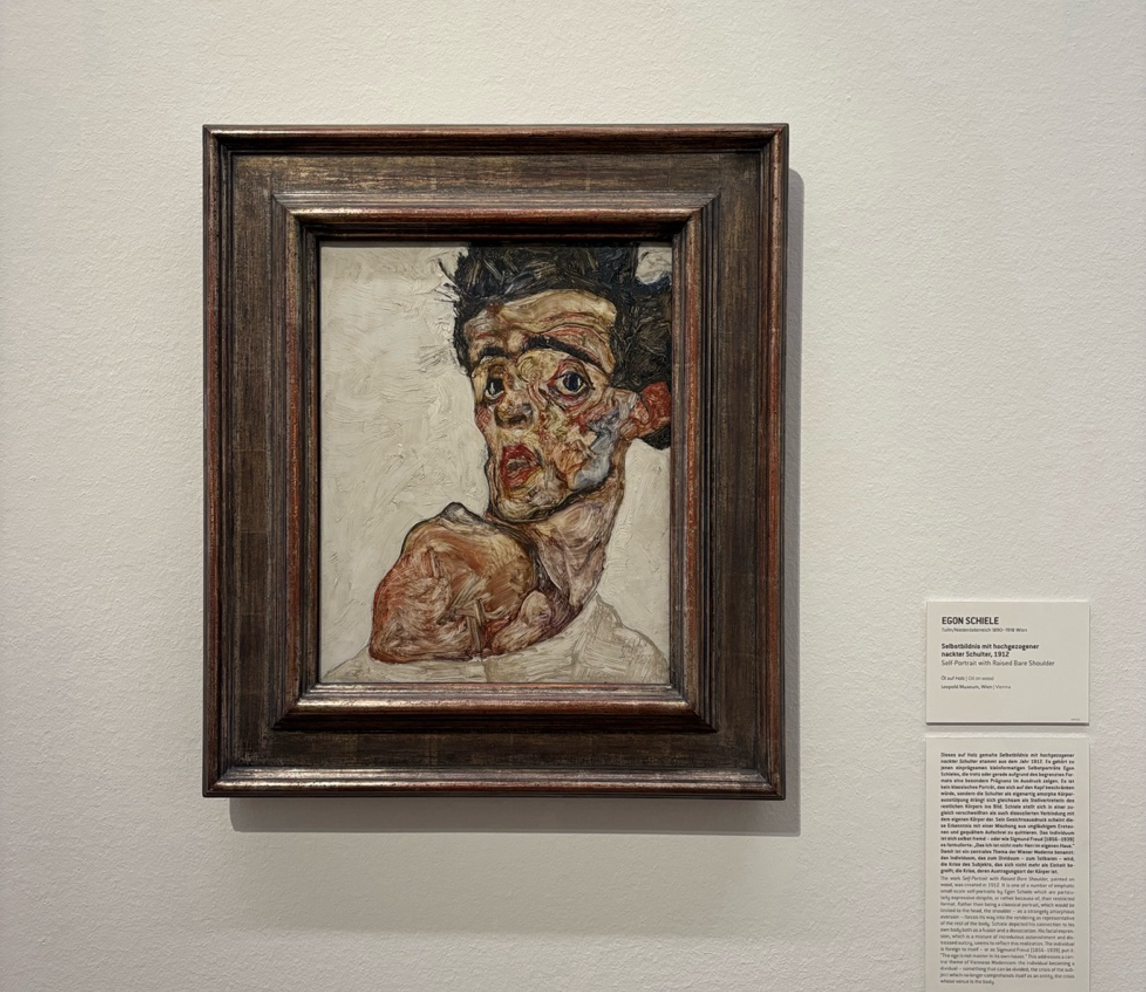
Egon Schiele, Self-Portrait with Raised Bare Shoulder, 1912, oil on wood, Leopold Museum. Image courtesy of Wiktoria Iwaniak.
By Wiktoria Iwaniak
Located in the heart of Vienna’s Museums quarter, the Leopold Museum beautifully narrates the beginnings of Viennese modernism, tracking the city’s artistic journey from the heyday of historicism in the 1870s to the founding of the Secession in 1897. The collection underscores the movement’s immense impact on art up to the end of the First World War, highlighting the radical change Austria experienced both politically and artistically in merely a few decades.
I discovered the Leopold Museum while researching which galleries to visit in Vienna prior to my recent trip. Upon learning that it houses the world’s largest permanent collection of Egon Schiele’s oeuvre, I knew this was an unmissable stop. As a prominent, controversial Expressionist and formative figure of Viennese Modernism, Schiele has long fascinated me with his unfiltered exploration of sexuality and emotion.
A large part of the permanent exhibition is focused solely on him and his output. Despite passing at just twenty-eight years old, he left behind a remarkably varied and extensive body of work. The gallery guides viewers through key motifs Schiele explored throughout his short but impactful career, including depictions of women, landscapes and, most importantly, himself. His self-portraits offer a poignant window into the human psyche, capturing an existential search for meaning that is prevalent across his work.'
Conservative critics often condemned Schiele’s art for its vulgar eroticism, underlining how far he pushed boundaries of social morality. His style is defined by caricature-like angularity, contorted positions and erratic brushstrokes that strip away idealised beauty conventions and expose a raw psychological honesty. Schiele’s interest in the subconscious also mirrors the wider Viennese curiosity with the inner self, pioneered by Sigmund Freud and shared by fellow Secessionists. Beyond the collection of paintings, seeing his sketches and writings gave an incredible insight into his creative process and personal life.
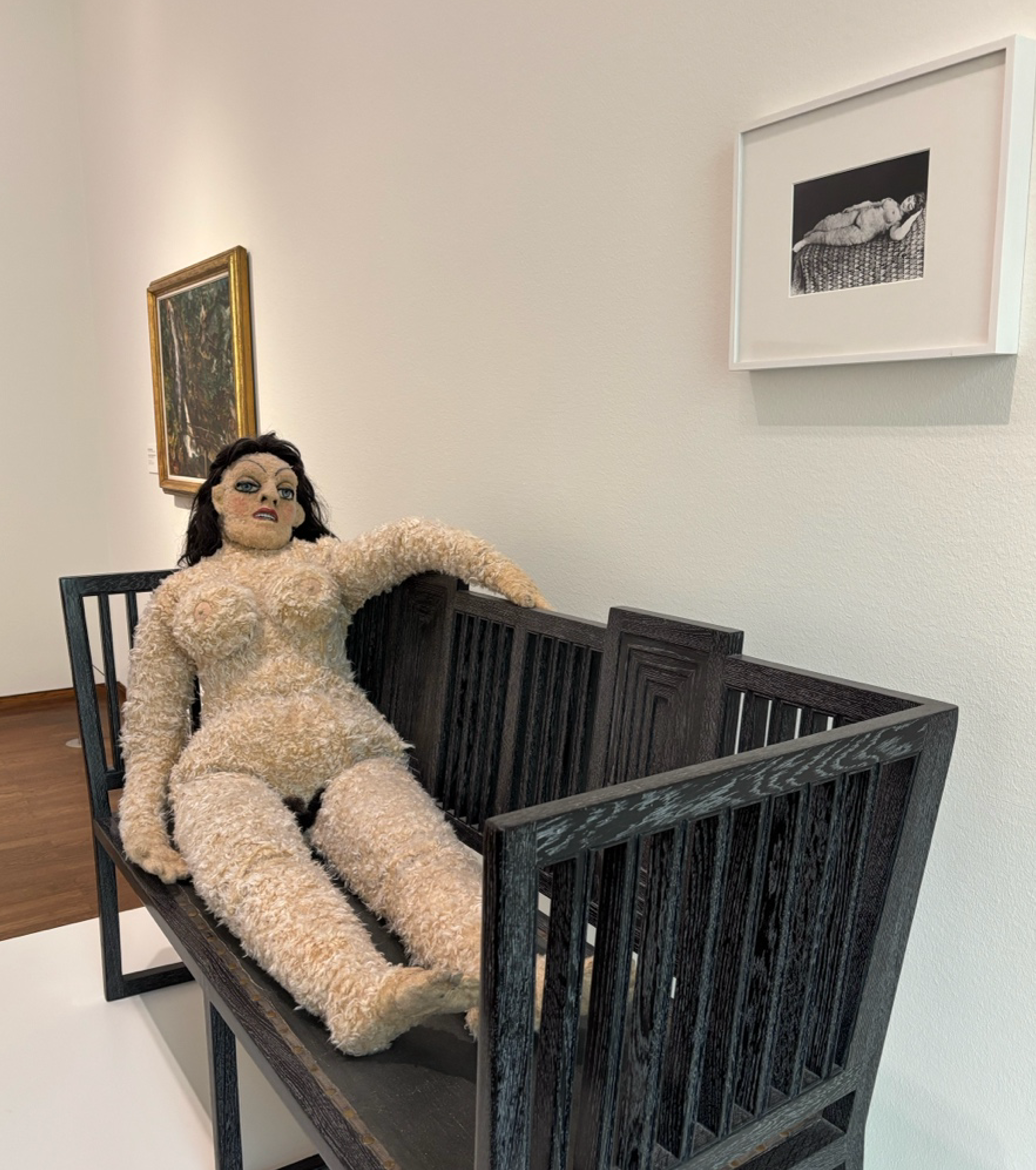
Hermine Moos, Oskar Kokoschka’s Alma Mahler Doll, 1918-19 (reconstruction). Image courtesy of Wiktoria Iwaniak.
In addition to showcasing the work of Egon Schiele, the museum spotlights a variety of artists from the period. The most disturbing yet fascinating piece on display was a recreation of Oskar Kokoschka’s Alma Mahler Doll (1918-19), tucked out of plain sight in its room. I remember glancing around the room and being physically taken aback when it came into my periphery, and I immediately wanted to learn more about this unsettling human-sized doll.
Kokoschka commissioned Hermine Moos to create a doll of Alma Mahler, with whom he had a tumultuous love affair a few years prior. The dollmaker fulfilled his grotesque desires, which underlined his obsessive longing for his former lover. A photograph hanging above it, taken by Kokoschka, shows the doll posed as Venus, exemplifying his absurd infatuation with Mahler. The piece in the museum is actually a replica, as the original was doused in red wine and decapitated by Kokoschka in front of his party guests in a theatrical ‘dollicide’ when he eventually grew tired of it after many years.
Reading the backstory both unsettled and engrossed me. The sheer absurdity of it felt surreal, piquing my interest in the man I had not heard of prior to this moment. Together with Schiele, Kokoschka paved the way for a new generation of modernism, characterised by strange and shocking explorations into the human condition.
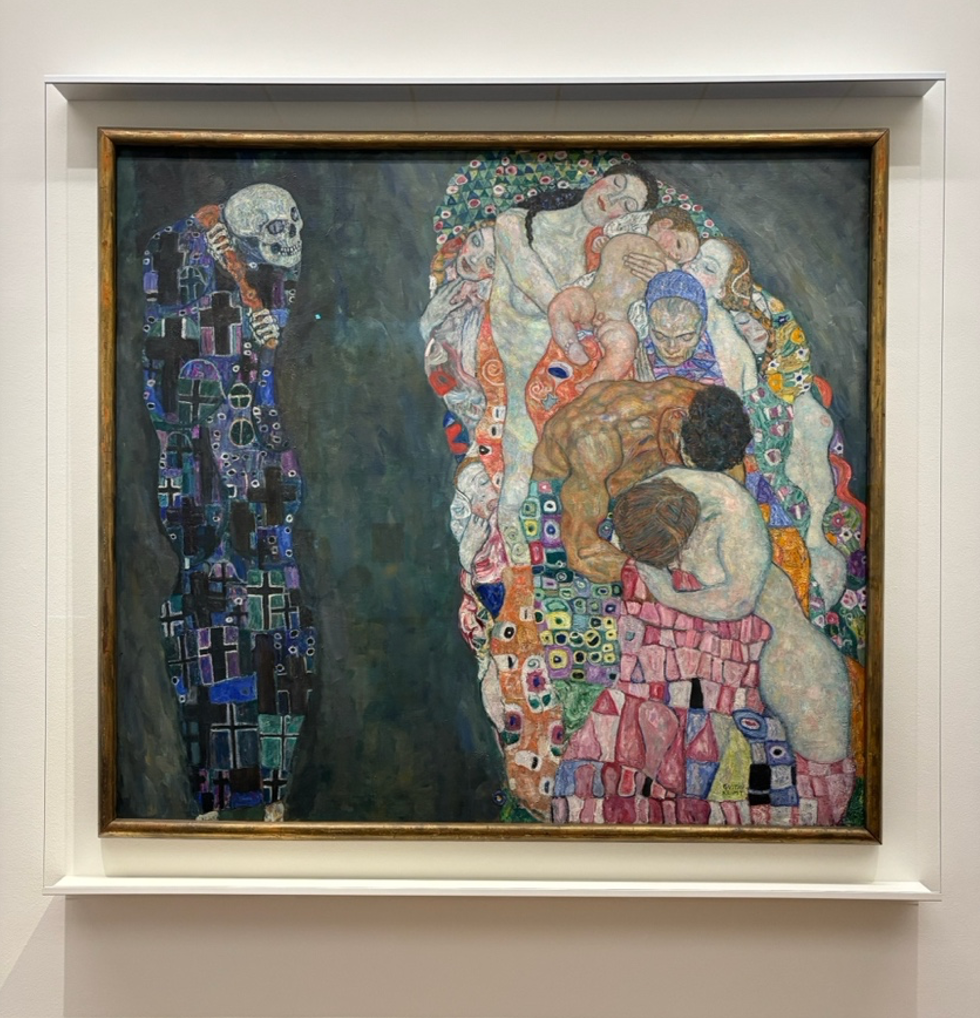
Gustav Klimt, Death and Life, 1910-15, oil on canvas, 180.8 cm × 200.6 cm, Leopold Museum. Image courtesy of Wiktoria Iwaniak.
Viennese Modernism cannot be discussed without mentioning Gustav Klimt, the founder of the Vienna Secession. The museum traces the progression of Klimt’s style, from his early historicist work to his complete embrace of symbolism and rejection of academic painting. The Leopold Museum possesses one of his great allegorical masterpieces, the impressively large Death and Life (1910-15), in which he explores the cycle of life from adolescence to the afterlife, a haunting yet beautiful commentary on human nature. The figures almost blur into one, encompassed by vibrant, geometric ornamentation that immediately draws the viewer’s attention.
Furthermore, the museum highlights the vital role the applied arts played in fin-de-siecle Vienna. During this era, modernism permeated all areas of life, extending from furniture and textile to ceramics and homeware. Founded in 1903 by Josef Hoffman and Koloman Moser, the Wiener Werkstatte were guided by the ideal of the Gesamtkunstwerk (total work of art), placing craft on an equal footing as the fine arts. Through close collaboration, expert craftsmanship and meticulous attention to detail, the group aimed to reform daily life through the production through their harmonious aesthetic vision.
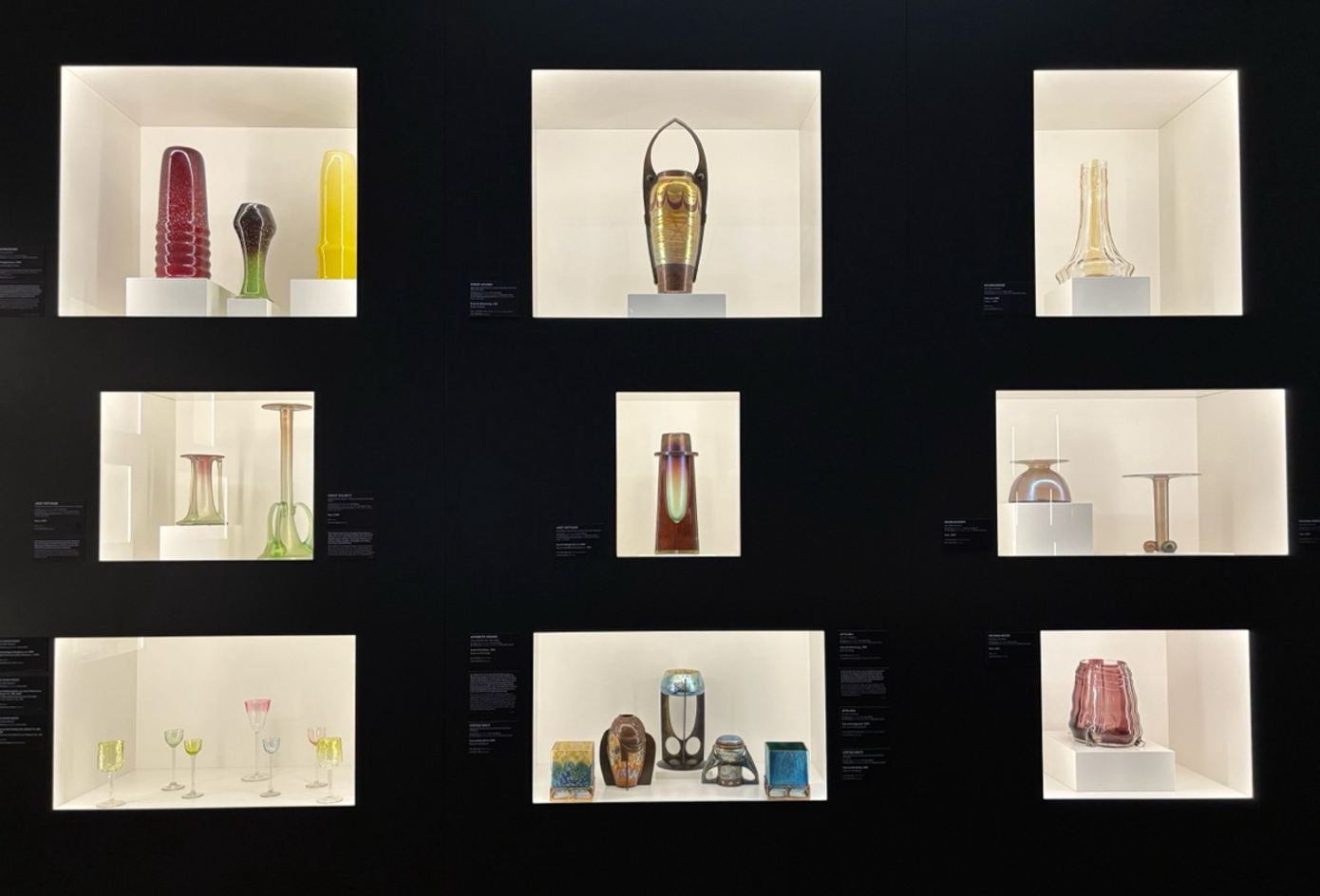
Assortment of Art Nouveau ceramics. Image courtesy of Wiktoria Iwaniak.
Overall, the permanent exhibition Vienna 1900: The Birth of Modernism at the Leopold Museum is inspiring and informative, effectively communicating the vibrant history of Vienna and its role as a world centre of culture. It explores a captivating period marked by tensions between liberalism and conservativism, the past and the future, and new ideas of what art could be. The museum introduced me to a plethora of new artists who shook up static, traditional conventions and changed the course of art history. I particularly enjoyed the multimedia focus of the museum as it highlights the rich interdisciplinary connections between various strands of artistic production. This small but mighty museum is a must-see if you are ever in Vienna.
Bibliography
Dukes, Hunter. 2025. ‘Oskar Kokoschka, Hermine Moos, and the Alma Mahler Doll’. The Public Domain Review. https://publicdomainreview.org/collection/alma-mahler-doll/.
Leopold Museum. n.d. ‘Collection | Leopold Museum’. Accessed 4 November 2026. https://www.leopoldmuseum.org/en/collection.
Wiener Tourismusverband. 2021. ‘Leopold Museum’. Vienna.Info. https://www.wien.info/en/art-culture/museums-exhibitions/top-museums/mq/leopold-museum-350866.