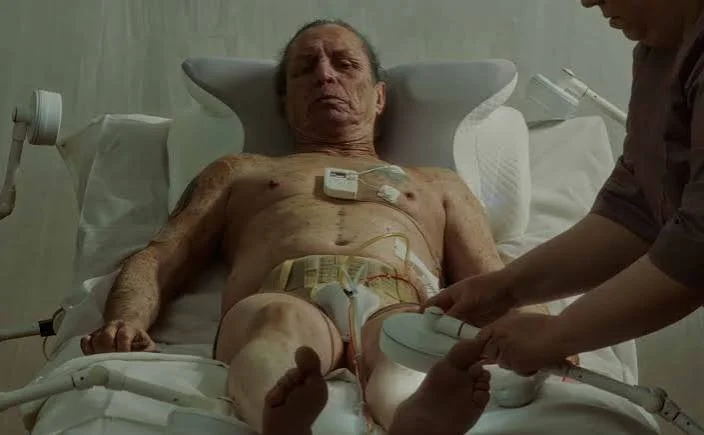
Roman Khimei and Yarema Malashcuk, Wishful Thinking, 2026, Multi-channel video installation, colour, sound, varying duration and dimensions, Talbot Rice Gallery. Image courtesy of Fondazione in Between Art Film.
By Sam Dickinson
An elderly Russian man lies supine, facing us. Futuristic medical equipment is attached to his body. He barely talks, although the interviewer still asks him about his experience during the 2022 invasion of Ukraine. He is projected through a small slit of light onto an otherwise dark wall. This work of darkly prophetic storytelling, Wishful Thinking (2026) by Roman Khimei and Yarema Malaschuk, sums up The Rupture as an exhibition. As the website states, The Rupture seeks to explore “the breakdown of established systems, rules-based order and global relationships”. It is an intense and often highly disturbing voyage into this theme.
The Rupture is an exhibition which aims to make you uncomfortable – there is no escape here from the harsh political, economic and moral realities of the modern world. And truly a complete world it is - as the exhibition video states, they brought together 15 separate global artists, each bringing a unique perspective on these cataclysmic times.
Something which struck me was the no-holds barred approach of the exhibition – the space of the Talbot Rice Gallery is structured in such a way that around almost every corner is a new, sobering image or thought. The multimedia nature of the exhibition also helps to communicate that feeling of being confronted – it gives plenty to think about across genres.
That sense of almost being attacked by images is demonstrated no better than by the first room of this exhibition. Walking in, I was immediately struck by Eoghan Ryan’s Terrible Simplifiers (2026), a giant wall installation. The work consists of various images, reminiscent of warning labels or traffic sign symbols, which are projected onto the wall, alongside simplistic and emotive words and phrases. These huge, brightly coloured and importantly simplistic images are impossible to ignore. Standing out against the white back drop, they play on the idea of a world in which information and political discourse is distilled down to raw, almost impulsive moments. The exhibitions guide notes the title’s link to Swiss writer Jacob Buckhardt who prophesised the introduction of such rhetoric. As a viewer of this work, we are subject to these ideas and images very much like we are in the modern world. I found this incredibly engaging, as well as a fantastic choice to start the exhibition with.
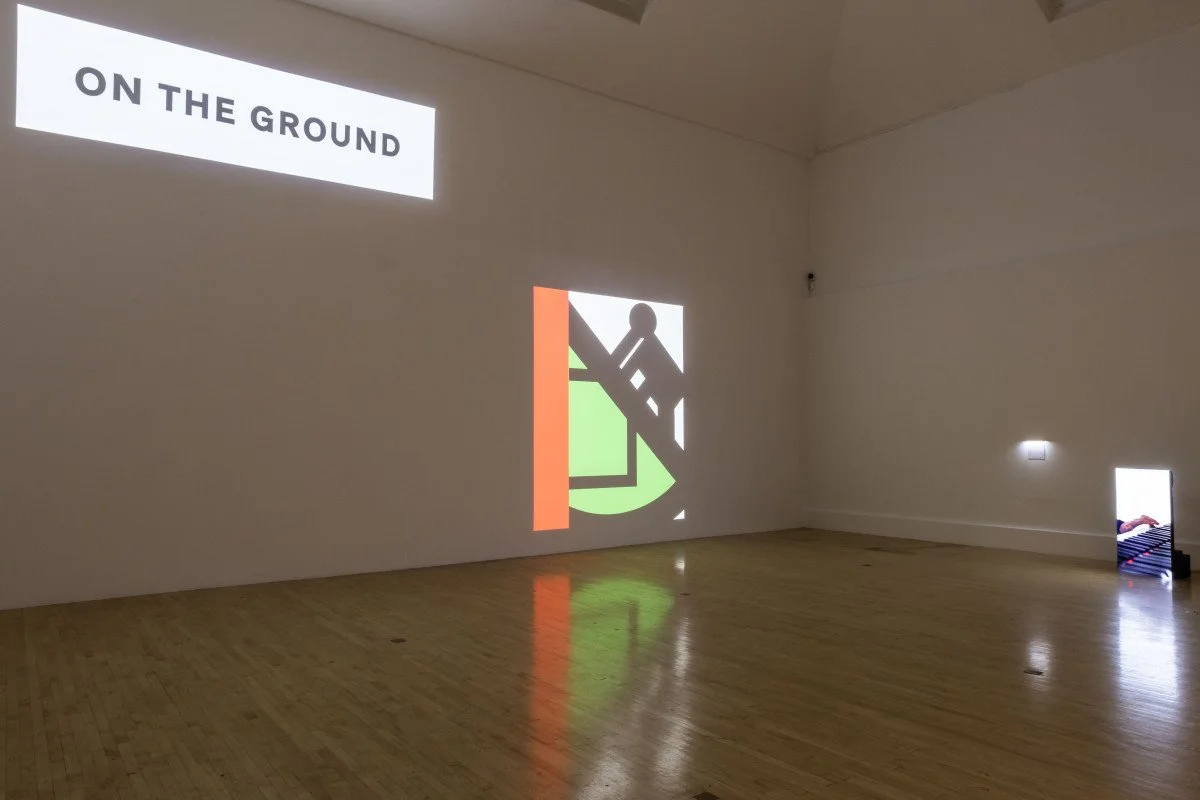
Eoghan Ryan, Terrible Simplifiers, 2026, Synced two-channel digital animation, variable dimensions, Talbot Rice Gallery. Image Courtesy of Talbot Rice Gallery.
Another stand-out work of the exhibition is Khimei and Malachuck’s Wishful Thinking. I found that the premise – a work of a speculative nature in an otherwise highly reflective exhibition – drew me in. In this fiction, we are witnessing imaginary interviews with Russian soldiers who have been involved in the war in Ukraine, now elderly and being interviewed about their experience. Their reactions to facing their past actions are varied – some cry, some are defensive, others say nothing.
I found the way in which the exhibition presents this story to the visitor – by placing us intimately in a room with the speaker, drives home the violence of current wars. We are able to view up close the mental and physical effects of war, rendered viscerally and disturbingly. The implication is also that we are missing in these interviews the many more who died in conflict.
I was also particularly intrigued by Li Yifan’s video installation Why Not Dance 1 (2025). It is an AI-generated music video, in which an immigrant worker raps about the difficulties of being working class in a highly predatory world. I must confess, I found it a little hard to agree with the use of generative AI in such a direct way to create almost the entire video – however, it is something which modern exhibitions must address as it becomes ever-more prevalent in art. I would also note how the exhibition guide indicates how Yifan views AI as a “tool for the emancipation of the worker’s voices”. In this light, I can understand why including this work was an important part of tracking the ‘rupture’ – on all levels of society, high and low.
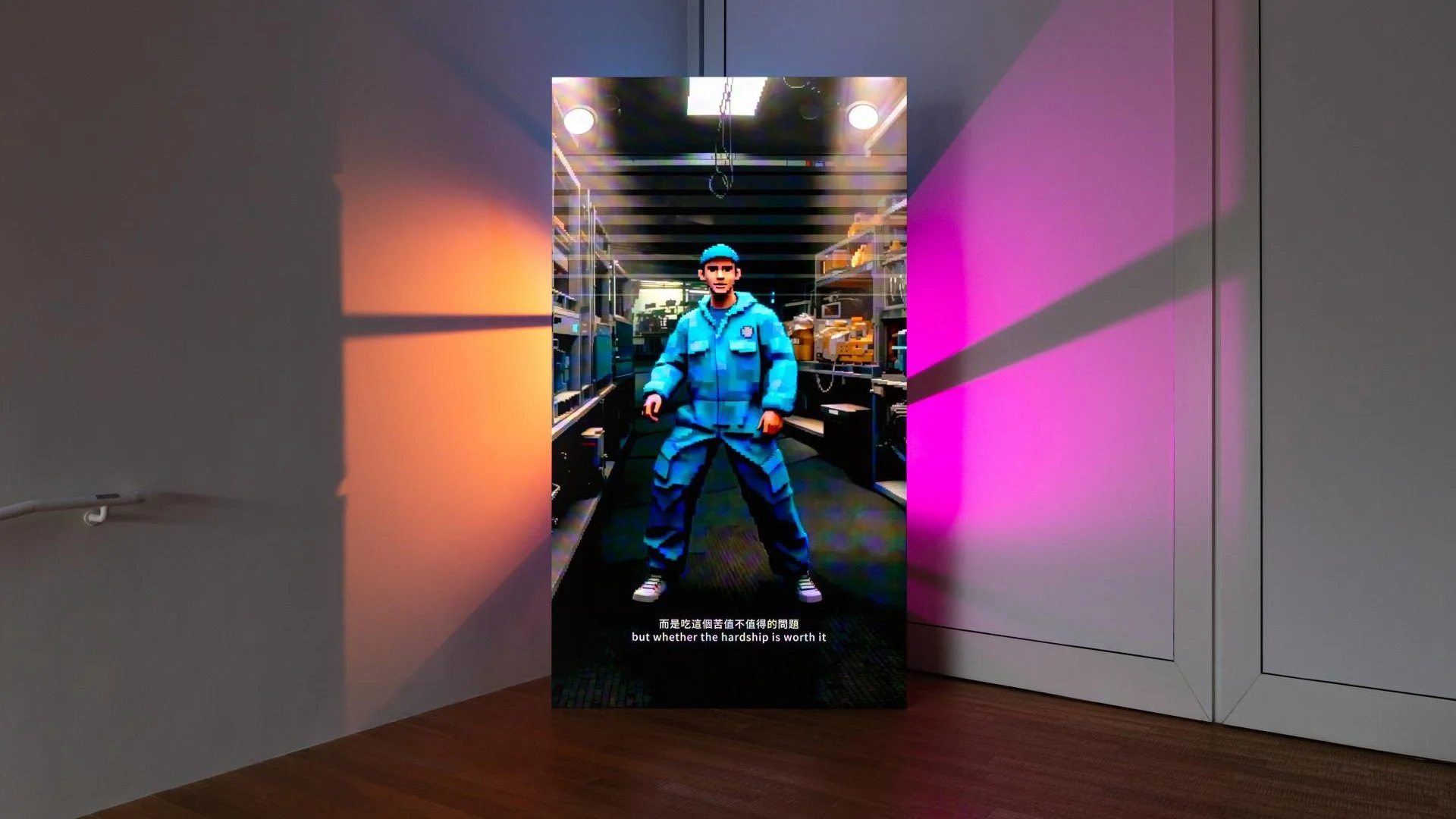
Li Yifan, Why Not Dance 1, Single-channel video, 2025, 21 min 58 sec, Talbot Rice Gallery. Image courtesy of Stir World.
So, for me, The Rupture is an exhibition which thrives on its ability to make the viewer uncomfortable – everything from the use of AI to the disturbing speculative videos, to the vast symbols on the wall in room one. and that is precisely why I think everyone should visit it. In the modern age, it is important that we confront the unsettling present moment – and indeed, where we may be heading.
Bibliography:
“The Rupture: No Condition is permanent”, Talbot Rice Gallery, Accessed November 20th, https://www.trg.ed.ac.uk/exhibition/rupture-no-condition-permanent
“The Rupture: No condition is permanent Exhibition Video”, Talbot Rice Gallery, Nov 2026. Video, 21 min., 12sec. https://www.youtube.com/watch?v=sv59uZTwaUc
Giblin, Tessa and Jasmina Cibic, The Rupture: No Condition is Permanent, Talbot Rice Gallery, 2026. https://www.trg.ed.ac.uk/sites/default/files/2026-11/The%20Rupture_Illustrated%20Guide_0.pdf