An exploration of Factum Arte’s Studio in Madrid
By Virginia Carlier
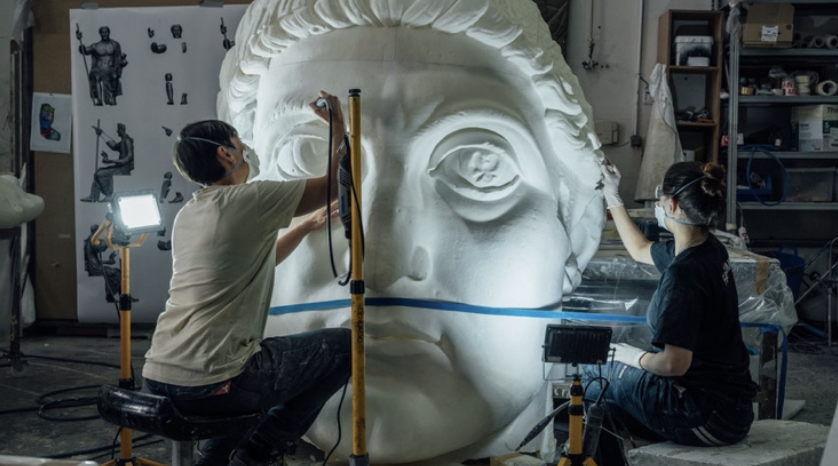
Fig. 1. Technicians refining the 3D printed head of the 13-meter fascimile of Colossus of Constantine (c. 312–315 AD). A reconstruction for the Recycling Beauty exhibition by the Fondazione Prada (2022-2023). Photograph © Copyright 2026 Factum Foundation.
In the sun-drenched outskirts of Madrid, I discovered a portal. What looks from the outside like a nondescript warehouse is the headquarters of Factum Arte - a space where history, technology and a bit of industrial sorcery meet. Guided by its founder Adam Lowe, we entered a workshop that initially felt like an artist’s studio on a grand scale. But as we navigated through the many canvases, sculptures and sketches, a strange feeling of “déjà vu” settled in. These were no mere objects, but rather the ghosts of art history’s past, summoned to the present by way of digital scanners, 3D printers and technical savoir faire. Within this 10,000-square-meter space, the world’s greatest art treasures are being resurrected and given a second life, thanks to Factum Arte’s impressive multi-disciplinary collaboration of digital innovation and artisanal skills. To witness a facsimile of Thutmose III’s tomb share the floor with a facsimile of Goya’s haunting Black Paintings made me realise we had just entered a 21st Century version of Ali Baba’s Cave.
As we cautiously wandered through Factum Arte’s labyrinth of workshops, Adam Lowe passionately described to us his vision. Since its founding in 2001, the organisation’s goal has been simple but ambitious: to fundamentally challenge the way we view, study and safeguard the world’s most treasured cultural heritage. Yet, Factum Arte’s remit goes far beyond the scope of digital recording, preservation processes and facsimile creation. It is also an artistic and commercial laboratory for the present day. Renowned contemporary artists such as Marina Abramović, Louise Bourgeois, Carlos Garaicoa and Grayson Perry (to name a few), all have turned to Adam Lowe and his 50 colleagues for their unique approach to digital mediation and their skilled production of art installations. Factum Arte has set out to be the living example of “what happens when technology is developed and applied by creative thinkers”. Still, as I watched this modern-day guild of engineers, sculptors, conservators, welders and textile specialists at work, a fundamental question arose. Can an artwork’s unique essence ever truly migrate across time and space from its original creation to a facsimile, albeit a perfect one?
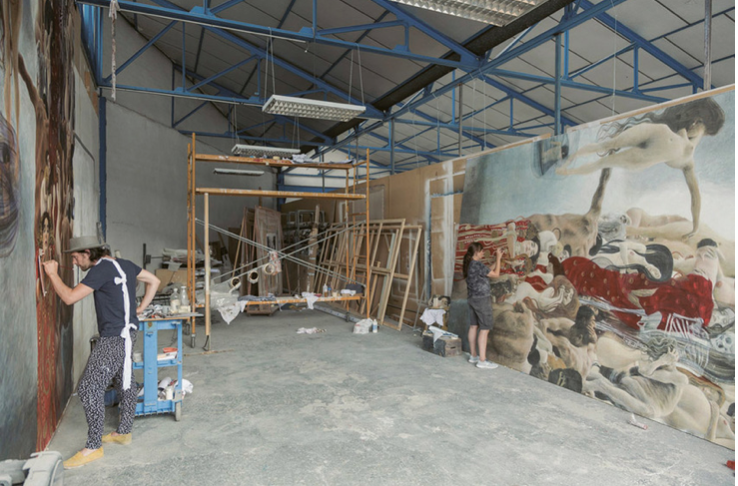
Fig. 2. Interior view of the large painting studio at Factum Arte’s headquarters in Madrid, where artists are working on the high-tech reconstruction of Gustav Klimt’s destroyed University of Vienna Faculty Paintings, Jurisprudence (left) and Medicine (right). Photograph © Copyright 2026 Factum Arte.
We all have surely once stood in a hushed gallery of a national museum and imagined a masterpiece returned to its original setting; for example, a royal throne room or a candlelit chapel. The time, place and intention of its creator all play a huge part in the perception of an artwork’s impact and meaning. This is the "aura", as German philosopher Walter Benjamin famously framed it in his 1935 essay “The Work of Art in the Age of Mechanical Reproduction”. Benjamin warned that in an age of technological frenzy, from the first printing press through photography and film to today’s AI-generated content, our attitude towards artwork’s traditional “aura” would inevitably wither due to mass reproduction. For many people, technology is the art world’s Trojan Horse: a gift of limitless access that inevitably impinges on the authenticity of the original. It then would seem logical to assume that an artwork’s aura is a fixed point, anchored to one unique object. But whilst roaming through Factum Arte’s studio, amidst the 3D scanners and clay facsimiles, I was struck by the realisation that first impressions are rarely straightforward.
Consider for a moment that an artwork’s “aura” may not be a fixed entity, but rather a sensory experience that can be carried across borders. What if the "aura" of an artwork or artifact could in fact migrate by way of perfectly accurate facsimiles? Take for example Paolo Veronese’s The Wedding Feast at Cana. Since Napoleon’s conquest of Venice in 1797, this 732-square-foot giant canvas has been exhibited in the Musée du Louvre, fighting for air and attention in the overcrowded Salle de la Joconde which houses the Mona Lisa. But in 2006, by request of Fondazione Giorgio Cini and in collaboration with the Musée du Louvre, Factum Arte undertook a project of digital mastery to reverse this fate. Through non-contact scanning, they de-materialised the canvas, to then re-materialise it via a custom-built printer. The result was a stunningly accurate facsimile that was returned to its original position in the Palladian refectory on Venice’s Island of San Giorgio Maggiore. Standing high above Venetian ground, the work can be viewed once again as Veronese had intended in 1563. As declared by Adam Lowe: “If such an experience feels authentic, has the painting’s “aura” stayed behind in Paris, or has it in fact found its way back to Venice?”
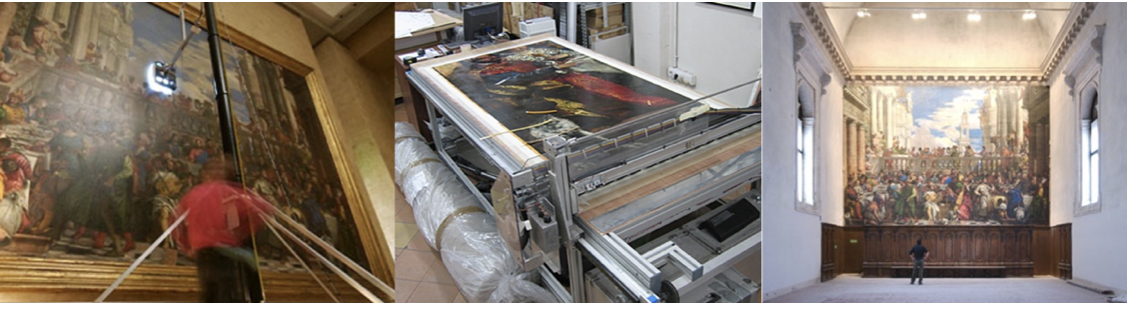
Fig. 3. High-resolution, non-contact color scanning of Paolo Veronese’s The Wedding Feast at Cana (1563) at the Musée du Louvre, Paris. Photograph © Copyright 2026 Factum Arte.
Fig. 4. Printing the 732-square-foot gesso coated canvas using Factum Arte’s custom-built, high-resolution printer. Photograph © Copyright 2026 Factum Arte.
Fig. 5. The finished facsimile of The Wedding Feast at Cana installed in its original architectural context on the Island of San Giorgio Maggiore, Venice. Photograph © Copyright 2026 Factum Arte
As our visit ended, we were joined by James Macmillan-Scott, President of the Factum Foundation for Digital Technology in Preservation, who described the organisation’s many successes and complex challenges. Since the establishment in 2009 of this not-for-profit endeavour, Factum Foundation has undertaken many collaborative projects with institutional giants, such as the British Museum, the Museo del Prado, the V&A and Fondazione Palazzo Te. The Foundation’s goals are not only to document, archive and safeguard the world’s cultural heritage, but also to show the importance of high-resolution transcription in making knowledge more widely accessible for research and education. Passing through a second-floor office space, we witnessed Factum Foundation’s mission in action. A triad of 17th Century Italian paintings by Caravaggio, depicting scenes on the theme of St Matthew, were commissioned for and are currently housed in the Contarelli Chapel of the Church of San Luigi dei Frances in Rome. Thanks to the creation of The Caravaggio Research Centre in 2010, Factum Arte rendered these three paintings into high-quality printed facsimiles which now allow academics to study the works in detail in Caravaggio, Italy, while the originals remain undisturbed for visitors to view in situ. Therein lies the magic of a facsimile: the ability for a masterpiece to be in two places at once.
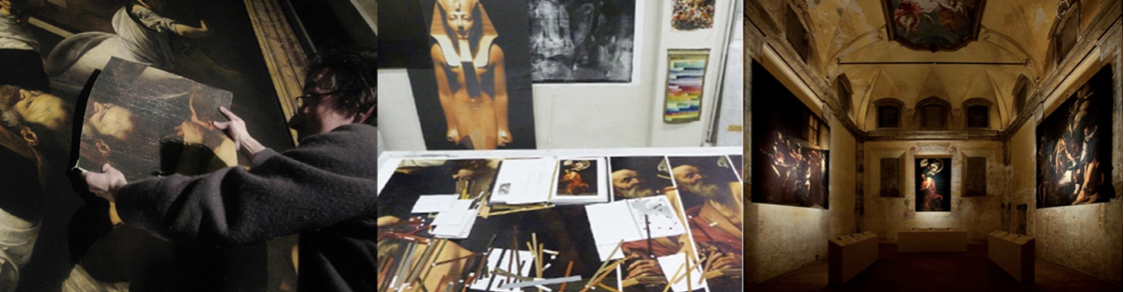
Fig. 6. Adam Lowe performing a direct color comparison, holding a printed test panel against Caravaggio’s original The Martyrdom of St. Matthew (1600) in the Church of San Luigi dei Frances, Rome. Photograph © Copyright 2026 Factum Arte.
Fig. 7. A close-up view of the detailed color matching process for The Inspiration of Saint Matthew (1602). Photograph © Copyright 2026 Factum Foundation.
Fig. 8. The completed facsimiles installed in the Sacristy of the Church of St. John the Baptist in Caravaggio, Italy. A viewer control system allows for dynamic modification of the projected light’s intensity and tone. Photograph © Copyright 2026 Factum Foundation.
As we stepped out from Factum Arte’s studio into the Spanish sunlight and bid farewell, I felt grateful for this glimpse into the extraordinary world of facsimiles but also intrigued by the potential drawbacks of such technological advances. This visit revealed countless pedagogical and preservation successes but also raised questions about the future trajectory of art in our digital age. This is echoed in Factum Arte’s core mission: “By preserving the past, we seek to empower the present and inspire the future”. Both sides of the argument regarding an artwork’s authentic “aura” and its potential migration are valid in their own right. Yet, the final verdict in this fervent debate will be judged in the public’s court. As material and digital borders grow increasingly blurred, we are left to wonder if original artworks still hold the higher ground, or whether facsimiles have now become just as significant.
For further information:
To learn more about Factum Arte’s current artistic and philanthropic projects, their digital processes and production activities can be further explored at https://www.factum-arte.com/en/inicio or the team may be reached directly via email at factum@factum-arte.com.
Bibliography
Benjamin, Walter. “The Work of Art in the Age of Mechanical Reproduction Illuminations Fontana.” Illuminations Fontana, 1935, 211–44.
Factum Arte. “Factum Arte : A Facsimile of the Wedding at Cana by Paolo Veronese.” www.factum-arte.com, 2007. https://www.factum-arte.com/pag/38/A-facsimile-of-the-Wedding-at-Cana-by-Paolo-Veronese.
Factum Arte, “Factum Arte: About,” www.factum-arte.com, 2026, https://www.factum-arte.com/aboutus.
Factum Foundation. “The Caravaggio Research Centre,” September 25, 2025. https://factumfoundation.org/our-projects/digitisation/the-caravaggio-research-centre/.
Latour, Bruno, and Adam Lowe. “The Migration of the Aura, or How to Explore the Original through Its Facsimiles.” Edited by Thomas Bartscherer and Roderick Coover. University of Chicago Press: Switching Codes: Thinking Through Digital Technology in the Humanities and the Arts, 2011.