By Tabitha Lawson
What do the wardrobes of Billy Connelly, Samuel L Jackson, and Princess Diana have in common? The textile work of Lochcarron, a small village tucked away in Wester Ross, and its weavers who would create what is now the world’s leading manufacturer of tartan.
In 1938, two weavers from the Scottish Borders, were sent up north to train local crofters in traditional tweed weaving practice and manage the mill that would become Lochcarron of Scotland. After the sudden break in production during World War Two, the Netherdale Handloom Weavers down in Galashiels was soon established. Now the company was able to manufacture more products to satiate the 1950s and 1960s growing markets for the tourist trade of Scottish tartan and highland wear.
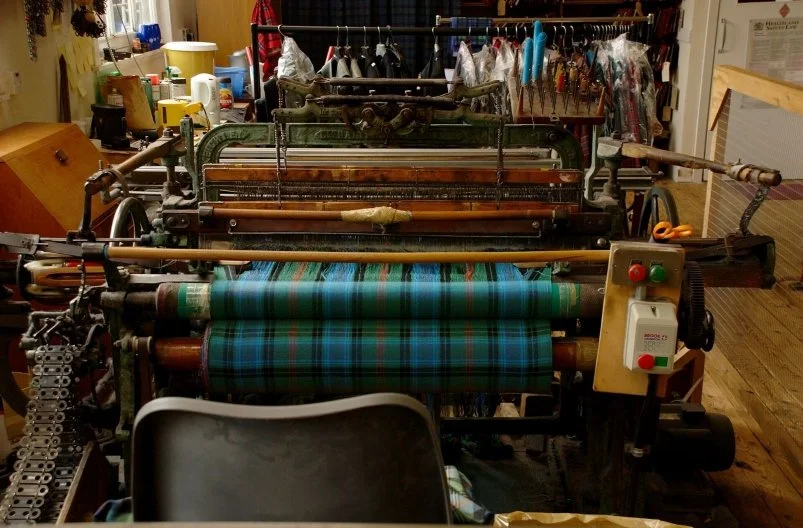
Electrically Operated Hattersley Domestic Loom at Premises of Lochcarron Weavers, Wester Ross, 2007. Image courtesy of Wikimedia Commons.
In 1949, the first Strome single-width tartan was woven, the Crawford tartan. While the weaving mill takes its name from the home of its weavers, the ‘kilt weight’ tartan produced for traditional kilts was called ‘Strome weight’ after the village of Strome a few miles from the Lochcarron mill. After the tartan was woven, it would be sent down to Galashiels to be washed and finished.
With this bigger space to produce new fabrics and designs, new opportunities opened in the fashion market for imported textiles. In 1988, Lochcarron of Scotland helped host Fashion 88; a promotional trip for high-end designers to the woollen mills of the Scottish Borders to platform traditional textile industries. This occasion welcomed prominent designers including Jasper Conran and Jean Muir. Vivienne Westwood, also present at the event, already had a well-established relationship with Lochcarron of Scotland, with up to 75% of her fabric for shows being supplied by the mill. In the hands of designers like Westwood, these traditional tweeds morphed into quirky and contemporary designs, endorsing the versatility of the textile.
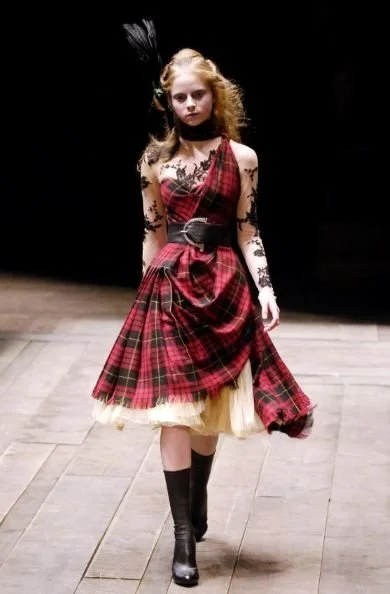
Alexander McQueen, Ensemble, Widows of Culloden Autumn/Winter 2006-7. Dress of McQueen wool tartan; top of nude silk net appliquéd with black lace; underskirt of cream silk tulle. Image courtesy of Marcio Madeira, Vogue.
Over the years, tartan manufactured at Lochcarron of Scotland has been showcased on the runways of Ralph Lauren, Burberry, and Alexander McQueen. McQueen’s Autumn/Winter 1995 collection Highland Rape and his Autumn/Winter 2006 Ready-to-Wear collection, The Widows of Culloden, used the red, green, and yellow McQueen’s clan tartan recreated by Lochcarron of Scotland, with the designer taking inspiration from his Scottish ancestry.
While the company’s exports continued to grow, their values of preserving traditional craft remained, passed down from generation to generation. The extensive team composed of designers, winding operatives, warpers, weavers, darners, and sewing team each honed their skills upon decades of experience and knowledge. Even aspects of this article come from conversations with my own family members about their time working at the original weavers in Lochcarron while growing up.
My aunt, Ruth Macdonald, recalls working in the weaving shed of the original shop. She remembers how it ‘was the biggest attraction for tourists travelling across the Highlands, watching as the lengths of tartan were being made. The orders would come in from all corners of the globe, by post and telephone, which would be written up in a large book beside the phone to ensure no errors. With the high demand, there were well over 100 bails of tartan in the shop at any one time, with main business coming from eight-yard kilt orders.’
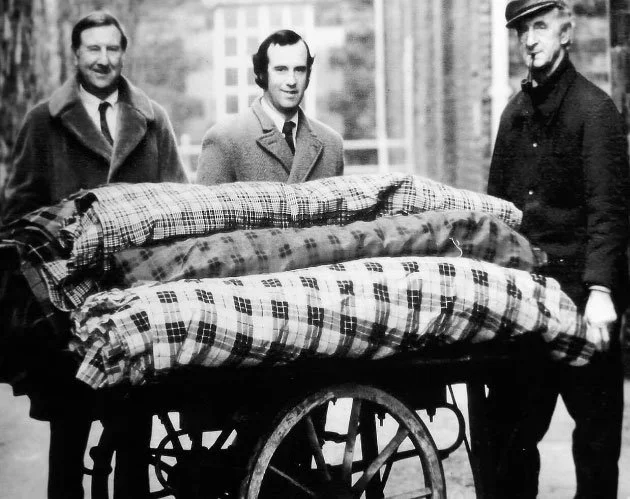
Lochcarron of Scotland tartan rolls. Image courtesy of Lochcharron of Scotland.
The main premises at Galashiels moved to Selkirk in 2006, around the same time that the mill in Lochcarron closed its weaving shed, remaining as the retail Lochcarron Weavers Heritage Shop. Over the years, Lochcarron of Scotland has earned royal visits to the mills, and as a champion of traditional crafts, continues to design and create bespoke tartans – whether it be for formal regalia, or a simple Scottish souvenir.
Bibliography
“Alexander McQueen Uses Lochcarron of Scotland Tartan.” Google Arts & Culture, British Fashion Council, 2006. https://artsandculture.google.com/asset/alexander-mcqueen-uses-lochcarron-of-scotland-tartan-lee-alexander-mcqueen/8wHh-NrtDtnqUg?hl=en
Faiers, Jonathan. “McQueen and Tartan.” The Metropolitan Museum of Art, Perspectives, June 30, 2011. https://www.metmuseum.org/perspectives/mcqueen-and-tartan.
Honigman, Ana Finel. What Alexander McQueen Can Teach You About Fashion. London: Frances Lincoln, 2021.
Jardine, Fiona Ann. “Fashion 88: Life in a Northern Town.” Back to the Future: 1979-1989. National Library of Scotland, November 7, 2019. Glasgow School of Art RADAR repository. https://radar.gsa.ac.uk/7086/
Lochcarron of Scotland. “About Us.” Accessed October 30, 2026. https://www.lochcarron.co.uk/about-us/
National Trust for Scotland. “Meet the Makers: Keith Russell from Lochcarron of Scotland.” June 5, 2024. https://www.nts.org.uk/stories/meet-the-makers-keith-russell-from-lochcarron-of-scotland
Undiscovered Scotland. “Lochcarron of Scotland.” Accessed October 30, 2026. https://www.undiscoveredscotland.co.uk/selkirk/lochcarron/index.html
Vivienne Westwood. “Lochcarron of Scotland.” Accessed October 30, 2026. https://www.viviennewestwood.com/en-gb/sustainability/craftsmanship-and-heritage/lochcarron-of-scotland/