The Thistle: Scotland's Enduring Emblem
By Anna Barlow
In recent weeks, St Andrews pubs have been packed with students and Scottish spirit as the Six Nations has unfolded, all watching players compete in a game as close to archaic warfare as sport permits. Bunting featuring the Saltire and five other competing nations’ colours has made our streets a vivid image of national pride. Yet one visual signifier has proven equally powerful: despite Scotland’s defeat, fifteen white thistles defended the county’s pride in the face of international competition.

Scotland winning against France at Murrayfield, 7th of March 2026. mage courtesy of Scottish Rugby.
Although Scotland did not win the Six Nations this year, on home televisions and pub projectors alike, the thistle, a small but deeply historic symbol, has served as a timeless reminder of national pride and enduring patriotism.
Since the time of Ancient Greece, organic motifs have frequented the emblems of nations and institutions, displaying power through the symbolic appropriation of forms drawn from the surrounding natural world — forms with the innate capacity to respond to human cultural needs.
A history as rich and longstanding as Scotland’s demands such a symbol: one that binds the present to the past and affirms the notion of a time as an endless return. The thistle is particularly well suited to this role. Among the most abundant plants in our environment, it may be transient in isolation, but as a species regrows collectively and endures with remarkable resilience.
Evoking the zeitgeist of the thirteenth century, the most celebrated, yet ambiguously sourced tale of the thistle comes from the Battle of the Largs. As Norse forces attempted to invade Scotland, their bare feet met the sharp spines of the thistle; their cries of pain roused the Scots and warned them of encroaching threat. In this legend, the thistle becomes a symbol of Scotland’s innate, natural strength as the landscape itself rose in defence of the nation.
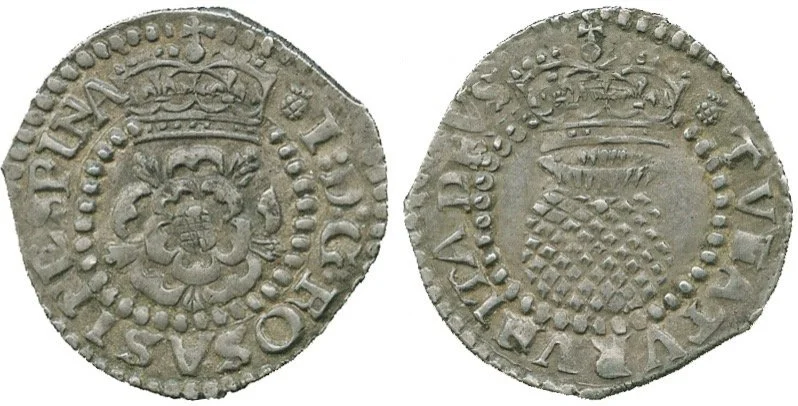
King James I of England, Half Groat, Third coinage (1619-24). Silver. Image courtesy of Balwin’s.
This spirit can be mapped as a visual anchor of patriotism throughout the canon of art history. First appearing on royal coinage under King James III of Scotland, the symbolic thistle became widely recognised from the 1470s onwards. As in Roman tradition, images achieved broad cultural currency only once they appeared on coins, embedding the thistle as an inherently Scottish motif — one of monetary power and civil value.
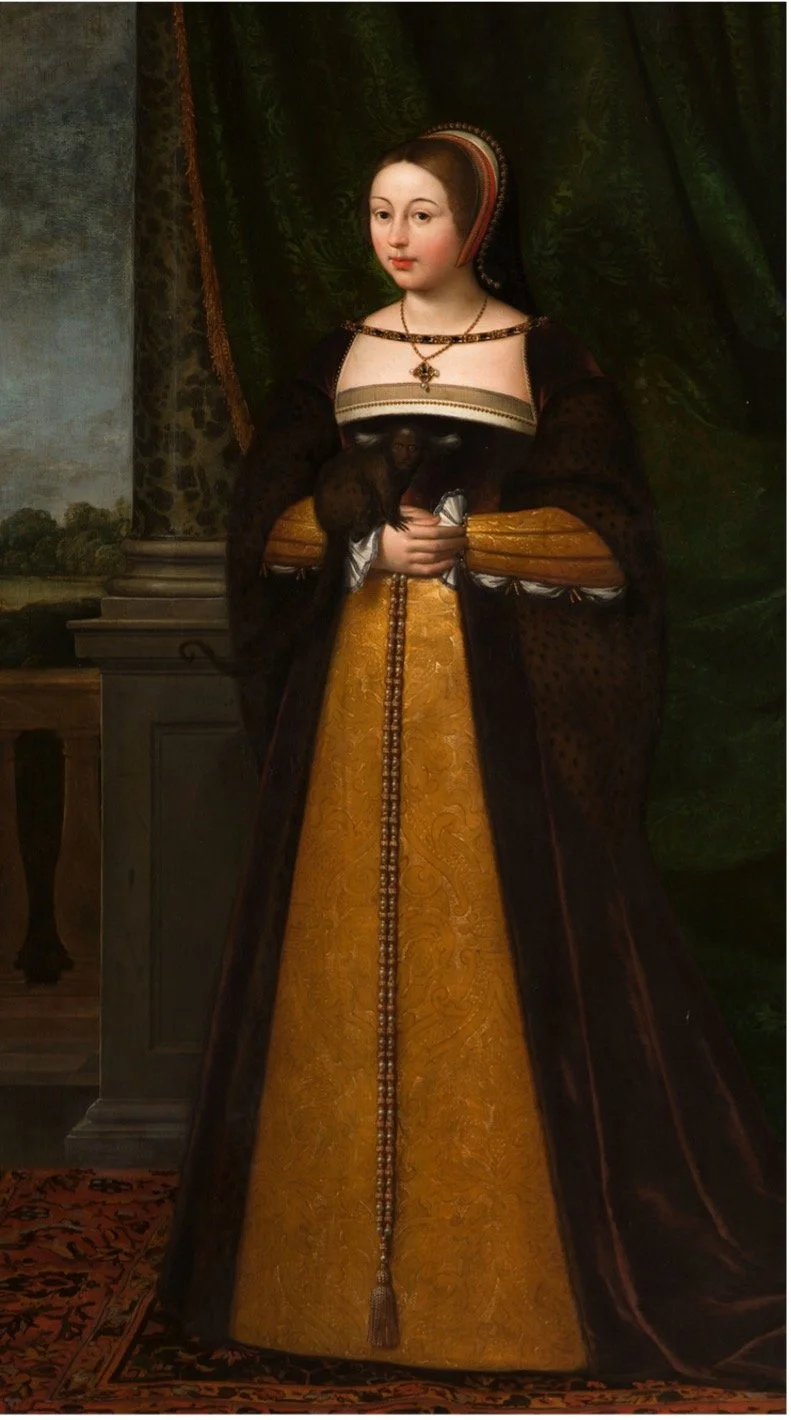
Daniel Mytens, Margaret Tudor, Queen of Scotland (1489-1541), c.1620-1639. Oil on canvas. 238.8 x 141.3 cm, Royal Collection Trust. Image courtesy of Royal Collection (UK).
Shortly thereafter, this thistle was integrated into royal portraiture. One of the earliest surviving depictions appears in the above portrait of Queen Margret Tudor of Scotland in which a thistle is skillfully rendered on an embroidered tapestry behind her. The work formed part of a series of the Nyne Olde Heads hanging in the Privy Gallery at Whitehall in the late 1630s, catalogued as depicting 'Kinge Henrie the 7th daughter who was married to Kinge James the 4th of Scotland’'. Here, the thistle is woven into the earliest visual fabrics of Scottish representation within Britain.
This symbolism has endured across the centuries. Even at the coronation of Queen Elizabeth II, the monarch wore the George IV State Diadem, which incorporated three national emblems: the English Tudor rose, the Irish shamrocks and the Scottish thistle; a means of displaying the Queen’s political sovereignty over the three constituent nations of the Union.
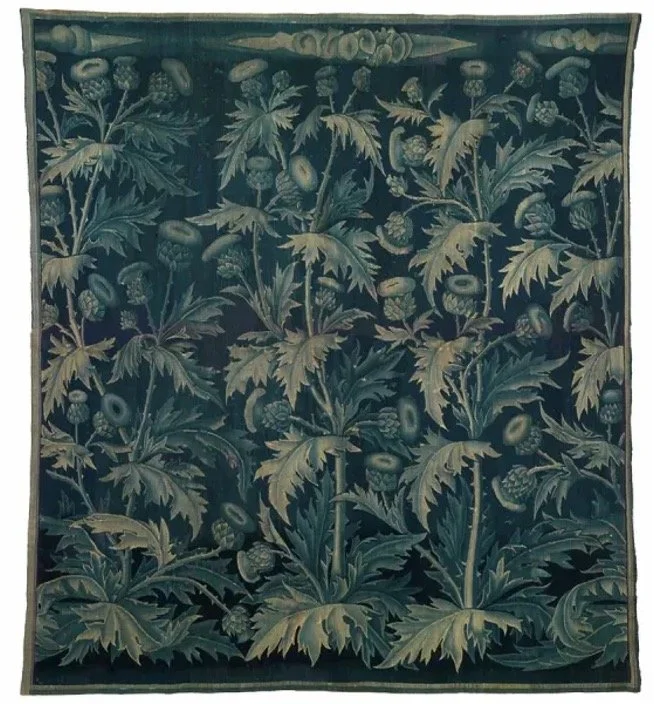
Franco-Flemish School, Verdure with Thistles (or Les Chardons), c. 1500. Wool, 264.1 x 246.3 cm, Burrell Collection, Glasgow, Scotland. Image courtesy of Glasgow Museums Collection / Bridgeman Images.
It would be a mistake, however, to regard this symbol as confined to Scottish art alone. By end of the fifteenth century, the thistle had already made an international mark as an emblem of Scottish identity. The Franco-Flemish tapestry Verdure with Thistles (or Les Chardons) (c. 1500), held in the Burrell collection, is considered to be one of the earliest surviving artistic illustrations of the plant as a Scottish signal — notably by a non-Scottish (but anonymous) artist.
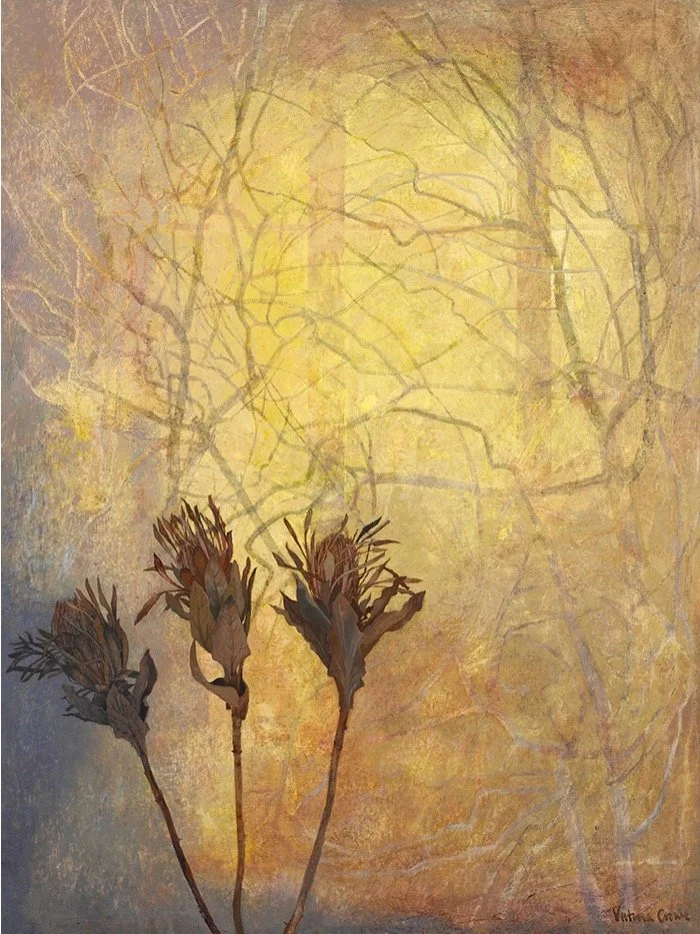
Victoria Crow, Diffused Light, 2007. Image courtesy of The Scottish Gallery.
In its timeless fashion, the thistle can be traced into the present day. Artists such as Victoria Crow often depict thistles as steadfast presences within the landscape, capturing ‘the rugged mood’ of Scotland’s terrain and changing landscape. These motifs allow her to explore ‘the connecting threads between her paintings and woven interpretations, highlighting her work with light, landscape, and memory’, evoking Scottish history and anchoring the thistle with tradition stretching back centuries, so works such as those of Daniel Mytens.
Over approximately six hundred years, Scotland has witnessed the transformation of the thistle: from a powerful folk tale affirming the nation’s intrinsic resilience, to a monarchical symbol of international authority, to a reclaimed and contemporary emblem of the Scottish people that we can watch at our rugby matches.
Bibliography
Baldwin’s. “James I, Half Groat,” March 6, 2019. https://www.baldwin.co.uk/product/james-i-half-groat/#tab-description.
Battlefield Restoration. “The Scottish Thistle - Which One?” Battlefield Restoration, May 16, 2023. https://www.battlefieldrestoration.co.uk/post/the-scottish-thistle-conundrum.
Carvalho, Luís Mendonça De, Francisca Maria Fernandes, Maria De Fátima Nunes, and Christopher Mills. “The Queen and the Flower Power— the Symbolic Use of Plants in the Court of St. James’s, United Kingdom.” Harvard Papers in Botany 17, no. 2 (2012): 317–22. https://doi.org/10.3100/025.017.0212.
Crowe, Victoria. “Victoria Crowe, Artist,” n.d. https://www.victoriacrowe.com/.
Digital Collection. “The Thistle Flower House,” 2026. https://sammlung.staedelmuseum.de/en/work/the-thistle-flower-house.
Grant, Michael. “ROMAN COINS as PROPAGANDA.” Archaeology 5, no. 2 (1952): 79–85. https://www.jstor.org/stable/41663050.
Royal Collection Trust. “Daniel Mytens (C. 1590-1647) - Margaret Tudor, Queen of Scotland (1489-1541).” www.rct.uk, 2021. https://www.rct.uk/collection/401181/margaret-tudor-queen-of-scotland-1489-1541.
Sargent, John Singer. “Thistles | the Art Institute of Chicago.” The Art Institute of Chicago, 2018. https://www.artic.edu/artworks/145807/thistles-.
Scottish Gallery. “The Scottish Gallery,” December 22, 2025. https://scottish-gallery.co.uk/artists/victoria-crowe/exhibitions/.
Scottish Rugby. “Match Report: Scotland 50-40 France,” March 7, 2026. https://scottishrugby.org/news-and-features/match-report-scotland-50-40-france/.