Hidden Gems: Legacy, Cameos, and James Tassie
By Kasia Middleton
If, like me, you enjoy spending your free time rummaging in the homeware section of your local charity shop or idly perusing the cabinets of a nearby antique centre, it is likely you are more than familiar with cameos and intaglios. These small gems appear time and again on the shelves of the aforementioned retail spaces, whether in the form of the eminently collectible Wedgwood jasperware, or as part of vintage jewellery collections. With the rise of internet aesthetics and ‘dark academia’ Pinterest boards, the cameo is well placed to be accepted back into the ever-progressing and ruthless trend cycle.
We understand that we like these items because they are a status symbol. They denote our appreciation for the Classicising forms engraved on them in relief, suggesting a certain timeless appreciation for fine items. What is perhaps less clear, however, is that since their very inception as an art form, cameos have been imitative. The Hellenistic Greeks were first to perfect them, but it has been the Roman pieces which have received the most celebration. These fine gems, often carved out of semi-precious stones like sardonyx, belonged to the most famous names from the pages of our history books, most frequently showing them and their associates immortalised in profile. They are often allegorising, and always symbolic. Ancient cameos by their very nature denote the existence of a skilled craftsman, able to manipulate banded stone incredibly finely, and a powerful patron, able to pay for such work to be done for really no practical purpose at all. That drives at the core of their fascination. A cameo is decoration, it is a frippery. They are hardly even display items, except when mounted in a larger framework. They are individualised, selfish works of art which are invested purely in who they portray and who can afford to wear them. No wonder the Hellenistic Greeks left such a lasting legacy which rang down through the ages, all the way from medieval collectors who reworked Classical cameos into biblical scenes, to Renaissance artists who copied from the gems held in their wealthy patrons’ extensive collections, to Neoclassical enthusiasts who rabidly collected up as many as they could possibly fit in their already bulging cabinets of curiosities, right on down to you and I, poking through dusty vintage jewellery of an afternoon.
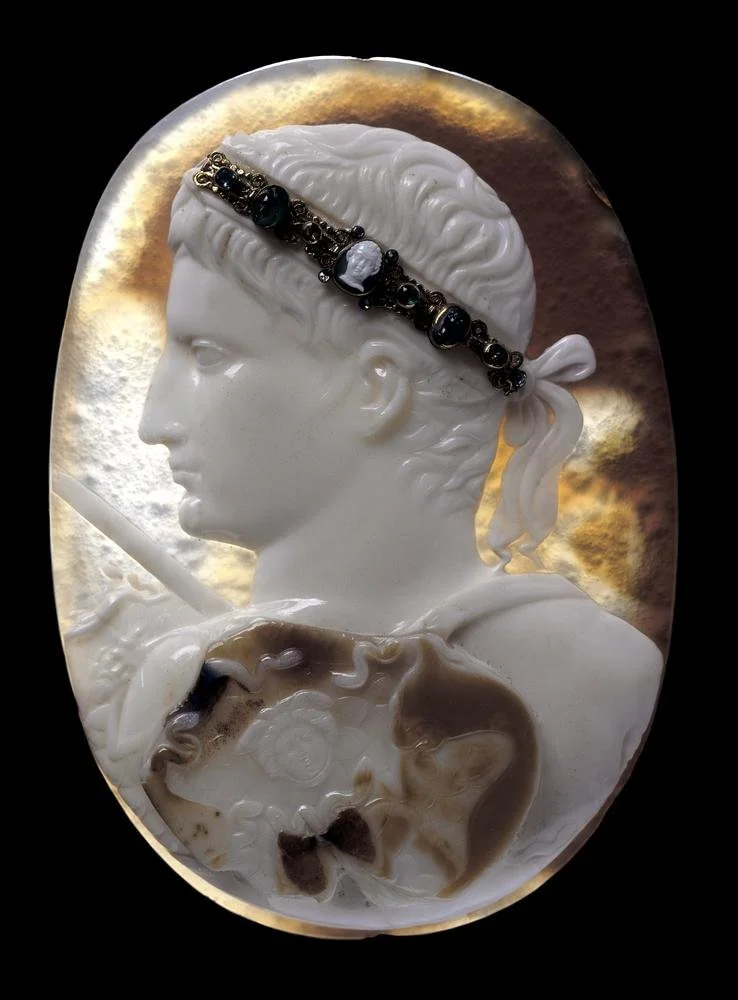
Particularly fine example of a Roman cameo, here showing Augustus, 14-20 CE (wreath probably changed in the medieval period). Sardonyx, length: 9.3cm. The British Museum, London. Image courtesy of The Trustees of the British Museum.
Really the interest these days is an inheritance from the eighteenth century collecting mania for these items. This was the period of Enlightenment and the beginning of industrialisation, the point in human history where obsession was beginning to become something that could be sated by mass-production. The natural interest of the collector in the easily portable status symbol that was the cameo was only amplified when taken in tandem with a resurgence of interest in the Classical past and the beginnings of the Grand Tour. In Britain, this presented an opportunity. Particularly savvy craftsmen who understood this desire to collect small, Classicising items, also understood that there was a finite number of ancient material to be collected, and that these small gems were easily copied with the help of modern technologies and craft materials. It no longer mattered especially whether the cameo was delicately carved out of a rare stone or shell. Appearances were the important part. Particularly famous Classicising craftsmen of the time included the aforementioned Josiah Wedgwood, and indeed, Wedgwood ceramics are still highly collectible items to this day.
Less well-known perhaps, but no less important, is the Scottish cameo merchant, collector, and artist, James Tassie (1735-1799). Born in Glasgow, he trained originally as a stone mason, but later was inspired to attend the Foulis Academy (set up in 1752 by the Foulis brothers, famous Scottish printers with a special interest in Classical texts), and there trained as an artist. After this, he moved to Dublin, and met Henry Quin, a physician who was also an amateur cameo maker. Together, they invented a new enamel formulation which had a particularly good finish, allowing Tassie to perfect his craft. He then relocated to London, and made a name for himself as one of the finest imitators of antique gems, garnering him commissions from such important patrons as Catherine the Great of Russia, and the chance to exhibit at the Royal Academy. He also had an extensive daktyliotheca (gem collection) of his own, complete sets of which now exist in London, Edinburgh, and St Petersburg.
Much of what is known about Tassie comes from a collection of letters written by him and his nephew William, who inherited his uncle’s business when he died. The correspondence, transcribed and made available by Duncan Thomson, now resides in the Glasgow City Archives and allows for many important insights into his working process, his interest in the antique, and the importance of the social acclaim of his patrons and those he represented in his gems. It also exposes the rivalry he had with Josiah Wedgwood, whose company actually went on to reproduce many of Tassie’s designs. But really the best insight into the world in which Tassie worked is his cameos. He represented numerous titans of the Scottish Enlightenment, including Adam Smith, Henry Raeburn, and Hugh Blair. All are shown in profile, in the contrasting hues characteristic of the cameo relief. One representation of Blair looks particularly Roman, with his veristic face and flowing hair accentuated by the bunched up neckline of what looks like a toga.
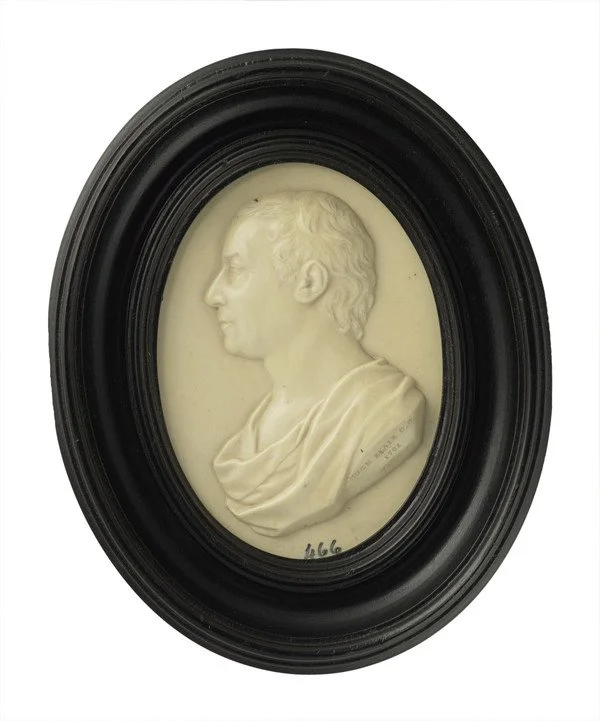
After James Tassie, Portrait of Hugh Blair, 1893. Plaster, 7.9 cm. National Galleries, Scotland. Image courtesy of the National Galleries of Scotland
Indeed, in a sense, cameos are the most emblematic art form of eighteenth century Neoclassicism. They are easily and inexpensively copied items which are displayed on the body as markers of connection and wealth, attainable in their thousands by wealthy royals or as small luxury items for individuals with the money to spare. The ancient world, which so many Grand Tourists were now desperate to bring home a piece of, was now made on commission at home on such a scale that the ripple effects of it are still felt today in the displays of antique shops. So, the next time you find yourself browsing vintage items, I hope you are reminded of the fact that no item, no matter how small, is unencumbered by material or visual history. Perhaps it is only when we really understand why we feel an inherent appreciation for something, that we should ever feel comfortable displaying it. Finding an inexpensive vintage cameo brooch beautiful is, of course, a perfectly good reason to buy one and wear it, but I find it is an experience much enriched by understanding the legacy of power and status which is now pinned to one’s jacket.
Bibliography:
Draper, James David. “Cameo Appearances.” In Heilbrunn Timeline of Art History. New York: The Metropolitan Museum of Art, 2000–.
Thomson, Duncan. “The Letters of James and William Tassie to Alexander Wilson 1778 to 1826.” The Volume of the Walpole Society 65 (2003): 1–87.
National Galleries of Scotland. “James Tassie.” National Galleries of Scotland, accessed 2nd March 2026. https://www.nationalgalleries.org/art-and-artists/artists/james-tassie