
Paisley’s Abandoned Hospital: Beauty in Decay
By Megan Waugh
As Scotland’s largest town, Paisley possesses a history far richer than its contemporary reputation suggests. While the town is often criticised as ‘past its prime’ and in a state of urban decline, elements of wealth persist through its architectural inheritance. The iconic 12th-century Abbey, spire-topped cathedrals, and towering textile mills render an image of the vibrant past that exists within Paisley. Beyond their aesthetics, these structures serve as material records of the town’s artistic legacy. As a result, Renfrewshire Council has maintained efforts to preserve the buildings as visitor sites and testaments to Paisley’s visual interest.
Yet, one of Paisley’s most compelling locations is also one of its most neglected. As one of the town’s oldest structures and certainly its most decayed, the Royal Alexandra Infirmary is infested with mould, blackened by fires, and utterly rotten. The Daily Record released an article about the building in 2016 titled ‘It’s like a scene from a horror movie’. Colin Lamont describes the sadness one feels to see a building of ‘grandeur’ reduced to ruin.
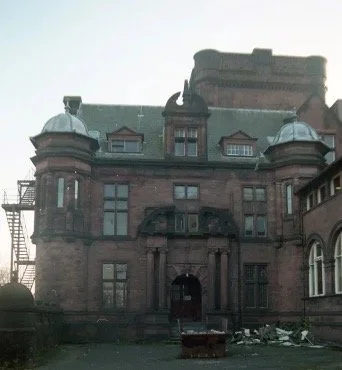
Entrance to the administration block on the north side of the infirmary, 1988, photograph.
Image courtesy of H. Richardson.
Constructed from 1894 to 1901, the hospital was one of Paisley’s most significant commissions, designed by Thomas Graham Abercrombie, one of Scotland’s leading architects. He designed several iconic Renfrewshire buildings, including Greenlaw Church, the Grammar School, and the Renfrew Victory Baths. Chris describes his impact, commenting that: ‘Abercrombie’s legacy extends beyond individual buildings to the very character of Paisley itself. He worked at a pivotal moment in the town’s history, when prosperity from the thread industry allowed for ambitious civic improvements, and he seized that opportunity to create architecture that was both functional and beautiful, progressive yet rooted in Scottish traditions.’
Indeed, Abercrombie’s work had a distinct character; one that set him apart from other Scottish architects, as his time in the United States gave him a unique sense of style and creativity. Late nineteenth-century American architecture was particularly characterised by the predominant Queen Anne style, defined by asymmetry, ornate detailing, and varied shapes. Historic Environment Scotland describes it as an ‘elaborately decorated’ former hospital, and the building is now B-listed. Such formal qualities make this building an exciting yet unconventional sight.
At the edges of sprawling overgrowth and collapsing roofs, two distinctive turret-shaped structures emerge. Lined with porches and balconies, they were likely intended to let patients get fresh air without having to leave the premises. Abandoned for roughly thirty-nine years, these viewing points remain eternally empty. Now, no one looks out from these platforms; it is only curious passers-by trying to look in. After all, is it not the building itself the most interesting view?
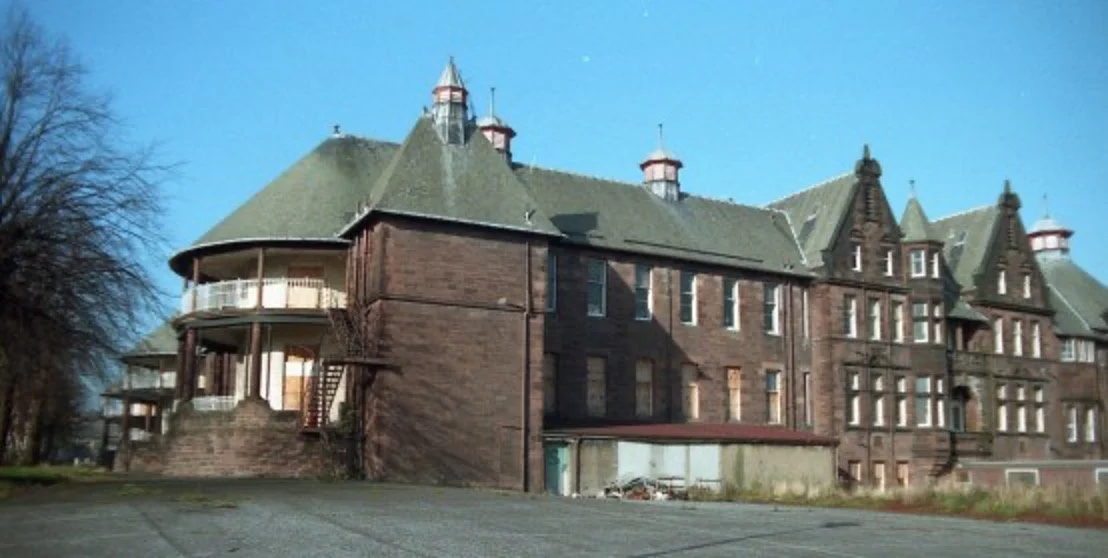
Paisley, Royal Alexandra Infirmary, 1988. Photograph.
Image courtesy of H. Richardson.
One does not have to be an avid appreciator of Victorian history to be intrigued by this structure. Laura Ferguson notes how urban explorers have uploaded videos of the building’s interiors, with YouTuber Dale stating it is about ‘seeing the history before it’s gone forever—it’s the best part.’ Thus, there appears to be an understanding of how architecture can transport us to a different time and allow access to a world that feels entirely separate from the present.
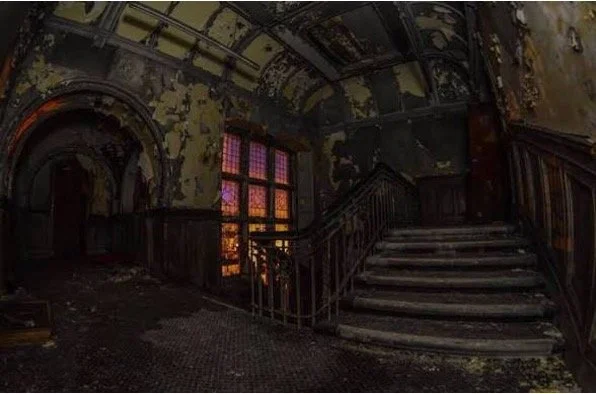
Inside the Royal Alexandra Infirmary, 2016, Photograph.
Image courtesy of the Daily Record.
Although it was built in the 1890s, the hospital’s tunnelling hallways and arched windows continue to beckon visitors, even when it is crumbling and covered in ivy. After several major fire incidents, locals have grown increasingly passionate about the protection of this building. Even if it no longer operates as a hospital, or is unfit for renovation of any kind, its beauty appears to be adequate reason for it to be protected.
Despite its state of degradation, the Royal Alexandra Infirmary continues to elicit fascination. It may be crumbling, past its prime, and needing desperate maintenance, but its beauty remains undeniable. As a town, Paisley is often criticised for similar issues, yet, interestingly, perhaps one of the best things it must show for itself is the most decayed building of all.
Bibliography
Colin Lamont. “It’s like a scene from a horror movie, but this is what lies behind the walls of Paisley’s old Alexandra Royal Infirmary.” Daily Record, November 2016.
“Thomas Graham Abercrombie.” Live Breathe Scotland. Accessed September 29, 2026. https://www.livebreathescotland.com/biographies/thomas-graham-abercrombie/.
“Inside Abandoned Royal Alexandra Hospital,” Glasgow Live, accessed September 29, 2026.