The Portrait as an Anti-fascist Artwork: Looking at Christopher Anderson’s Vanity Portraits of JD Vance, Susie Wiles & Karoline Leavitt and their Comparisons with Pre-World War II Works
By Alix Ramillon
Fascism has historically thrived on the suppression of individuality in favour of mythic figures, idealised heroes, and compliant masses. The essence of portraiture lies in its ability to highlight the erasure of personal identity, with the leader becoming an icon, the crowd morphing into an indistinguishable mass, and the citizen reduced to a mere type rather than a multifaceted subject. By presenting a face and body that embody their unique qualities, vulnerabilities, and contradictions, we defy fascist aesthetics and disrupt the spectacle through a presence that lacks the glorification of heroism. As John Berger pointed out, seeing is never a neutral act; power dynamics, historical context, and ownership shape it. Given that fascism seeks to control perception, our viewpoint is influenced by our knowledge and beliefs. Therefore, images can be challenged and redefined. When we observe something, we inevitably do so in relation to ourselves. This perspective shifts the viewer from a passive observer to an active participant.
In light of the current resurgence of fascism, it’s crucial to remember the artists who took a stand against its horrors and the politicization of art. Fascists typically disdain modern art, viewing it as a rupture from tradition and ill-suited for propaganda. They favor conformity in artistic expressions that glorify the nation. Yet, art is potent enough to challenge and subvert these ideological frameworks. By politicizing the human body and utilizing self-representation, artists can convey vulnerability and critique rather than reinforce nationalist narratives. Walter Benjamin aptly remarked in The Work of Art in the Age of Mechanical Reproduction that ‘the aestheticisation of politics is the hallmark of fascism.’
Fascism often glorifies idealised masculinity, racialised notions of beauty, and rigid symbolism, creating an image of soldiers that feels grotesque and morally fractured. While fascism seeks clarity and recognisability, resistance may thrive in ambiguity. This speaks to the power of refusing compliance as an act of defiance, in which self-commissioned portraits can effectively counter official representations. Resistance emerges not through depicting rebellion, but by challenging how fascism frames perception. While artists before World War II confronted fascism by distorting its symbols, contemporary creators resist it by wholly rejecting its visual logic, which is what we will look at.
Christopher Anderson’s Vanity Fair portraits represent how publicity shapes our consumer culture, often leaving us feeling slightly discontent with our current lives. Anderson highlights this idea by showing how the flaws in people's faces can disrupt the glossy narratives created by propaganda. His work demystifies images, revealing how the very essence of these visuals, and the way they're perceived, has political significance.
Anderson cleverly contrasts traditional fascist techniques where portraits signify visual hierarchies: leaders are prominently featured, the masses remain faceless, and enemies are depicted in exaggerated, mocking ways. As a portrait photographer with a background in photojournalism, he approaches his Vanity Fair work with striking, unflattering close-ups of Trump’s administration.
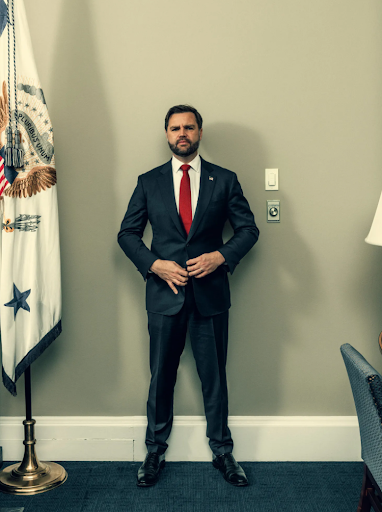
Christopher Anderson, Portrait of J.D. Vance, 2025.
Image courtesy of Vanity Fair.
Take J.D. Vance’s portrait, for example. The composition feels unusual; typically, you’d have a clear distinction between the subject and the background. Instead, Vance seems almost flattened against the wall, while the scene expands through an inviting doorway. The multiple frames in the image trap the viewer's eye, yet oddly, Wiles occupies none of them. Vance's soulless, confused gaze contrasts sharply with Wiles's wide-open eyes, creating an unflattering yet thought-provoking scene.
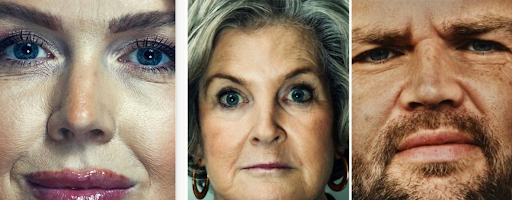
Christopher Anderson, Portraits of Karoline Leavitt, Susie Wiles, and J.D. Vance, 2025.
Image Courtesy of Vanity Fair.
Karoline Leavitt, the White House press secretary often dubbed the “Mouthpiece,” stands out with her striking, cool-toned close-up. Her image carries an unsettling vibe, enhanced by a tighter crop and cooler palette. A thin sheen of melted plastic reveals her lip fillers, casting doubt on the polished facade of a key figure in the White House’s publicity machine. In an interview, Anderson stated, ‘I like the idea of penetrating the theatre of politics.’ His approach doesn’t rely on Photoshop as a political tool; he isn’t here to serve propagandists. As an artist, the photographer wields considerable power in choosing images. According to Anderson, his work presents a candid portrayal of the subjects. If they come across poorly, it’s simply a reflection of who they really are. The way these images are reproduced can be a double-edged sword, as Berger points out, flattening meaning while democratising access to and critique of them. Today, photographers wield editing tools that allow them to preserve the original integrity of their artwork.
The rigid poses and sharp symbolism, coupled with lifeless gazes, exude an audacious irreverence, with shadows looming almost threateningly over their expressions. This evokes a haunting comparison to portraits created by artists during World War II, who captured the aftermath of fascist brutality. Anderson’s work serves as a stark reminder of the persistent, looming dangers that echo those in earlier portrayals.
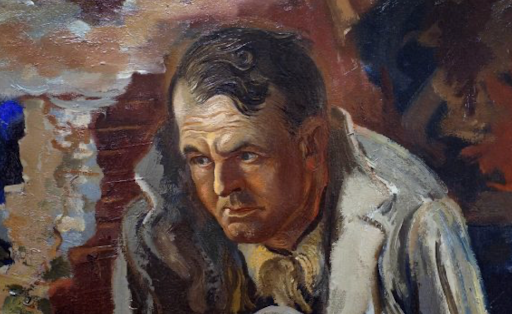
George Grosz, Remembering, 1937.
Image courtesy of Smarthistory.
During World War II, to escape fascism in the United States apocalyptic landscape, George Grosz used an unusual medium for a self-portrait. In portraits, the sitters are usually depicted looking at the viewer. However, in Remembering, the sitter is looking forward, pensive, with a wrinkled forehead. He emphasises in his works: ‘My paintings became prophetic. I was compelled’, reflecting his nervous breakdown as a post soldier. Here, he is not of powerless subordination, denouncing fascism for tactics of denunciation.
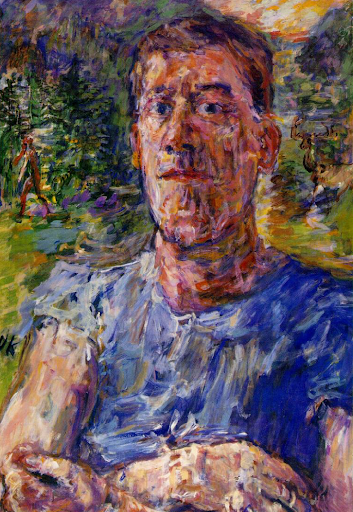
Oskar Kokoschka, Self-portrait as a Degenerate Artist, 1937.
Image Courtesy of Artchive.
Oskar Kokoschka is notably included in the Nazis' infamous guide of degenerate artists, which he embraces with a sense of pride. In this self-portrait, he presents a striking defiance, showcasing a complex self-image. In the background, his deceased mother appears amidst a lush green landscape, accompanied by a stag and a hunted beast, symbols of scapegoating and suffering. This imagery reflects his duality: the sick and the healthy.
As you step back from the portrait, the features seem to hollow out before transforming back into a smile; the left side exudes anger, while the right appears contemplative and almost melancholic. This interplay of contrasting emotions highlights a subtle yet persistent act of defiance, with Kokoschka's irreverence taking on a political dimension.
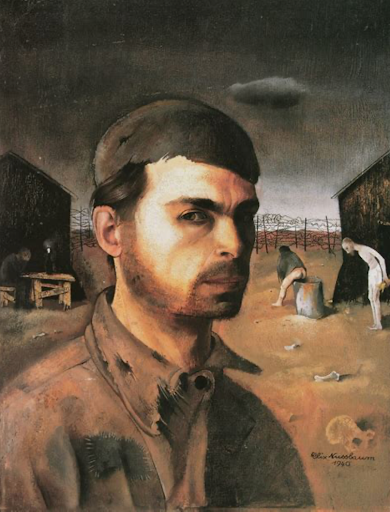
Felix Nussbaum, Self-Portrait in Concentration Camp, 1944.
Image courtesy of Outrejournal.
Here, Nussbaum depicts himself in a concentration camp, testifying to the artist’s portrayal, which resonates deeply with the world he inhabits and captures the regime's impact on personal identity. It becomes a powerful form of self-exposure, a voice arising from a specific situation that critiques the broader circumstances. This lived experience is conveyed through the tools of criticism, fear, and confusion.
Portraiture, whether in the medium of self-representation or from an external eye, as we have seen with Anderson’s works, is a medium for the artist to both engage and dissociate from fascist restrictions. Caricature has long served as a means of horizontal resistance against vertical power, employing exaggeration, ridicule, and distortion to communicate its message. Still, less blatant forms of criticism also serve as a political message in the art world.
Bibliography
Benjamin, Walter. 2016. “The Work of Art in the Age of Mechanical Reproduction.” Illuminations, September, 82–84. https://doi.org/10.4324/9781315509693-26.
Berger, John. (1972) 2008. Ways of Seeing. Penguin UK.
Kahina Sekkaï. 2025. “Christopher Anderson on His White House Photos.” Vanity Fair. December 23, 2025. https://www.vanityfair.com/news/story/christopher-anderson-white-house-photos-maga-vanity-fair?srsltid=AfmBOorREseodauVF9vMCGLtPXaMVtqT69EiiD_Y7xcxGyL-hgtpum5e.