Art of Advent Day 1
By Elizabeth Gillett
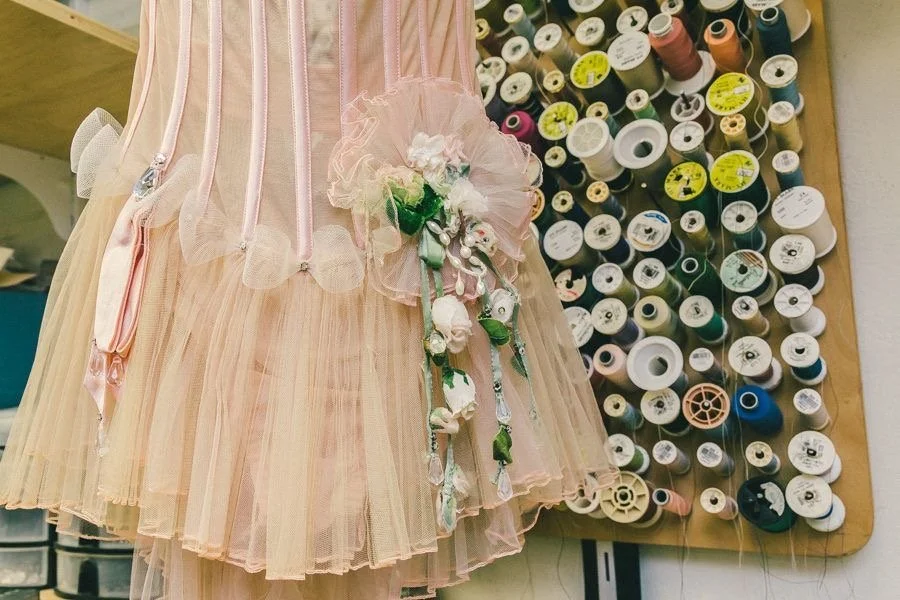
Close up of the Dewdrop costume for the New York City Ballet. Originally designed in 1964 by Barbara Karinska.
Image courtesy of Racked New York.
As HASTA’s countdown to Christmas begins, so too does my countdown to perhaps my most treasured holiday tradition, going to the Nutcracker ballet. The anticipation for my favourite event of the season has prompted my nonstop listening to Tchaikovsky as I revise in my resident spot on the fourth floor of the library, as well as a deep dive on the ballet’s costuming and the influence of costumier Barabara Karinska.
After leaving Russia in 1928, Karinska settled in Paris, where she would begin her career in costuming at age 41. She later spent time in London, before settling in the United States. Although she collaborated with some of the foremost artists of the period, including Henri Matisse, Joan Miró, and Salvador Dalí, it was her 40-plus year collaboration with choreographer and co-founder of the New York City Ballet George Balanchine for which she is best known.
Balanchine, who grew up in St Petersburg and danced in the roles of the Mouse King and the Nutcracker Prince in his youth, debuted his own version of the Nutcracker at the New York City Ballet (NYCB) in 1954. It was his choreography, which included reinstituting children into the featured roles, which led the Nutcracker and ballet more widely to sweep the nation.
Alongside Tchaikovsky’s compositions and Balanchine’s choreography (and of course its execution by the dancers), Karinska’s costumes play a key role in telling the story. Today, the NYCB’s costume shop, headed by Director of Costumes Marc Happel, work to preserve the integrity of Karinska’s designs, while advancing the pieces functionality. For instance, the base of the tutus was historically made from stiff, non-stretch fabric, but today, the costumers utilise a stretch netting base which provides the dancers with greater comfort and mobility and keeps the original design intact. The team also restores pieces of the original costumes, rework proportions of Karinska’s designs to fit modern body types, and create custom fabrics to replicate those that no longer exist.
In the first act, the children and their parents are dressed for the Christmas celebrations in beautiful dark velvets and wools, but it is the second act where Karinska’s work truly shines. As the second act begins, Marie, also known as Clara, accompanied by the Nutcracker Prince entre the Kingdom of Sweets, ruled by the Sugar Plum Fairy. Within this fantastical land, Karinska’s frothy, delicate, and innovative works come to life.
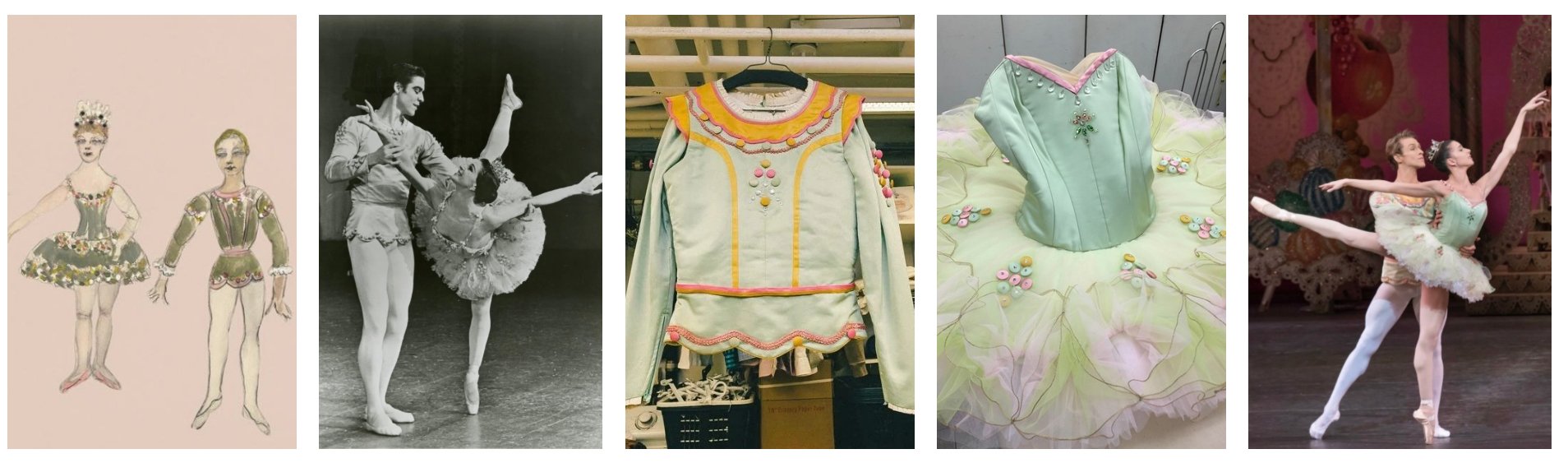
From left to right: Karinska’s original design for the Sugarplum Fairy and Cavalier, Melissa Hayden and Jacques D’ Amboise as the Sugarplum Fairy and her Cavalier in NYCB’s Nutcracker, today’s Cavalier and Sugarplum costume in the shop, the Sugarplum Fairy and her Cavalier on stage.
Images courtesy of The New York Public Library, NYCB, Racked New York, DuJour Magazine, and NYCB.
The second of the Sugarplum Fairy’s costumes is worn during the famed pas de deux with her Cavalier. The piece consists of a pistachio satin bodice with a tutu made from layers of tulle outlined in gold metallic thread, which are then folded and tacked to create a ruffled effect. Candy-like buttons, which feature a Swarovski crystal in their centre, dot the tutu, and coordinate with those adorning her Cavelier’s jacket.
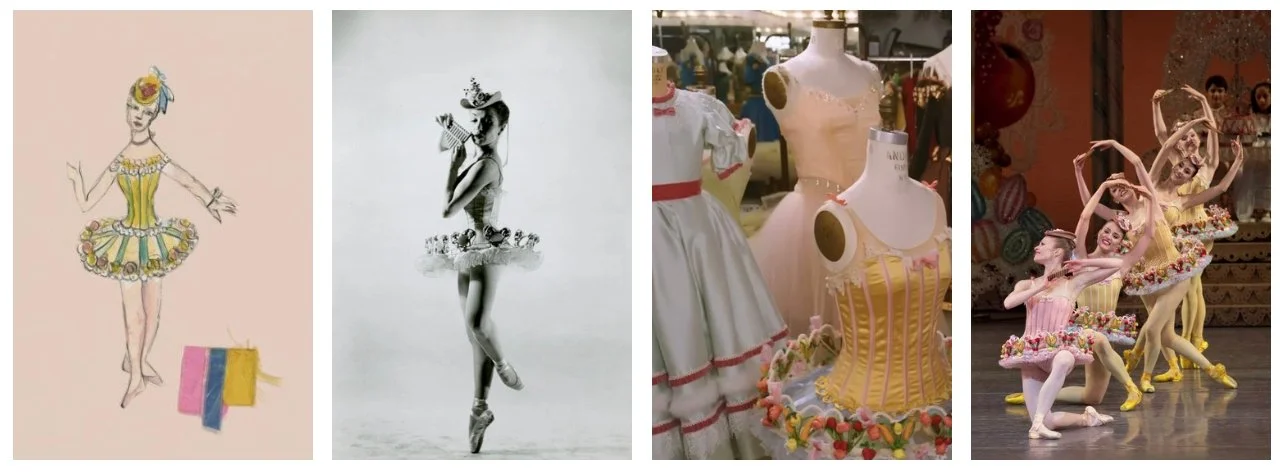
From left to right: Karinska’s original design for the Marzipan Shepherdesses, Janet Reed as Marzipan in NYCB’s Nutcracker, today’s Marzipan costume in the shop, the Marzipan Shepherdesses on stage.
Images courtesy of The New York Public Library, NYCB, In Style, and NYCB.
The Marzipan Shepherdesses’ costumes are particularly whimsical. Their tutus are crafted from a wire frame and are adorned with stuffed marzipan fruits and vegetables, while the bodice is made from satin, in keeping with the bodice of the Sugarplum Fairy costumes.
However, it is the Dewdrop costume, which Happel stated was ‘so ahead of its time’, that best highlights Karinska’s innovativeness as a designer. The body is made from a single layer of sheer stretch net with a duchess satin boning applied to the outside of the fabric. The skirt of pleated tool is accentuated by the polyester horsehair trim, which is usually used on the interior to give a ribbon shape.
Of Karinska, Balanchine famously remarked, ‘I attribute to her 50 percent of the success of my ballets to those that she has dressed,’ and it truly is Karinska’s fanciful designs (beautifully reproduced by the NYCB costumers) that brings the magic to the iconic Christmas ballet.