
Art of Advent Day 2
By Alix Ramillon
Babette’s Feast (1987), masterfully directed by Gabriel Axel, is the film that wraps me in warmth every Christmas. It serves as a cinematic almanac of grace during the winter months, intertwining the themes of the season with its visuals. Set in a quaint, wind-kissed village on Denmark’s Jutland coast, the film is bathed in a palette of muted greys and whites, illuminated by the hushed glow of the cold northern light. The town appears to be in an eternal twilight, reminiscent of late autumn or the subtle embrace of winter.
Life in this sombre community is shaped by a commitment to simplicity—unadorned meals, humble garments, and emotions kept in check. The stark, lifeless landscape reflects their denial of warmth and joy. And yet, from this frosty moral landscape arrives Babette, a Parisian refugee whose very presence heralds the promise of warmth, colour, and sensuality. Her arrival, alongside the feast she prepares, serves as an emotional and spiritual thaw, not one of temperature, but of the heart and soul.
As she cooks, the once stark interior of the Nordic dwelling fills with the soft glow of candlelight, rich aromas, and the laughter of people rediscovering joy. This moment captures the essence of winter not just as a season of dormancy but as a time of anticipation, likening it to the reflective periods of Lent or Advent, which leading to the joyful explosion of Christmas and epiphany—a celebration of revelation through the senses.
The feast becomes a symbollic winter jubilation, a reversal of the typical Puritan fast, transforming into a midwinter banquet infused with joy, forgiveness, and communion. In the context of Danish Lutheran culture and the rhythms of Nordic life, winter feasts are an uncommon treasure, rich in meaning as they signify resilience and the hopeful return of light. They draw on the tradition of feasting, yet are elegantly reimagined through the lens of Danish minimalism.
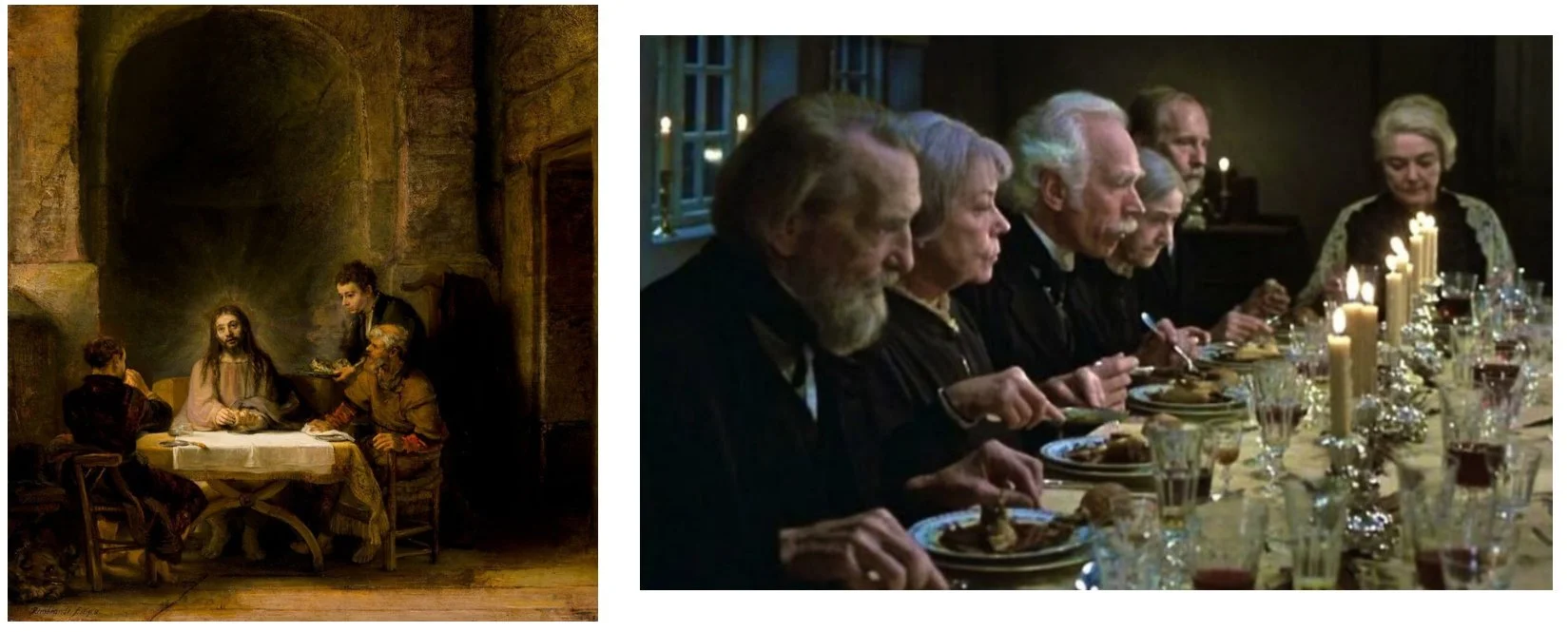
Left to right: Rembrandt, The Supper at Emmaus, 1684. The feast takes place.
Images courtesy of Wikipedia and IMDB.
In Babette’s Feast, guests are gathered around the candle-lit table as faces emerge from darkness, golden light pooling on glass and silver. Both works utilise chiaroscuro and the composition around the table as moral stage. Moments of grace are rendered through light rather than action.
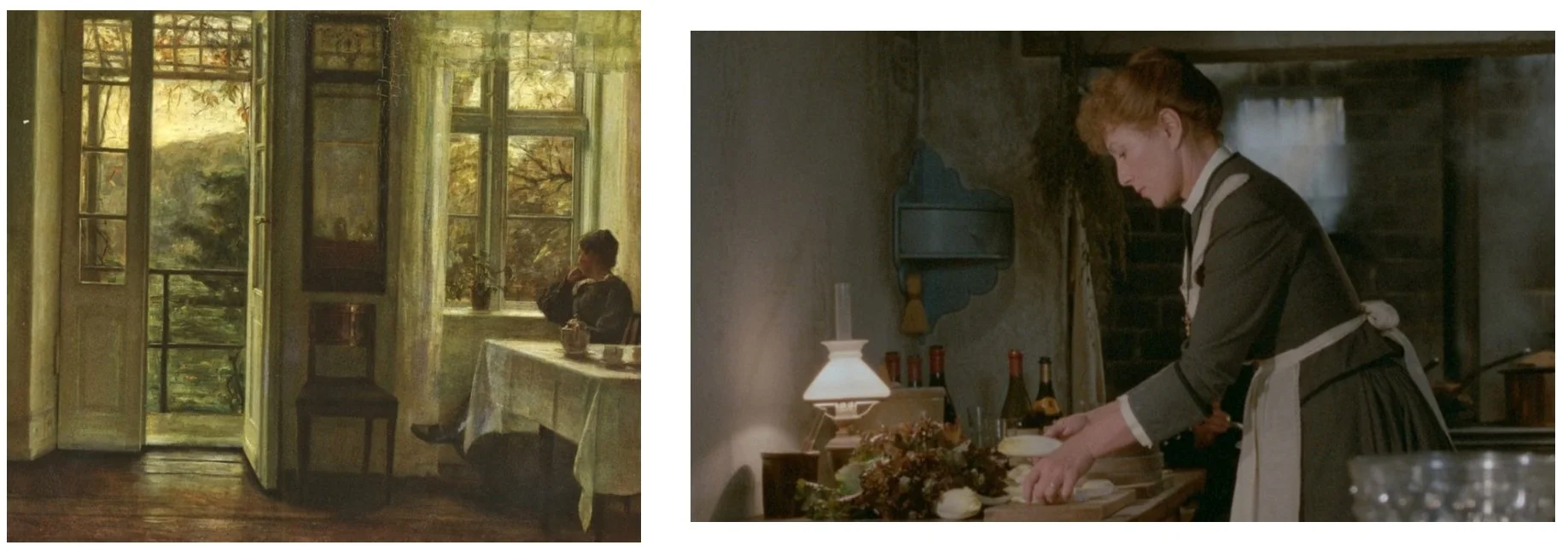
Left to right: Carl Holsøe, The Artist's Wife Sitting at a Window in a Sunlit Room, c. 1900. Babette in a small kitchen, working alone as light spills through the window onto table linens.
Images courtesy of WikiArt and IMDB.
There is a subtle gradation of light across domestic space. Babette is absorbed in quiet labour with a spiritualized everyday action. Doorways and window frames are part of the compositional geometry. Holsøe’s women perform silent devotion through routine, and Babette transforms that devotion into art.