Art of Advent Day 11
By Natascha Watt
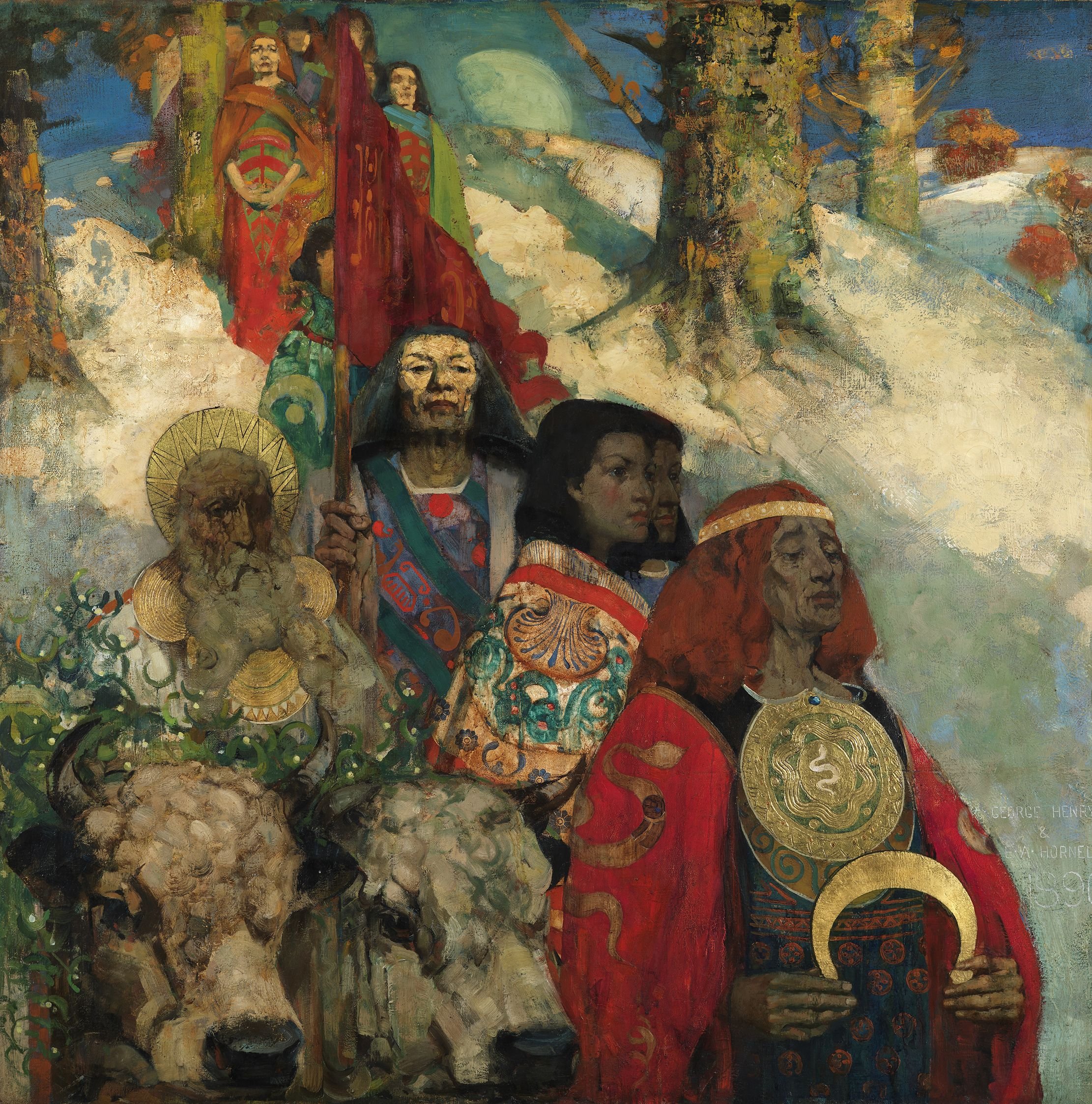
George Henry and Edward Atkinson Hornel, The Druids – Bringing in the Mistletoe. 1890. Oil on canvas. 152.4 x 152.4cm. Kelvingrove Art Gallery and Museum, Glasgow.
Image courtesy of Glasgow Museums.
Kissing under the mistletoe is a tradition that has been around for a while, but why do we do it? There is no singular origin for this tradition, but in the UK it is believed to have started during the eighteenth-century, truly gaining popularity in the nineteenth-century. Interestingly, a connection to Scotland’s history can be made through the mistletoe.
Indeed one of the origins of this tradition harks back to first-century Celtic druids who used the invasive plant (which cannot grow on its own, but has to grow on a host such as a tree) to make a sacred fertility elixir. This seems to be why it is now mostly used as an excuse for a kiss.
From the late 1880s in Scotland, artists looked back to Celtic history and Gaelic culture. Edward Atkinson Hornel (1864-1933), a Glasgow Boy, was one of them, interested in Scottish history, archaeology, and antiquities. This can be seen in The Druids – Bringing in the Mistletoe (1980) which he painted with fellow Glasgow Boy George Henry (1858-1943).
In the painting, this penchant for history is demonstrated in the robes, inspired by Pictish designs found on early carved stones in Scotland. Additionally, in his research and preparation for the painting, Hornel also studied druidical skulls and the Duke of Hamilton’s herd of ancient white cattle. Towards the end of the 1880s, both Henry and Hornel turned towards more symbolic and decorative imagery in their paintings, leaving traditional perspective behind, using rich colours and patterns. This is seen in The Druids – Bringing in the Mistletoe with its high horizon line that gives the painting a sense of flatness. The artists have also imbued the scene with a sense of sacred mysticism through their use of gold leaf over incised gesso, emphasising the composition’s rich ornamentation. The frame itself is decorated with a Celtic knotwork design.
In this scene, the Celtic priests or Druids walk down a snowy hillside in the moonlight, donning decorated robes. The mistletoe has been cut from the sacred oak, with the golden sickle held by the Druid leading the procession. It is carried on the back of two white bulls who will eventually be sacrificed.
Thus, one of the origins of this Christmas tradition can be found right here in Scotland. Druids considered the plant to have magical as well as medicinal properties, thinking it could cure infertility and be an antidote to poison.
Bibliography
Anderson, Sonja. “How Mistletoe Became a Christmas Kissing Tradition: The thorny origins of the yuletide canoodling ritual.” December 2024, Smithsonian magazine. https://www.smithsonianmag.com/history/how-mistletoe-became-christmas-kissing-tradition-180985450/.
Art UK. “The Druids: Bringing in the Mistletoe.” Accessed December 10, 2025. https://artuk.org/discover/artworks/the-druids-bringing-in-the-mistletoe-84452.
Glasgow Museums Collections Navigator. “The Druids – Bringing in the Mistletoe.” Accessed December 10, 2025. https://collections.glasgowmuseums.com/mwebcgi/mweb?request=record;id=695;type=101.
Newsround. “Why do people kiss underneath the mistletoe?” December 23, 2022, BBC. https://www.bbc.co.uk/newsround/16164453.