Art of Advent Day 10
By Dorothy Bigelow
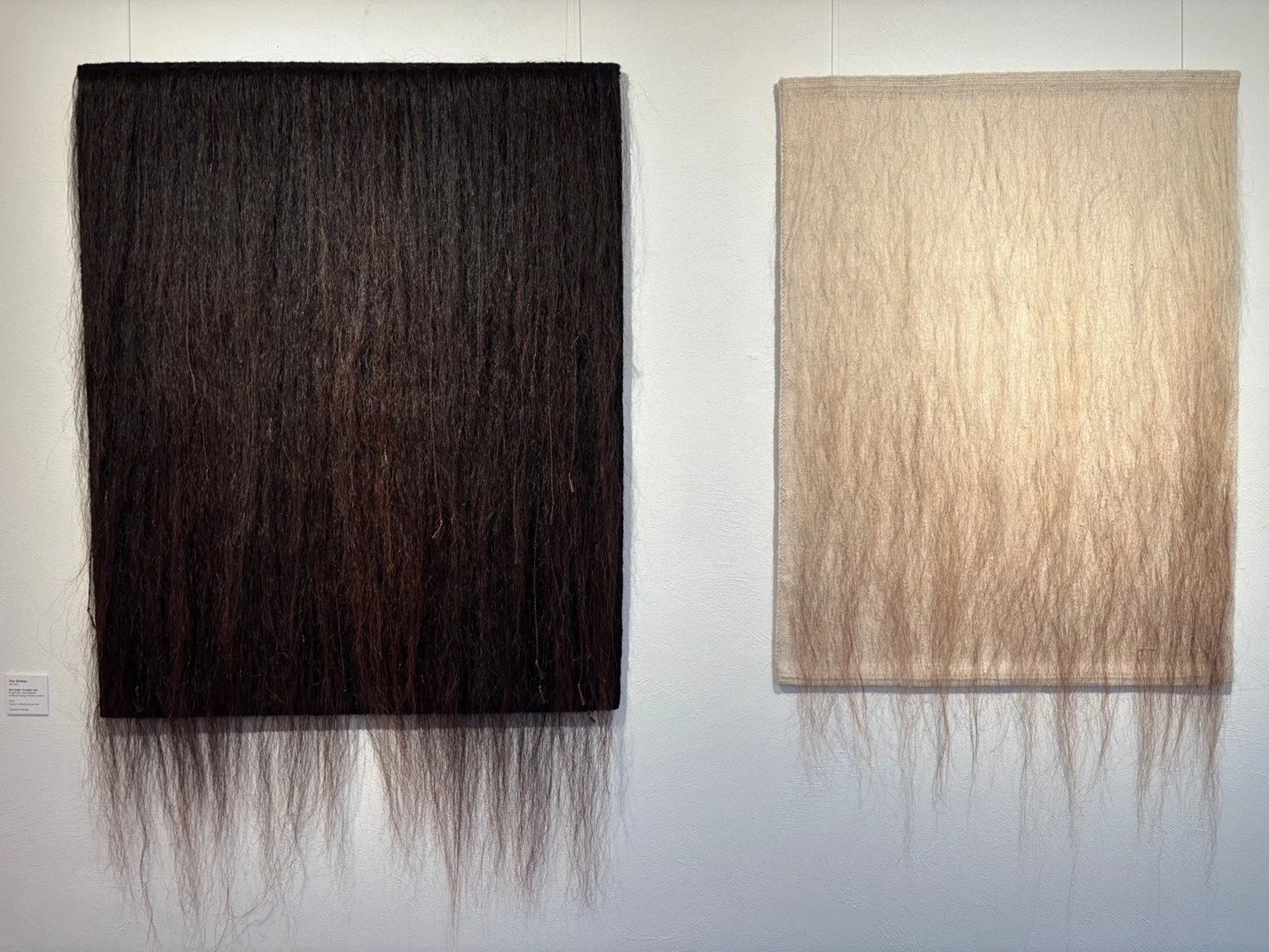
Left work: Tita Vinther, Ta. er tv.tt . hv.rjari .tt (The Black Sheep of the Family), 2011, Wool, horsehair, and copper, 176 x 110 cm, National Gallery of the Faroe Islands.
Right work: Tita Vinther, Sirm (Drizzle), 1993, Wool and horsehair, 127 x 96 cm, National Gallery of the Faroe Islands.
Image courtesy of the author.
Two bedraggled sheepskins hang on the wall, one cream and one dark. Even in their size and the burred texture, the patchy, almost fringe-like appearance of the yarn invites one to run a hand over the long staples (a technical term for spinners describing of the length of individual fibres, determining the properties of the wool). However, they also closely resemble the actual appearance of the rugged, unprocessed coats that sheep grow in wintery climates, bringing to mind the rugged, beating wind and cold, wet winter weather humans and sheep are insulated from by wool.
Despite these shaggy expanses of wool and horsehair being woven by Finnish-Faroese fibre artist Tita Vinther (1941-2019)—part of a series that spanned twenty years of her career—rather than naturally formed by the famous sheep that give the Faroe Islands their name, Sirm (Drizzle) (1993) and Ta. her tv.tt. Hv.rjari .tt (The Black Sheep of the Family) (2011) cannot be divorced from the natural world in their materials or their technical execution.
Vinther spent most of her life in Denmark studying weaving and other fibre crafts, before settling in the Faroe Islands, Europe’s most isolated archipelago, at nineteen. Here, textiles were not a fashionable or decorative embellishment or lesser applied art, but a life-line in an isolated community often at the mercy of the harsh storms of the North Atlantic. Textiles were a living craft that responded to the challenges of nature, marrying heritage techniques passed on over hundreds of years and practical innovation precisely because of their continued relevance to daily life.
For the next twenty years, Vinther apprenticed and studied various heritage textile crafts—knitting, weaving, net-making, and sail-making—imbuing her practice with a robust understanding of the materiality of her medium. Further, this gave her an expansive perspective on the capabilities of wool. These works bridge the gap between craft and fine art, allowing the technical and material processes of weaving to come to the fore. They animalistically recall sheep but also the labour of human hands, the naturalistic shifts and variegations in the hair’s tone adding depth to their large monochrome expanses, almost functioning like woolly Scandi Rothkos.
It is an oft-quoted idea that, in the Faroe Islands, art was a ‘comparatively recent phenomenon,’ growing alongside the emergence of the island’s fishing wealth that overtook the historic reliance on less-profitable wool exports. However, even in a place where colder months are associated with continued survival rather than cosy festivities, Vinther’s union of nature and craft reminds us that these concepts need not be so separate.
The wool in the ubiquitous jumpers and scarves seen on students leaving the library to brave the wind and rain on the count of three are part of a tapestry. This tapestry further connects Vinther’s boundary-pushing textile artwork to the historic craft of weaving and spinning that allowed this time of year to become tolerable and the sheep on the knolls on the banks of the Tay and cliffs of the Faroes , warm in their own winter coats.
Bibliography
Norman, David W. “Tita Vinther: Weaving the Monochrome.” Periskop: Færøsk kunsthistorie i dag, Forum for kunsthistorisk debat, Nr. 32, 2024. 85-93, 10.7146/periskop.v2024i32.150342.