
Art of Advent Day 14
By Natalia Ramirez
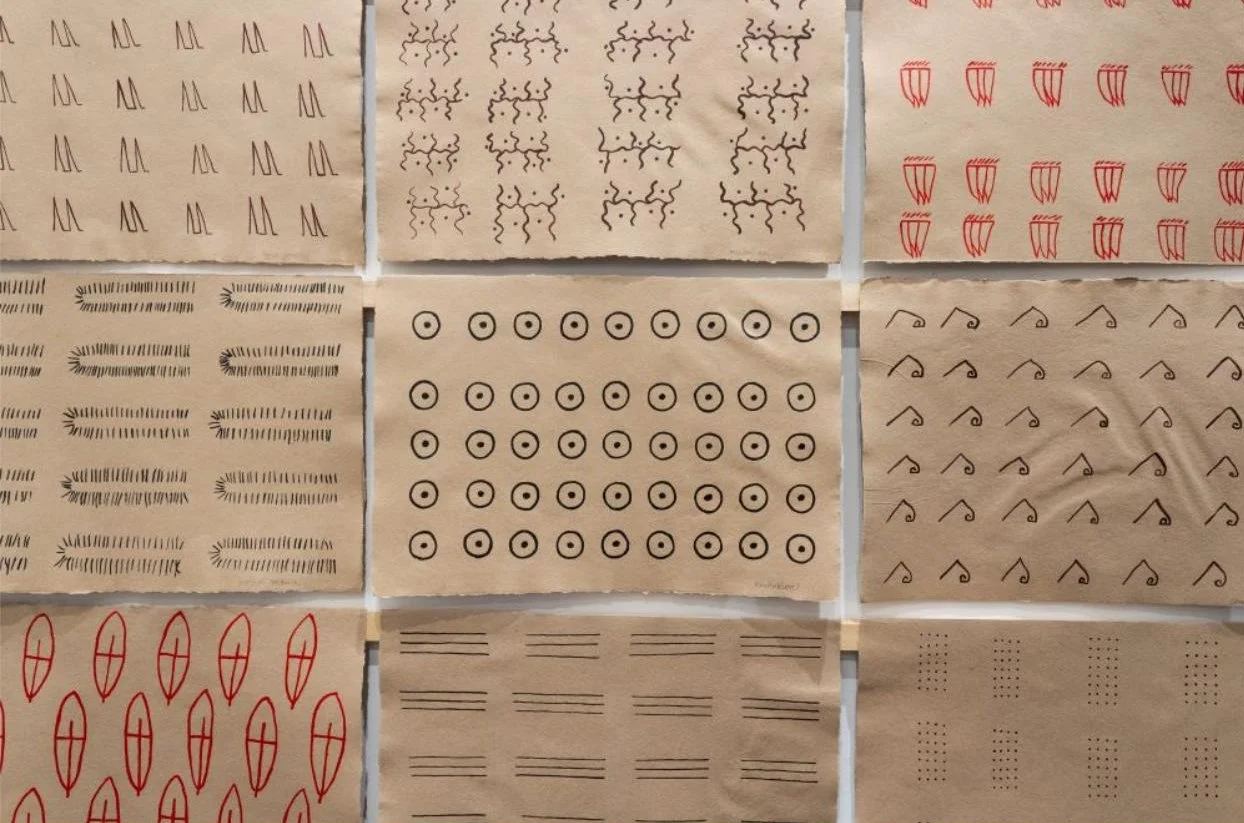
Sheroanawe Hakihiiwe, Kamie ya uriji pi jami Parawa ujame theperekui uriji ter- imi thepe komi kua (Where I live in my jungle and in the Orinoco river all these animals also live), 2018, Acrylic on 79 sheets of cane fibre paper, 35 x 51 cm each.
Image courtesy of Colección Patricia Phelps de Cisneros.
Reimagining the hemispheres through art, Latin American and Arctic artists forge unique visual and material dialogues that reorient translocal exchange as an important part of how we understand the Americas. Rather than treating the continents’ southern and northern regions as disconnected cultural peripheries, artists and curators remap aesthetic and political continuities from Tierra del Fuego to the circumpolar North. This perspective revives and reframes earlier landscape traditions, such as those explored in Picturing the Americas, that once used panoramic scapes to construct national imaginaries. Today, though, these landscapes become not just monuments of territorial pride but shared instances of curiosity about identity, belonging, and the conversations around colonial everpresence.
Deepening these hemispheric connections, contemporary projects actively convene Indigenous artists from the Amazon, the Andes, and the Arctic to explore how their communities navigate parallel histories of extraction, displacement, and cultural persistence. Projects like Bridging the Distance Between the Arctic and the Amazon brings together artists from Peru, Brazil, and northern Indigenous nations. The project emphasizes how rainforest and tundra peoples engage land as a living epistemology based on various ontologies. Through installations, performance, and collaborative research, these artists articulate that despite geographic distance, their cosmologies resonate in their emphasis on kinship, reciprocity, and the land’s agency in supporting and shaping human life.

Arctic/Amazon: Networks of Global Indigeneity, with works by Couzyn van Heuvelen, Uýra and Sheroanawe Hakihiiwe.
Photo by Henry Chan; Image courtesy of the Power Plant.
Expanding upon these ideas, exhibitions such as Arctic Highways: Unbounded Indigenous People challenge the numerous borders that have long segmented Native nations and aesthetic traditions throughout the Americas. By gathering circumpolar artists who contend with similar issues of modernization and resource extraction, the project recognizes how Indigenous practices (from weaving to carving to digital media) tend to ebb and flow across national boundaries. When considered in dialogue with Latin American and Amazonian works, these projects illuminate similar ways of resistance, healing, and environmental stewardship that refuse the isolation imposed by colonial cartography.
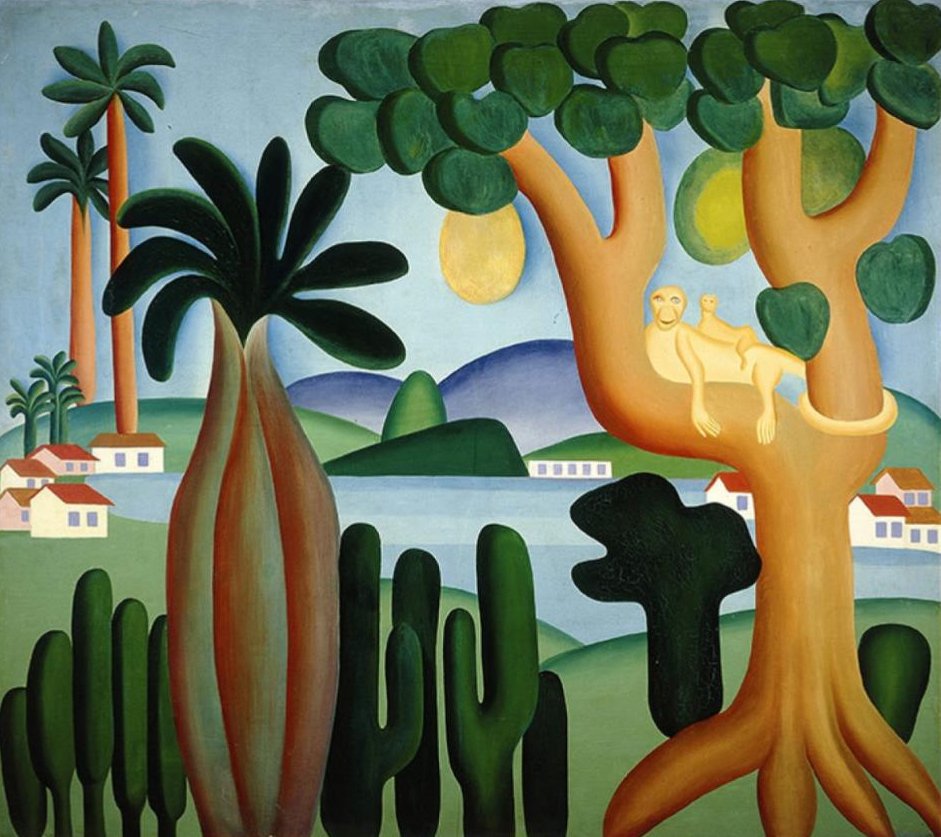
Tarsila do Amaral, Postcard, 1929. Private Collection, Rio de Janeiro.
Photo by Romulo Fialdini; Featured in Picturing the Americas: Landscape Painting from Tierra del Fuego to the Arctic
Ultimately, these transcultural exchanges orient the Americas not as a simple north–south dichotomy, but as a mobile series of Indigenous diplomacy, creative practices, and interconnected environments. By acknowledging collaboration across vast and often oversimplified geographies, artists craft a new visual and political dialogue that mediates often singular narratives of nationhood and identity. The result is a reimagined hemisphere where the Arctic and Amazon speak with one another clearly and purposefully, offering a more holistic mode for understanding the continents as shared, relational spaces proliferated by dialogue rather than division.
Bibliography
Arctic Highways: Unbounded Indigenous People. American Swedish Institute. Exhibition materials and curatorial texts, Minneapolis, MN, 2022–2023.
Bridging the Distance Between the Arctic and the Amazon. Inuit Art Foundation. IAQ Online. Accessed at: https://www.inuitartfoundation.org/inuit-art-quarterly/iaq-online/bridging-the-distance-between-the-arctic-and-the-amazon
Brown, K., and L. Mendoza de Arce (eds.). Picturing the Americas: Landscape Painting from Tierra del Fuego to the Arctic. New Haven: Yale University Press, 2015. Exhibition catalogue, Art Gallery of Ontario / Terra Foundation for American Art.
Arctic/Amazon: Networks of Global Indigeneity. Organized by the Power Plant Contemporary Art Gallery, Toronto, 2021. Exhibition and curatorial essays.
Amazonia Açu. Americas Society / Council of the Americas. Exhibition catalogue and curatorial texts, New York, 2023.
Schwartz, Martha, and Gerald McMaster. “Hemispheric Indigeneity and Transcultural Exchange.” In Indigenous Modernities, edited by Gerald McMaster. Toronto: Art Canada Institute, 2020.
McMaster, Gerald, and Nina Vincent (eds.). The North American Arctic: A New Modernity? Paris: Musée du quai Branly, 2017.