
Art of Advent Day 8
By Grace Liang
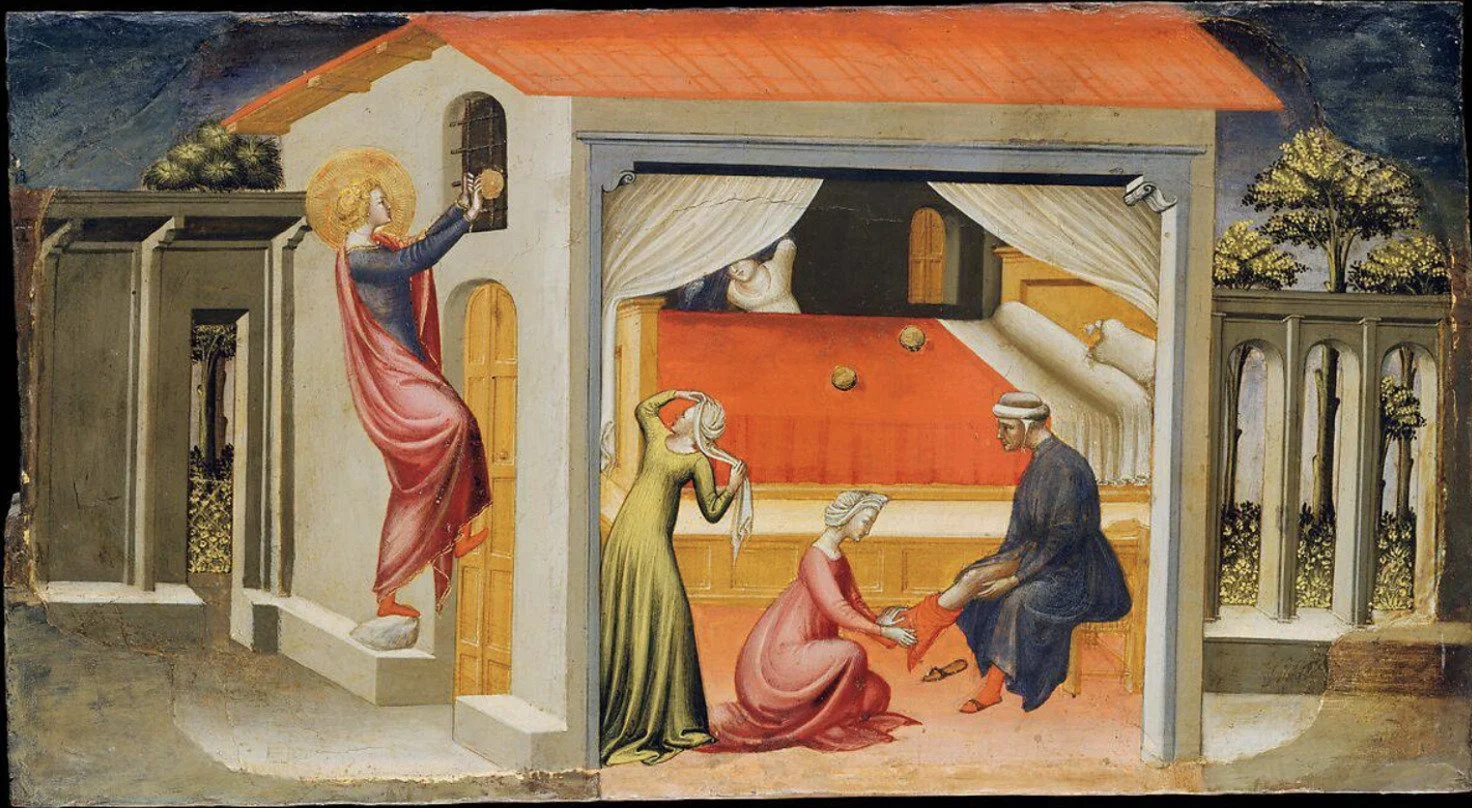
Bicci di Lorenzo, Saint Nicholas Providing Dowries, 1433-35, tempera and gold on wood, 30.5 x 56.5cm.
Image courtesy of The Metropolitan Museum of Art, New York City.
The Santa Claus that we know today is a jolly, white-bearded man in red who rides in his reindeer-pulled flying sleigh, delivering toys and gifts to children everywhere. Our concept of Santa has roots that can be traced back thousands of years to the fourth-century Greek Bishop, Saint Nicholas. In one especially popular legend, St. Nicholas is said to have secretly gifted a poor widower with the gold for the dowries of his three daughters to keep them from resorting to prostitution. As seen in this renaissance panel painting, the saint climbs up the side of the house to throw in three golden balls though the window, not far off from the Santa who climbs down the chimney to drop off his presents.
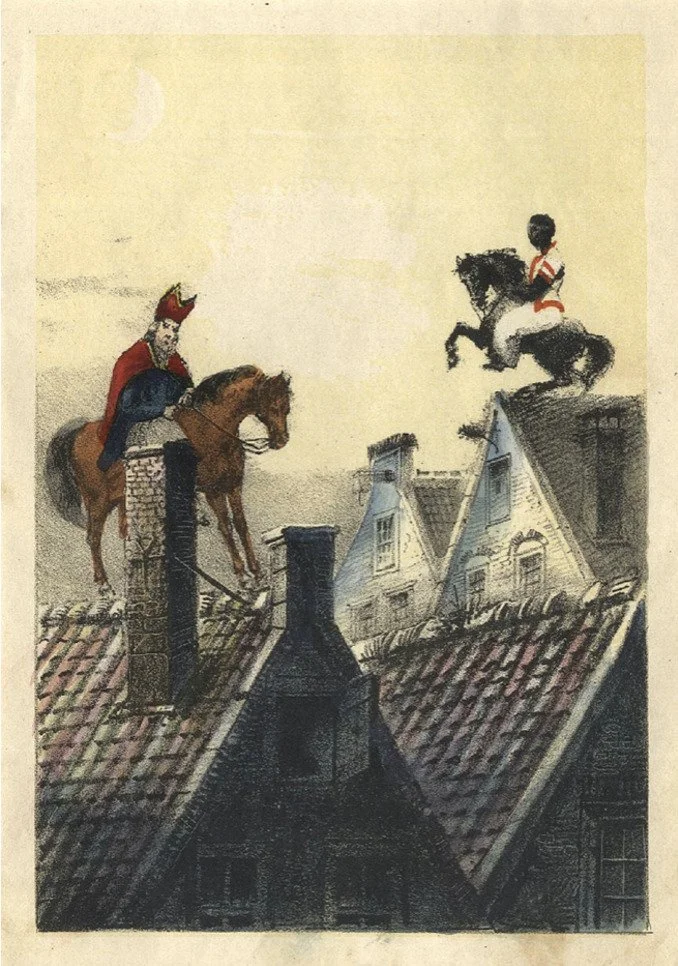
Jan Schenkman, illustration from Sint Nikolaas en zijn knecht, 1850.
Image courtesy of Project Gutenberg.
St Nicholas’s fame spread throughout Europe, arriving in what is now Belgium and the Netherlands. His name was translated to Sint Nikolaas which was abbreviated to Sinterklass. Sinterklass was portrayed as a stern, slim old man wearing red robes and the mitre of a bishop. It was believed that he would leave gifts in the shoes of good children on the night before December 6, St Nicholas’s Day. The image above comes from an 1850 children’s storybook titled Sint Nikolaas en zijn knecht, written by a Dutch schoolteacher named Jan Schenkman. In his illustration, Sinterklass can be seen in his bishop's garments riding a horse over the roofs of the Dutch houses.
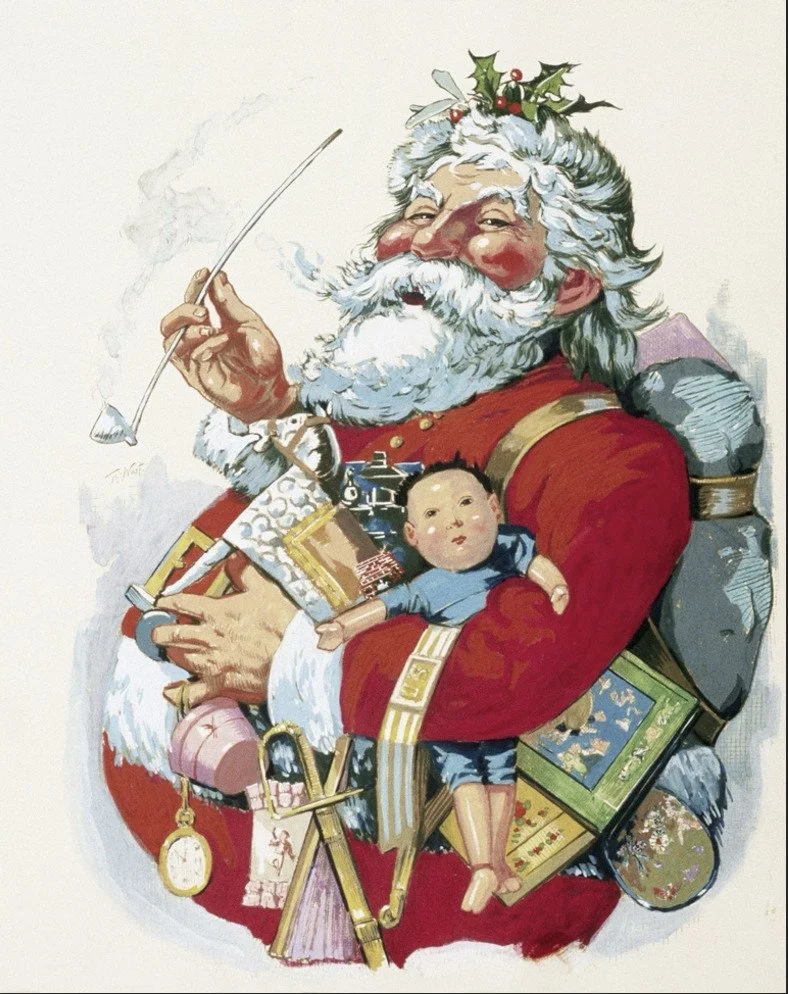
Thomas Nast, Merry Old Santa Claus, 1881.
Image courtesy of Wikimedia.
This Dutch tradition was spread to the new world through the colony of New Amsterdam, which we now know as New York. The retellings of this story evolved, and Sinterklaas was Americanised to Santa Claus. Early nineteenth-century New Yorkers introduced many of the most iconic Santa Clause trademarks as they exist today. The iconic red coat, the reindeer and sleigh, and the Christmas eve date all originate from an anonymous illustrated poem called ‘Old Santeclaus with Much Delight’ which was published in 1821. And just a few years later Clement Clark Moore published “A visit from St Nicholas” which we may know better as “The Night Before Christmas”. The cartoonist Thomas Nast is credited with practically inventing the image of Santa through his illustrations of the figure for Harper’s Weekly. His most famous depiction is “Merry Old Santa Claus” which was published on the first of January 1881. This is the most enduring version of Santa Claus, and though it is impossible to guess if and how the image of Santa will change over the next two thousand years, Nast’s Santa is the one who defined the childhood Christmases of the past five generations.
Bibliography
BBC News. “The Real Reason Father Christmas Wears Red and White.” December 24, 2018. https://www.bbc.co.uk/news/business-46619012.
Encyclopedia Britannica. “Santa Claus | History, Legend, & Facts,” December 4, 2025. https://www.britannica.com/topic/Santa-Claus.
Metmuseum.org. “Saint Nicholas Providing Dowries,” 2021. https://www.metmuseum.org/art/collection/search/435668.
Project Gutenberg. “Sint Nikolaas En Zijn Knecht by J. Schenkman,” November 20, 2022. https://www.gutenberg.org/ebooks/69396.