
Anna Waser (1678-1714)
By Mili Medwed
At only twelve years old, Anna Waser had already presented herself not just as a precocious child, but as an artist in her own right. In her Self-Portrait at the Age of Twelve (1691) she sits beside the easel, gazing back at the viewer. Born in Zürich on October 16, 1678, Waser grew up in a family that supported her artistic fervour. Recognising her skill from a young age, her father enrolled her in foreign languages, mathematics and calligraphy courses, which were quite atypical in content, though not unheard of for a woman of her background. She studied with Johann Georg Sulzer before travelling to Bern to work under the prominent painter Joseph Werner. Waser’s abilities developed within a network of people who recognised and encouraged them. At the same time, the opportunities available to her were somewhat unusual. Her early career therefore illustrates what exceptional talent could achieve, while also underscoring the advantageous economic circumstances that made such opportunities available to her.
Considering this, Waser’s self-portrait becomes all the more remarkable. Rather than depicting herself conforming to the usual scenes of female portraiture during this period (that is to say, sitting languidly, perhaps with a prayer book or a lap dog), Waser instead depicts herself in the position of the maker. Her palette and brushes identify her profession, whilst her gaze conveys confidence and self-assurance. Indeed, this confidence is not unfounded, for twelve-year-old Waser is among only two women artists during this period - Gentileschi and Leyster - to style herself in such a way. Seated beside the easel, she shows off her work to the viewer, who thus becomes a visitor in her private studio. In portraying her teacher, she demonstrates not only her technical ability, but also her position within an artistic lineage. In this way, roles reverse. Although Sulzer was the established artist from whom she learned, he becomes her subject. This may be read as an assertion of meritocracy: in an artistic sphere where a veritable hierarchy of male artists existed, and their female counterparts were benevolently excused from attaining the heights of greatness they otherwise deserved, Waser does not shy away from presenting her artistic prowess.
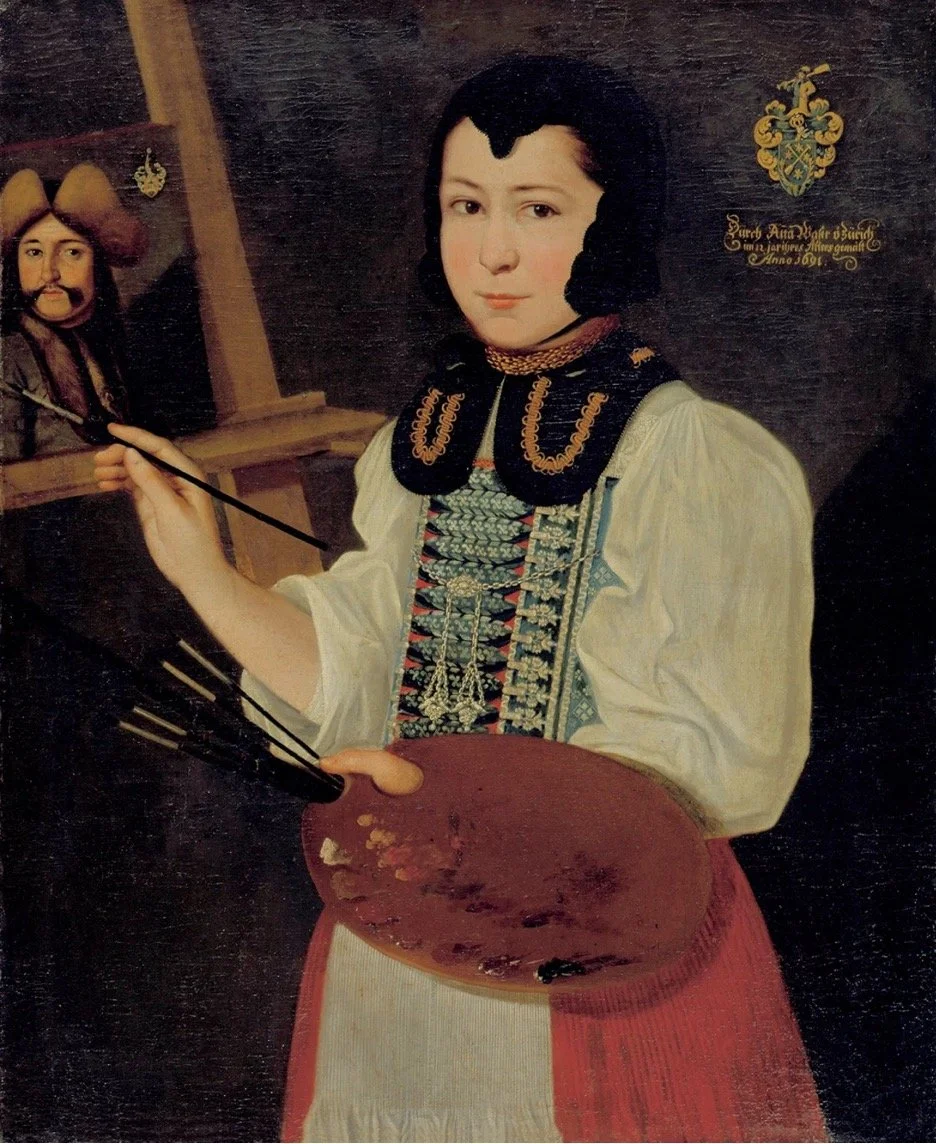
Anna Waser, Self-portrait at the age of Twelve, painting the likeness of her teacher Johannes Sulzer (1691), oil on canvas, 83 x 68 cm, Kunsthaus Zürich. Image courtesy of Kunsthaus Zürich
As art historian Frances Borzello suggests, women artists had to negotiate the conflicting expectations society placed on women and on professional artists. While women were expected to embody femininity and modesty, Waser’s self-portrait emphasises her artistic ability without abandoning her identity as a young girl. By presenting herself as both palpably feminine and capable, she challenges the idea that these identities are in some way contradictory. Her portrait therefore becomes an assertion of her identity.
Waser’s position within art history raises similar questions surrounding the memory and recognition of women artists within the canon. In her discussion of Waser and Maria Sibylla Merian, Seehafer notes that Johann Caspar Füssli’s Geschichte und Abbildung der besten Mahlern in der Schweitz gave independent entries to only two women. Although he included Waser among the leading artists of Switzerland, he highlighted how unusual it was for women to receive such recognition. Waser’s talent enabled her to establish a professional career, though her opportunities and subsequent recognition existed within a male-dominated artistic culture, thus limiting her greatness to a margin that was deemed appropriate for her sex. Her self-portrait can therefore be understood not only as a presentation of artistic prowess, but also as a piece which implies a wider struggle for women’s place in art history.
Waser’s later career gives this early self-portrait additional significance. Following its completion, Waser continued her training under Joseph Werner, becoming the only known woman to study at his drawing school in Bern. In 1700, she became court painter to Wilhelm Moritz of Solms-Braunfels, establishing a professional career beyond her initial training. Her later achievements therefore suggest that the precocity conveyed in the portrait was not merely an artistic exercise. Nevertheless, her relative obscurity today raises a further question about how women’s contributions to art have been remembered, and indeed whose achievements have been selected for recognition.
What makes her portrait so compelling, then, is the tension between her subject and her circumstances. A twelve-year-old girl in seventeenth-century Switzerland was not a probable candidate for a professional artistic career. Yet Waser uses the conventions of self-portraiture to imagine that future. Even today, her confident gaze commands the viewer to question why her success would ever be implausible.
Bibliography
Borzello, Frances. Seeing Ourselves: Women’s Self-Portraits. New York: Harry N. Abrams, 1998.
Seehafer, Michèle. ‘Waser and Merian – Two Trailblazing Female Artists of the Baroque Era.’ Swiss National Museum (Swiss History Blog), January 9, 2023. Accessed October 6, 2026.
Google Arts & Culture ‘Self-Portrait at the Age of Twelve – Anna Waser.’. Accessed October 6, 2026. https://artsandculture.google.com/entity/anna-waser/m05p2n9n
Grove Art Online. ‘Waser, Anna.’ Accessed October 6, 2026. https://www.oxfordartonline.com/groveart/display/10.1093/gao/9781884446054.001.0001/oao-9781884446054-e-7000090759