Alberto Giacometti (1901-1965)
By Annabel Van Grenen
Born in Switzerland on 10 October 1901, Alberto Giacometti was to become one of the most influential and recognisable sculptors of the modernist age. His father, a post-impressionist painter, instilled in him an artistic curiosity throughout his upbringing, so much so that he created his first painting and bust, respectively, at age fourteen. Sculpture proved to be a lifelong endeavour for Giacometti, and the human figure in particular fascinated him endlessly. After moving to Paris in 1922 to study at the Académie de la Grande Chaumière, he joined the Surrealist movement, led by André Breton, in 1931. His days were taken up by all-consuming work, paired with socialising in the Left Bank and Montparnasse, before he returned home to resume his diligent work.
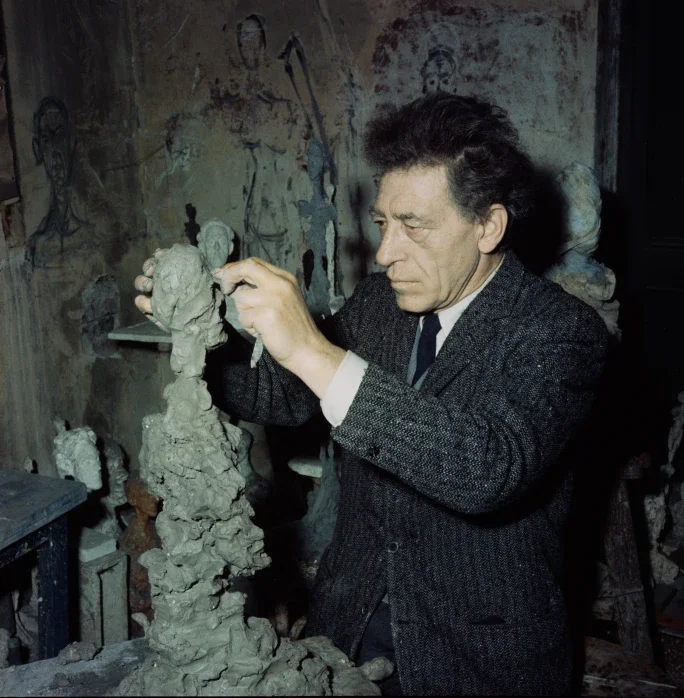
Alberto Giacometti at work on a sculpture in his studio. France, 1958. Image courtesy of Paul Almasy/Corbis/VCG via Getty Images
Beyond encapsulating the human figure, Giacometti's aspiration seemed to be to capture the very essence of his subject, not necessarily its visual verisimilitude, but who they really are. This is one of the reasons why the thin figures he developed after his departure from the Surrealist movement in 1935 are so fascinating. Despite their androgynous anonymity, he had close relationships with his models, one of whom was his brother Diego. The iconography of these sculptures, with their extreme thinness, elongated limbs and scales ranging from a teaspoon to life size, has become quintessentially Giacometti.
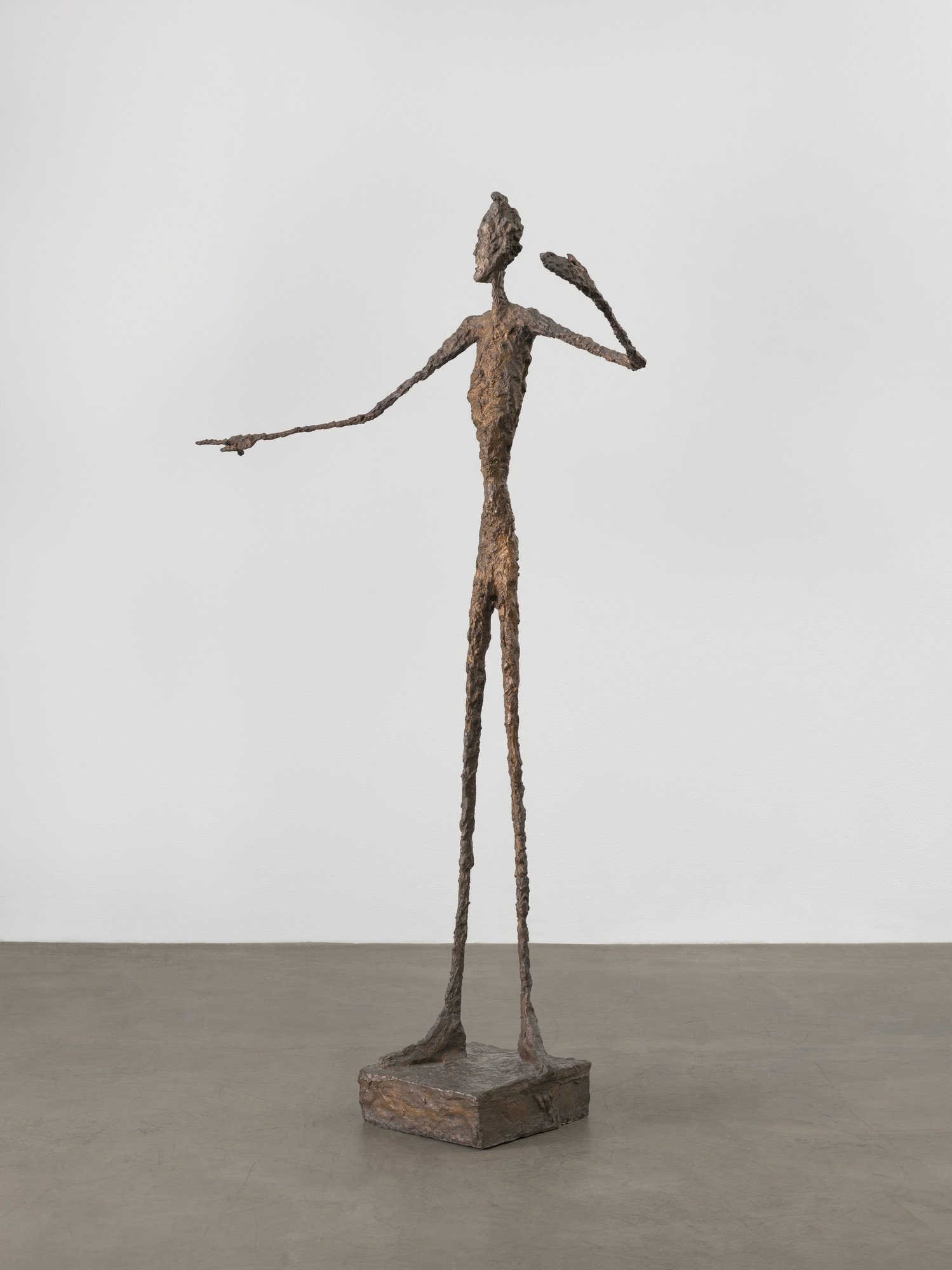
Alberto Giacometti, Man Pointing ,1947, 1780 x 950 x 520 mm, Tate Gallery. Image courtesy of https://www.moma.org/collection/works/81779
His 1947 Pointing Man, for example, captures his iconic style. Giacometti's hand is visible in the moulding of the work, adding an oddly personal familiarity. Despite its ostensible frailty, it stands with assurance and points with confidence, perhaps beckoning us closer. What is it pointing towards? Life after WW2, maybe? Who is it addressing? We are invited to question the figure. In a 2017 Guardian article on Giacometti's retrospective at the Tate, Jonathan Jones writes that "He gives the modern condition the grandeur of myth." Whilst art and myth have a long-standing relationship, traditional bronze representations of mythology are more likely to take the form of Benvenuto Cellini's Perseus with the Head of Medusa, a stoic hero, than an unidentified, twig-like silhouette that at times almost seems to disappear when viewed in the round. To choose a medium charged with historical prominence and gravitas, and to reduce it to its bare bones, all in the pursuit of humanity, is incredibly effective. Its leanness brings us into the work and makes viewers aware of their own standing in relation to the figure, as Reinhold Hohl states in the Guggenheim's retrospective on Giacometti.
Space was vital to the artist, as is most evident in his multi-figured works. His 1948 City Square, for example, places five spindly figures on a bronze slab. Again we are bombarded with questions: what does this formation mean, and are these figures related? It recalls a quote of Giacometti's: "In the street people astound and interest me more than any sculpture or painting. Every second the people stream together and go apart, then they approach each other to get closer to one another." This stranger's waltz is presented to us in a dynamic work, with seemingly separate figures existing within each other's space, almost seeming to move. Hohl describes them as in "the condition of being always on their way." They remain perpetually frozen in medias res, always on the brink of movement. Observed close up, their scale is undefinable, appearing as either clay dolls or otherworldly giants. There is a slight disturbance in their appearance: they are uncanny in their lack of human facial features and their unusual thinness, yet they are shaped with an undeniably human form. Perhaps this makes it easier for viewers to project themselves onto the work. Whichever direction the man is pointing, or wherever the figures are walking, is ultimately up to the viewer.
For Giacometti, this path meant working until his death in 1966. Since then his work has only increased in value and regard, displayed in prominent galleries globally and consistently fetching high prices. His Pointing Man, for example, ended up indicating the direction of US$141 million, the amount for which it sold in 2015, elevating an unidentified figure, reflected in every viewer, to the realms of high art.
This begs the question: where is he pointing you?
Biography
Biggs, Lewis, and host institution Tate Gallery Liverpool. Alberto Giacometti : The Artist’s Studio / [Edited by Lewis Biggs]. Edited by Lewis Biggs. Tate Gallery, 1991.
Foundation Giacometti. “Alberto Giacometti: Biography.” Fondation Giacometti. Accessed October 5, 2026. https://www.fondation-giacometti.fr/en/biography
Jones, Jonathan. “Giacometti Review – a Spectacular Hymn to Human Survival.” The Guardian, May 8, 2017. https://www.theguardian.com/artanddesign/2017/may/08/giacometti-tate-modern-london-reviewciteturn0view0
Lucas, Tamara. “Giacometti’s Gaze.” The Lancet 387, no. 10014 (2016): e6–e7. https://doi.org/10.1016/S0140-6736(15)01363-X.
The Solomon R. Guggenheim Museum. Alberto Giacometti: A Retrospective Exhibition. New York: Solomon R. Guggenheim Museum, 1974.