Annie Leibovitz (1949-Present)
By Audrey O’Rafferty
It can be difficult to imagine that, before the advent of platforms like social media, the world of celebrities was set at a distance from the public and largely mediated through magazines. It was from this glossy-paged world that photographer Annie Leibovitz began curating the illusion of intimacy with her subjects long before our 'For You' pages began attempting to.
Born on 2 October 1949 in Connecticut, Leibovitz didn't pick up a camera until she attended the San Francisco Art Institute in the early 1970s. Her career in the magazine world began in 1970 after she submitted a portfolio to Rolling Stone. She was formally hired in 1971 and promptly rose to Chief Photographer by 1973. After Rolling Stone, Leibovitz went on to work for Vanity Fair and Vogue, the latter of which she continues to work for as a freelancer. Within these publications, she immortalised many celebrities and solidified some within the canon of popular culture.
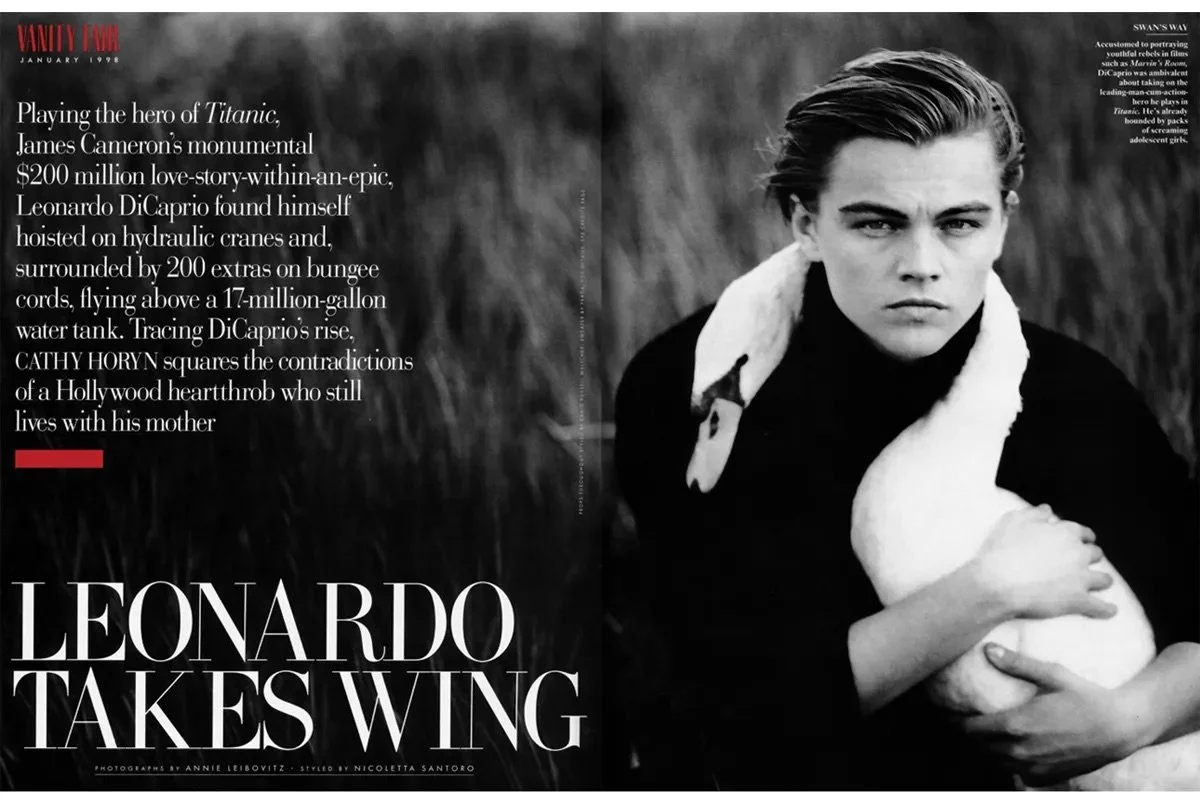
Annie Leibovitz, Portrait of Leonardo DiCaprio, 1998, photograph. Image courtesy of Vanity Fair.
Take her 1998 portrait of Leonardo DiCaprio for Vanity Fair. The black-and-white composition presents a distinctive air of melodrama, while the swan and DiCaprio cling to one another almost like lovers. With his slightly furrowed brow and pursed lips, DiCaprio exudes all the moodiness and angst one would expect from an era-defining heartthrob. Both his features in Vanity Fair and his starring roles in films like Titanic, Romeo + Juliet and The Basketball Diaries certainly produced him as a digestible figure of late 1990s and 2000s popular culture. Despite this, the way Leibovitz has DiCaprio gaze so forthrightly at the lens creates a vulnerability that perhaps seeks to strike us with his humanity even amidst his immense stardom.
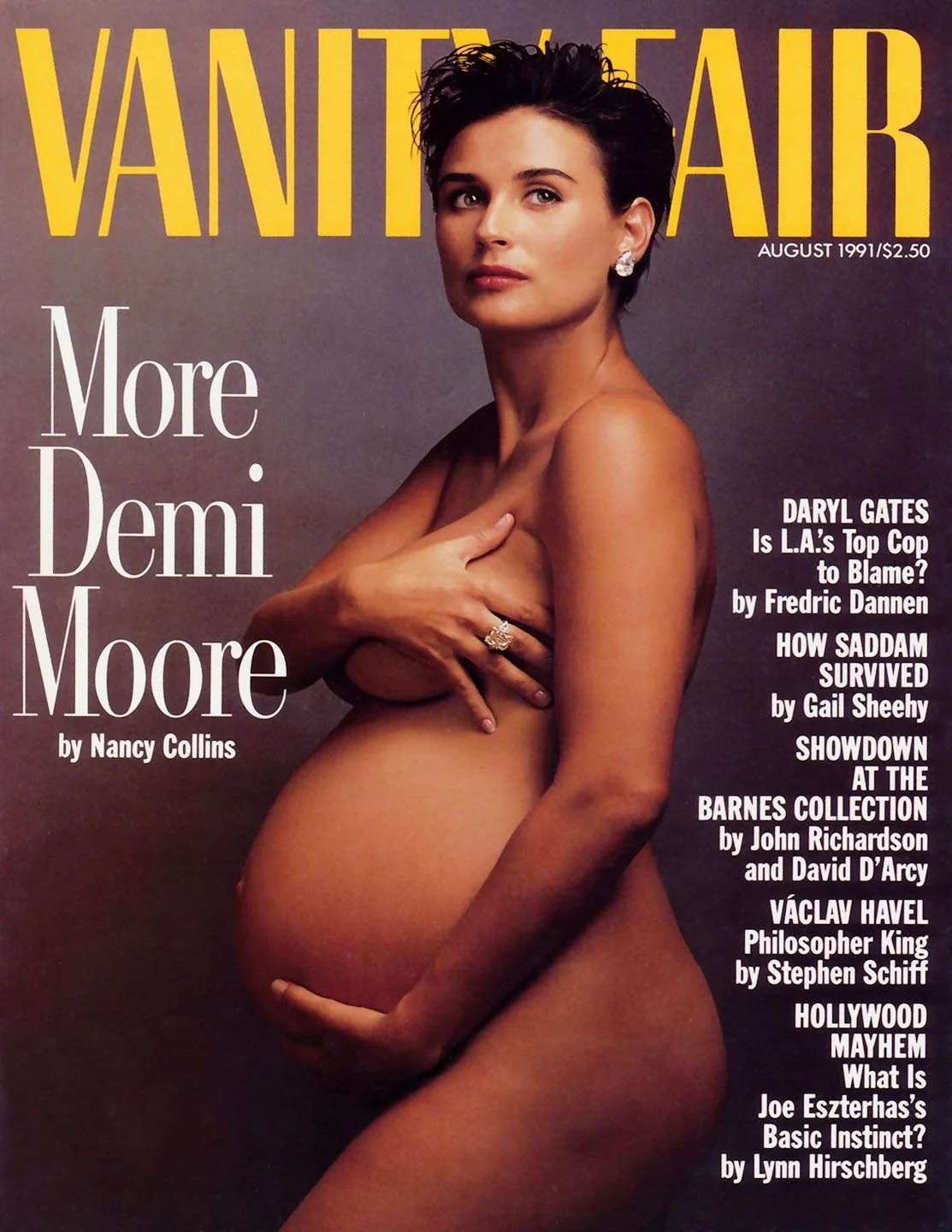
Annie Leibovitz, Portrait of Demi Moore, 1991, photograph. Image courtesy of Vanity Fair.
Beyond capturing icons of popular culture, Leibovitz's photography proved to be a device for changing it. Magazine covers depicting the often nude bodies of pregnant celebrities, such as Britney Spears for Harper's Bazaar in August 2006, feel somewhat normal today. But when Leibovitz shot Demi Moore nude and seven months pregnant for the August 1991 issue of Vanity Fair, many vendors refused to sell it, while those who did wrapped it in opaque cellophane to conceal its supposed vulgarity and indecency. Nevertheless, it sold over a million copies. Moore's adornment with a large diamond ring and earring suggests that pregnancy can be glamorous. This, combined with her poised upward gaze, imbues Moore with a graceful and dignified demeanour. The saturated composition gives Moore's skin an ethereal glow that highlights her pregnant stomach and can be read as an assertion that pregnancy should be celebrated.
Leibovitz's portraits of DiCaprio and Moore can give one the impression that we are sharing an intimate moment with these celebrities, whether through a piercing gaze or the vulnerability of nudity. This makes it easy to forget that both were editorial shots, carefully posed and selected for publication. The careful construction of the images is reinforced by Leibovitz's reputation for perfectionism on set, as she often takes hours to be satisfied with a shot.
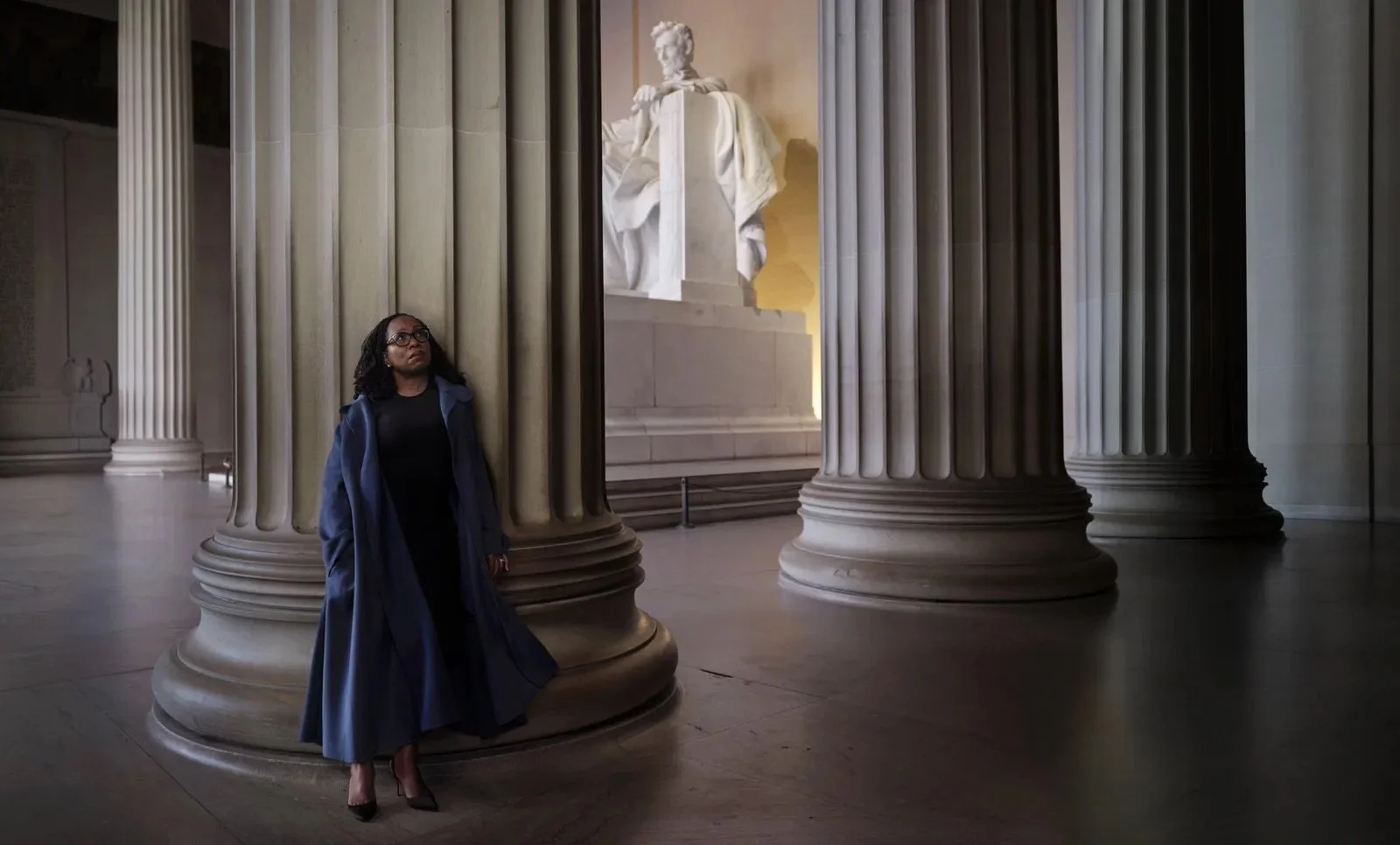
Annie Leibovitz, Standing Tall, 2022, Photograph. Image courtesy of Vogue.
Though Leibovitz's photographs have been widely celebrated, her work is not immune to controversy. Her 2022 Vogue shoot of US Supreme Court Justice Ketanji Brown Jackson exemplifies the widespread scrutiny the photographer has faced for her portrayal of Black women. Critics have noted that the statue of Abraham Lincoln lingering behind Jackson perpetuates a 'white saviour narrative', as Lincoln is the president most associated with US abolition. A broader critique of Leibovitz's portraits of Black women is that her compositions dull and darken the skin. Historically, there are many instances of the US media intentionally darkening photographs of Black individuals to make them appear more menacing. It has been speculated that Leibovitz did not intend to vilify Brown Jackson, but rather that the choice of dark lighting inadvertently associates the photographs with this racist pictorial tradition.
Over her five-decade career, and across the three publications she has worked for, Leibovitz has produced hundreds of covers. Now in her seventies, she continues to work, once stating, 'Photography is not something you retire from.' It is intriguing to imagine the ways Leibovitz's lens will continue to interact with Western popular culture.
Bibliography
Bero, Tayo. ‘Annie Leibovitz proves yet again: she can’t photograph Black women.’ The Guardian, August 23, 2022. https://www.theguardian.com/commentisfree/2022/aug/23/annie-leibovitz-ketanji-brown-jackson-vogue-photos.
Goldman, Andrew. ‘How Could This Happen to Annie Leibovitz?’ New York Magazine, August 12, 2009. https://nymag.com/fashion/09/fall/58346/.
Hauser & Wirth. ‘Annie Leibovitz.’ Accessed September 26, 2026. https://www.hauserwirth.com/artists/24984-annie-leibovitz/.
Pridmore-Brown, Michele. ‘Annie Leibovitz’s Queer Consumption of Motherhood.’ Women’s Studies Quarterly 37, no. 3/4 (2009): 81–95. http://www.jstor.org/stable/27740576.
Ramzi, Lilah. ‘In a New Volume Out This Fall, Annie Leibovitz Revisits Her Women.’ Vogue, June 10, 2025. https://www.vogue.com/article/annie-leibovitz-women-book-2025.