Paul Delvaux (1897-1994)
By Josh Warnock
Born in Antheit, Belgium in September of 1897, Paul Delvaux trained initially in architecture before turning to painting at the Académie Royale Des Beaux-Arts in Brussels. Though known chiefly for his Surrealist and Expressionist styles, he first worked in an Impressionist vein. We observe this decisive shift during the 1930s following an encounter with the work of Giorgio de Chirico, and through his friendship with René Magritte, towards the broader surrealist movement. Alongside recurring fascinations with classicism, memento mori, and nudity, Delvaux possessed the core vocabulary he would use for the rest of his six-decade career. Unlike the distortions or the visual puns of surrealist contemporaries, Delvaux's Surrealism is quiet, contemplative and statuesque. Semi-nude women often stand motionless in architectural dreamscapes - a grammar which, together with a boyhood fascination with the railway, would remain in his scenes for the remainder of his six-decade career.
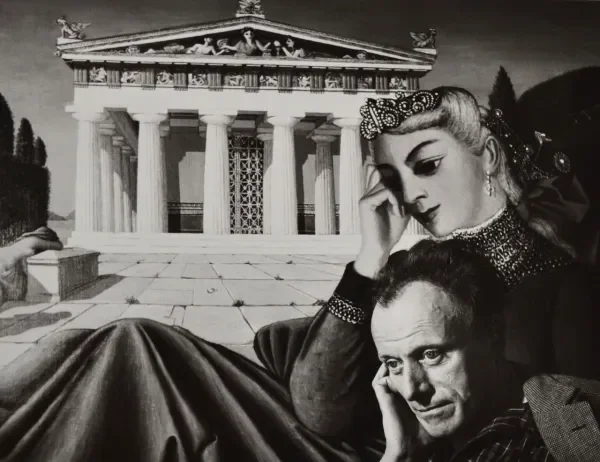
Image courtesy of ‘On This Date Photography’
Of equal consequence was Delvaux’s visit to the Musée Spitzner (circa 1932), a Parisian itinerant cabinet of anatomical waxworks. An experience that furnished Delvaux with the enduring visual of the body displayed immobilised and lit as a specimen rather than as a subject in motion. This Grammar finds full expression in Sleeping Venus (1944), foremostly in that it shares its name with a mechanism found at the Spitzner. Here a recumbent nude Venus reclines in a moonlit Plaza flanked by Grecian temples. A skeleton, and a cluster of onlooker’s arrest in postures of alarm or lamentation, rendered in a glacial palette of greys and blues under raking theatrical light. The titles invocation of Venus sees no obscurity in its depiction. Delvaux joins two registers of the deity that convention opposes: the erotic figure on display, inherited from the Spitzner’s own waxen Venus, whose mechanical breathing blurred the line between medical instruction and voyeuristic spectacle. Contrasted with the votive, sacred figure of classical devotion elevated upon an altar. Delvaux’s Venus is thus offered to the viewer’s gaze in the manner of an anatomical specimen even as she is composed with the frontal stillness of a cult image awaiting veneration. The onlookers suggest a rite performed before a goddess who is simultaneously a corpse under glass, as she is desire and devotion collapsed into one.
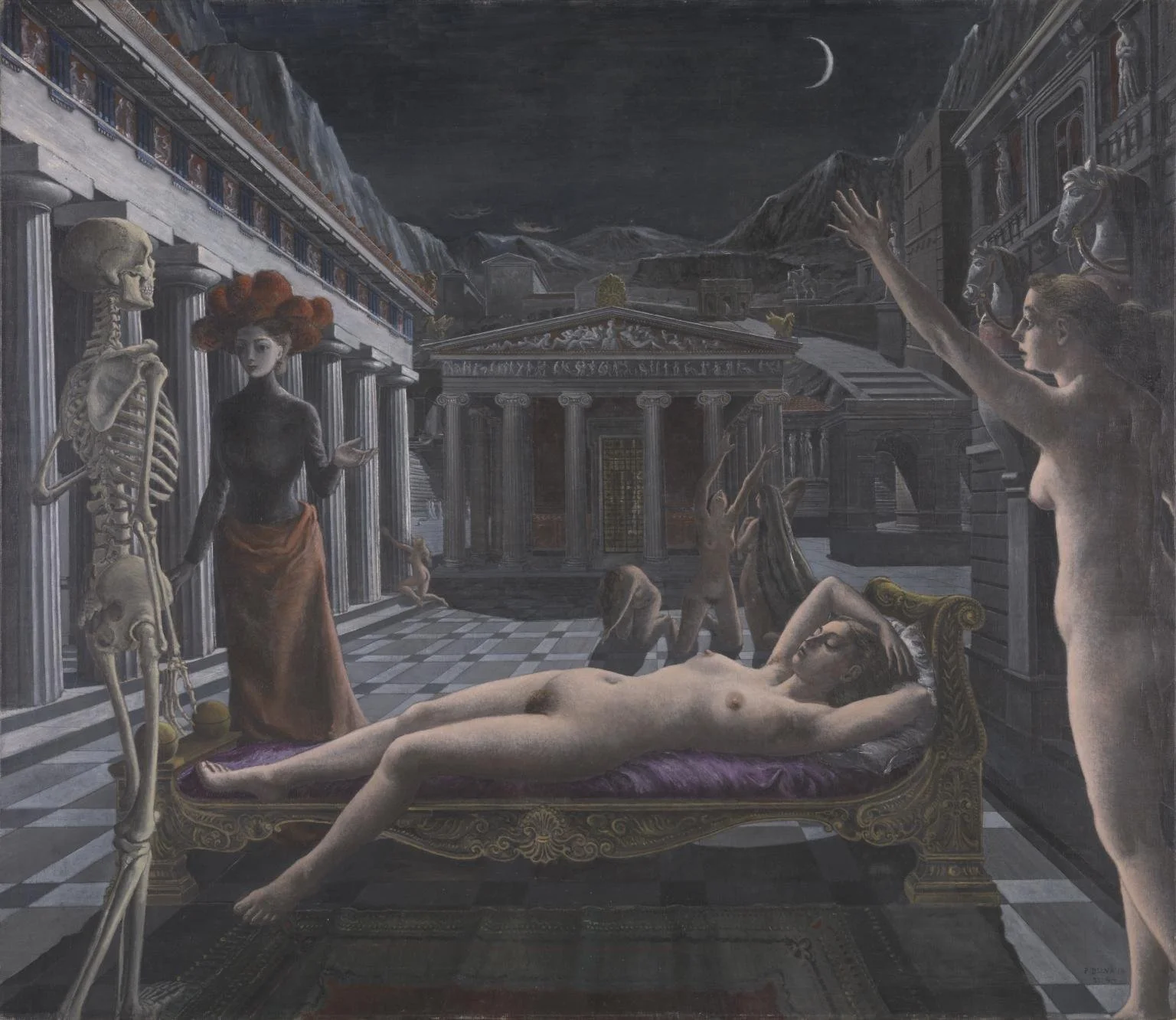
Paul Delvaux, Sleeping Venus, 1944, oil on canvas, 172.7 × 199.1 cm, Tate, London. Image courtesy of the Tate
Delvaux fascination with railway achieves its most considered treatment almost two decades on, in Le Viaduc,(1963), by which point Delvaux had long been established as a central figure of Belgian Surrealism. The composition diaphanously situates a spectre of modernity – the steam locomotive- upon a gilded mirror framing a table lamp. The inanimate quality of the background buildings with their small, illuminated windows provokes the effect of a set display. The silence within the scene, especially so without the presence of humans, proves as disquieting as the frozen presence of Sleeping Venus’ votive figures. For in some way, this scene is equally as frozen. Interrupted perhaps by the whistle of a passing locomotive, or the flickering of the lights – though all of which are forever suspended. In the mirror’s reflection, we are offered a glimpse into an obscurely placed table lamp. The reflection is placed in such a way as to reveal this symbol to us, though its message is of course, unclear. I however, find it best to resolve it as a glimmer of home against the austere reality of modernity.
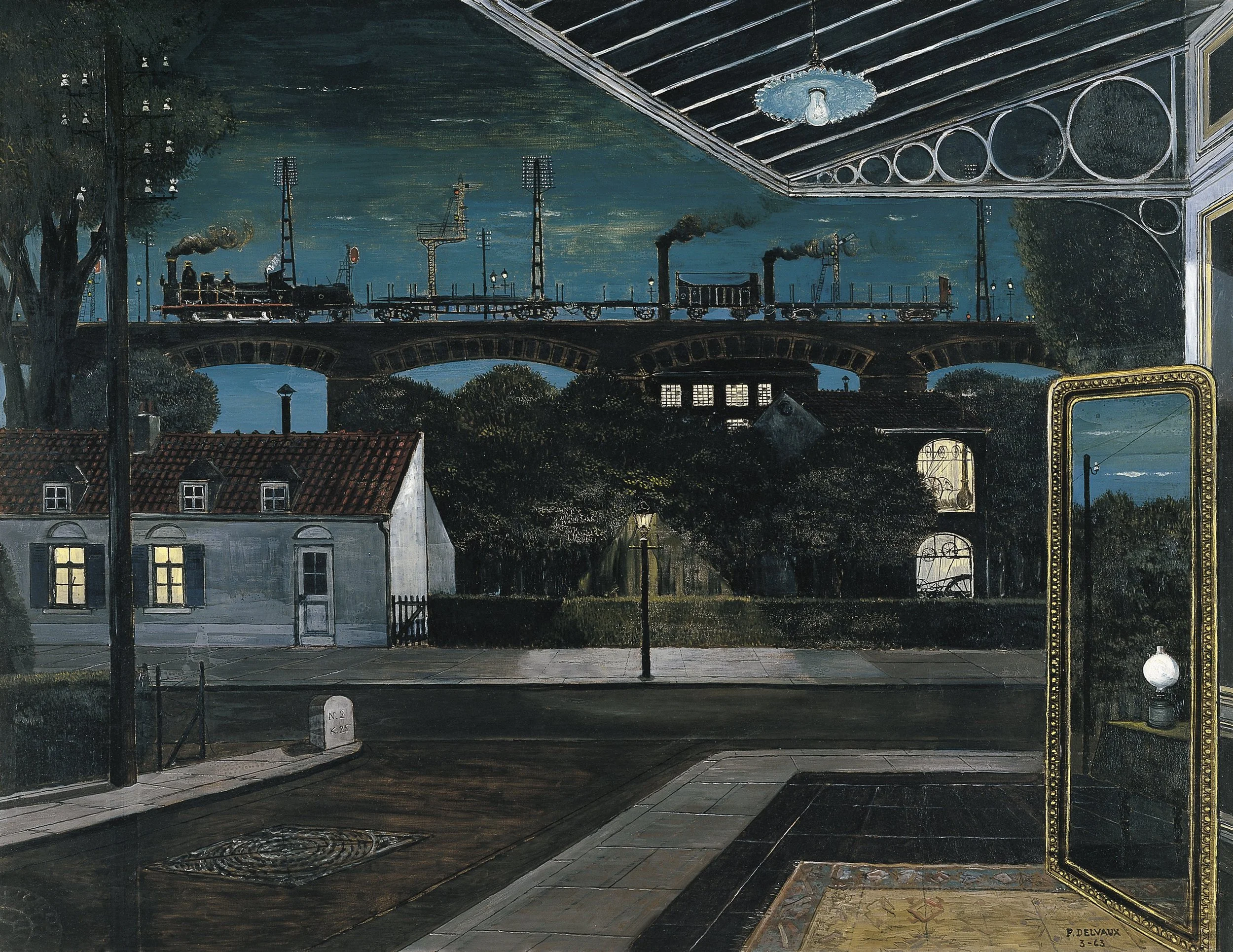
Paul Delvaux, Le Viaduc, 1963, Oil on canvas, 100.3 x 130.8 cm, Carmen Thyssen Collection. Image courtesy of Thyssen-Bornemisza National Museum.
Read across the arc of a career that began in conventional modes and settled, by the 1930s, into an idiom scarcely altered thereafter, these two canvases – separated by nineteen years and by an intervening world war – illuminate the paradox of Delvaux’s Surrealism. A pictorial universe where opposites are linked: dread and eroticism, antiquity and modernity, and are suspended rather than resolved. wherein the uncanny is pronounced through the excess of stillness, and the harsh clarity thereof.
Delvaux sustained this vision with remarkable consistency until his death in Veurne in 1994, by which time a museum devoted to his work had already been established at Sint-Idesbald in 1982. A fitting institutional monument to an artist whose practice was in its way, an act of monumentalising the subconscious.
Bibliography
Museo Nacional Thyssen-Bornemisza. ‘The Viaduct.’ Accessed September 21, 2026. https://museothyssen.org/en/node/17458.
Museo Nacional Thyssen-Bornemisza. ‘Paul Delvaux: A Walk with Love and Death.’ Accessed September 21, 2026. https://www.museothyssen.org/en/node/16443.
Museum Digital. ‘Paul Delvaux.’ Accessed September 22, 2026. https://global.museum-digital.org/people/214825.
Ordovas Art. ‘Paul Delvaux.’ Accessed September 23, 2026. https://www.ordovasart.com/artist/paul-delvaux/
Butor, Michel, Jean Clair, and Suzanne Houbart-Wilkin. Delvaux. Brussels: Cosmos Monographies, 1975.
De Bock, Paul-Aloïse. Paul Delvaux: L'Homme, Le Peintre, Psychologie d'un Art. Brussels: Laconti, 1967.