José Sabogal (1888-1956)
By Daphne Richard
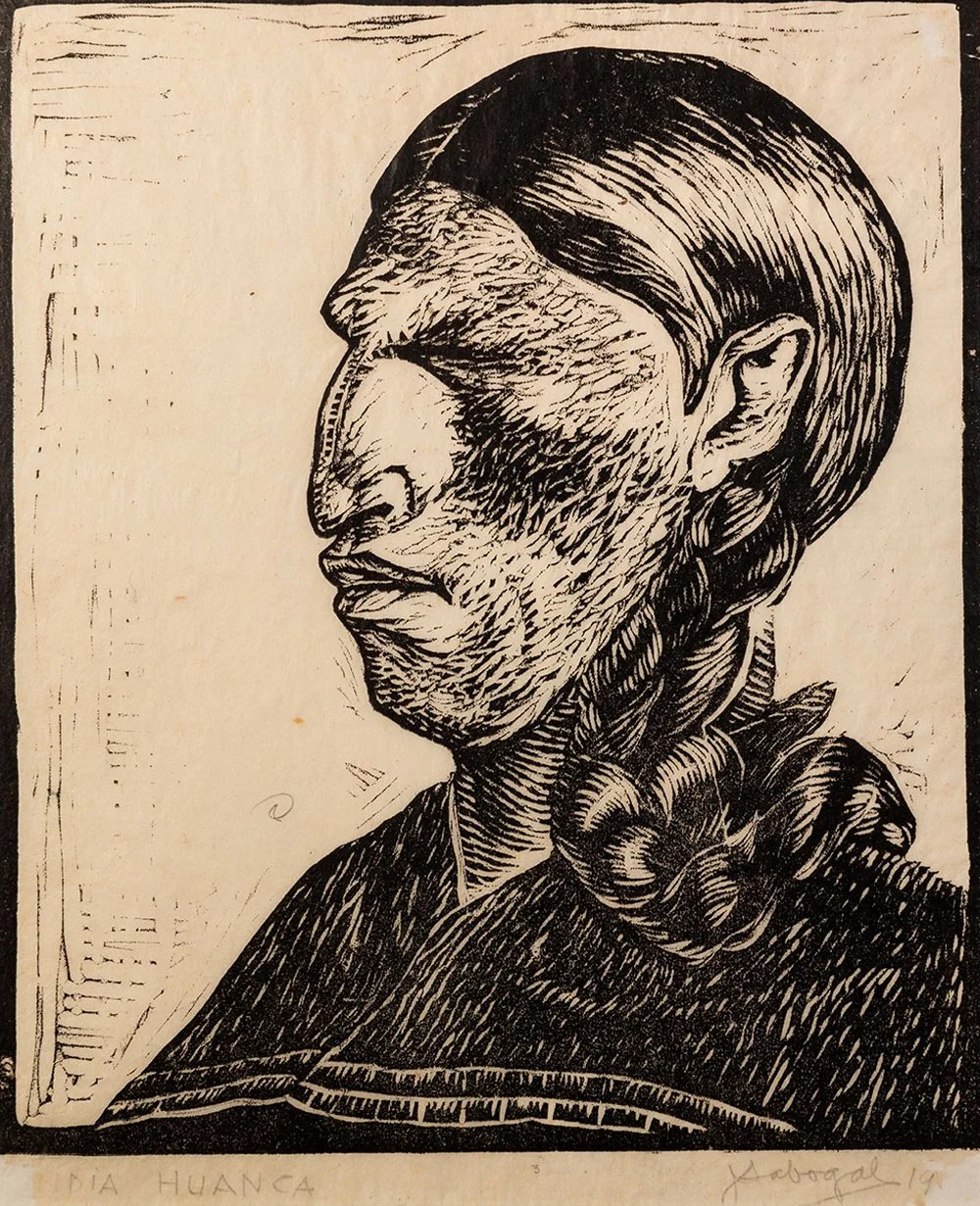
José Sabogal, India Huanca, 1930, woodblock print, 13 x 10.5in. Art Museum of the Americas.
Image courtesy of the Art Museum of the Americas.
Growing up in California, I spent years learning about the ‘conquests’ of the Americas. To contextualise the history, we covered many units about the ancient empires that spanned North and South America, from the vastness of the Incan empire to the urbanism of the Aztecs. However, as soon as the colonial land was divided, we stopped discussing South America. Curious, I decided to do my own looking and encountered José Sabogal.
Born 19 March 1888 in Cajabamba, Peru, José Sabogal worked as a printmaker, muralist, and painter. Considered one of the leaders of the Peruvian Indigenismo movement (a twentieth-century socio-political movement which responded to European inquisition), he sought his own authentic representation of Peruvians free of colonial standards and stereotypes.
Sabogal’s indigenism manifested through the visibility he provided. His figures are typically strong and solitary with a strong sense of autonomy, depicted through gaze, or lack thereof. In the etching India Huanca (1930) the woman’s eye is slammed shut. The roughness of the woodcut makes it feel as though she choses to withhold her gaze—to block the viewer out. Her strong, weathered face implies hardship and perseverance that comes from a life in the rural mountains. Here, Sabogal depicts a woman who has worked and lived; her posture confident, and her features sharp.
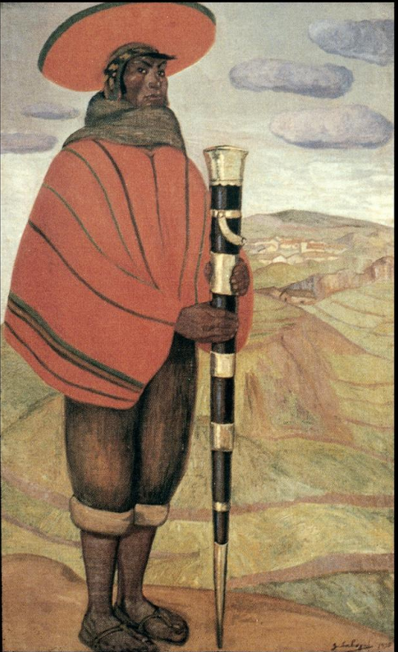
José Sabogal, Varayoc de Chincero, 1925, 109 x 169cm, Pinacoteca Municipal Ignacio Merino.
Varayoc de Chincero (1925) portrays the mayor of the region of Chincero. He confidently stands in a three-quarter profile, his head turned slightly, making eye contact with the viewer. Sabogal pulls from indigenous clothing and objects as a way to reflect on the pre-colonial era. He fuses the present and past to reform and create a new Andean identity.
Stylistically, the piece plays with colour and landscape. The bright red of the mayor’s clothing stands starkly against the steep, green mountains. The lack of urbanisation in the background emphasises the rural identity Sabogal tries to connect with. It is evident that Sabogal attempts to reclaim and reforge an identity for Andeans that has been disrupted by Spanish conquests and colonialism.
As a trailblazer of Peruvian indigenism, Sabogal turned to the folklore and lives of the rural people in his country. He connected with their gazes, making his subjects strong-willed and connected to their viewers, or granting them the autonomy to shut off the viewer. From his woodcuts to his paintings, there is a strong sense of Andean strength and perseverance—a perseverance that did not end because of Spanish imperial powers that I learned about in my younger years.
Bibliography
Art Museum of the Americas. “Jose Sabogal: b. 1888, d. 1956.” OAS.org, n.d. https://www.oas.org/artsoftheamericas/jose-sabogal.
Greet, Michele. “The Avant-Garde Networks of Amauta: Argentina, Mexico, and Peru in the 1920s.” Art Inquiries 18, no. 1 (2020). https://scholarscompass.vcu.edu/cgi/viewcontent.cgi?article=1145&context=artinquiries_secacart.
MOMA. “Jose Sabogal: Young Girl from Ayacucho 1937.” Moma.org, 2022. https://www.moma.org/collection/works/80353?artist_id=5106&page=1&sov_referrer=artist.