On Form: Exploring Tsai Jia-Hong's Mother Vessels
By Brynn Gordon
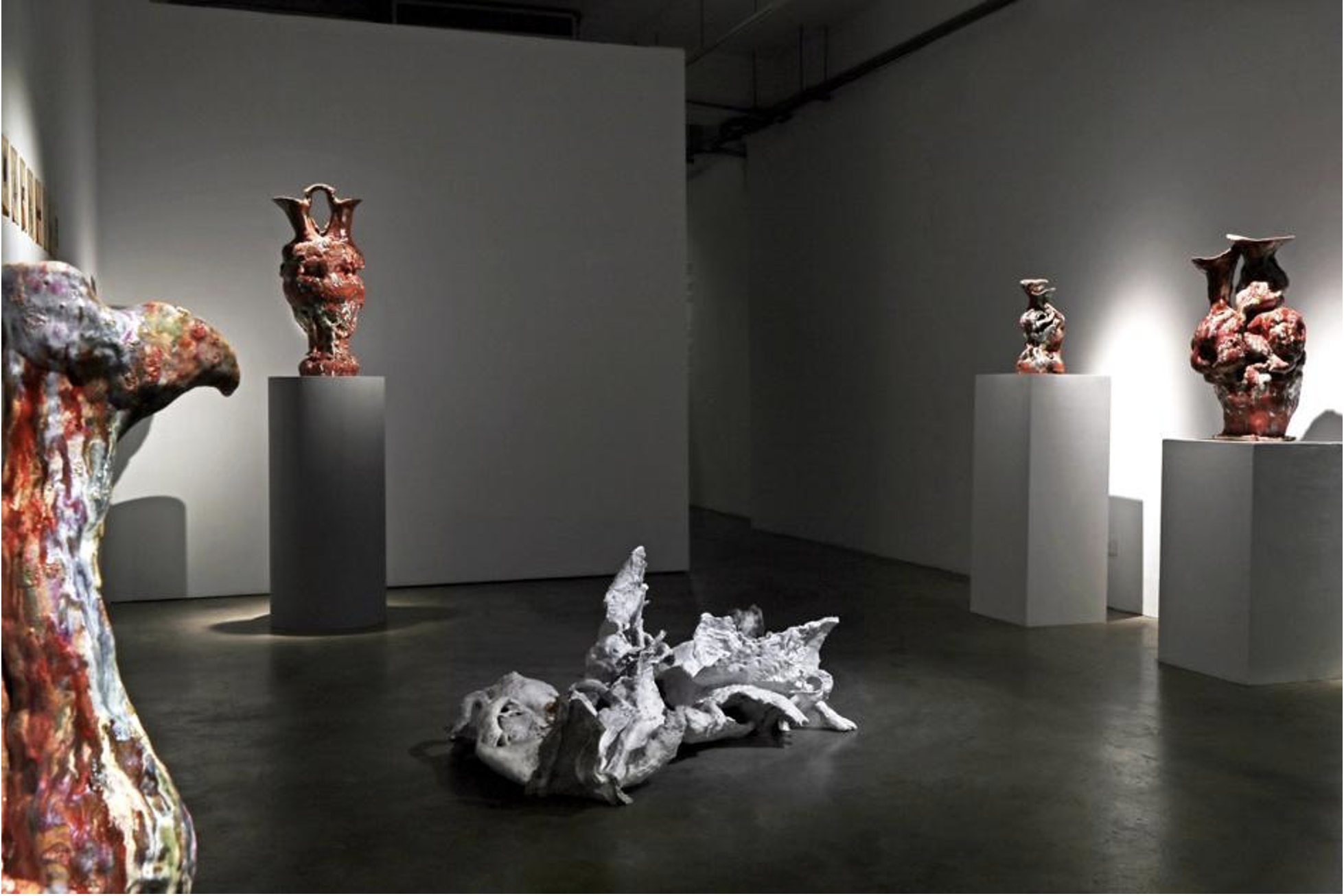
‘The Cripped And Queered Vessel’, Installation View, Absolute Art Space. (Photo Courtesy of the Artist)
There is a persistent concern that young artists struggle to meaningfully situate their work within universal themes. An over-reliance on specific personal experience risks trapping work within an artificial sense of relatability, which can sever its ability to resonate with broader culture, society, and audiences. Conversely, artwork that leaves an impression on a wide audience, must instead bridge the gulf between the personal and the universal. Kaohsiung-based ceramic artist Tsai Jia-Hong’s (b.1994) most recent solo exhibition ‘The Cripped and Queered Vessel’, held at Tainan’s Absolute Art Space, attains this higher form of connection.
This exhibition presents a new body of work by Tsai that builds on her established visual language of exquisite decay, featuring a pared-back, earthen, slip-covered aesthetic, informed by her recent endometriosis diagnosis.[1] This series extends her interrogation of physical trauma and corporeality, a recurring thematic concern since 2019, which was explored in her earlier large-scale ceramic sculpture series Flower (2019-), Fruit (2021-), and Chunk (2021-). The three preceding series primarily dealt with Tsai’s feelings of mortality and pain accompanying a diagnosis and remission from thyroid cancer, establishing a standard of finely worked ceramic sculpture that implicitly approaches unspoken physical experiences like alienation from one’s body; or trauma from illness by using potent metaphors, such as decaying fruit or flowers. These crystalline-glazed and jewel-toned creations eclipse audiences’ knee-jerk reactions to the often disturbing experiences discussed, recognising both the human capacity for despair as well as the reverence within such moments.
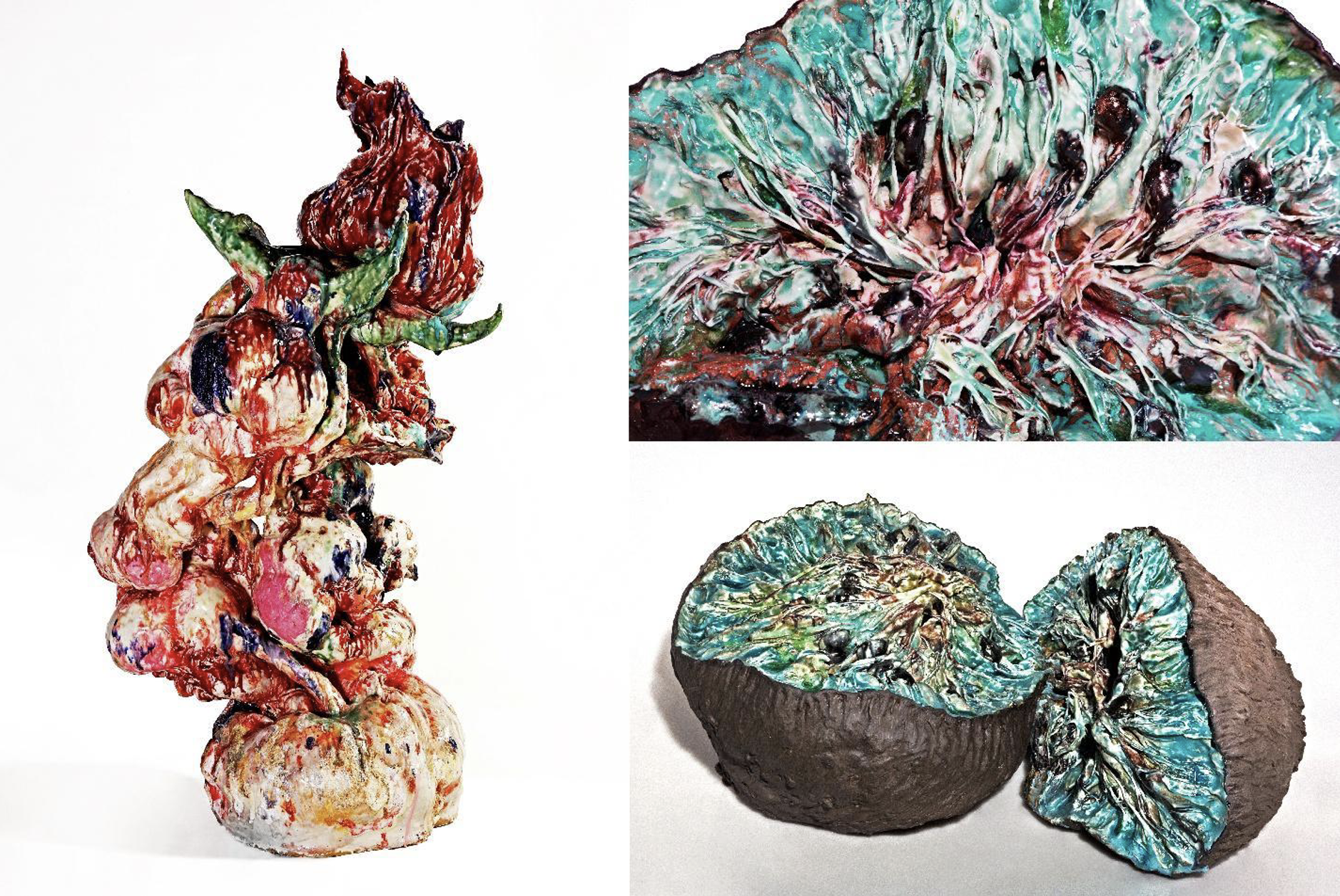
Tsai Jia-Hong, Flowers' Parting Structure, 2021, clay, glaze, 65×50×120 cm; Kiwi Fruit, 2022, clay, glaze, 60×45×30 cm (https://mvak438972.wixsite.com/website)
In this new series, Tsai confidently presents her thematic explorations in compact, explicitly anatomical forms: the organic whorled silhouette of Mother Vessel 4 (2025) recalls a collapsed organ or womb; the jagged Vessels’ Interior (2025) is intentionally cut and cracked into calcified white shards, bone‑like in appearance; and The Cripped and Queered Vessel (2025), Tsai’s first soft sculpture, gathers bed-quilts and Ramie grass into a bulbous, stolid tumour-esqe shape hanging at the heart of the exhibition. This new body of work appears more vulnerable than her previous thematic explorations of physical and emotional pain, displaying cut and cracked sculptures and exposing their internal structure to literally open them up before the audience, imbuing the clay with a genuine feeling of the imperfect human form.
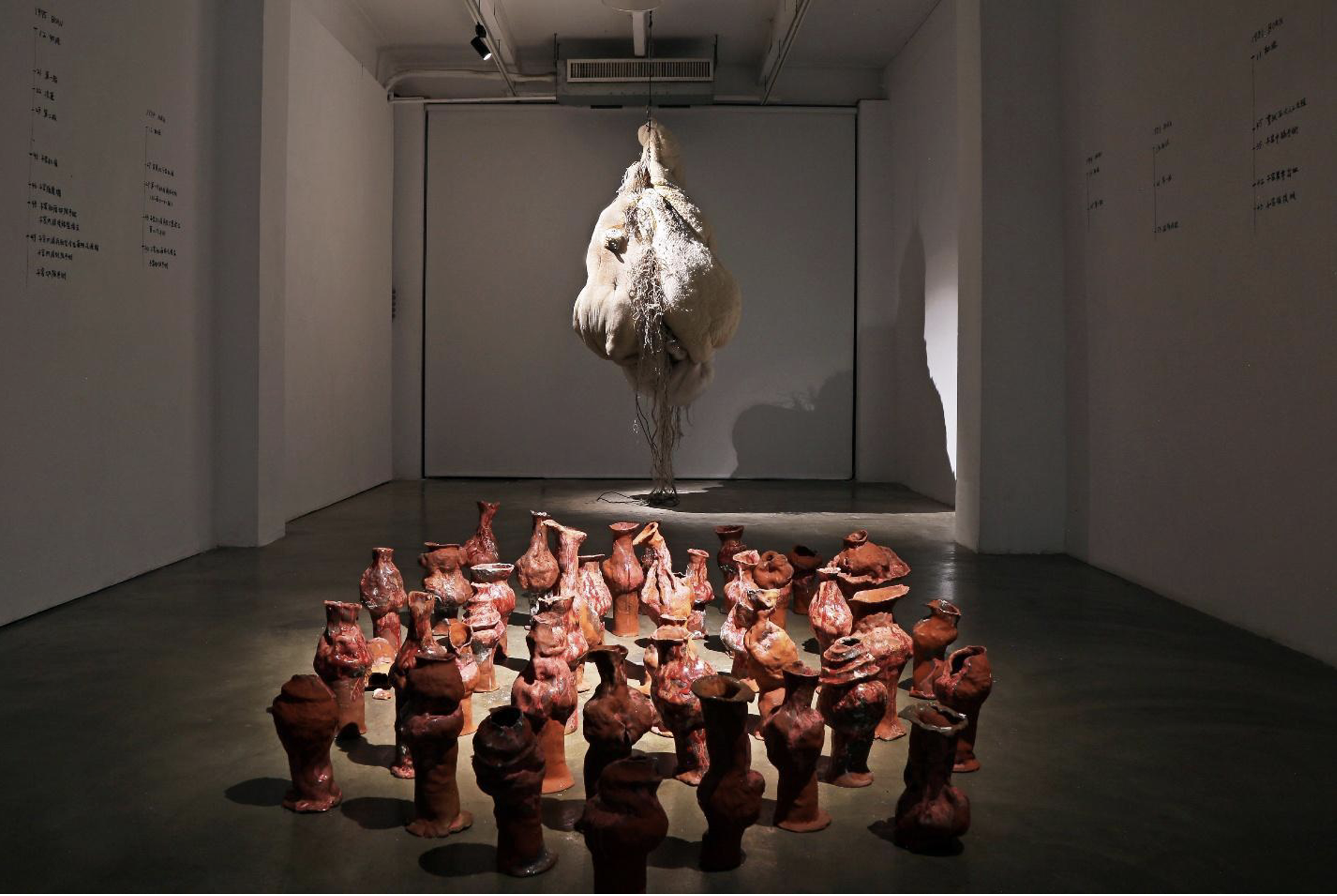
Tsai Jia-Hong, Installation View of Mother Vessel Collective and The Cripped and Queered Vessel, 2025, Absolute Art Space. (Photo Courtesy of the Artist)
The sense of decay that permeated earlier subjects is now extended in Tsai’s work, relying on the rough material properties of Hawaiian Laguna Red Clay and crackled matte glazes to capture and process embodied experiences of impermanence and mortality. Through the vessels’ womb-like double-necked structure, Tsai references ancient examples of fertility icons to critically engage with and deconstruct the culturally ubiquitous symbol of the female as a life-giving goddess. Her sketched images of mother-goddesses from art history, displayed on the gallery walls, clearly draw this contrast between the deified feminine and the true imperfect fragility of human flesh, thus challenging the archetype of the “Mother Vessel” in the face of the emotional and societal realities in which all women exist. Rather than conforming to presentations of the female body as only a site of biological reproduction, or of ceramics as a merely decorative craft, Tsai’s twisted, pleated, and sinewy imaginations of the womb realize authentic physical and emotional aspects of womanhood that simplified cultural constructions do not.
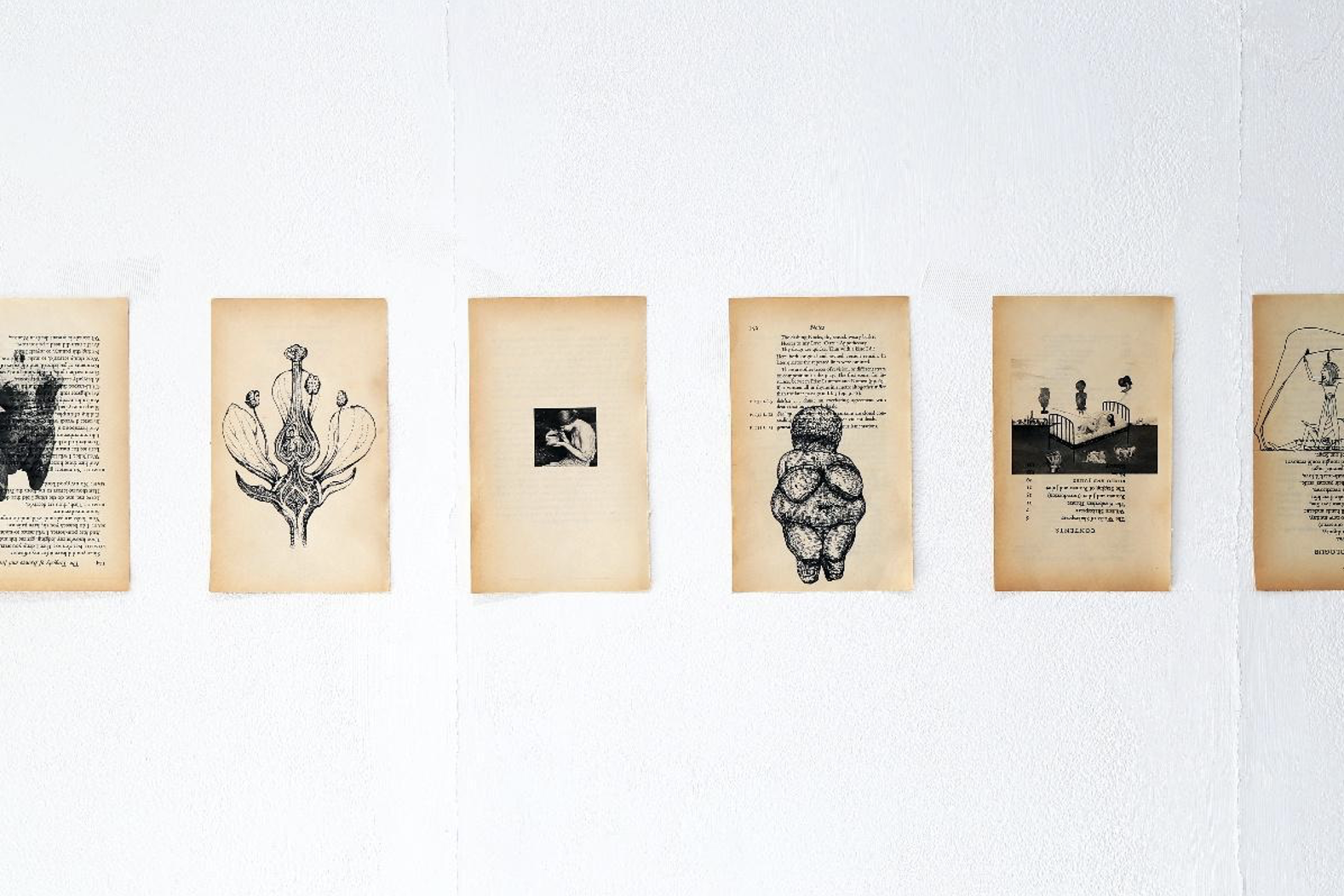
Tsai Jia-Hong, Sketch, 2025. (Photo Courtesy of the Artist)
The series, while drawing from the artist’s own life, expands beyond this scope to consider how individual experiences are framed by broader social meanings, particularly in anatomically and symbolically charged sites like the uterus and ovaries. Initially, Tsai “wanted to return to work focused on [her] body’s physical situation, which in this case was related to reproductive health issues”, and rapidly developed this exhibition concept with curator Lu Wei-Lun after the bouts of severe abdominal pain leading to her endometriosis diagnosis.[2] By examining the interplay between personal somatic reality and culturally inscribed understandings of the female body’s role, Tsai’s work invites nuanced discussion: her new amorphous vessels appear to have been developed in anticipation of such symbolically loaded public responses and interpretations. Rather than attempting to bypass viewers' immediate thoughts and reactions to the disquieting sensation of seeing a private and internal matter exposed and made public, in her latest works, Tsai has confidently embraced these conclusions. Among these, Tsai was struck by the intensity of societal reaction to the externalisation of womb-specific physical difficulties compared to that of her earlier thyroid cancer and to their spilling over into her relationships, friendships, audiences, and broader social interactions. [3]
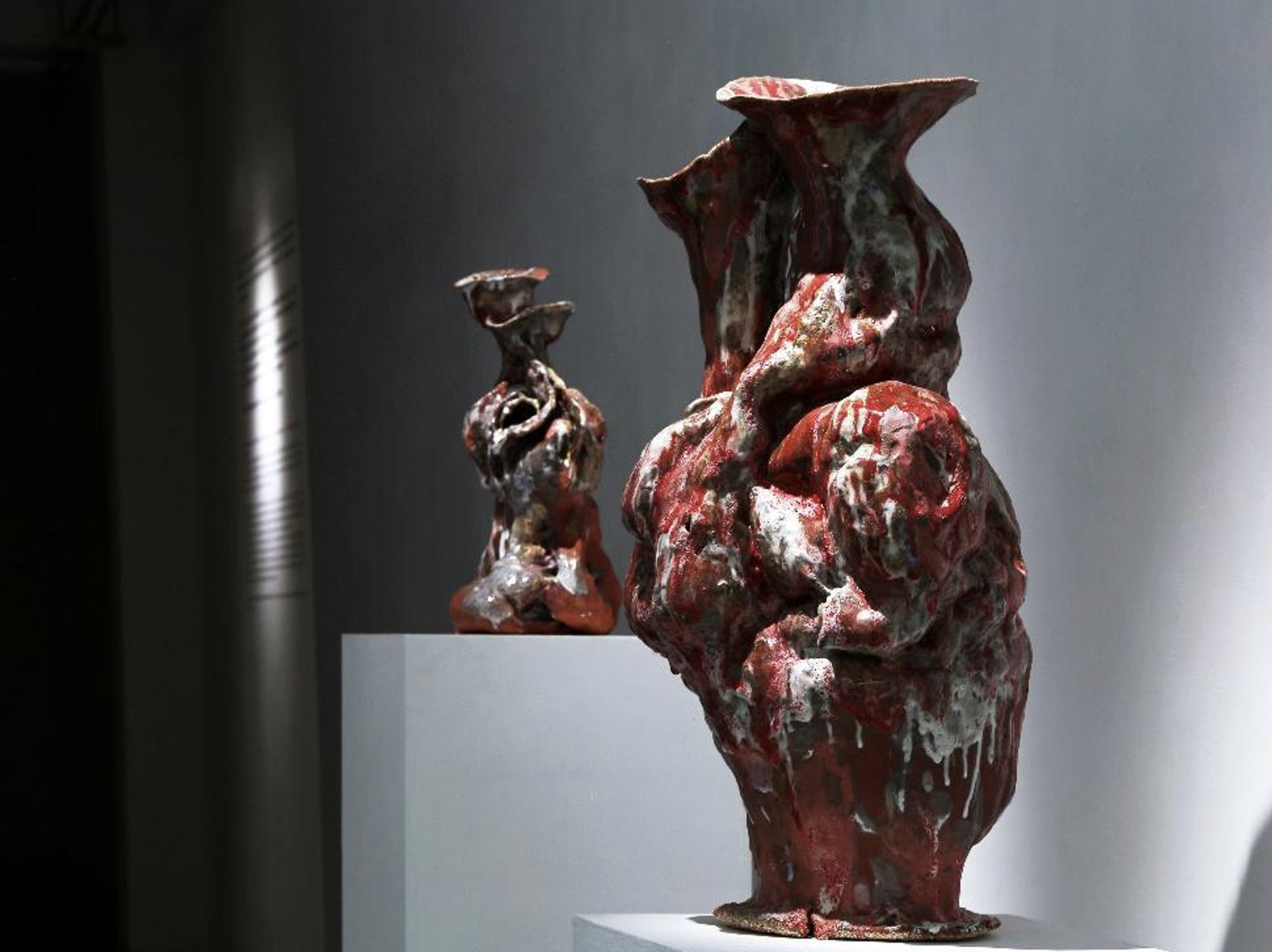
Tsai Jia-Hong Mother-Vessel 4, 2025, clay, glaze, 20x22x40 cm; Mother-Vessel 2, clay, glaze, 35x30x68 cm, 2025. (Photo Courtesy of the Artist)
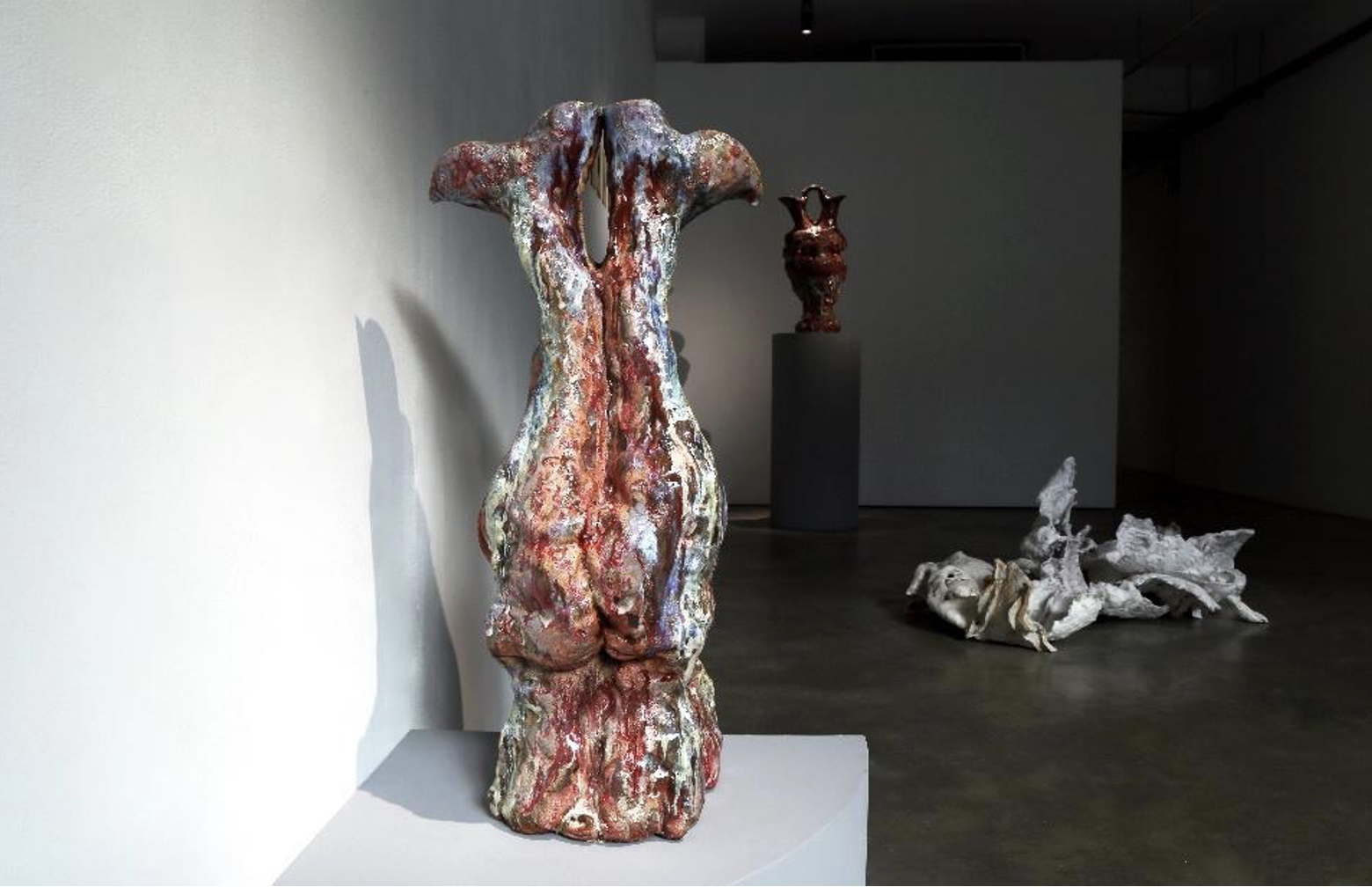
Tsai Jia-Hong Mother-Vessel 3, 2025 clay, glaze, 40x28x79 cm. (Photo Courtesy of the Artist)
Audience reactions to the exhibition have ranged from projections of personal experience and political stances, to observable extremes of sorrow and joy upon seeing the art. Tsai asks how these damaged vessels might spark connections across flesh and emotion beyond familial ties. The intensity of response that ‘The Cripped and Queered Vessel’ invites represents a crystallisation of Tsai’s theoretical artistic objective, namely the quiet unwavering pursuit of “authentic emotion”. This delicate emotional state is elusive yet universal, a knife-edge balance of whip-lash dualities between beauty and repulsion, compassion and rejection, creation and decay.
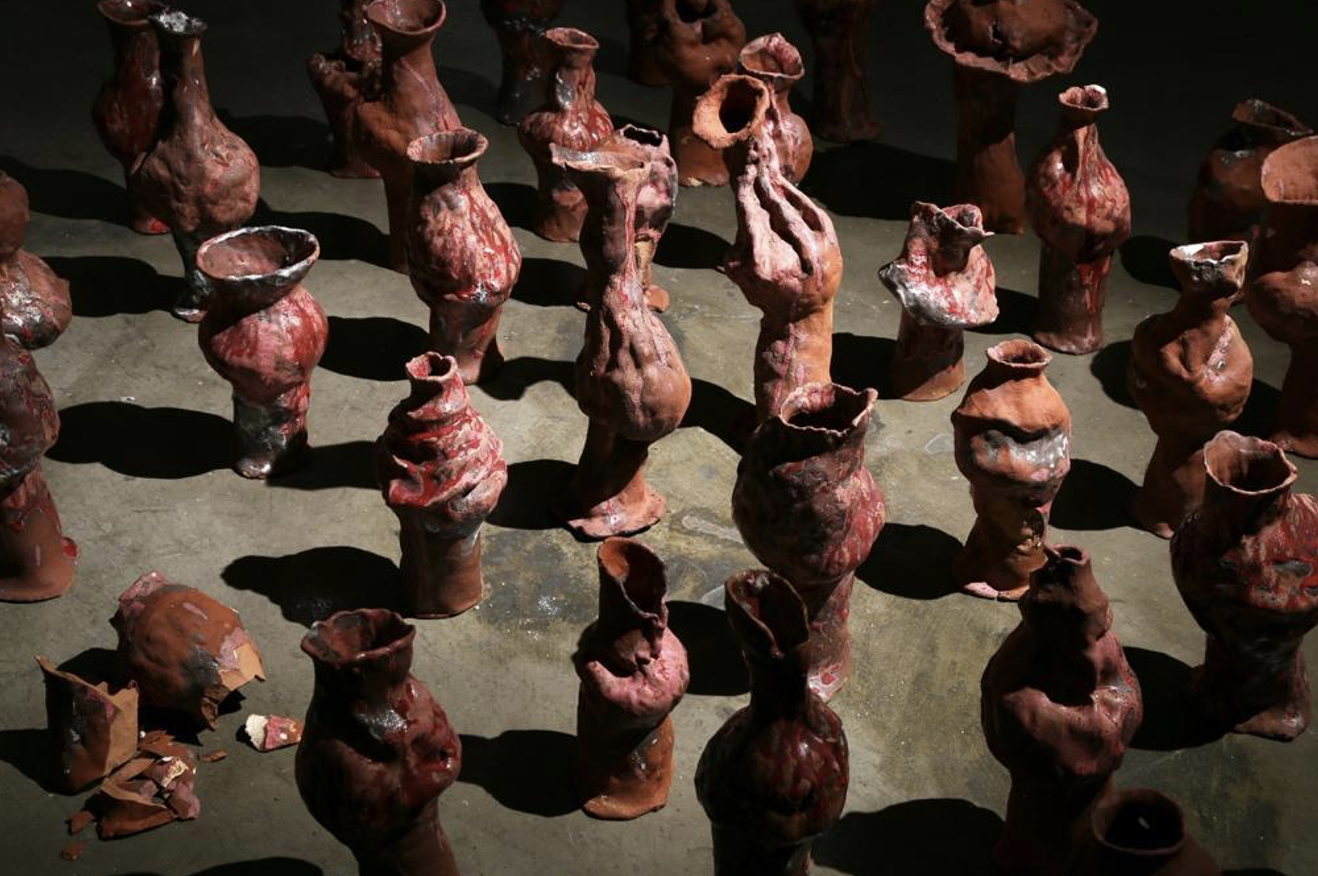
Tsai Jia-Hong, Mother Vessel Collective, 2025, Dimensions Variable. (Photo Courtesy of the Artist)
This reconciliation of dualities is seen throughout Tsai’s career, but is especially prevalent in her subversion of the womb as a “vessel”, a whole, perfect, site of fertility and utility, by laboriously depicting asymmetrical, fractured and open-bottomed vessels “cripped” (殘 cán) and emptied of their conventional function. Rather than affirming the constructed ideal of the “mother vessel” (母器 mù qì), her focus on its equally powerful and terrible potential for fragility and refusal speaks to a more authentic sense of pain and anxiety, and empathetic to the shared human experience. Her “queered” (酷, kù) vessel does not directly reference a specific identity, but rather a process of deliberately unsettling understood norms. It knocks presupposed reactions off their axis: to create unstable, emptied, unsettling structures, but depicts them beautifully and naturally in their rich palette of earths, bone and bruises. Tsai’s vessels conceptually bridge the gulf between the ideal of perfection and the inevitability of imperfection, between the intimacy of personal experience and the universality of raw human conditions.
In this sense, ‘The Cripped and Queered Vessel’ asks to see both ceramic and mother vessels anew, as reflected technically in Vessels Interior. Without access to industrial-size kilns, Tsai resorted to intentionally breaking down her own structures and displaying them as fragments to create the effect of a larger work – creating from “broken” parts an artistic and emotive effect multiples greater than the sum of their whole. Likewise, in Mother Vessel Collective (2025), the artist embraces the ceramic medium’s unpredictable variations in glazing and firing, producing a small army of vessels marked by unique twists and turns in variations that become integral to the work. Whether through the fractured vessel, the unsettled glaze, or the visceral evocation of the body, Tsai seeks to capture the simultaneity of compassion, vulnerability, disgust, and fear. Rather than offering viewers a resolution, the work holds these tensions in balance allowing truth to emerge from its capacity to dwell in uncertainty. Tsai’s pursuit of “authentic feeling” does not seek resolution, just as her new explorations of ceramic techniques resist perfection.
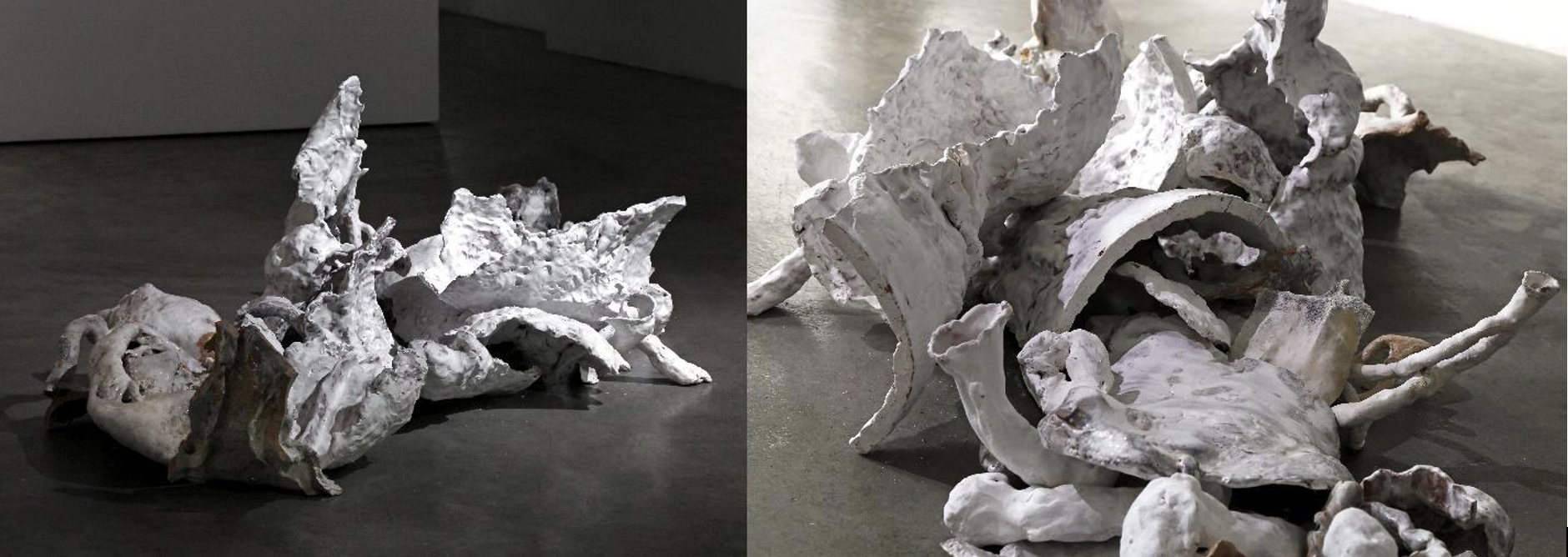
Tsai Jia-Hong, Vessels Interior, 2025, clay, glaze, Dimensions Variable. (Photo Courtesy of the Artist)
Tsai’s understanding of the capacity of internal experiences to foster external connection is fully incorporated into the exhibition via the physical timelines of anonymous women displayed in the inner gallery room. Based on interviews with friends, family members, and strangers, these timelines juxtapose common experiences of first periods and menopause with cases of surgery, illness, or infertility, underscoring the real physical experiences to which her Mother Vessels refer. Tsai’s focus on direct audience engagement through discussions of the body resemble a more mature return to the theme of her debut Flesh‑Body (2019–2021) series.
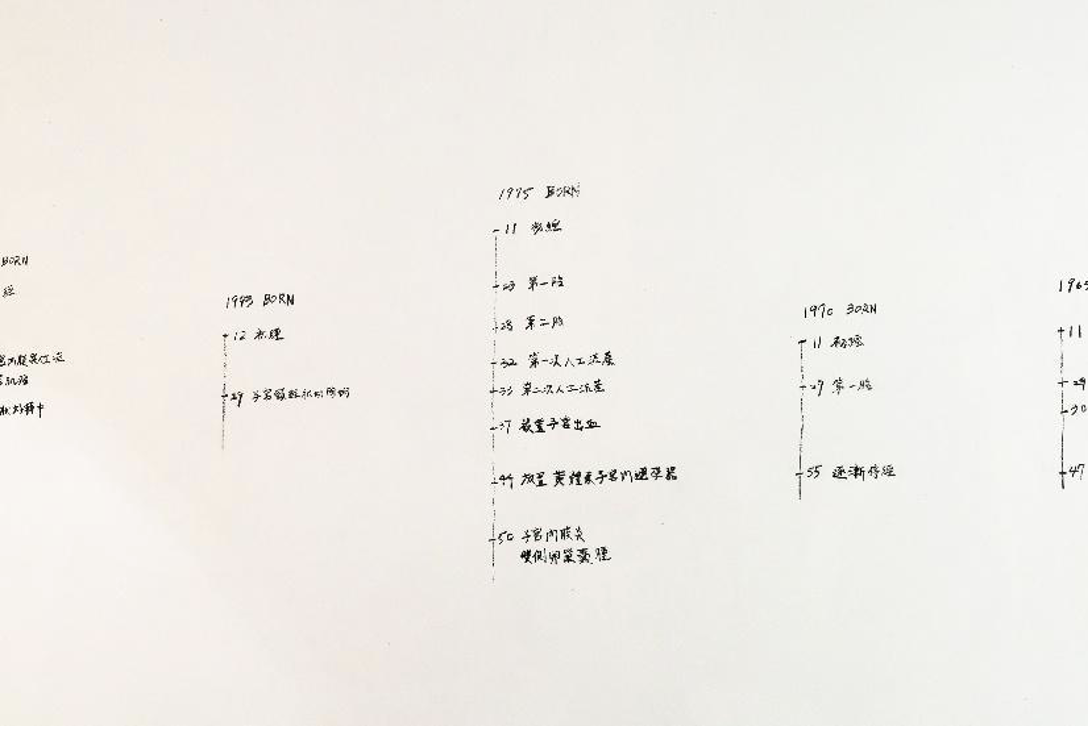
‘The Cripped and Queered Vessel’, Installation View, Absolute Art Space, 2025. (Photo Courtesy of the Artist)
Exhibited only once in ‘The Personal Tortuous History of Flesh’ (2022), audience members were moved by Tsai’s depictions of decayed organs like Algos-1 (2019) (the work Algos-2 (2019) coincidentally pre-dating Vessels’ double-neck structure) to share with her their own experiences of physical unease, bodily estrangement, illness, and the pervasive anxieties surrounding their health, reproductive or otherwise. These pre-existing feelings and symbolic associations held in common, far from being a “problem”, actually transformed elements that might otherwise be reduced to shock factor or confessional into something expansive and connecting. The frank address of such issues, without shame or romanticisation, brings the “authentic emotional” encounter to new heights. These works ultimately exist on a human scale—both in their physical size, subject, and emotional core—underscoring how the unresolved, unfinished, and imperfect can open a wider scope for meaningful engagement in universal experiences.
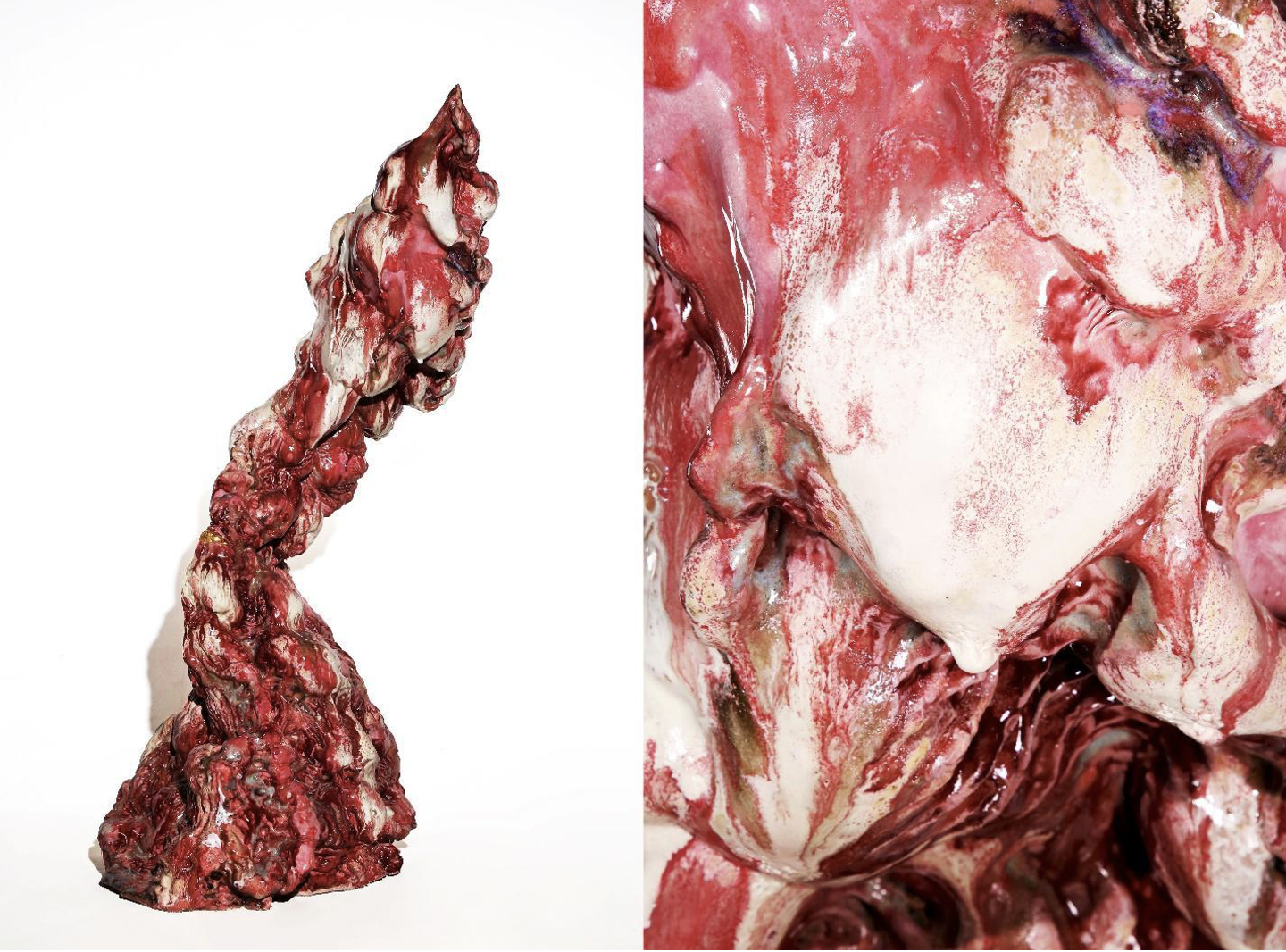
Tsai Jia-Hong, Algos-1, 2019, clay, glaze, 60×50×120 cm. (https://mvak438972.wixsite.com/website)
One hopes that Tsai’s practice will continue to develop its theoretical and fine art dimensions, ensuring that she avoids the potential pitfalls experienced by some ceramic artists of being categorised merely as artisans rather than artists, or being diminished by uninformed criticism. Her collaboration with Curator Lu and her anonymous interviewees have enhanced her focus on the outward-looking effects of inward-looking struggles. “I understand better now why I make works of this kind”, said Tsai, as a kind of therapeutic release that can reach others.[4] By continuing to resist simple categorisation in her treatment of ceramics and remaining true to her internal voice, she can continue to capture greater depths of integrity in her work. Tsai’s ability to mobilise her own experience of pain into an expansive register, fills a gap left by many contemporary works that conflate a confessional tone or surface-level explorations with the deeply connective capacity of thoughtful artistic theory and execution.
‘The Cripped and Queered Vessel’ was on display between August 14th and September 21st 2025 in Tainan’s Absolute Art Space. This exhibition has been nominated for the third quarter of the 24th Taishin Arts Awards.[5]
[1]Tsai, Jia-Hong, Lu Wei-Lun, Wu Yuling, “A Record of the Symposium on ‘Cruel Mother Vessel’: The Alternative Genealogy of ‘Mother Goddess’ and the Compassion of the ‘Mother Vessel,’” Absoluteart.space, Absolute Art Space, Sep 2025. https://absoluteart.space/14606488?fbclid=IwdGRjcAMp9SljbGNrAyn1HGV4dG4DYWVtAjExAAEez87rgvShrBLJaYvnpOXXjuoIfQ0NWQ-I5htxpMEA8Or0rf4hCZS2JJWF62k_aem_biNPBRqiDp1ueGnpBZHXyQ
[2] Tsai Jia Hong, Online interview with Brynn Gordon, Sep 20 2025.
[3]Tsai, et al, “Symposium on ‘Cruel Mother Vessel’.”
[4] Tsai Jia-Hong, Online interview with Brynn Gordon, Sep 20 2025.
[5] Tsai Jia-Hong (@jia_hong_tsai), "I’m delighted to share that 《殘酷母器The Cripped and Queered Vessel — Tsai Jia-Hong Solo Exhibition》 has been nominated…", Oct 20 2025, https://www.instagram.com/jia_hong_tsai/p/DP_ovUHEhak/
Bibliography
Absolute Art Space. “The Cripped and Queered Vessel ─ Tsai Jia-Hong Solo Exhibition.” Absolute Art Space, Aug 2025. https://absoluteartspace.wixsite.com/absolute-art-space/single-post/the-cripped-and-queered-vessel-tsai-jia-hong-solo-exhibition.
“殘酷母器 ─ 蔡佳宏個展 The Cripped and Queered Vessel ─ Tsai Jia-Hong Solo Exhibition.” Absolute Art Space. Published Aug 29 2025. Accessed Oct 22 2025. 5:30. https://www.youtube.com/watch?v=h1Bo988fWHc.
Tsai Jia-Hong | 蔡佳宏陶瓷創作. “Home.” 2021. https://mvak438972.wixsite.com/website?fbclid=PAZXh0bgNhZW0CMTEAAaev2H9shnbK--iYnB_PQ_h-4DM_AC5NwNoog-Zq2fElk2yQPrE2D9ikqY6Btg_aem_58_CUl2uwVDebMkWlhtM1A.
Tsai Jia-Hong (@jia_hong_tsai). "I’m delighted to share that 《殘酷母器The Cripped and Queered Vessel — Tsai Jia-Hong Solo Exhibition》 has been nominated…" Oct 20 2025. https://www.instagram.com/jia_hong_tsai/p/DP_ovUHEhak/.
Tsai Jia-Hong, Lu Wei-Lun, Wu Yuling. “A Record of the Symposium on ‘Cruel Mother Vessel’: The Alternative Genealogy of ‘Mother Goddess’ and the Compassion of the ‘Mother Vessel.’” Absoluteart.space. Absolute Art Space, September 2025. https://absoluteart.space/14606488?fbclid=IwdGRjcAMp9SljbGNrAyn1HGV4dG4DYWVtAjExAAEez87rgvShrBLJaYvnpOXXjuoIfQ0NWQ-I5htxpMEA8Or0rf4hCZS2JJWF62k_aem_biNPBRqiDp1ueGnpBZHXyQ
Tsai Jia-Hong. Online interview with Brynn Gordon. Sep 20th 2025.