Grotesque Glamour: A$AP Rocky, Tim Burton, and the Expressionist Art of Being Seen
By Hanna Yoon
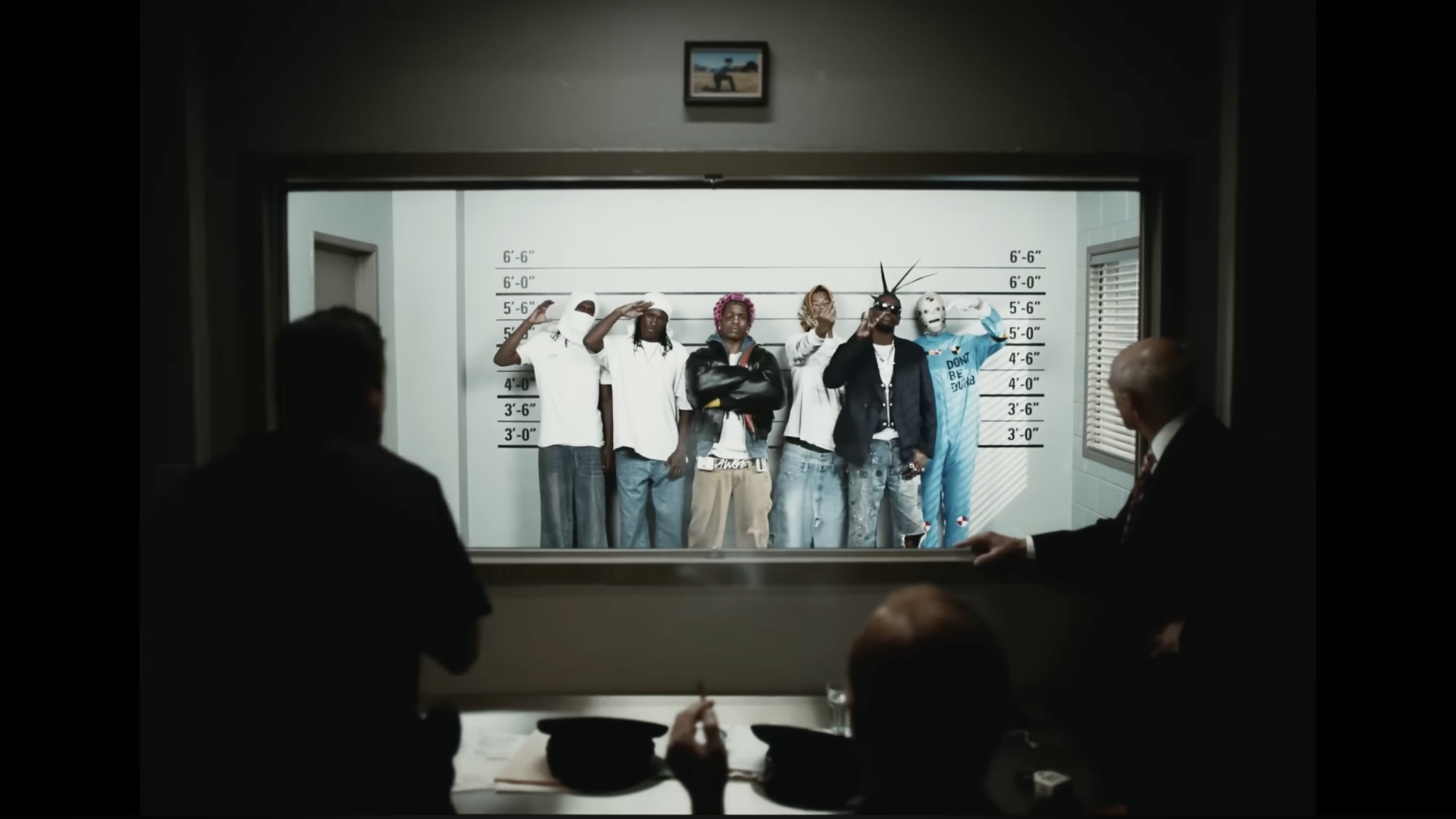
Still from A$AP Rocky, PUNK ROCKY (Official Video), 2026.
Image courtesy of YouTube
When A$AP Rocky told DAZED that he was currently inspired by ‘German Expressionism film’ – specifically Fritz Lang’s Metropolis (1927) – and followed it up with an unabashed declaration that ‘Tim Burton… is the man. The greatest,’ I couldn’t help but linger on it. Not because the reference felt unexpected, but because it felt telling. Rocky has never been interested in subtlety. What he gravitates toward instead is distortion, theatricality, and the aesthetic pleasure of being slightly unnerved, all of which crystallise in his recent album, Don’t Be Dumb.
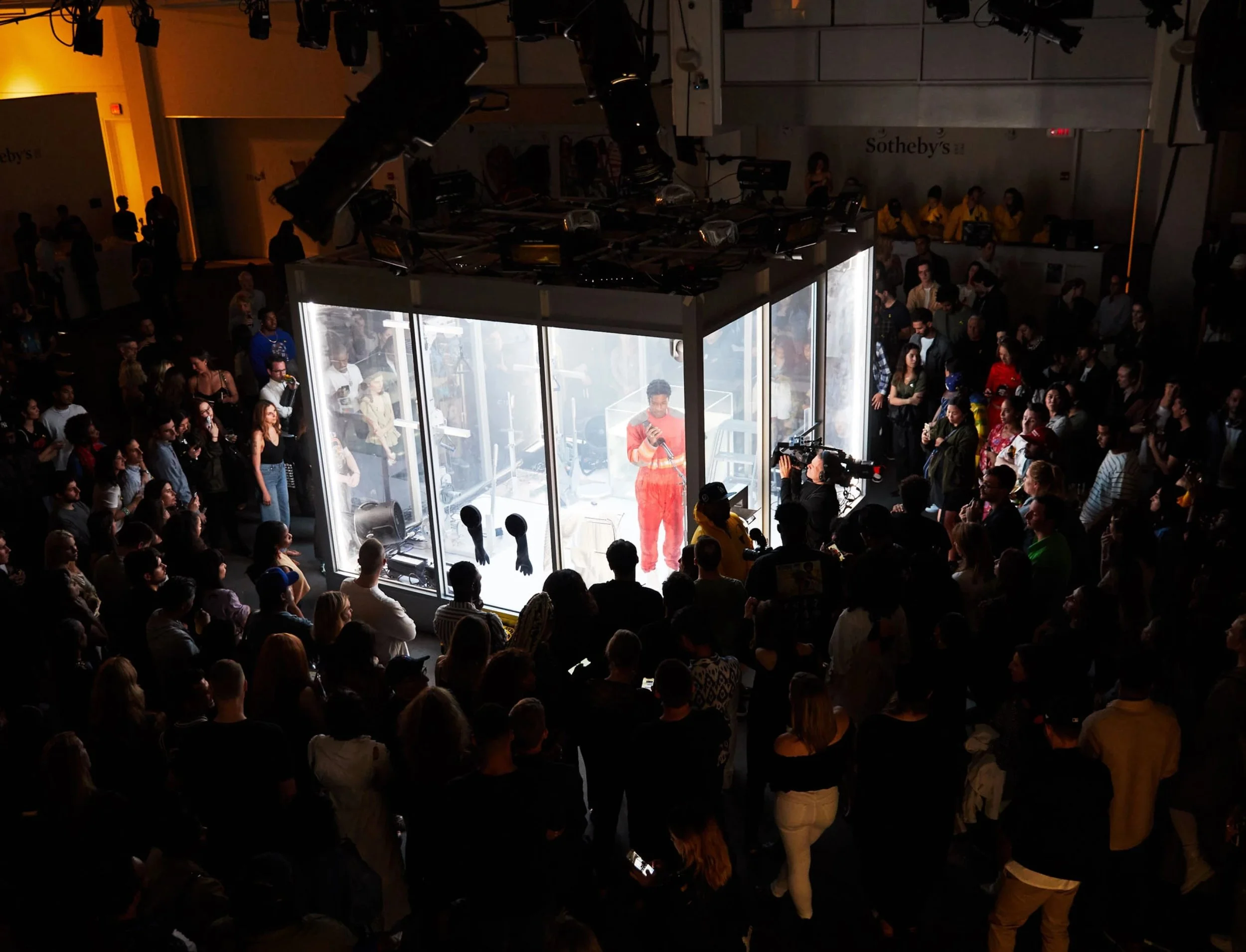
Photograph by Sam Nixon, The Tank from Above, 2018.
Image courtesy of Sotheby’s.
I’ve long been aware of Rocky as a figure where fashion, music, and image collapse into one another. But it wasn’t until coming across his 2018 Lab Rats performance at Sotheby’s New York – staged, conceptual, and conspicuously out of place within the auction house’s white-cube sanctity – that his interest in art history and visual performance was clear to me. Seen in this light, his collaboration with Tim Burton on Don’t Be Dumb didn’t surprise me but felt like a logical next step. Rocky is not dabbling in art history – he is actively positioning himself inside it.
Scrolling past the album cover and announcement on Instagram, I was struck not by its polish but by its deliberate estrangement. The imagery of Burton’s odd figures does not seduce so much as it unsettles. Faces appear distorted, bodies feel slightly misaligned, and the familiarity of hip-hop luxury is warped into something faintly grotesque. This is not the aspirational clarity we have been trained to expect from celebrity imagery, but something closer to caricature – and that is precisely the point.
Rocky’s collaboration with Burton situates Don’t Be Dumb within a lineage that runs through German Expressionism, Gothic exaggeration, and the long art historical tradition of the distorted body as a vehicle for psychic truth. Burton, after all, has always functioned more as a curator of Expressionist aesthetics than as a filmmaker. His visual language – elongated limbs, sunken eyes – draws directly from Robert Wiene’s The Cabinet of Dr. Caligari (1920), from Ernst Ludwig Kirchner’s jagged urban figures, and from an Expressionist cinema where the external world bends to mirror inner disturbance.
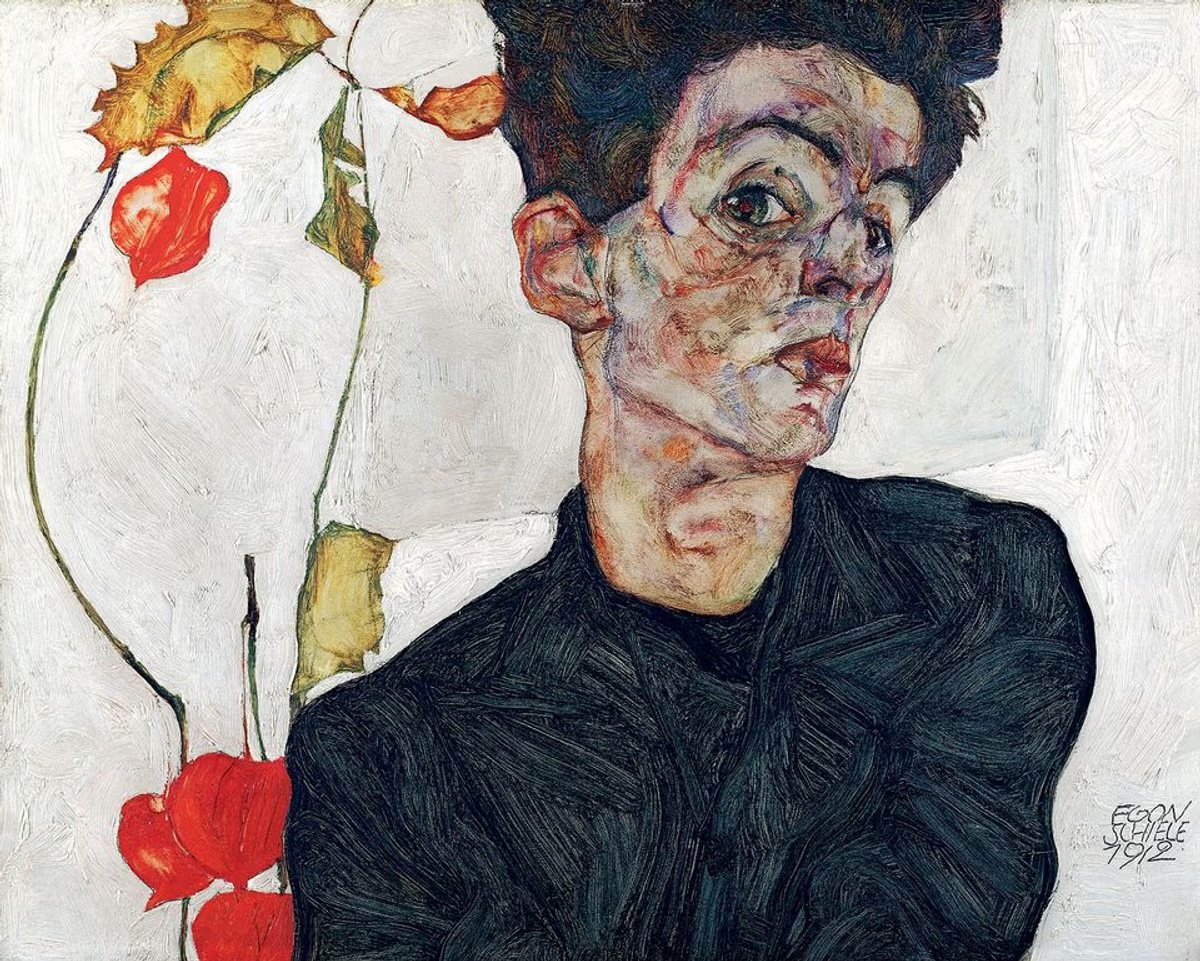
Egon Schiele, Self-Portrait with Chinese Lantern Plant, 1912, Oil and body colour on wood, 32.2 × 39.8 cm.
Image courtesy of Leopold Museum, Vienna.
On the Don’t Be Dumb album cover, Burton renders Rocky not as monumentalised but as twisted and strange. In doing so, Rocky’s artistic persona becomes less “rapper” than figure – part anti-hero, part apparition, part self-aware cartoon. The image refuses realism entirely, recalling Expressionism’s rejection of anatomical fidelity. Like Egon Schiele’s self-portraits, which contort the artist’s own body into something brittle and confrontational, Rocky’s image feels hyper-aware of its own construction. These are not portraits so much as alter egos, a term Rocky himself uses in his tour posters.
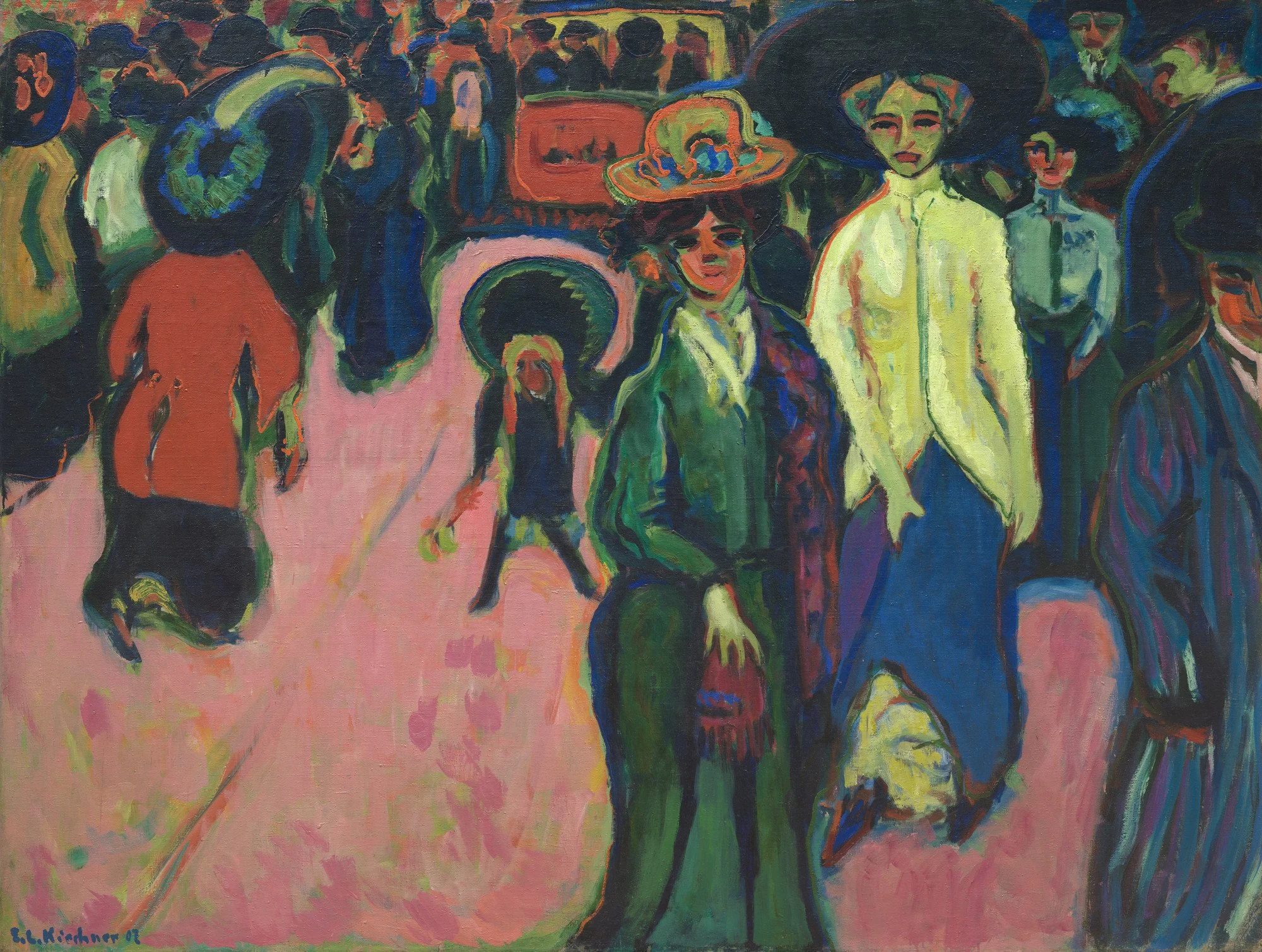
Ernst Ludwig Kirchner, Street, Dresden, 1908, Oil on canvas, 150.5 x 200.4 cm.
Image courtesy of the Museum of Modern Art.
Masculinity, here, is not smooth or authoritative, but theatrical, unstable, and even faintly anxious. The illustrated Rocky alter ego, wearing a trench coat, appears elongated and stiff, his body slightly uneven, as though caught mid-performance. The figure is not presented as an object of desire, but a site of tension, stretched between power and vulnerability, control and collapse. The trench coat itself, traditionally associated with authority, concealment, and masculine cool, becomes exaggerated to the point of unease. Rather than stabilising the body, it amplifies its fragility. In this way, Don’t Be Dumb aligns with the Expressionist conviction that distortion is not excess, but honesty. Like Ernst Ludwig Kirchner’s sharply dressed yet psychologically strained urban figures, Rocky’s trench-coated alter ego is not meant to be classically beautiful, but to register damage – a luxury rendered uncanny, where the symbols of success remain present yet subtly off-putting, as though a warped figure might reveal something truer than a flawless reflection ever could.
Burton’s involvement also introduces a Gothic strain that complicates the album’s art historical positioning. Gothic art has long been preoccupied with the hybrid grotesque body as a means of externalising moral and psychological conflict. From medieval marginalia to Francisco Goya’s Los Caprichos, the grotesque functions as a critique of rational order. Rocky inhabits this tradition fully. His image oscillates between menace and absurdity, suggesting that contemporary masculinity itself has become a kind of Gothic performance – overstated, hyper-visible, and faintly ridiculous.
What makes Don’t Be Dumb particularly compelling is how deliberately it embraces theatricality beyond the static image. Expressionism was never subtle – it relied on exaggeration, costume, and performance to translate interior states into visible forms. Rocky’s visual world operates in precisely this register, refusing the language of authenticity in favour of artifice. Alienation is not hidden or softened – it is staged openly.
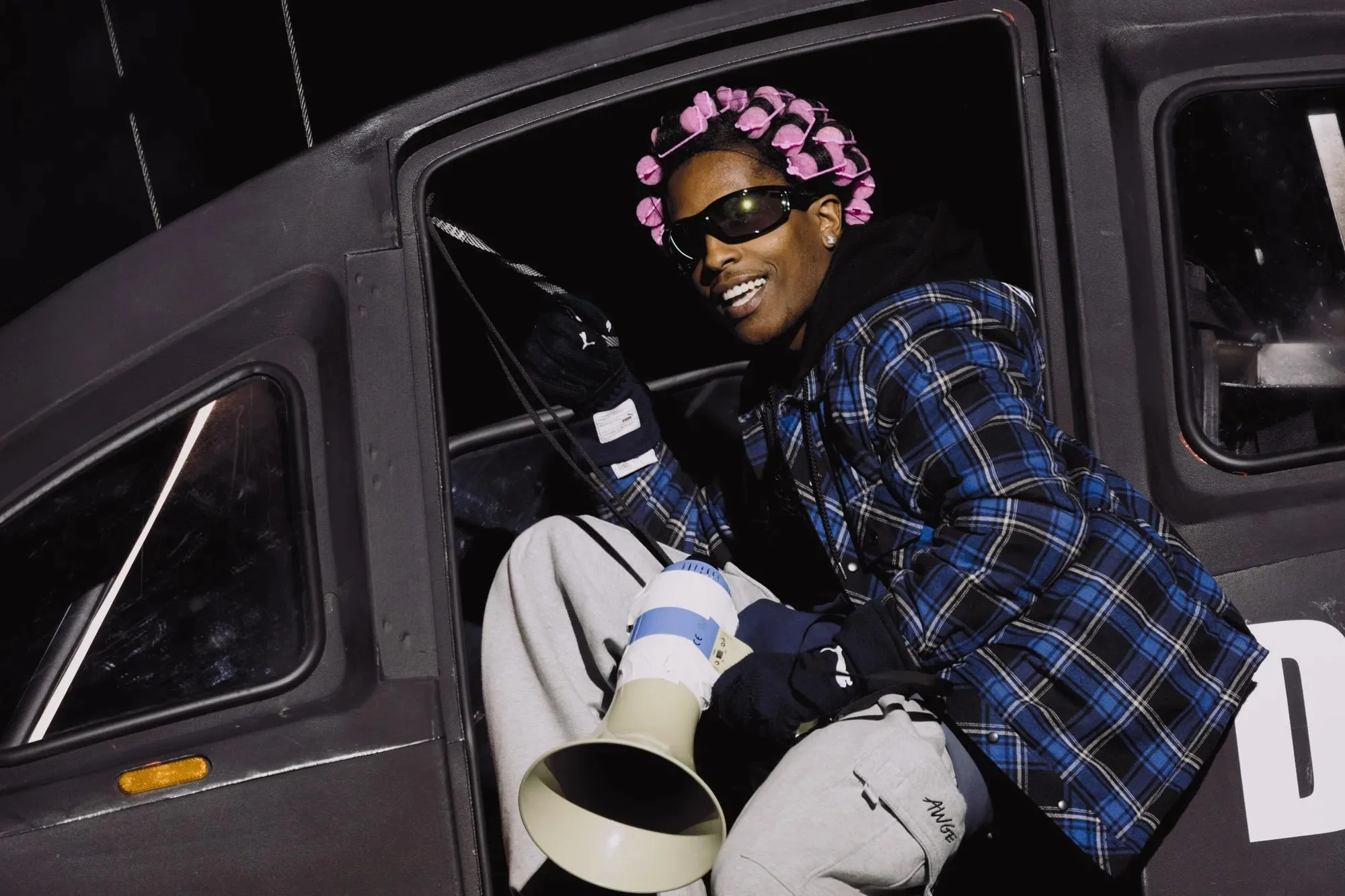
Photograph by Colin Hancock, A$AP Rocky performing at Lollapalooza, 2025.
Image courtesy of mxdwn.
This logic extends seamlessly into live performance. When Rocky appeared wearing pink hair rollers during his Saturday Night Live performance and at Lollapalooza, later introducing the object as a beanie sold as merchandise, the gesture read less as provocation than as a visual narrative. Rollers, typically associated with preparation and private labour, are transformed into public costume, collapsing the boundary between the self being constructed and the self being consumed. Like figures in German Expressionist cinema, frozen mid-gesture and mid-identity, Rocky presents himself in a state of becoming rather than completion. What are we meant to do with an image that refuses polish? Are we invited to admire the performance, or to confront the conditions that make performance permanent?
Perhaps this is why Don’t Be Dumb feels so art historically resonant. It does not seek resolution, only confrontation. In a culture defined by relentless visibility, Rocky’s visuals ask an old Expressionist question with new urgency: how do you make inner fracture legible without neutralising it as style? Beauty slips into grotesque, vulnerability becomes costume, and identity reveals itself as something constructed, unstable, and perpetually on display. Rocky does not ask to be admired, or even understood. He asks to be looked at – and like the Expressionists before him, he seems to understand that to be truly seen is to risk being rendered strange.
Bibliography
“A$AP Rocky Performs ‘Lab Rat’ at Sotheby’s | Contemporary Art | Sotheby’s.” 2018. Sothebys.com. May 21, 2018. https://www.sothebys.com/en/slideshows/a-ap-rocky-performs-lab-rat-at-sothebys?slide=the-tank-from-above.
ASAPROCKYUPTOWN. 2026. “A$AP Rocky - Punk Rocky (Official Video).” YouTube. January 5, 2026. https://www.youtube.com/watch?v=lCp0BmcFPQ8.
“Egon Schiele: A Buyer’s Guide.” 2019. The Art Newspaper - International Art News and Events. March 27, 2019. https://www.theartnewspaper.com/2019/03/27/how-to-buy-an-egon-schiele.
Hancock, Colin. 2025. “Lollapalooza Day 4 Photo Review: A$AP Rocky, the Marías and BOYNEXTDOOR Close the Weekend in Style.” Mxdwn Music. August 11, 2025. https://music.mxdwn.com/2025/08/11/reviews/lollapalooza-day-4-photo-review-aap-rocky-the-marias-and-boynextdoor-close-the-weekend-in-style/.
Moma. 2019. “Street, Dresden.” The Museum of Modern Art. MoMA. 2019. https://www.moma.org/collection/works/78426.
Peters, Alex. 2023. “A$AP Rocky: ‘Home Is Anywhere That I Have My Lady and My Children.’” Dazed. Dazed Digital. October 2, 2023. https://www.dazeddigital.com/beauty/article/60980/1/asap-rocky-interview-gucci-new-album-2023.