
The Human Fascination with Uncanny In-Betweens: The Visual Language of Liminal Spaces
By Sakura Mogami
The flicker of a fluorescent light illuminates a seemingly unending network of corridors; the walls are plastered with a wallpaper that is undoubtedly etched in your mind from a distant, elusive memory. These were the defining visuals of Kane Parsons’ psychological and analog horror film Backrooms (2026), igniting a wave of intrigue for all things under the umbrella of liminal spaces.
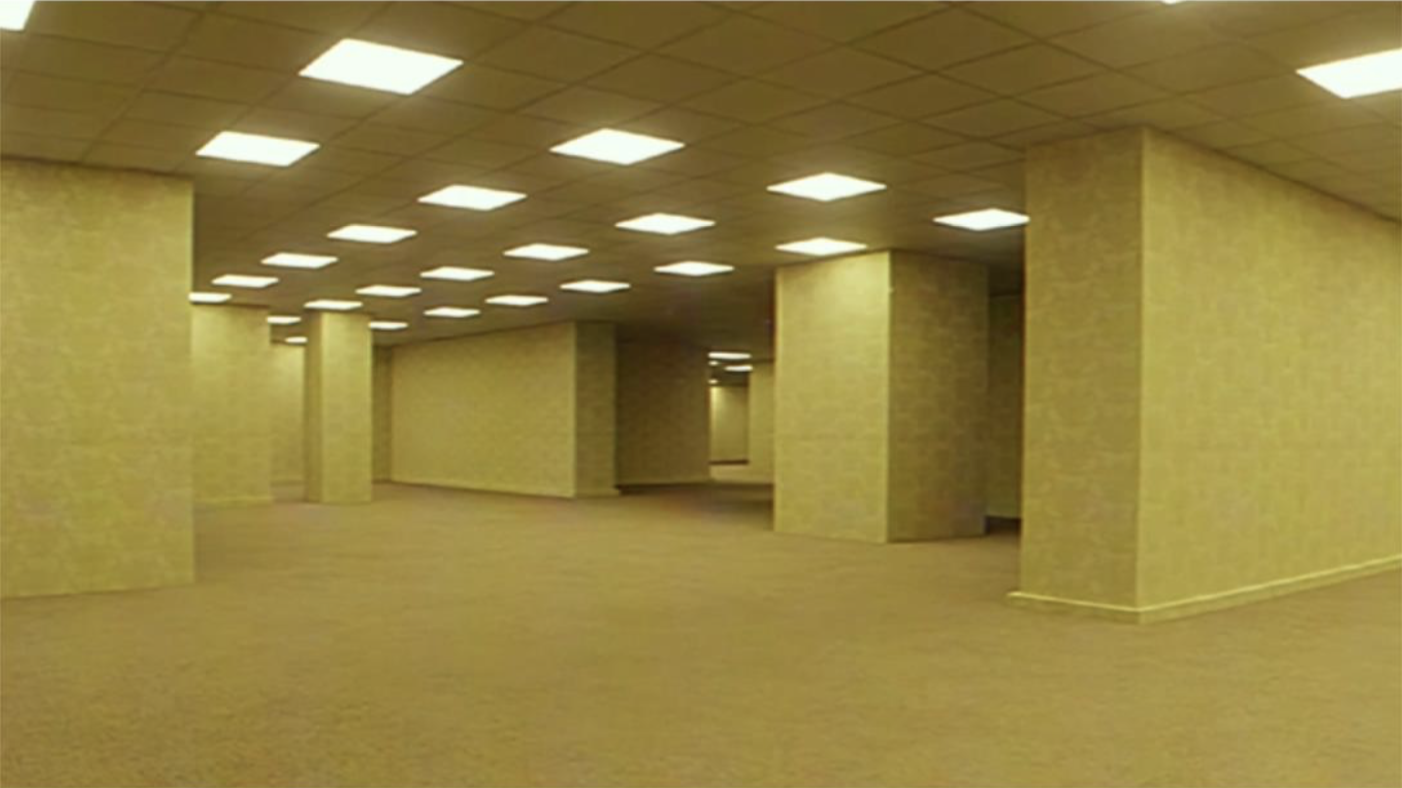
Still from Kane Parsons The Backrooms (Found Footage), 2022.
Image courtesy of Youtube.
Etymologically and architecturally, a liminal space is a transitional threshold that serves as a gateway between two distinct points. Oftentimes, people trace the modern mythology of the liminal space, as we know it, back to 2020, when a world cloistered by pandemic lockdowns gravitated towards images of deserted public spaces. In fact, the 2026 Backrooms was based on Kane Parsons earlier Backrooms (2022) web series, which was itself an adaptation of the 2019 original 4chan image board post. These images reflected both a collective longing for a simpler past and a quiet existential dread seeping from society’s forced confrontation with uncertainty. The liminal spaces popularised during this period typically featured deserted hallways and airports, lone petrol stations at night, and empty shopping malls – all direct examples of transitional sites. Yet, the term has since expanded to encompass any environment that evokes the psychological state of liminality. These spaces share a common denominator: an eerie atmosphere, capable of treading the uneasy line between nostalgic familiarity and the inexplicably uncanny.
It’s easy to point to social distancing and the widespread isolation practices as the sole catalysts for our affinity with liminal spaces; after all, humanity found itself in a state of liminality, adjusting to the demands of the pandemic. However, doing so disregards the last century of mankind’s artistic practise and visual culture. In order to trace the lineage of liminal space representations, we must confront a foundational question: what qualifies a space as capable of exuding these sensations of liminality?
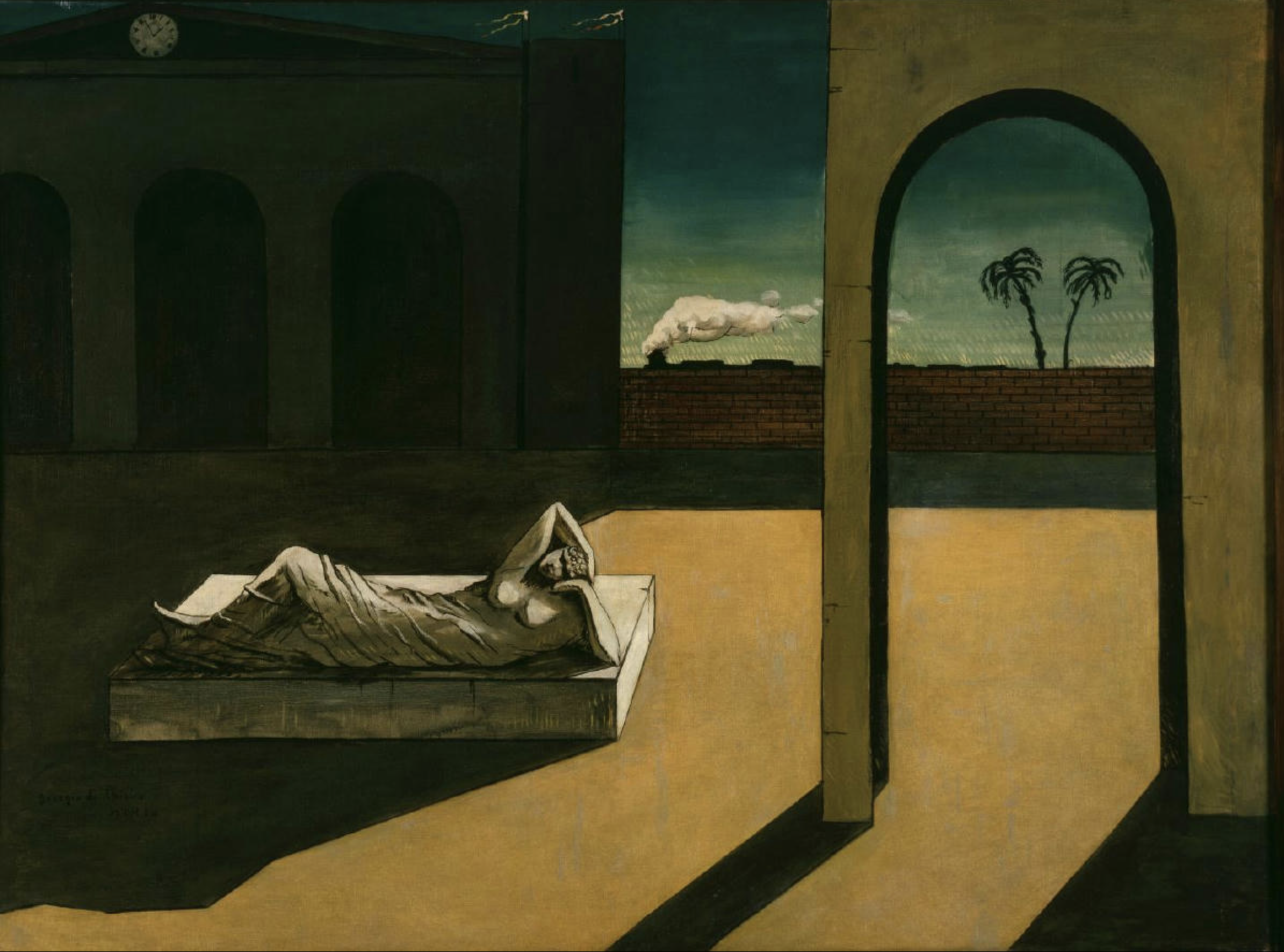
Giorgio de Chirico, The Soothsayers Recompense, 1913, Oil on canvas, 135.6 x 180 cm, Philadelphia Museum of Art
Image courtesy of Encyclopedia Britannica.
At the turn of the 20th century, Giorgio de Chirico found himself in the full swing of the Second Industrial Revolution, an era that ushered in new technologies, scientific discoveries, and the looming shadow of the First World War. De Chirico was an Italian artist who pioneered Pittura Metafisica, the metaphysical painting movement, which rejected the contemporary Futurist and Cubist styles, critiquing of their romanticisation of industrialisation and geometric fracturing of human dimensionality. His works, such as The Soothsayer’s Recompense (1913), sought to depict the tangible world in its purest form by stripping everyday objects and scenes of their ordinary contexts to evoke the metaphysical.
In The Soothsayers Recompense, a rigorous geometric precision governs the composition: vertical outlines and columns frame the scene, while to the center-left lies a marble statue of a delicately reclined figure. From the penumbra of shadows, the viewer can make out fragments of recognisable environments – austere architectural arches, a distant locomotive, brickwork, and classical statuary. Yet their exaggerated shadows, stark visual distinctions between the foreground, middle ground, and background, all on a perfectly uniform flat surface, disrupt the coherence of these familiar elements.
These visual elements destabilise the compositions spatial logic and reveal a calculated absence of contextual signifiers that would make the scene identifiable and intelligible. Does the image depict a public square, courtyards, or perhaps museum grounds? If so, where is the bustle of pedestrian viewers, or incidental detritus that could suggest a distinct location? While our minds attempt to fill in the blanks, the resulting space remains elusive: recognisable enough to evoke a fragment of memory, but unfamiliar enough to resist identification. Perhaps it is reminiscent of a forgotten outdoor gallery or a faded childhood travel pamphlet. This disjunction between the appearance of an identifiable place and the absence of the context needed to make sense of it is the first key ingredient in producing the tension of a liminal experience.
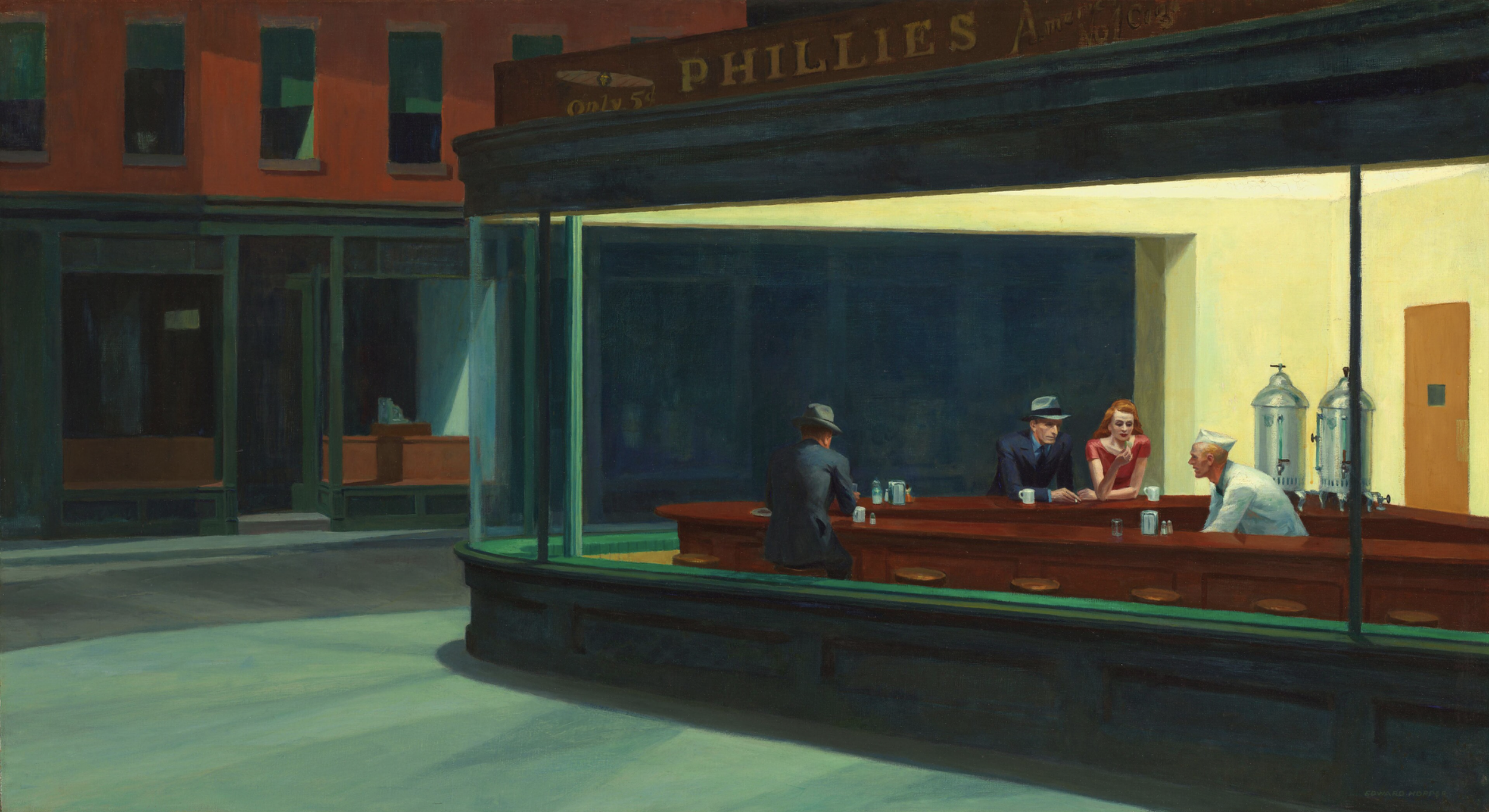
Edward Hopper, Nighthawks, 1942, Oil on canvas, 84.1 × 152.4 cm, Art Institute of Chicago.
Image courtesy of Encyclopedia Britannica
Internet discourse has pushed the idea that liminal spaces must be devoid of human presence entirely. Yet while physical vacancy often heightens this disorientation, this effect can still be achieved, and sometimes even intensified, by art that features depictions of people. Take, for example, Edward Hopper’s most celebrated work, Nighthawks (1942).
The composition places the viewer on a street bathed in the fluorescent light spilling from the windows of a diner. A customer with his back against the viewer shares the bar with a couple sitting side-by-side with averted gazes, being tended to by a uniformed employee. Despite the multiple figures occupying the diner, there is a pervasive sense of isolation. Their physical proximity only accentuates their psychological distance. The diner itself is an architectural puzzle: the absence of a visible door or entrance paired with the uncanny transparency to the glass windows render the relationship between the external observer and the occupants indeterminate.
Created in two months following the Pearl Harbor attacks, the painting emanates the American public’s anxious paralysis during an acute historical crisis. By presenting the familiar public space of a diner, but suspending any sense of genuine community, Hopper robs an ordinary setting of its inherent liveliness, generating an unsettling interiority. To qualify as a liminal space, the scene does not have to be devoid of people; rather, it must evoke a sense of displacement that alienates the individual from their surroundings, inviting a reconsideration of memory and reality itself.
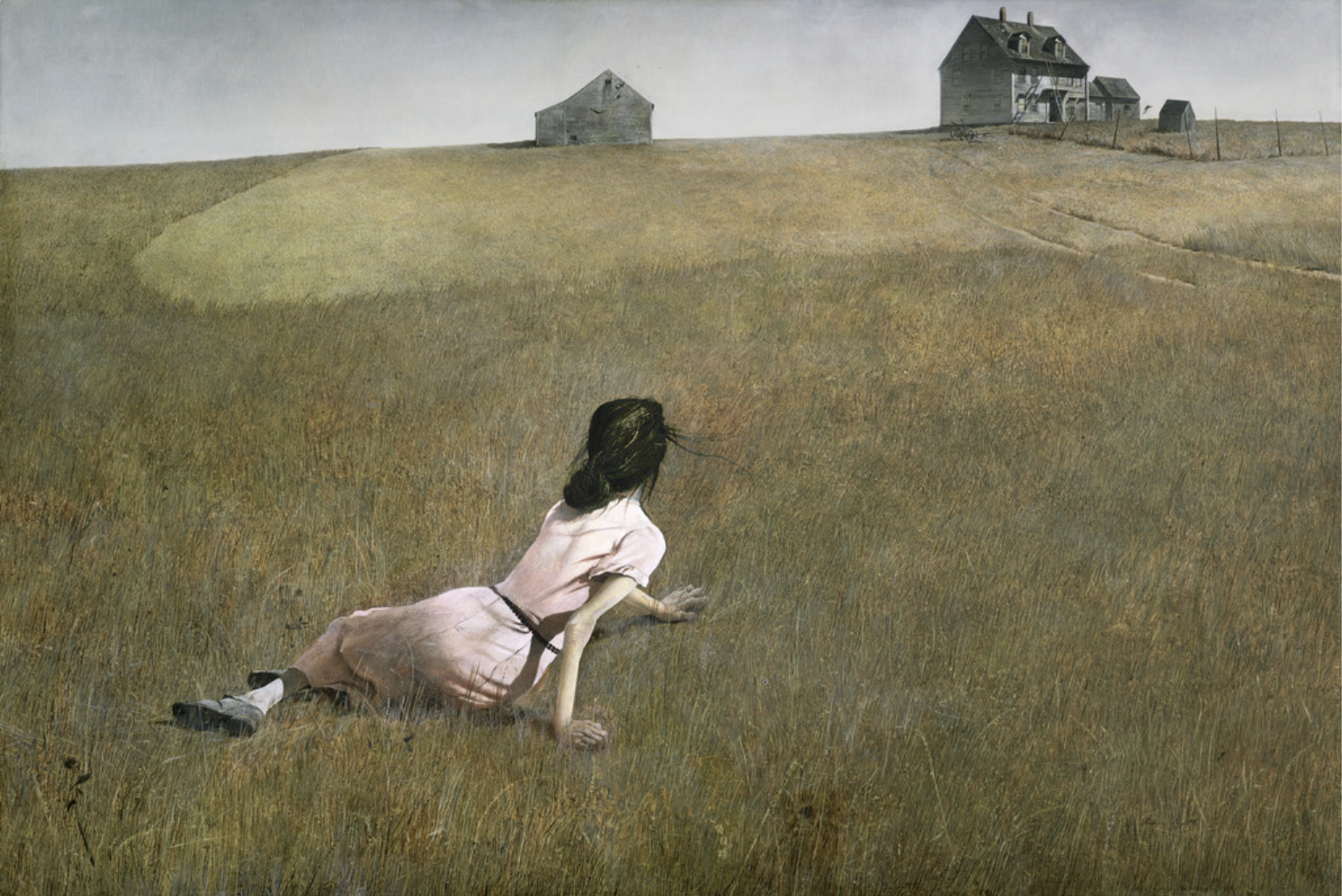
Andrew Wyeth, Christina’s World, 1948, Tempera on gessoed panel, 81.9 cm × 121.3 cm. Museum of Modern Art, New York.
Image courtesy of the Museum of Modern Art
The idea of liminality is equally embedded in the fabric of Andrew Wyeth’s Christina’s World (1948). The subject is based on Anna Christina Olson, a family neighbour, who struggled with a degenerative muscular disorder that paralysed her lower limbs. Despite being a landmark of American realism, Christina’s World purposefully distorts the proportions of the hill to warp the perspective, amplifying the distance between Christina and her home while extracting the neighbouring houses that were present in the real Maine landscape. The resulting composition transforms an identifiable rural setting into an expansive, dreamy, and desolate terrain. In the composition, Christina lies in the muted grass with her arms bolstering her upper body as she gazes toward a distant farmhouse. Her posture suggests both vulnerability and resolve: her movement is constrained, yet her orientation towards the house implies an ongoing effort to reach it. She is neither entirely disconnected from the world she inhabits nor able to navigate it unimpeded. Instead, she occupies an uneasy in-between state, suspended between physical limitation and personal agency. In this sense, Christina’s World extends the idea of liminality beyond empty architecture or deserted public spaces. Its liminality lies in the spacial and existential friction between the figure and her environment, and in the disquieting distance that separates them.
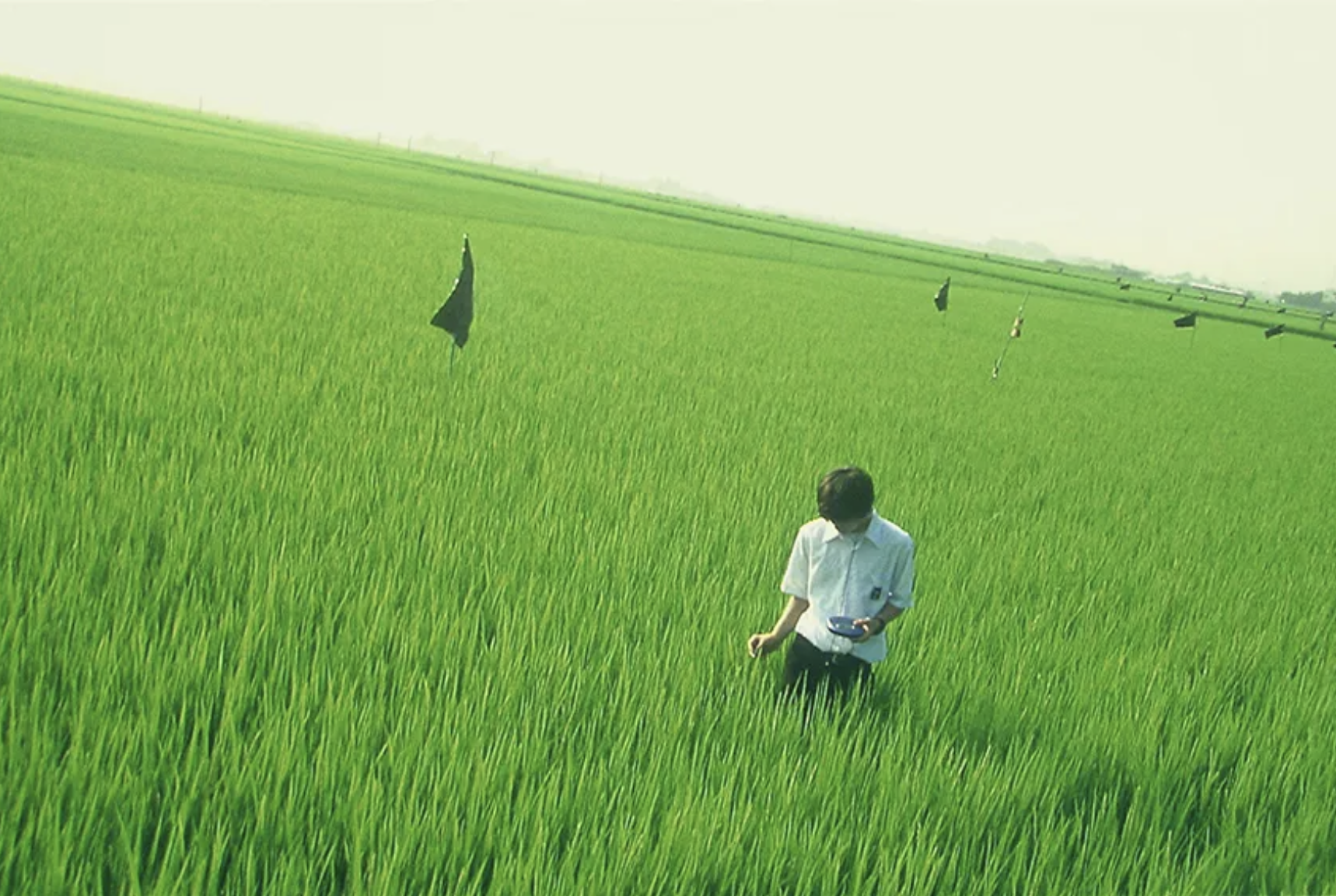
Film still from Shunji Iwai, All About Lily Chou Chou, 2001.
Image Courtesy of Variety
Liminal spaces continue to leave an imprint upon contemporary visual culture; their association with transition and the unknown makes them prevalent in coming-of-age narratives as well as psychological thriller and horror. From Yuichi Hasumi ruminating on his fleeting adolescence in an endless stretch of saturated green fields in All About Lily Chou Chou(2001); to the present-day infinite abandoned hallways of the Backrooms, liminality remains a powerful means of exploring the boundaries between the familiar and the unknown.
Liminal spaces force viewers to confront an inevitable facet of the human condition: we are perpetually in states of change, without ever truly reconciling our anxieties about uncertainty. For Chirico, painting became his medium for navigating an era caught between technological advancement and catastrophic warfare. Similarly, Hopper captured an atmosphere of isolation and national anxiety amidst the impending turbulence of World War II. Meanwhile, Wyeth explored a more personal tension between physical limitation and agency. All three artists interrogated the threshold: that uncomfortable suspension where the familiar turns strange, and the destination remains perpetually out of reach.
Bibliography
Art Institute of Chicago. 2009. Nighthawks. Webpage/catalog entry. The Art Institute of Chicago. https://www.artic.edu/artworks/111628/nighthawks.
Elley, Derek. 2001. “All About Lily Chou-Chou.” Variety, September 28, 2001. https://variety.com/2001/film/reviews/all-about-lily-chou-chou-1200469705/.
MoMA (Museum of Modern Art). 2019. Christina’s World. Collection online. The Museum of Modern Art. https://www.moma.org/collection/works/78455.
Parsons, Kane. 2022. “The Backrooms (Found Footage).” YouTube video, 9:14, January 7, 2022. https://www.youtube.com/watch?v=H4dGpz6cnHo.
Encyclopaedia Britannica. n.d. “The Soothsayer’s Recompense.” Accessed October 12, 2026. https://www.britannica.com/topic/The-Soothsayers-Recompense.