Silhouettes of Fire: The Dynamic Art of Ana Mendieta
By Eleanor Martin
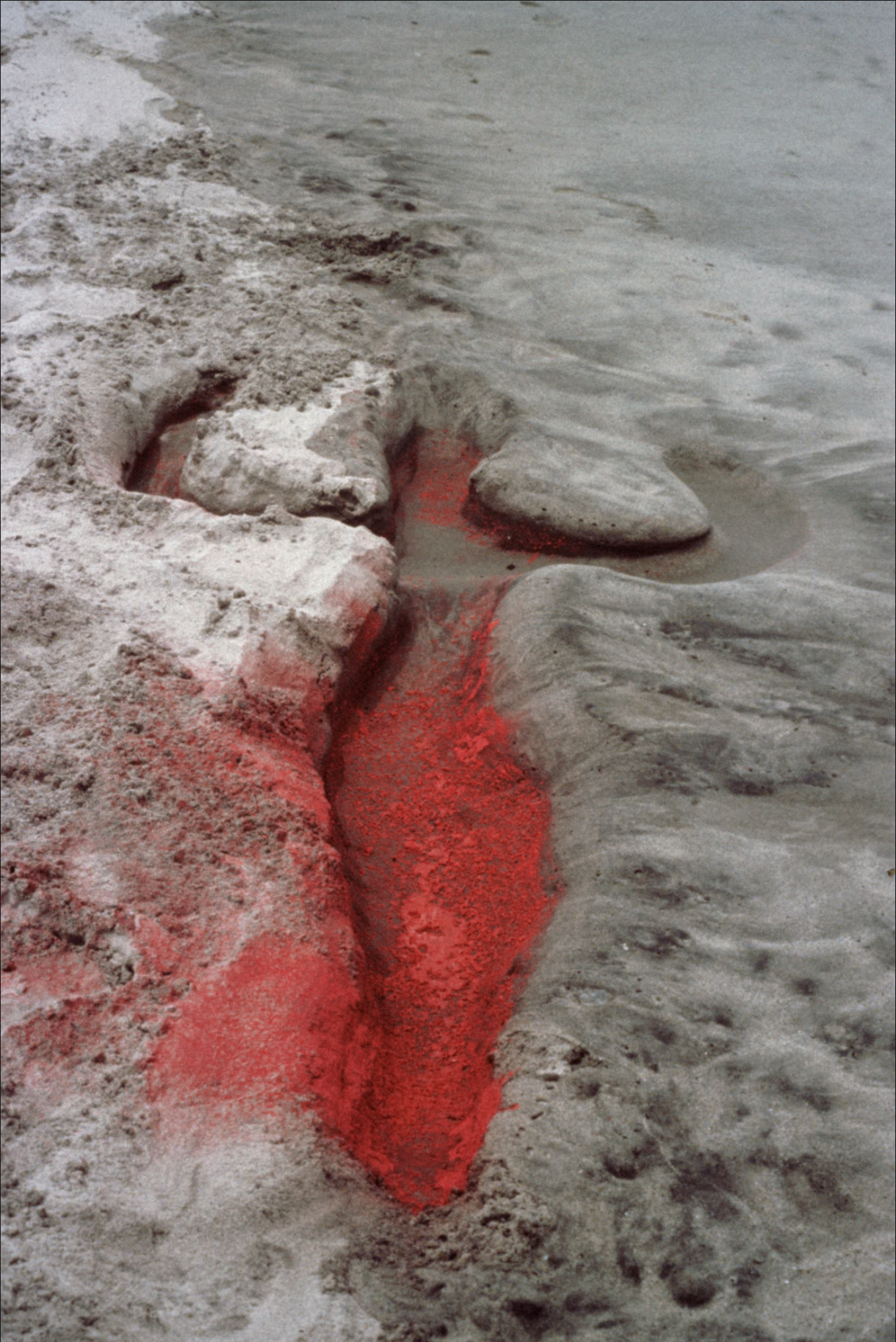
Ana Mendieta, Untitled Silueta Series, 1976.
Image courtesy of Marian Goodman Gallery/Alison Jacques, London/DACS 2026.
The Cuban-born artist Ana Mendieta worked across a variety of disciplines, and incorporated drawing, sculpture, photography, performance and film into her practice. She explored a dynamic approach to artmaking: rather than a series of static objects, her art exists in the process of its formation. It bridges the gap between opposing states: the US and Cuba, exile and home, absence and presence, generating energy through tension. Born in 1948 to an aristocratic family, Mendieta and her sister were flown to the United States as a part of “Operation Peter Pan”. This programme airlifted over 14,000 Cuban children from Havana to Miami after the Cuban Revolution with the support of the United States. At just 12 years old she was exiled from her parents and her country of birth. She spent her teenage years moving between orphanages in Iowa, while her father was imprisoned for eighteen years in a Cuban political prison. After training as a painter at the University of Iowa, she developed her interdisciplinary practice on the university’s new Intermedia programme between 1972 and 1974.
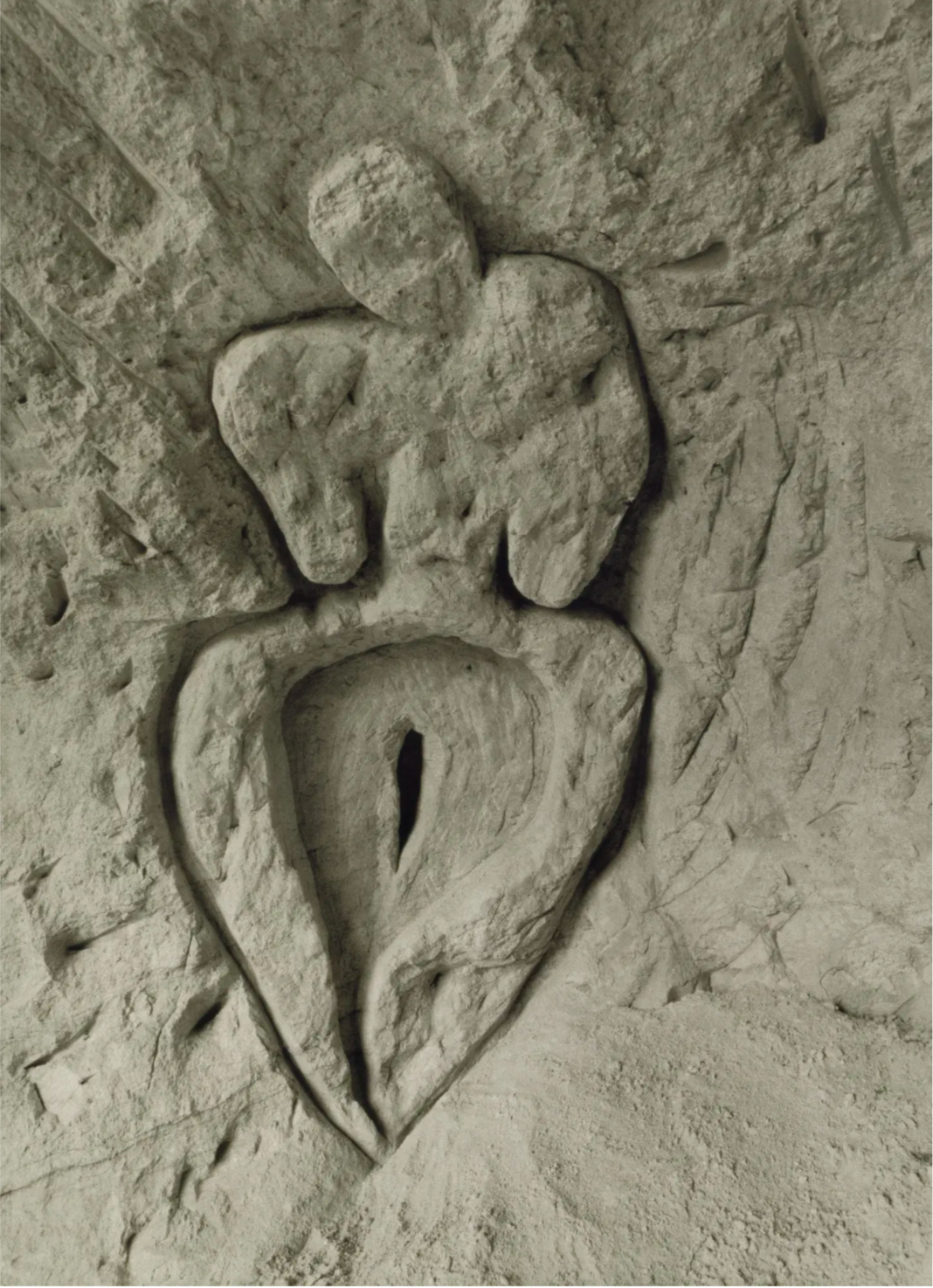
Ana Mendieta, Untitled (Guanaroca), 1981.
Image courtesy of The Estate of Ana Mendieta Collection.
Many of Mendieta’s artworks function as paradoxes, knitting absence and presence into a single image. They reflect both the artist’s displacement from her homeland, and her deep connection to it. Her ritualistic performance art and earth-body work drew on the Afro-Cuban religion, Santería, which developed in Cuba in the eighteenth and nineteenth centuries amongst enslaved people. Fusing Roman Catholicism with Yoruba beliefs, the religion reflects Mendieta’s interest in rituals, immersion in nature, and interconnecting spiritual energy. By drawing on the cultural vocabulary of Santería, she articulated the experience of exile and of Othering. She forged cultural bonds with her homeland, even as she remained geographically distanced, just as the displaced Santeros used their religion to re-establish ties to their community. Similarly, her Rupestrian Sculptures (1980-85) seek to re-establish bonds with the land from which she was removed. Mendieta carved these sculptures into the limestone Jaruco caves outside Havana after returning to her homeland. Influenced by petroglyphs, the titles of her Rupestrian Sculptures reference deities from indigenous Taíno culture and form an enduring presence in the landscape, equating land with home. In this way, she sought to bridge the abyss created by her displacement.
Mendieta referred to such works not as land art but as earth-body art, separating herself from the male-dominated land art movement that was developing at the time. Her sculptures centre the female body as a primordial force, combatting its colonisation as a passive object of male desire. This feminist protest statement is even more pronounced in her performance art. After a female student was murdered at her university, Mendieta staged the performance piece, Rape-Murder (1973), during which students from her M.F.A programme entered her apartment to see her bent over naked, covered in blood, and tied to her table. It made an unnamed victim and an abstract crime into a visceral reality for her audience. She frequently used blood in her performance art, such as in Body Tracks (1974), in a further reference to Santería practices: blood in Santería is associated with ashe, which means life source. By intertwining feminist statements and Santería practices, she related the reclamation of the female body to the reclamation of Cuba from colonisation.
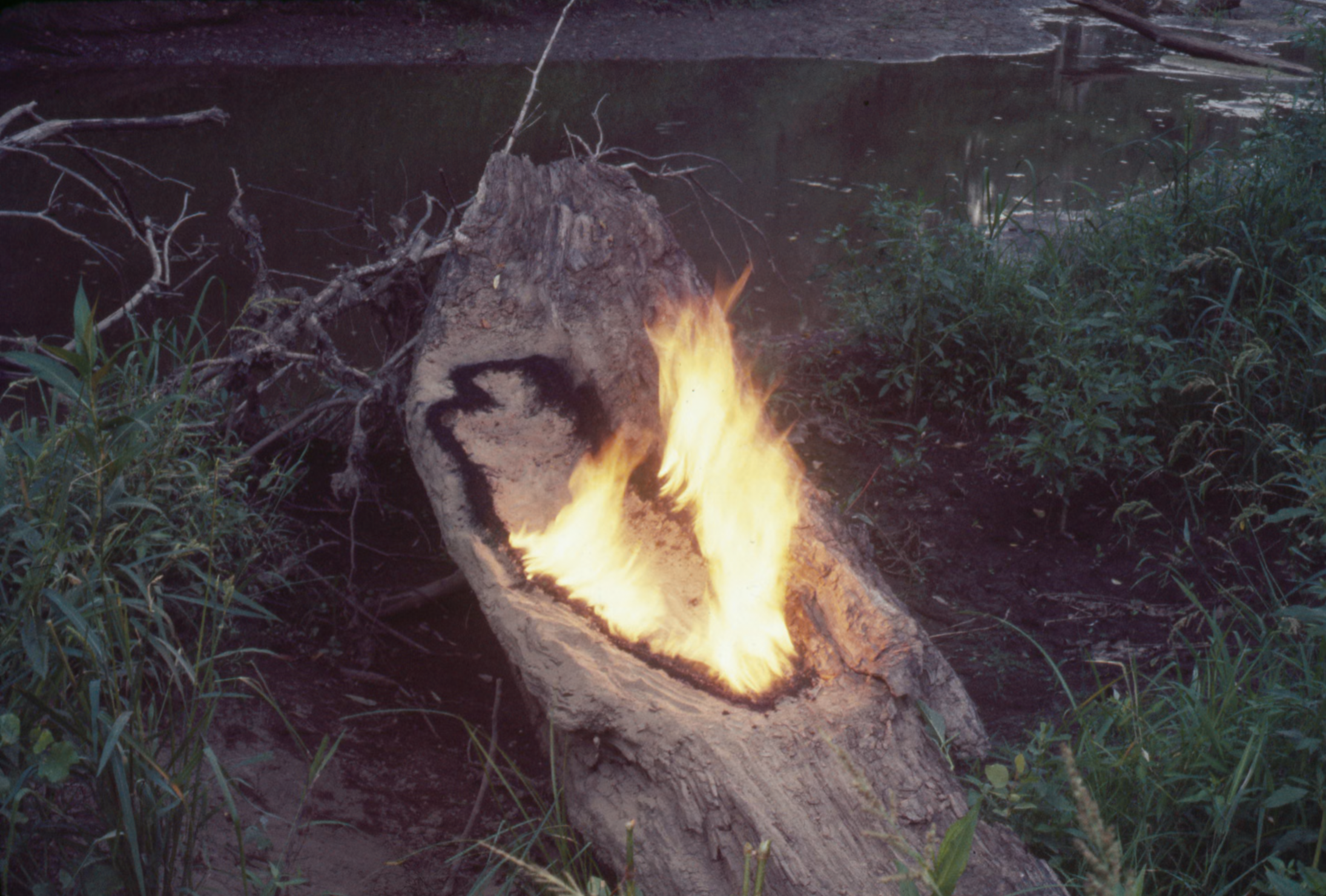
Ana Mendieta, Untitled, 1977.
Image courtesy of The Estate of Ana Mendieta Collection, LLC/DACS 2026.
In Body Tracks, she drags her arms, coated in red paint, down a canvas: her body becomes a paintbrush. Many of her artworks depict the transformation of her own body. In one film, she pours blood across her naked body before rolling in white feathers, becoming the sacrificial bird of Santería tradition; in another, her body melts into the trunk of a tree. In each case, her body seeks transformation, to become other than itself. But her art also outlines a deep connection between these varied states. This interconnectedness is influenced by the Santería concept of spiritual energy: “My art is grounded on the belief in one universal energy which runs through all being and matter, all space and time,” she said. In her art, the body has an alchemical power and contains within it the potential for metamorphosis: it can become a wild animal or an ancient deity, and is a material with which she produces art, like clay or paint. She depicted identity generally not as a fixed state but as a dynamic process of construction. In the photographic series, Untitled (Facial Cosmetic Variations) (January-February 1972), Mendieta sculpted her appearance with shampoo and cosmetics. In Glass on Body Imprints (1972), she pressed her face against glass, to create distorted and unsettling self-portraits.
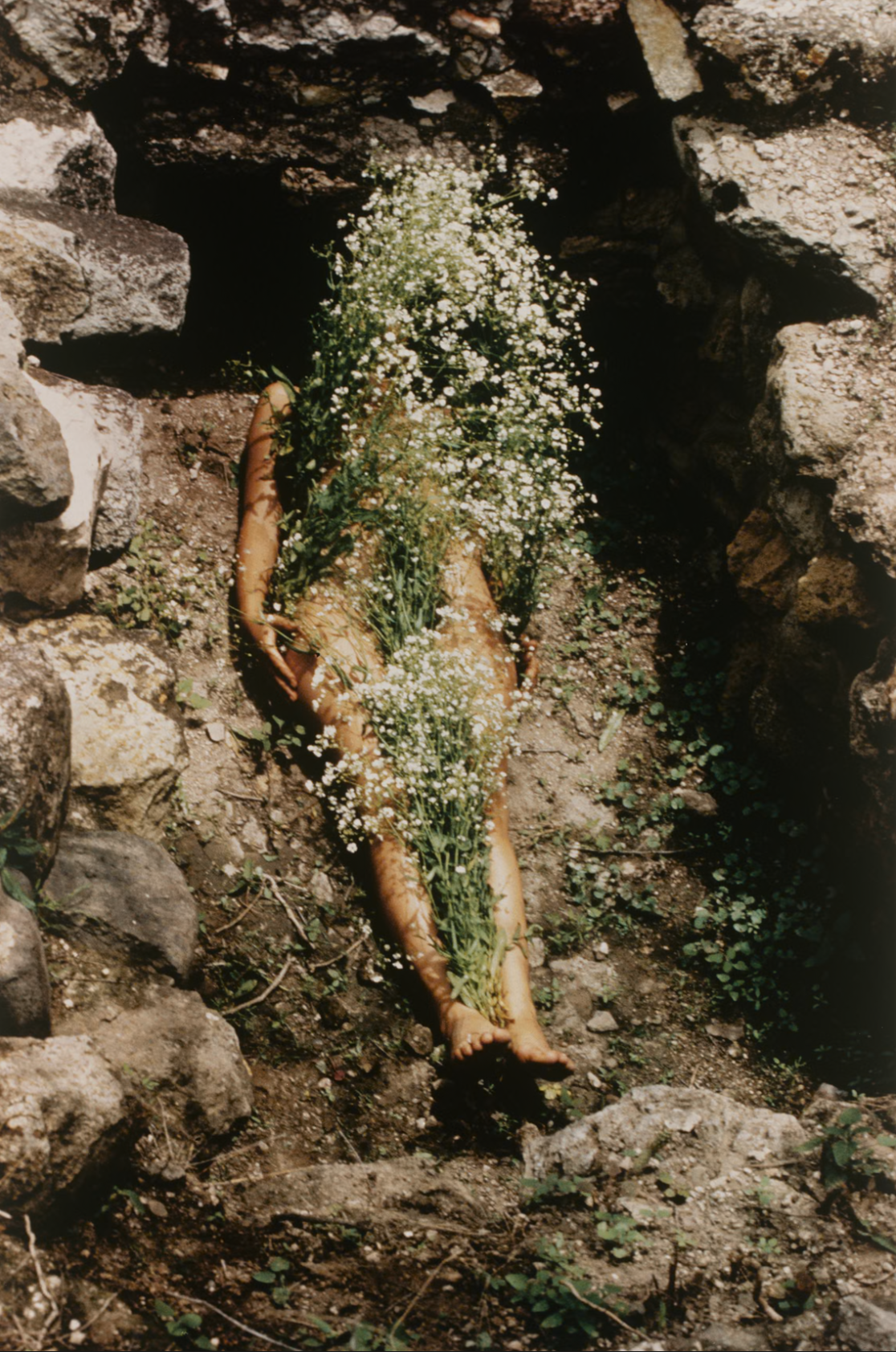
Ana Mendieta, Imágen de Yágul, 1973.
Image courtesy of: The Estate of Ana Mendieta Collection, LLC.
In her performance art, she protested the male-dominated art scene by centering her female body. The medium of performance also rejects the commercial art gallery system because it cannot be collected or commodified. Mendieta’s most widely known artworks, which derive from her Silueta series (1973-1980), are similarly ephemeral. Initially, she inserted her own body into these works and dressed her limbs in flowers and feathers, but later works are less corporeal, more ghostly. In these later works, she set her silhouette on fire, brightened by gunpowder. Her Siluetas possess a timeless, ancient quality, yet through their constituent materials of the body, mud, flowers, and fire, they remain restless and impermanent.
Her Silueta series is deeply concerned with leaving a mark, and with the threat of being erased: she appears as a haunting presence, a lively absence, in these artworks. This preoccupation with legacy is given a particular resonance by her suspicious death at the age of thirty-six. Mendieta died after falling from her apartment window, and her husband was accused of her murder. As a result, feminist groups turned Mendieta into a symbol of violence against women. Due to her exploration of this theme in her work, the lines between her biography and art became deeply blurred. Ana Mendieta’s estate, which is managed by her niece, rejects the sensationalising of her death, arguing that it reducesher to a victim. Her estate has sought to shift the focus from her death to her life, and to celebrate her as a talented artist rather than mourning her as a victim of male violence. At exhibitions of her husband, Carl Andre’s, work, protesters chant this question: “Where is Ana Mendieta?”. The message of Mendieta’s estate is clear: do not look for her in true-crime literature, or at her husband’s exhibitions, because you will not find her there, instead look for her in her art. They seek to reshape her legacy for the general public and refuse all mention of her violent death.
Mendieta’s art exists in the tension between opposing states: between disconnection and connection, between absence and presence, between movement and stillness. Her own legacy is fraught, caught between the protest movements that highlight her death and the academic studies that centre her work. Her art remains in a perpetual state of creation, evidenced by looped films of ritualistic performances and photographs of Siluetas still ablaze, just as her critical legacy continues to unfold.
Bibliography
“Ana Mendieta.” Tate Modern. https://www.tate.org.uk/whats-on/tate-modern/ana-mendieta/ana-mendieta.
Cabañas, Kaira M. “Ana Mendieta: ‘Pain of Cuba, Body I Am.’” Woman’s Art Journal 20, no. 1 (1999): 12–17.
Denes, Melissa. “‘I thought of her as a volcano’: the triumphant art and very troubling death of Ana Mendieta.” The Guardian, July 1, 2026. https://www.theguardian.com/artanddesign/ng-interactive/2026/jul/01/ana-mendieta-art-death
Remick, Rachel. “Ana Mendieta.” MOMA. https://www.moma.org/artists/3924-ana-mendieta
Roulet, Laura. “Ana Mendieta as Cultural Connector with Cuba.” American Art 26, no. 2 (2012): 21–27.