When Progress Becomes Horror: Tammy Nguyen’s Moral Cosmology
By Sophie Thompson
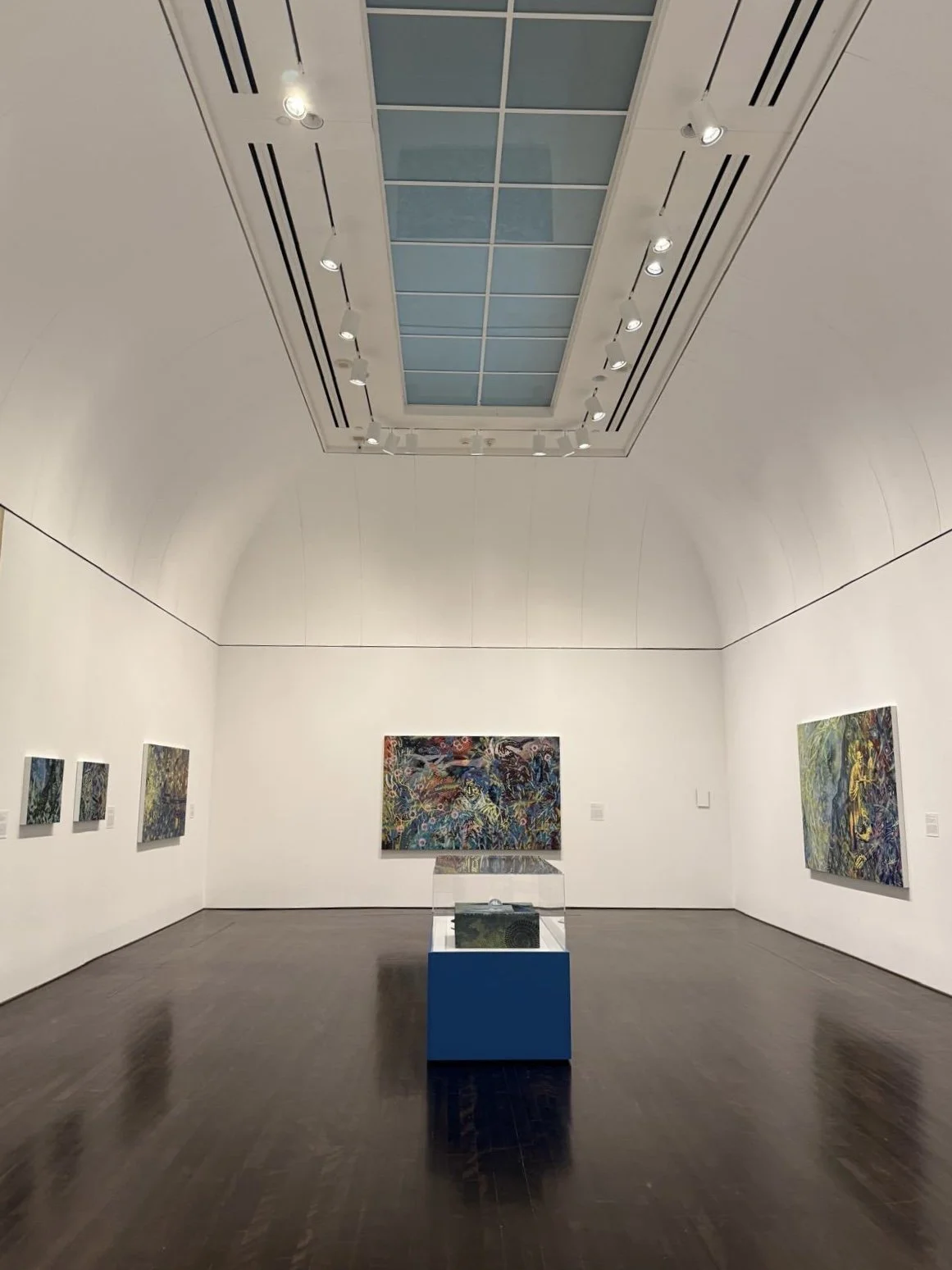
Installation view of Contemporary Project 16: Tammy Nguyen: The Horror! The Horror!, Blanton Museum of Art, 2026.
Image courtesy of Sophie Thompson.
There is something unsettling about leaving an exhibition that possesses as much beauty as Tammy Nguyen’s The Horror! The Horror! (2026). Mounted at Blanton Museum of Art in Austin, Texas, The Horror! The Horror! is saturated with colour: luminous yellows, deep blues, botanical forms, and intricate layers of images that seem to unfold the longer the eye lingers. Yet, beneath this visual richness lurks a considerably darker undercurrent. Nguyen explores what happens when humanity’s desire to know, invent and transcend its limitations becomes inseparable from its capacity for destruction.
The exhibition, the sixteenth instalment of the Blanton’s Contemporary Project series, brings together newly created paintings, prints and a handmade artist book. Nguyen weaves literary references, Cold War-era science, ecological imagery, along with figures drawn from history, mythology and popular culture. The result is what the exhibition describes as a world in which ambition, belief and invention repeatedly collide with instability. More significantly, it is a world in which morality refuses to remain comfortably divided between good and evil.
Nguyen’s title immediately establishes this tension. The Horror! The Horror! takes its name from the final words of Kurtz, a European ivory trader in Joseph Conrad’s Heart of Darkness (1899), uttered at the moment of his death after his descent into colonial violence and obsession. In Conrad’s novella, horror becomes indistinguishable from the pursuit of power itself. Nguyen seizes this moment of reckoning and recontextualises it within a much larger visual history of human ambition.
The invocation of Conrad is far from mere literary decoration. Throughout Nguyen’s exhibition, canonical texts become hermeneutic frameworks for the radical reconsideration of historical events. Her figures include Icarus, King Lear, Walter Cronkite, and Cold War scientists, surrounded by elephants, birds, snakes, moths, and dense vegetation. These references belong to drastically disparate contexts, yet the artist deliberately places them within the same pictoral universe. Under Nguyen’s brush, history becomes less of a linear sequence and more of a vibrant, tangled ecosystem in which ideas, actions, and consequences continually cross-pollinate and overlap.
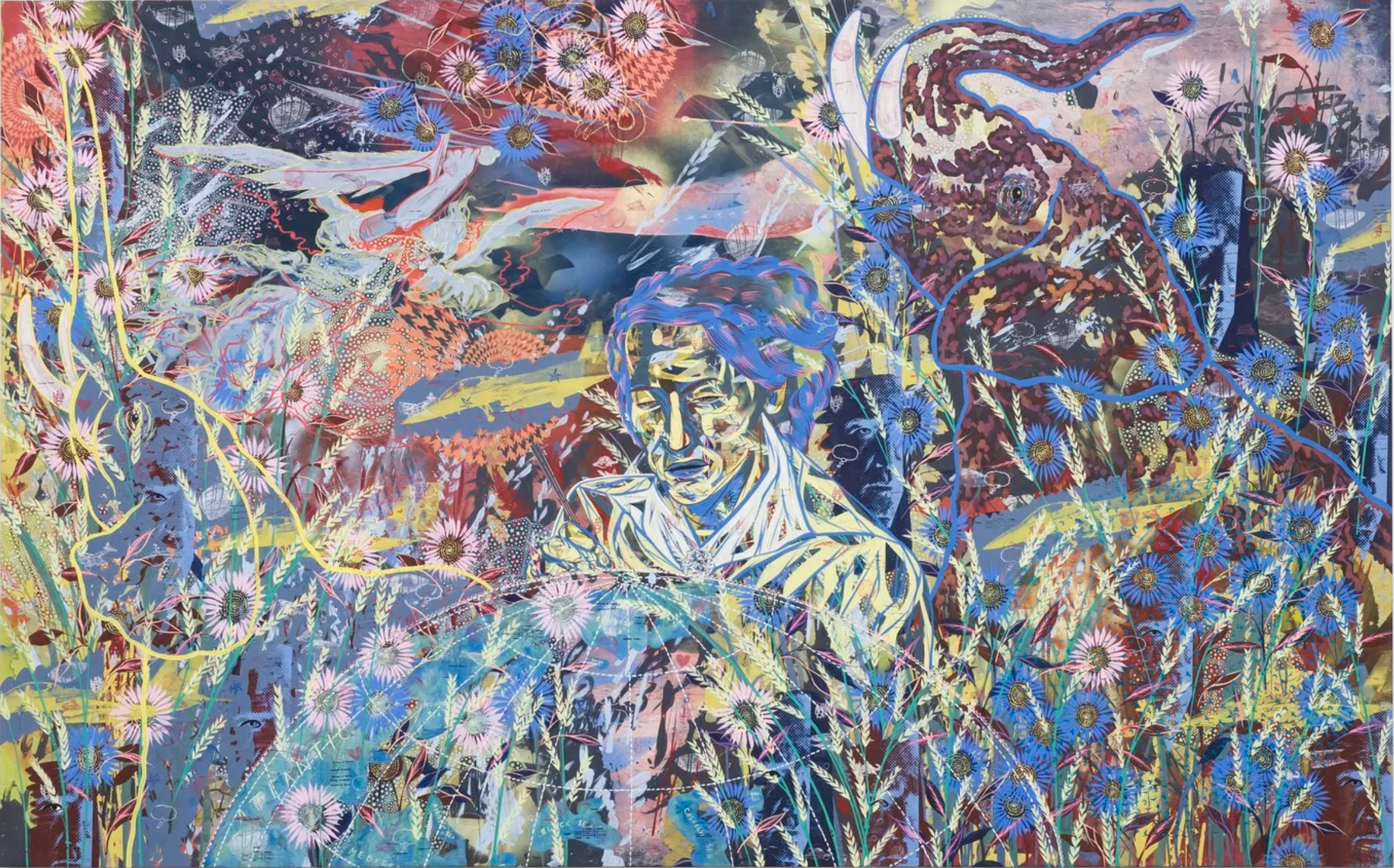
Tammy Nguyen, The Globemaker, 2026.
Image courtesy of Tammy Nguyen Studio / Blanton Museum of Art.
This is historiographical entanglement is particularly evident in The Globemaker (2026). The figure of the cartographer evokes humanity’s perennial desire to map and comprehend the world, but the surrounding jumble of imagery complicates that seemingly innocent pursuit of knowledge. Nguyen’s compositions repeatedly juxtapose images of scientific and technological advancement with those of conflict, destruction, and environmental vulnerability. The work does not imply that knowledge itself is immoral ,but rather it asks what happens when knowledge becomes entangled with the pursuit of hegemonic power, and when our ability to alter the world develops faster than our ability to comprehend the consequences of doing so.
That is the question that haunts Nguyen’s treatment of the Cold War. Her work draws upon the scientific and technological ambitions of the period, particularly the pursuit of aviation, nuclear technology, and space exploration. These developments can be understood as extraordinary monuments to human ingenuity, yet they unfold within a geopolitical environment shaped by military competition and the threat of catastrophic violence. Nguyen does not seek to resolve this contradiction. Instead, she makes the contradiction hypervisible through dense visual dissonance.
The recurring motif of flight is especially revealing in this regard. Icarus, perhaps the most ubiquitous symbol of dangerous ambition appears throughout the exhibition in the series Icarus, Where Are You? (2026). The myth traditionally offers an uncomplicated warning: reach too far, and you will fall. Nguyen’s Icarus, however, exists alongside scientists, inventors, and historical figures whose ambitions cannot be so easily condemned. Humanity requires ambition for creation, discovery, and progress, yet that identical impulse contains equal potential for catastrophe.
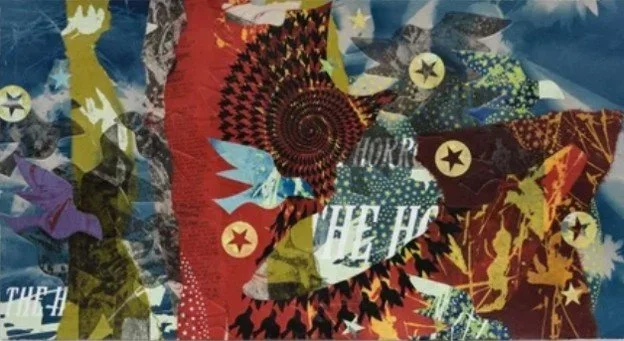
Tammy Nguyen, Icarus, Where Are You No. 1, 2026.
Image courtesy of Tammy Nguyen Studio / Blanton Museum of Art.
This ambiguity is central to Nguyen’s broader practice. Her work has repeatedly brought literature into conversation with geopolitical history, most notably in her earlier A Comedy for Mortals series, which reimagined Dante Alighieri’s Divine Comedy through the geopolitics of the Cold War. In Inferno, Dante’s descent into Hell was connected to the Space Race; in Purgatorio, the ascent towards spiritual purification became entangled with the 1955 Bandung Conference and the Grasberg mining project. Across these works, canonical literature becomes a conduit for interrogating histories that resist simplistic categorisations of heroism or villainy
This synthesis of narrative and geopolitical trauma makes Nguyen’s interest in moral ambiguity particularly compelling. Historical narratives are often constructed around clear binary opposites: progress versus stagnation, civilisation versus barbarism, hero versus villain. Yet Nguyen’s densely layered compositions render such distinctions increasingly difficult to sustain. A technological achievement can be simultaneouslyremarkable and destructive; an act of political ambition can produce both liberation and suffering. Even knowledge itself wavers on an uncertain ethical axis, contingent upon how it is acquired and what it is marshaled to accomplish.
The handmade artist book in The Horror! The Horror! reinforces this dialectic in material form. Nguyen was inspired by Ambroise Vollard’s Réincarnations du Père Ubu (The Reincarnations of Father Ubu) (1932), illustrated by Georges Rousalt. The book reimagines Alfred Jarry’s grotesque caricature of Father Ubu, a figure associated with absurdity, authoritarianism, and an exaggerated appetite for power. Nguyen draws particularly upon the chapter “Le Père Ubu à l’Aviation” (“Father Ubu Goes Flying”), transforming its absurd meditation on power and invention into another reflection on the porous boundary between reason and madness.
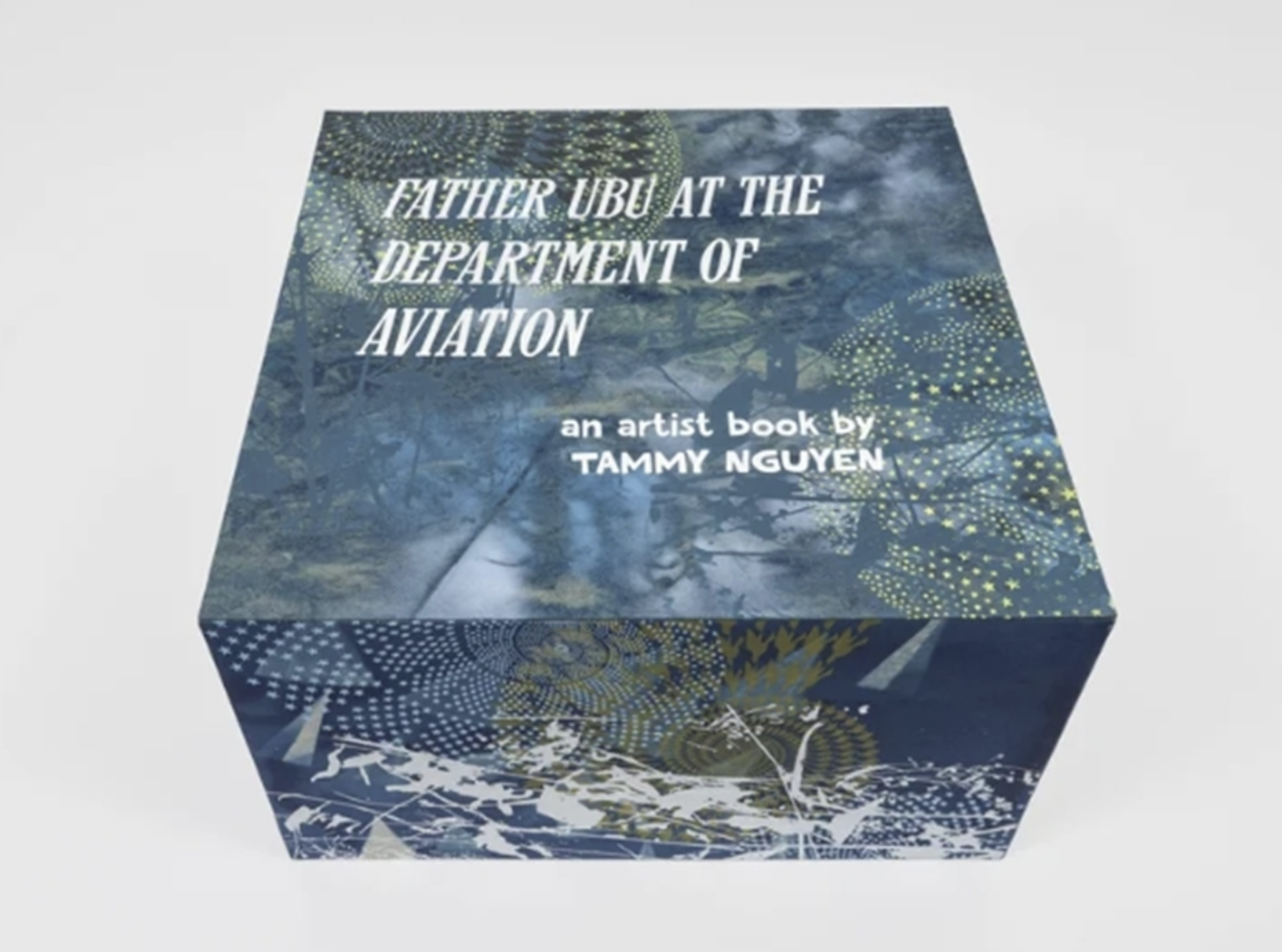
Tammy Nguyen, Father Ubu at the Department of Aviation, 2026.
Image courtesy of Tammy Nguyen Studio / Blanton Museum of Art.
The inclusion of Father Ubu is significant because Nguyen refuses to treat madness simply as the antithesis of rationality. Throughout the exhibition, madness appears simultaneously as danger and revelation: an incendiary force that can propel invention while simultaneously courting self-annihilation. This is perhaps where the exhibition’s moral ambiguity becomes most trenchant. Nguyen does not implore viewers to reject ambition, scientific discovery, or progress; instead, she asks us to confront the structures of belief that engender these pursuits, and the heavy toll of complicity that accompanies them.
The result is an exhibition that feels distinctly contemporary without relying solely upon the visual idiom of our moment. Nguyen looks backward—to Conrad, Dante, Cold War history, mythology, scientific treatises, and early twentieth-century satire—in order to examine patterns that remain chillingly recognizable. Her historical references are not presented as inert relics of the past; they become mirrors through which the present is laid bare.
Standing before Nguyen’s paintings, one finds oneself caught in an uneasy oscillation between admiration and dread. The longer one gazes, the harder it becomes to determine where beauty dissolves and horror begins. But perhaps that is precisely the provocation Nguyen intends. The Horror! The Horror! does not offer a moral lesson with a neat conclusion. Instead, Nguyen constructs a world in which history is layered, responsibility is fraught, and progress always carries the gravitational pull of consequence.
Her work ultimately suggests that grappling with issues of morality may require us to resist the comfort of simple opposites. Good and evil do not arrive under separate banners; they cohabit within the same invention, the same historical event, and the same human desire. Nguyen’s art asks us to rest in that uncomfortable space and to look again, to question what we think we know, and to confront the reality that the stories we inherit about progress and power are rarely as straightforward as they first seem.
Bibliography
Blanton Museum of Art. “Contemporary Project 16: Tammy Nguyen: The Horror! The Horror!” Blanton Museum of Art. Accessed 24 September 2026. Blanton Museum of Art exhibition page.
Blanton Museum of Art. “Contemporary Project 16: Tammy Nguyen.” 2026 Exhibition Press Release. 13 March 2026. Blanton Museum of Art 2026 exhibitions press release.
Conrad, Joseph. Heart of Darkness. 1899.
Nguyen, Tammy. “The Horror! The Horror!” Tammy Nguyen Studio. 2026. Tammy Nguyen Studio: The Horror! The Horror!
Vollard, Ambroise, and Georges Rouault. Réincarnations du Père Ubu. 1932.