Fashioned from Paradise
By Saskia Dickinson
The Year is 1892, and a London auction house has achieved a new record. It has sold 6,000 Bird-of-paradise skins in a single week. These birds have been hunted for a newly flourishing millinery industry, during a period known as the ‘Plume Boom,’ and are destined to adorn the headwear of elites across the western world.
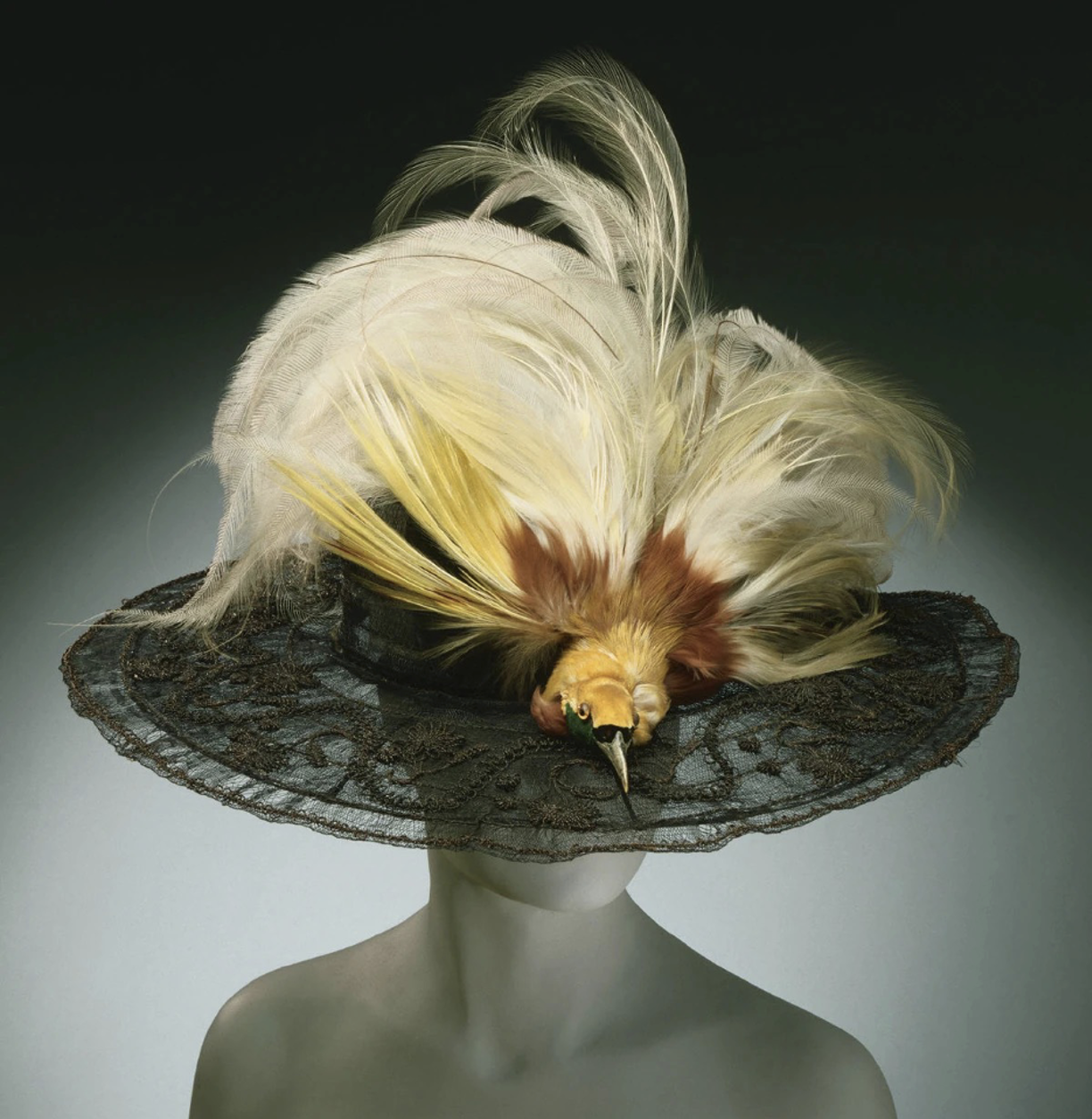
James G. Johnson & Co. Newark. New Jersey, Greater Bird of Paradise hat (black horsehair lace, stretched over a wire frame decorated with a Greater Bird-of-Paradise (paradise apoda)) c.1910.
Image courtesy of the Maryland Centre.
Now, in the 21st century, the relationship between fashion and birds of paradise looks quite different. Hats are no longer an outfit staple, colourful feathers have been replaced by synthetic dyes, and birds of paradise are protected species. However, this group of birds is still a fascinating case study for the sheer world-altering influence of fashion, and the tempestuous relationship that art has with the natural world. Exploring the history of ‘Paradise Fashion’ from past to present, this article seeks to illuminate the impact of these birds on fashion’s global legacy and hopefully answer how they may continue to shape it in the future.
In 1552, the first Bird of Paradise skins came to Europe. On arrival, they attracted immediate scientific and artistic fascination. Part of this intrigue was borne from misconception. The skins brought to Europe had been traded through second parties, meaning Europeans had only seen dead specimens, often with their feet and wings removed. Myths spread of birds that glided on the wind, needing no feet or wings because they never touched the earth, leading to the name: Paradisaea apoda, or “legless bird-of-paradise”. For Europe, these feathers were a commodity from heaven itself, impossibly beautiful, and alluringly unattainable.
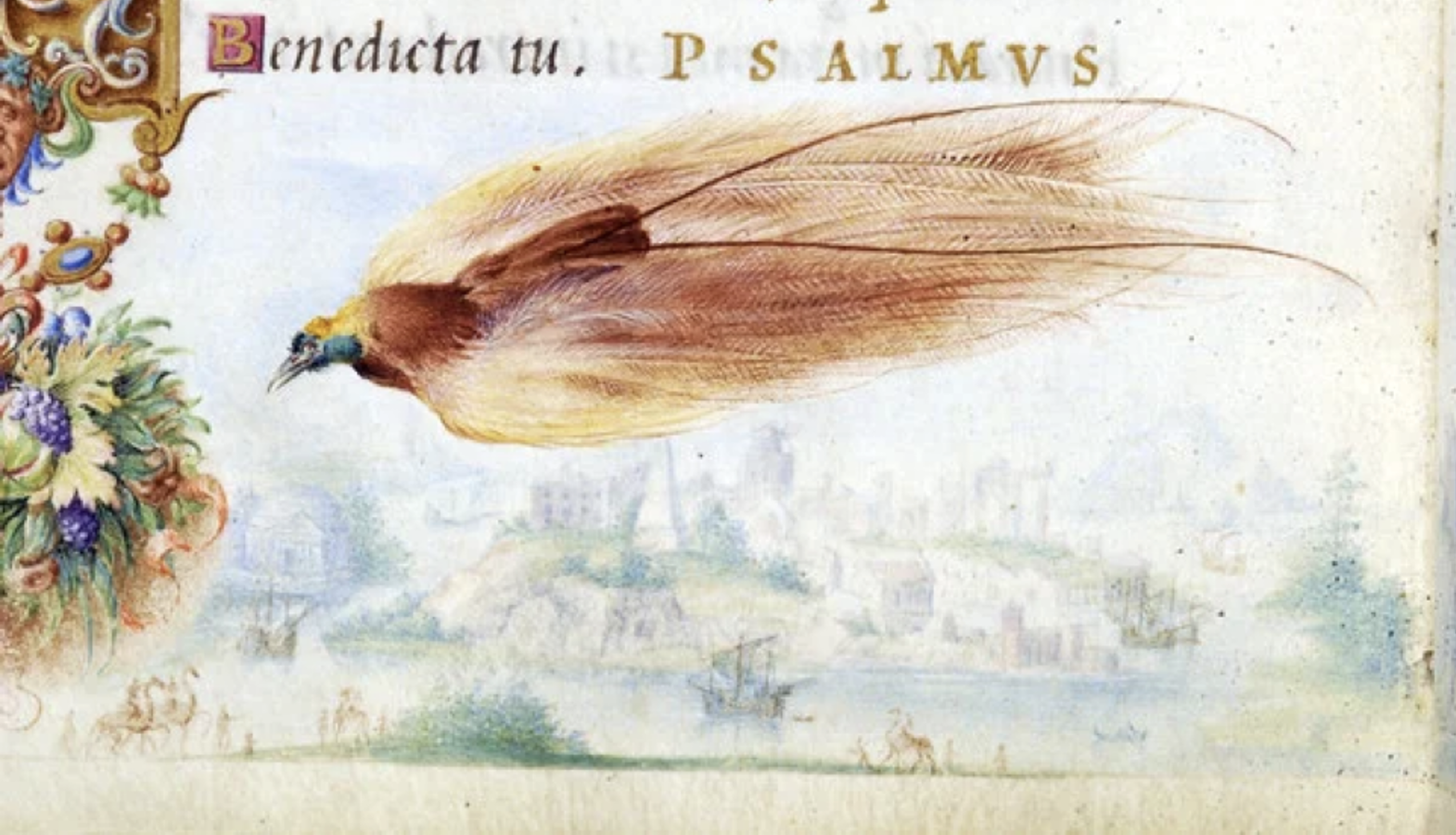
Julije Klovicín, Bird of Paradise illustration in Farnese Hours, (Paint, vellum manuscript, 173 x 110 mm) c.1546.
Image courtesy of Morgan Library and Museum.
'Paradise' would soon prove to be within Europe’s grasp. The Renaissance and Enlightenment had created new appetites for art, discovery, and collection, but it would take the Industrial Revolution for these desires to translate into acquisition. Cheaper manufacturing and rising income across classes in the 19th century led to an explosive demand for exotic luxury items. Meanwhile, growing imperial influence and steam-powered travel made that demand increasingly easier to fulfil. New Guinea was now within reach, and the Bird of Paradise was the jewel in its crown. Skins had historically been supplied to Moluccan traders by the Papuans, but in answer to growing demand, European hunters were sent into the islands, mapping and settling territories for colonial powers, and bringing indigenous communities into contact with Western powers for the first time. Indigenous groups like the Yonggom referred to Euro-Americans as ‘ono dapit’ well into the 1980s, a name which refers both to their light-coloured skin, but also to the greater bird of paradise, or ‘ono’, in recognition of the Western preoccupation with the species. In this way the feather trade became an active agent of colonial conquest.
Meanwhile in Europe and America the feather trade was mired by further controversy. Awareness of the trade's environmental cost grew steadily during the 19th century, but any protests were quickly swallowed by a louder question: Who was to blame? This debate over culpability is an enduring one. Does responsibility lie with the industry itself, or the consumers who necessitate and finance it? Then, as it is now, the answer was far from clean-cut.
In 1911, ornithologist Walter Goodfellow visited New Guinea and documented how trading houses would continue hunting and stockpile skins when periods of anti-plumage protests caused prices and demand to drop, waiting for the market to turn while creating an illusion of a thriving bird population. Moreover, traders had “the excuse of low prices to pay the shooters less, and as the latter [were] always kept in their employer’s debt”. As a result, legislation like the 1909 Dutch prompted objections from hunters who would be left destitute and in debt, resulting in the bans being repealed. Meanwhile, it was certainly in the traders' interests to keep the industry running. A spread from Eaton Co. Fall and Winter Catalogue (No. 108) 1913-14 advertised individual Bird of Paradise tail feathers for $12.00, around $400 in today’s currency.
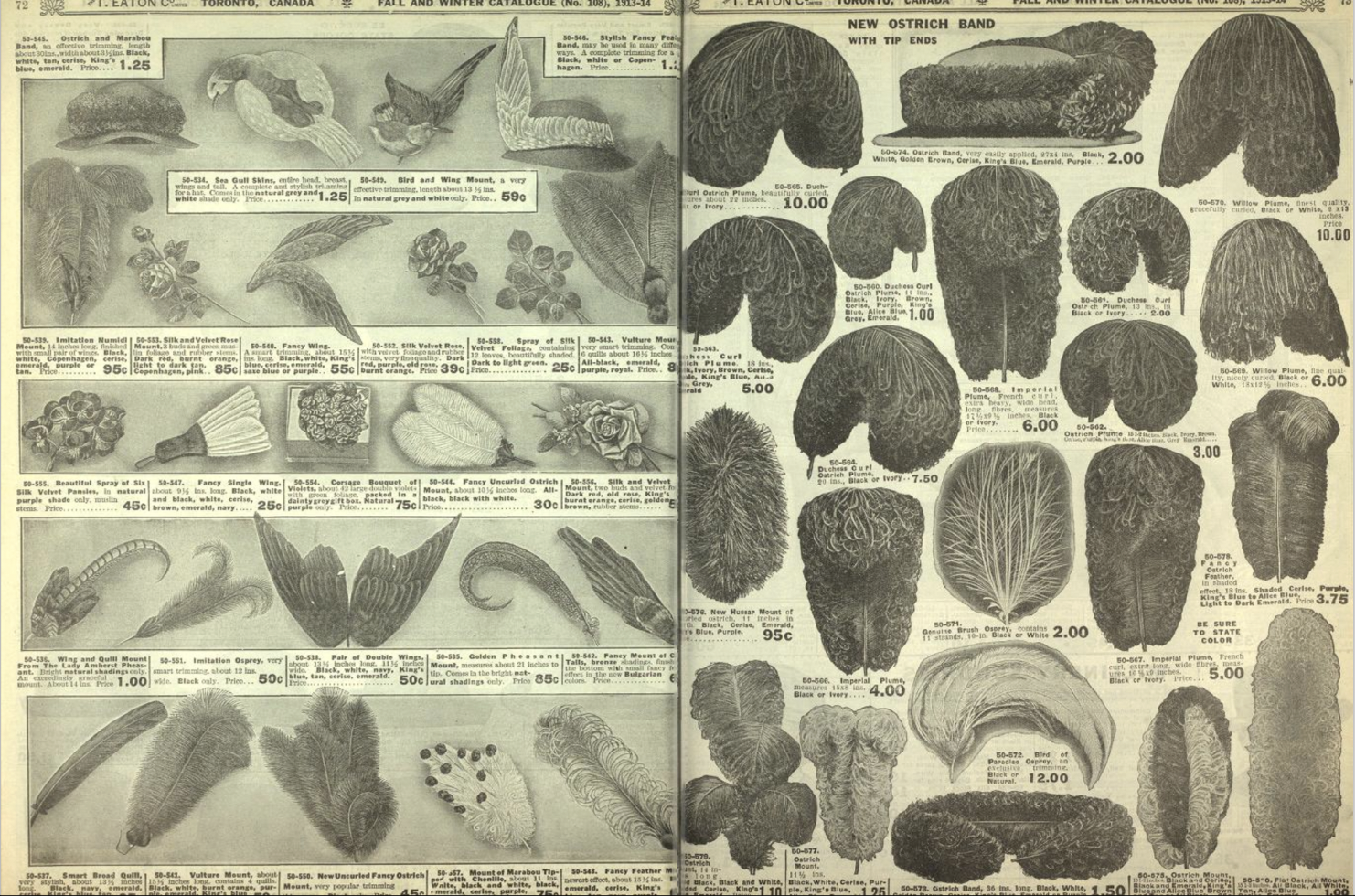
Unknown, Eaton Co. Fall and Winter Catalogue (No. 108) 1913-14, (Print Image) c.1913.
Image courtesy of Toronto Public Library
Across the Atlantic, Europeans cast the moral blame for these atrocities was almost exclusively on women. In The Woman behind the Gun, an illustration from Puck in 1911, male milliners are caricatured as tame dogs acting out the will of the female consumer. This increasingly gendered rhetoric created a moral smokescreen for the predatory mechanisms of industry. Women were shamed for indulging in feathered luxuries, and, in the same breath, criticised for their lack of style if they rejected these fashions. This scapegoating was additionally suspect given that the majority of campaigners against the feather trade were women, e.g. the first Audubon Society in America had a predominantly female membership.
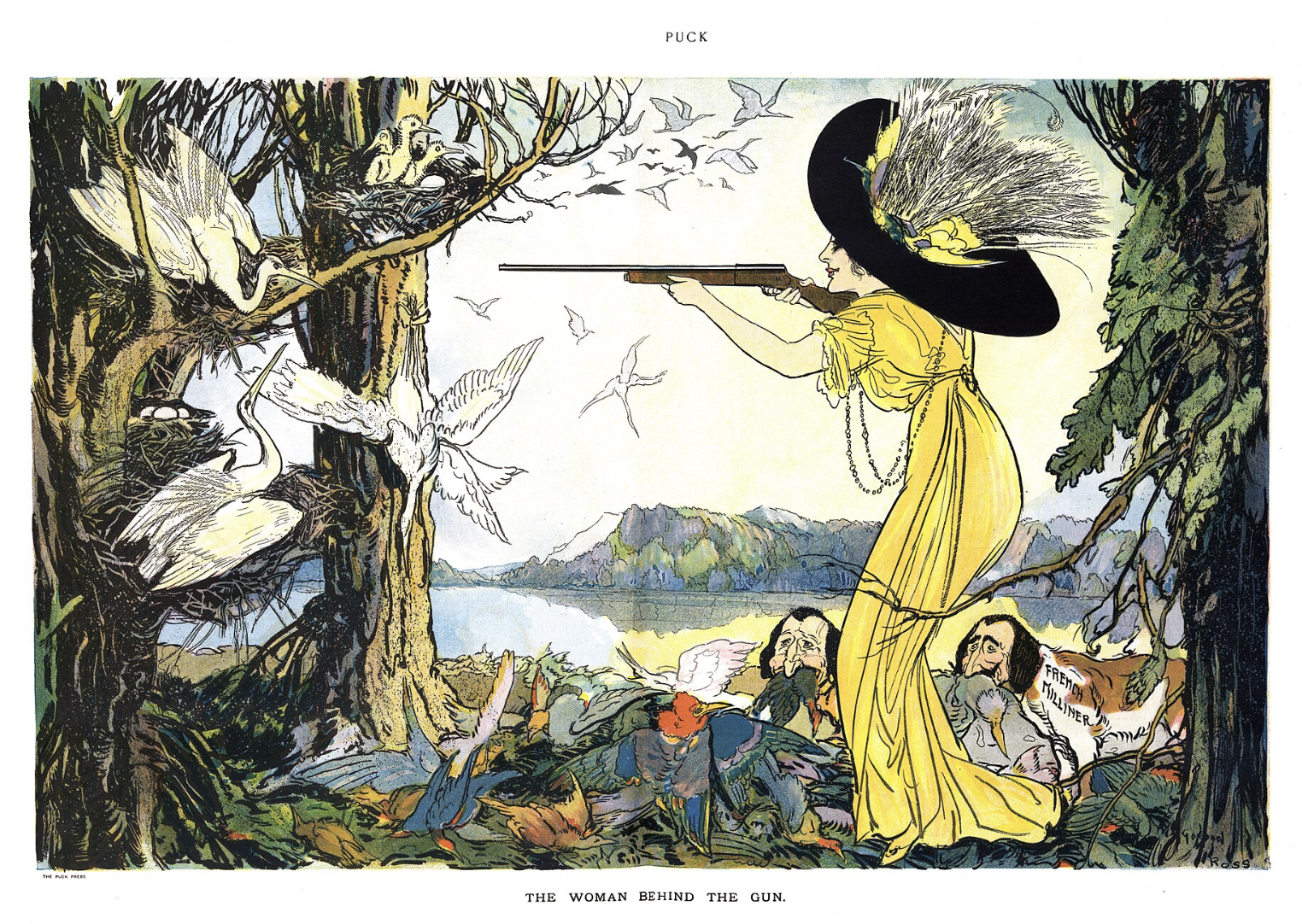
Gordon Ross, in Puck, The Woman behind the Gun, Photomechanical print, c. 24th May 1911.
Image courtesy of the Library of Congress.
This industry could not last, and in 1913 and 1921 sweeping bans in the US and the UK finally brought an end to the ‘Plume Boom.’ By then, sixty-seven species of birds were endangered worldwide. The New Zealand Huia and Carolina Parakeet were extinct. Some bird-of-paradise species were reduced to 5% of their original population size. At last the killing had finally stopped. The question then remains: Why?
There are two forces at work here. On one side, the activists, who had pushed bans, reforms, and legislation despite major political and economic pushback. These remarkable efforts were arguably the origin point for modern conservation as we know it today. But on the other side, a less altruistic and far more subtle force was at work. As scholar Dr Merle Patchett points out, ‘it was really a fashionable new hairstyle that ultimately saved the birds. In 1913, the bob and other short hairstyles were introduced — cuts which would not support large extravagant hats.’ On at least some level, the Birds of Paradise were saved by the same unpredictable force that had almost destroyed them: Fashion.
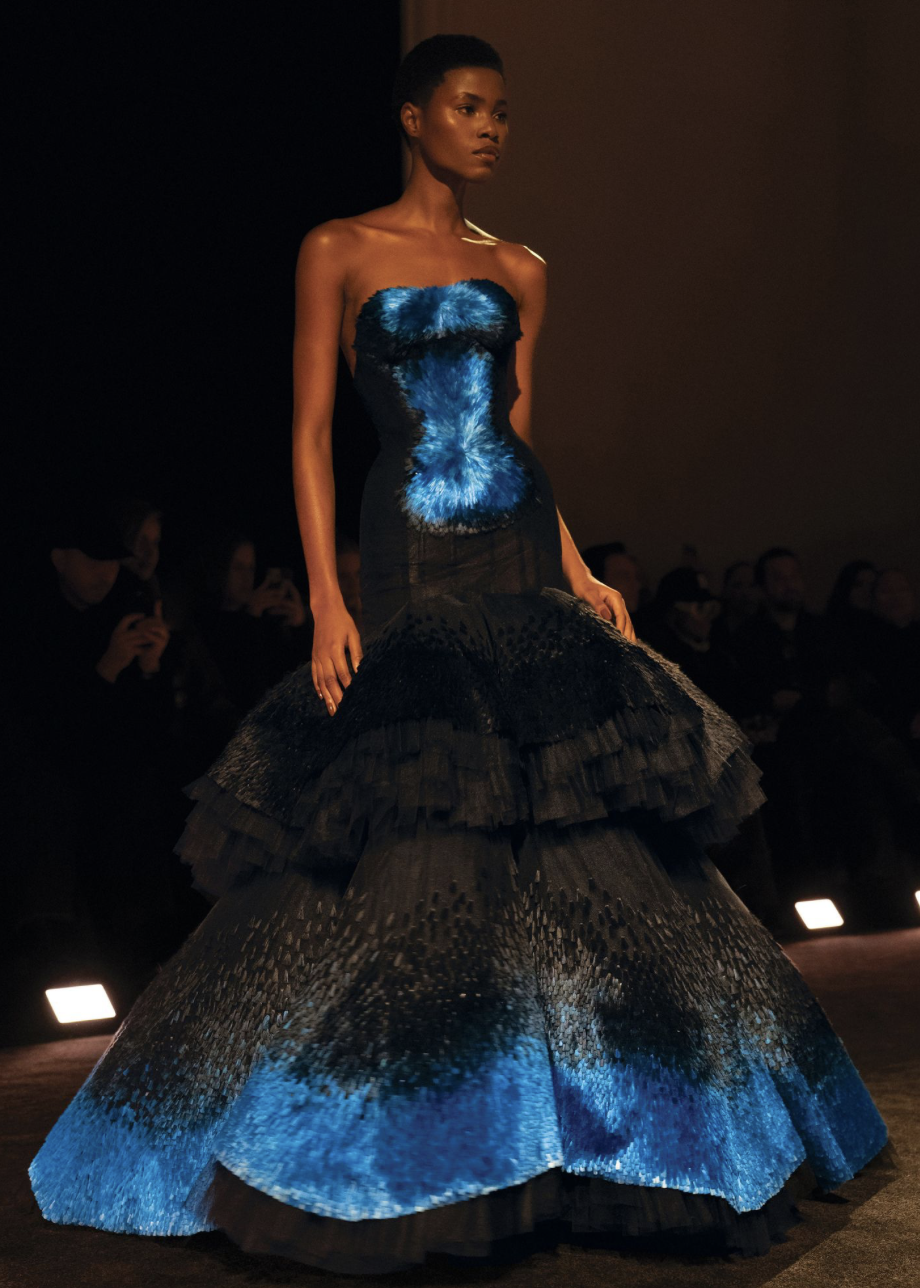
Schiaparelli, The Agony and the Ecstasy collection (spring-summer 2026) LOOK 26, (Moulded bustier gown in black, embroidered with a radial effect of 65 000 kingfisher blue and black raw silk feathers in satin stitch embroidery. Blue satin pump enhanced with a hand sculpted trompe l’œil bird’s head and a curved heel.), c.2026
Image courtesy of Vogue.
But this was not the end of fashion’s obsession with the bird of paradise. A 21st-century revival in ecologically inspired design saw ‘Paradise Fashion’ hitting catwalks across the globe. Iconic looks like McQueen’s La Dame Bleue Headdress, Birds-of-Paradise Gown, and Mugler’s La Chimère are testament to how these birds’ dramatic silhouettes and iridescent feathers are still synonymous with luxury in fashion today, but perhaps nothing shows their continued influence better than this year’s Schiaparelli, The Agony and the Ecstasy, collection. The show, which featured iridescent silk feathers and bird's-head earrings and shoes, was explicitly inspired by Birds of Paradise, though, in the words of director Daniel Roseberry, ‘no birds were harmed in the making of these pieces.’ This collection’s attention to the physical characteristics of individual species combined with an emphasis on ethical imitation is a fantastic example of the ever-increasing desire to simultaneously document and maintain the natural world, as a symptom of ever-escalating ecological loss. It also represents an increasing public awareness and fascination with these species, enabled by documentaries like Netflix’s Our Planet | Birds of Paradise, 2019, which publicised never-before-seen displays and images of the very species that Roseberry based his work on.
So, with the past and present of ‘Paradise Fashion’ covered, what does the future look like? At the risk of making a slightly unfortunate pun, the answer may be this: Bright! Birds of paradise get their beautiful, iridescent plumage from something called structural colour. This is a clear organic structure that bends light waves to create the illusion of bright pigmentation. Up until recently, it was impossible to synthesise artificially. However, in 2021 Kew Gardens’ ‘Naturally Brilliant Colour’ exhibition revealed a new technology to the public: ’Pure Structural Colour’, AKA artificial iridescence. As highlighted by Kew, it ‘has the potential to replace pigments used in wider industry that may not be sourced ethically or sustainably’. Unlike pigments, structural colour is not reliant on toxic chemicals, nor does it fade over time. This promises to alleviate waste and pollution for both producers and consumers. Animal products like fur and feathers may have fallen out of public favour in the 21st century, but fashion is currently the 2nd most polluting industry worldwide. Its environmental impact has arguably never been larger, and breakthroughs like these are key to the futures of both the industry and the environment itself. 'Paradise Fashion' has inspired innovation, spectacle, and destruction for hundreds of years – yet it may still be more significant today than ever before.
Bibliography
Cowie, Helen Louise. “Introduction.” In Victims of Fashion, p.1-16. Cambridge: Cambridge University Press, 2021. https://doi.org/10.1017/9781108861267.001.
Harrison, Thomas P. “Bird of Paradise: Phoenix Redivivus.” Isis 51, no. 2 (1960): 173–80. http://www.jstor.org/stable/226849.
Huang, Meilin, ShengGuo Lu, Yongcong Ren, Jingpeng Liang, Xueying Lin, and Xiaoru Wang. “Structural Coloration and Its Application to Textiles: A Review.” The Journal of the Textile Institute 111, no. 5 (2020): 756–64.
Kew.org. “See the Brightest Colours Ever Created on Display for the First Time | Kew.” Kew, 2021. https://www.kew.org/about-us/press-media/naturally-brilliant-colour-exhibition-kew-gardens.
Kirsch, Stuart . “History and the Birds of Paradise.” Expedition Magazine Volume 48, no. 1 (2006). https://www.penn.museum/sites/expedition/history-and-the-birds-of-paradise/.
Kroef , Justus M. van der. “Culture Contact and Culture Conflict in Western New Guinea.” Anthropological Quarterly 32, no. 3 (1959): 134–60. https://doi.org/10.2307/3316899.
“Murderous Millinery.” In Victims of Fashion, 17–54. Cambridge: Cambridge University Press, 2021. https://doi.org/10.1017/9781108861267.002.
Netflix. “Our Planet | Birds of Paradise | Exclusive Clip | Netflix.” YouTube, March 22, 2019. https://www.youtube.com/watch?v=rX40mBb8bkU.
Patchett, Merle, “1. Birds of Paradise,” Fashioning Feathers: University of Alberta Clothing and Textiles Collections. November 15, 2010. https://fashioningfeathers.info/birds-of-paradise/
Pernetta, John C, and Lance Hill. “Traditional Use and Conservation of Resources in the Pacific Basin.” Ambio 13, no. 5/6 (1984): 359–64. http://www.jstor.org/stable/4313075.
Roseberry, Daniel. “Haute Couture Spring-Summer 2026.” Schiaparelli.com, 2026. https://schiaparelli.com/en/pages/haute-couture-printemps-2026.
Swadling, Pamela, Roy Wagner, and Billai Laba. Plumes from Paradise : Trade Cycles in Outer Southeast Asia and Their Impact on New Guinea and Nearby Islands until 1920. Sydney: Sydney University Press, 2019.