By Alice Caserta De Arruda MacHado
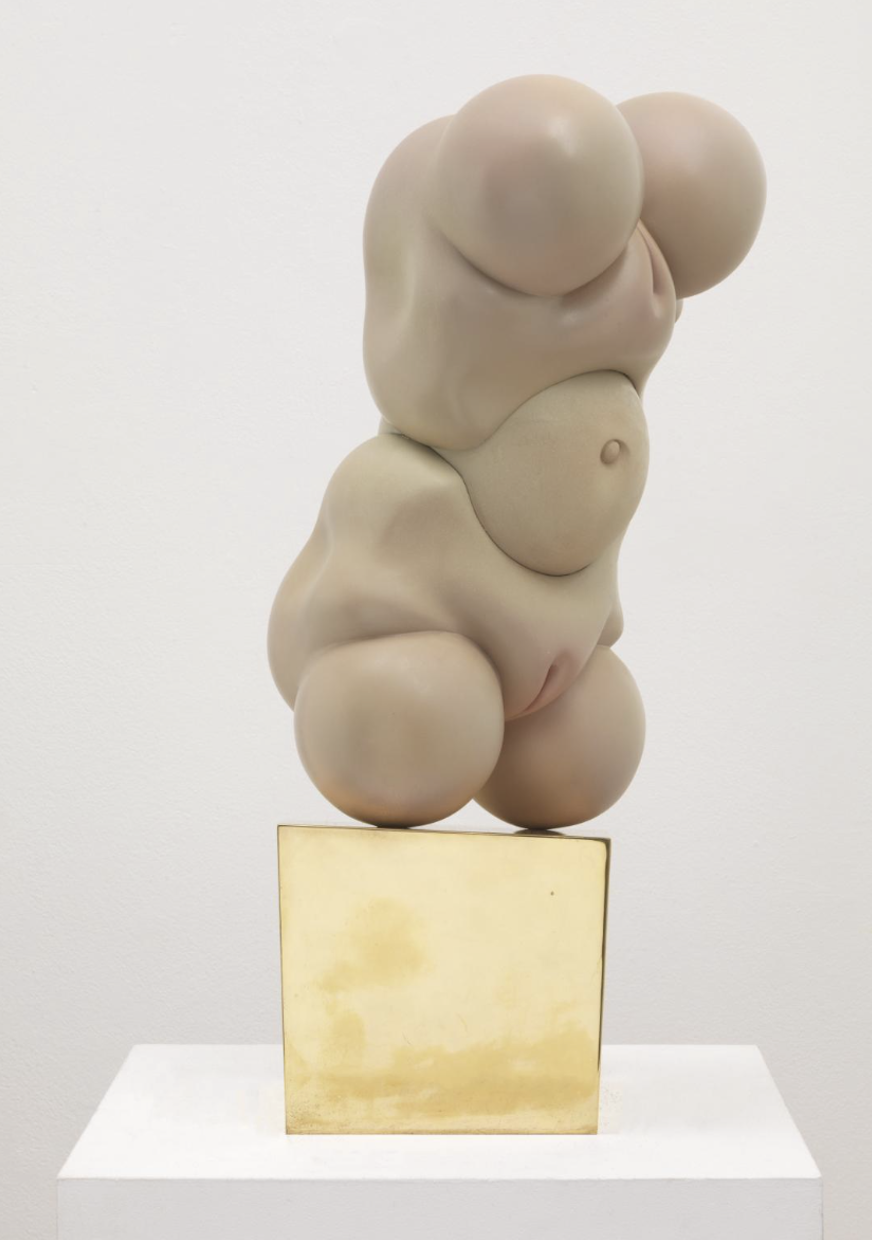
Hans Bellmer, The Doll, 1936 (reconstructed in 1965), Painted aluminium on brass base, 635 x 307 x 305 mm, Tate.
Image Courtesy of Tate.
In 1936, at an exhibition of Surrealist objects in Paris, Hans Bellmer showed a headless, armless form built from swollen spheres around a single ball joint. The piece was preceded by an earlier doll made of wood, plaster, flax-fibre and glue, designed so that its body could be taken apart and put back together in any configuration. Nearly thirty years later Bellmer had it cast and fixed in a single arrangement. It now stands, still, in museum collections, where it is read as defiance of the Nazi regime. Yet the question it poses, about a body whose entire meaning lies in being rearrangeable, is one the artist settled himself by casting it. The Doll (1936) is grotesque, bulbous and disjointed. Its skin is stretched and distorted into a form that makes no attempt to reproduce the natural body. It mocks it, bastardises it. Bellmer resists beauty and revels in disfigurement. But the disturbance the sculpture causes does not come from ugliness. It comes from what the ugliness is made to do. This the relic of an old artistic model, where the female body is seen as raw material for a male artist’s intellectual rebellion. The body carries anxiety, frustration, and libidinous desire. It is a site for the artist’s rebellion to be played and repeated, an “inchoate babble” in which it speaks for the artist rather than for itself.
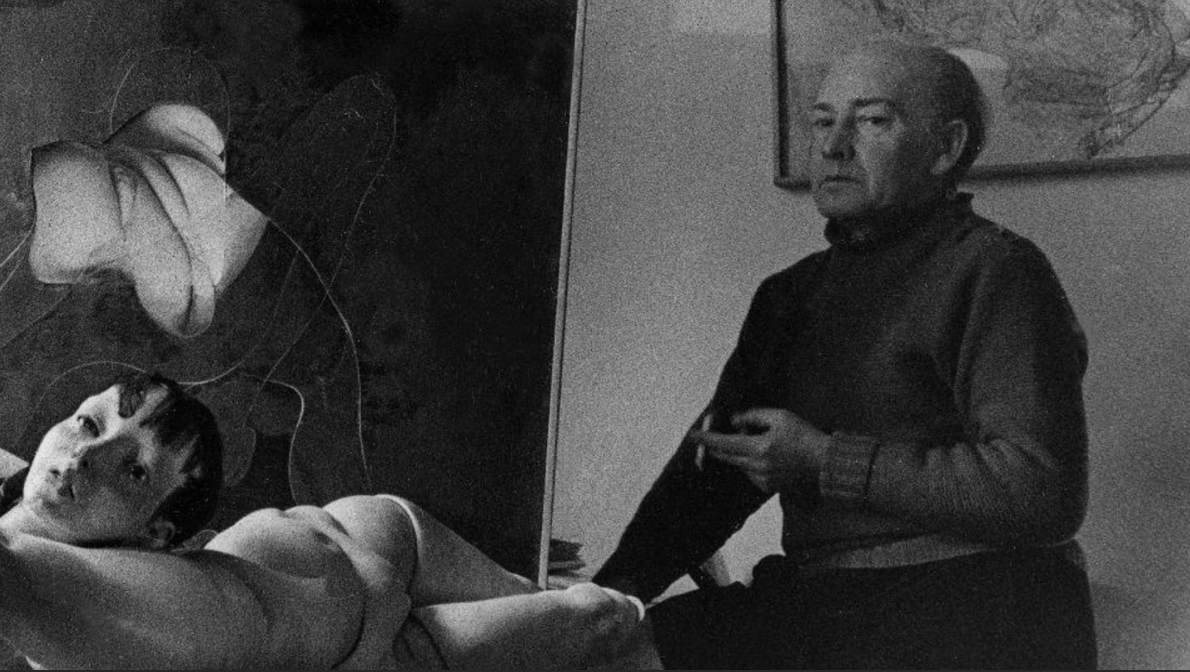
Pierre Argillet, Hans Bellmer with cigarette, Hotel Room, Rue Mouffetard, Paris 5th, 1963, Gelatin silver print.
Image Courtesy of Artsy.net
In early 1935 Bellmer travelled to Paris, where he met Paul Éluard and other Surrealist writers and was introduced to André Breton. Photographs of his first doll had appeared in Minotaure the previous December, and a group show at the Galerie des Quatre Chemins confirmed his place in the circle. In March he went back to Berlin, to a society that was scrutinising every corner of cultural life. Well before the Degenerate Art exhibition of 1937, modern works were already being gathered for public ridicule in so-called “horror chambers of art” organised by Goebbels’s Ministry for Public Enlightenment and Propaganda.
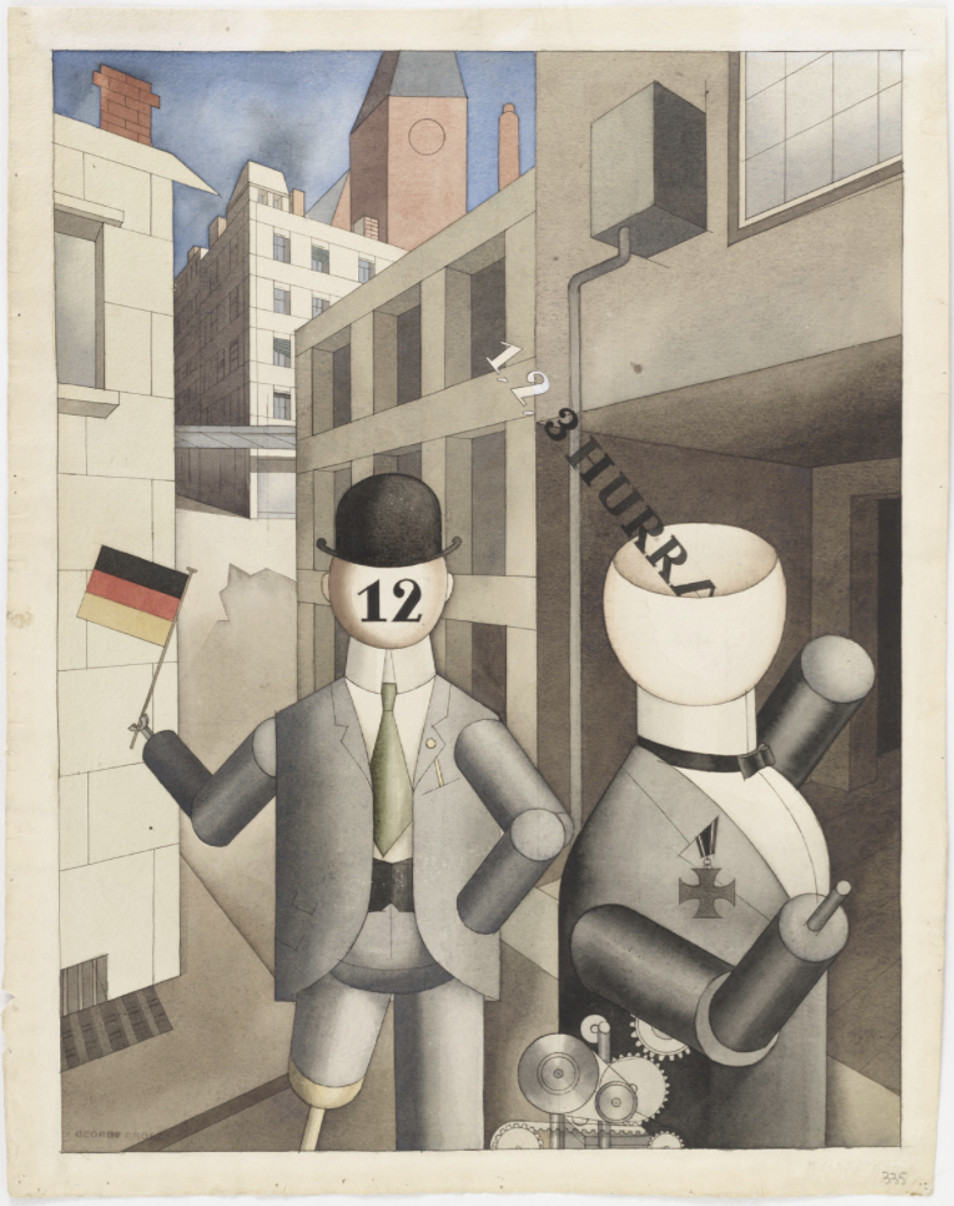
George Grosz, Republican Automatons (Republikanische Automaten), 1920, Watercolour and pencil on paper, 60 x 47.3 cm, Museum of Modern Art. Image Courtesy of MoMA.
Against that background, a headless, amputated body looks like a statement. It recalls the mutilated bodies that were left in the wake of the First World War, and it sets the ‘degenerate’ body against the ‘perfect’ Nazi ideal, with its claims to purity and idealism. But it is hard to look past the artist’s hand. The female form is mutilated under the guise of rebellion, repeating the violence it claims to resist. The eye scours every swollen bulge, and the doll is once again a marionette for a male artist’s message. Bellmer does not free the body from the regime’s ideal. Instead, he replaces one prisoner with another, exchanging the classical for an uncomfortable theatre of mutilation.
The Nazi regime can be considered as having two conceptions of the body. The first was ideological: the Volkskörper, a living, whole, racially unified body. The second was administrative: bodies as countable, sortable, interchangeable units on a form. Hannah Arendt, a German-American philosopher, and her portrait of Adolf Eichmann shows a man who almost exclusively considered this second type of body. He was a logistician for whom people were seats on a train and entries on a list. While historians have since contested this portrait, it remains useful as a description of a mode of thinking. Critics usually read The Doll as a rebuke to the first body: a mutilated, broken, imperfect form set against the Aryan ideal. But in refusing wholeness by breaking the body into rearrangeable parts, Bellman still reflects the logic of the second body. Bureaucratic reason works by fracturing the body into interchangeable units. The Doll escapes the Nazi myth of the whole only by perfecting the Nazi practice of the part. Bellmer’s own phrase for the doll’s endless recombination, the “anagram of the body”, describes a filing system. Thus, in the very manner of resistance, the body is oppressed.
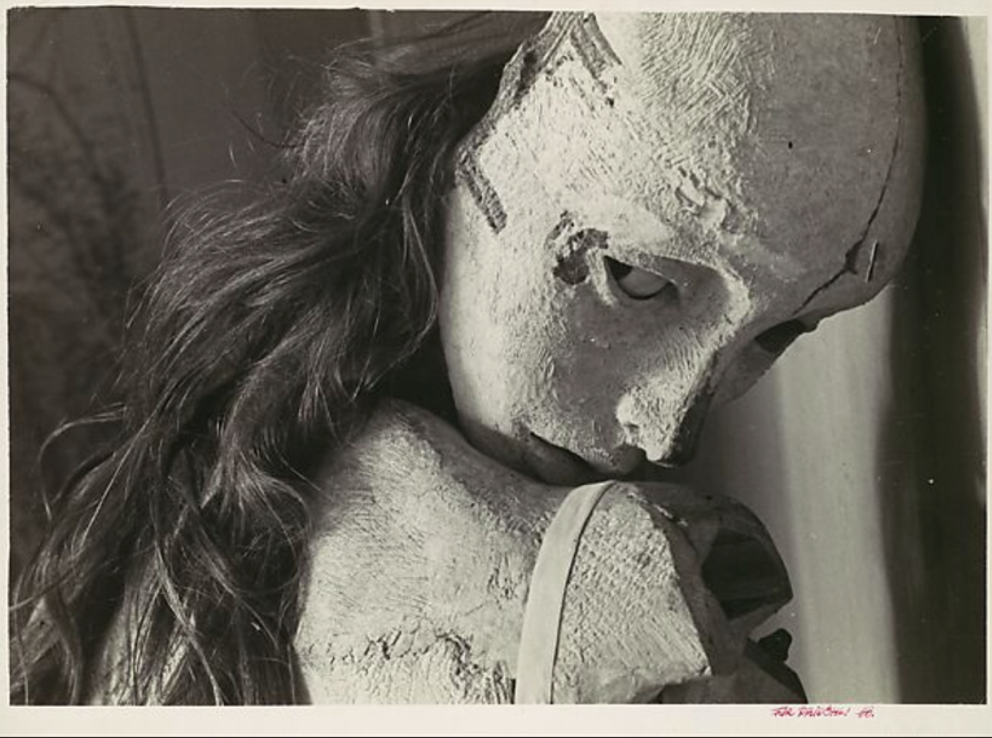
Hans Bellmer, La Poupée (The Doll / Die Puppe), 1934, Gelatine silver print, The Metropolitan Museum of Art.
Image Courtesy of Sotheby’s.
Here the question of male emancipation becomes precise. A man who cannot act under the regime builds a world in which action is unnecessary. In The Human Condition, Arendt separates freedom from sovereignty, arguing that the ideal of sovereignty denies the plurality on which freedom depends. Bellmer’s studio is the clearest case: a sovereign without plurality, who experiences that condition as liberation. He is candid about the fantasy. In Memories of the Doll Theme he imagines the doll as a final triumph:
“Would it not be the final triumph over those adolescents with wide eyes which turn away if, beneath the conscious stare that plunders their charms, aggressive fingers were to assault their plastic form and slowly construct, limb by limb, all that has been appropriated by the senses and the brain? Adjust their joints one to the other, arrange childlike poses by using ball joints to their fullest extent, follow very gently the contours of the hollows, taste the pleasure of the curves, wander in the labyrinths of the ears, make everything pretty, and ruthlessly spill the salt of deformation… Should not that be the solution?”
Giorgio Agamben’s concept of bare life gives the position a name. Agamben describes the homo sacer as a life stripped of political standing and exposed to whoever holds power over it. The sovereign is whoever decides the exception, the moment the usual protections of a body are suspended. The Doll is that condition with the ‘person’ removed. It keeps the human form that holds the viewer’s attention, shocks us, disgusts us, but the possibility of a victim has been built out, so that it is human enough to arouse and not human enough to wrong. Bellmer in the studio is a sovereign in miniature.
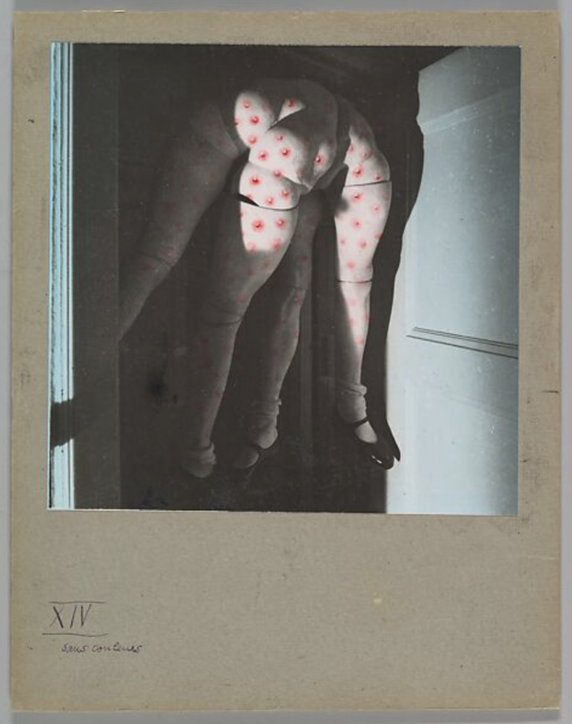
Hans Bellmer, La Poupée (The Doll), 1938, Gelatine silver print with applied hand, 17.9 × 18.3 cm, The Met. Image Courtesy of The Met.
Bellmer’s nude is not free from objectification despite its far more abstracted depiction of the body. The Classical body is static, permanent in its divine perfection; the Surrealist body is broken, dismembered. The Classical body was exalted and the Surrealist body debased, but neither is autonomous. What is most disturbing about the cast is its rendering of the genitals: a smooth surface in the manner of antique sculpture, producing an image that is eerily infantilised. This is not female freedom, it is spectacle. And yet the doll has been used continually as a tabula rasa on which artists etch their own philosophy, an unrestricted, accessible commodity for exploring one’s own suffering. The casting completes the gesture. The body designed to be rearranged without end was frozen by its maker in the single form that would last. The doll cannot be wronged: a real transgression needs a victim, and it has none. Yet the work only resonates if the viewer feels transgression, the frisson, the discomfort in the chest. That feeling is the recognition that this is a body, a person’s body, so the work depends on the very personhood it denies. From the inside, you cannot tell your conscience from your pleasure. That is a better account of ‘banality’ than any monster. The sense of wrongdoing has become part of the experience. In its appropriation of the body, the work feigns profundity. Bellmer’s gratuitous expression of the psyche is trapped in its cold patina and looking at it, you do not see rebellion, but domination.
Bibliography
Nikolopoulou, Kalliopi. (1998) 2000. Review of Homo Sacer: Sovereign Power and Bare Life. Review of Homo Sacer: Sovereign Power and Bare Life, by Giorgio Agamben. 124–31.
Pepperell, Robert. (2000) 2002. Review: Art, Obsession and Possession: Is Freud Still Interesting? Review of Hans Bellmer: The Anatomy of Anxiety and Myth and Metamorphosis: Picasso’s Classical Prints of the 1930S, by Sue Taylor and Lisa Florman. 455–57.
Poë, Simon. 2011. ‘The Cult of Beauty: The Aesthetic Movement 1860-1900 “Victoria and Albert Museum’. The British Art Journal 11 (3): 89–91.
Spampinato, Francesco. 2016. ‘Body Surrogates’. A Journal of Performance and Art 38 (2): 1–20.
Taylor, Sue. 2000. Hans Bellmer : The Anatomy of Anxiety. MIT Press. https://archive.org/details/hansbellmeranato0000tayl.