Confectioned Cities: A Global Art History made Edible (The Case of April’s Baker London)
By Natalia Ramirez
‘Culinary art is expressed in possible gradations of polarity between the new (originality, surprise, shock) and the known (familiarity, comfort, reassurance).’
- Silvia Bottinelli and Margherita d’Ayala Valva in The Taste of Art: Cooking, Food, and Counterculture in Contemporary Practices
Confectioned by two sisters in London, April’s Baker curates robustly ornate cakes featuring color palettes, architectural piping, and municipal motifs. Their cakes, meant for consumption, speak to something deeper about making cultural essences palatable, transmissible, and accessible for appreciation to a wide audience. Standing out most is their well-established series, Cities Around the World as Wedding Cakes, a cheekily creative collection of cakes that combine aesthetic elements to transform the essence of global urban imagery into something literally digestible.
Food as art is far from a new concept, with the need to feed being an innately human problem to solve, the refinement of flavor, color, material, form, and visuality coalesce into skillful creations of ephemeral sustenance; as art often does, infusing utility with visual value. As the philosopher Adam Andrzejewski argues in How to Frame Edible Art, food may become art when it is presented and interpreted within a framework that invites aesthetic contemplation rather than mere consumption. Complimentary scholar Maddalena Borsato describes pastry as occupying a liminal space between art and everyday life: an edible medium capable of adopting the formal qualities of sculpture, architecture, and design. Confectionery has historically imitated architectural structures and decorative traditions, from elaborate sugar sculptures to ornate wedding cakes. In this sense, decorated cakes already share a long lineage with the visual arts.
The city cakes of April’s Baker extend this tradition by treating urban form itself as aesthetic material. Their designs rely on visual shorthand: the recognizable architectural silhouettes and colour palettes through which cities circulate globally in photographs, tourism imagery, and popular media. In this sense, the creations function more as objects of admiration than of accuracy, often serving as catalysts for controversy, as their reception faces an internet-based global audience with an innumerable variety of perspectives. I argue, however, that their cakes illuminate a hopeful admiration for a multilocal world through a consumable composition. Having created more than twenty diagram-like urban cakes, each one captures a sweetness from a different corner of the globe.
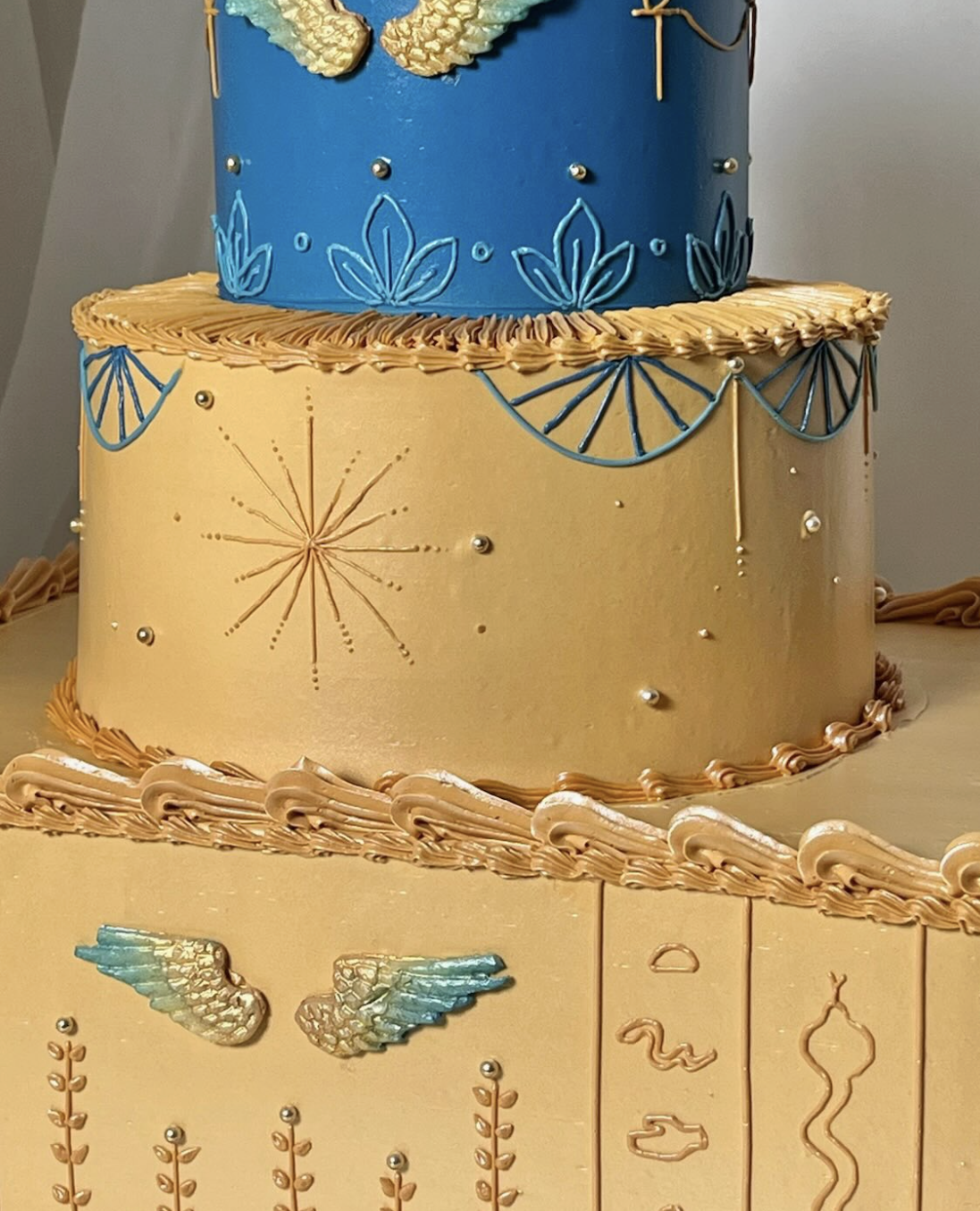
Cairo cake, 2025.
Image courtesy of April’s Baker London Instagram (@aprilsbakerlondon).
The Cairo cake, gilded in an opulent gold, provides a striking example. The visual identity of Cairo is frequently associated with the monumental forms of ancient Egyptian architecture, most famously the pyramids, which pierce the sky from the desert plateau near the city. Structures such as the Great Pyramid of Giza have long served as global symbols of Egypt, appearing in everything from tourism imagery to film and, of course, art history. Their bold geometric order makes them instantly recognizable. In the cake’s decorative language, these monumental forms become simplified shapes rendered in frosting and confectionery ornament. The pyramids appear as abstracted shimmering shapes rather than realistic archaeological structures, translating easily into decorative motifs and thus capturing a semiotic essence.
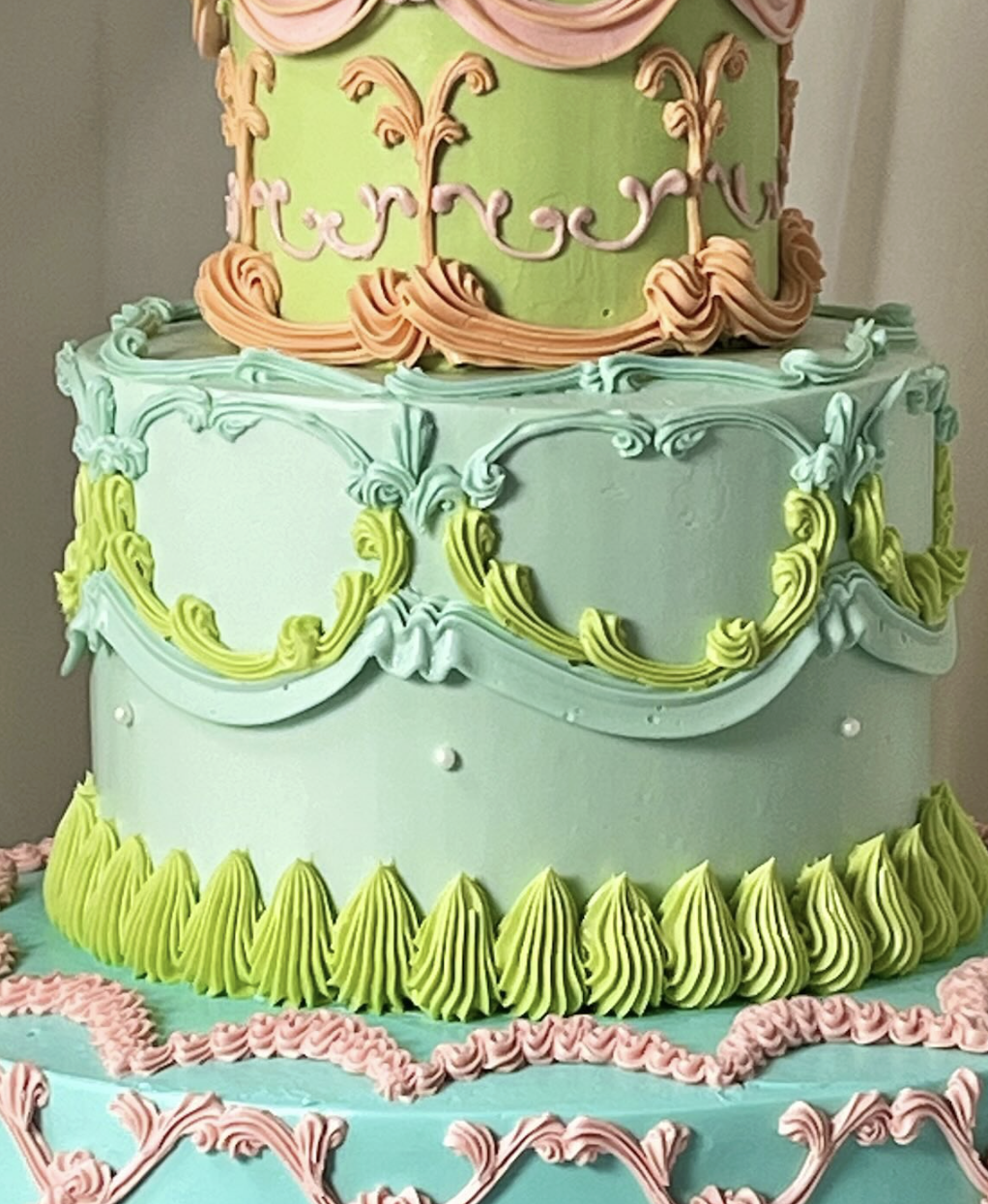
Havana cake, 2026.
Image courtesy of April’s Baker London Instagram (@aprilsbakerlondon).
A differing aesthetic language appears in the Havana cake. The Cuban capital is often characterised by its vibrant colonial streetscapes, where pastel façades and wrought-iron bars characterise the warmth and strength of the island nation. Habana Vieja (Old Havana) houses extensive ensembles of colonial architecture, combining baroque, neoclassical, and art deco influences within brightly coloured streets, remembering the Americas’ difficult and undeniably syncretic history. The cake translates this environment into a palette: sun-bleached pinks, blues, and yellows reference an aging infrastructure with optimism. What remains is the city’s visual logic rather than its precise architecture, the icing dancing in baroque-esque forms that recognise Cuba’s neo-Baroque movement, which has, in part, symbolised Havana’s inventive visual identity.
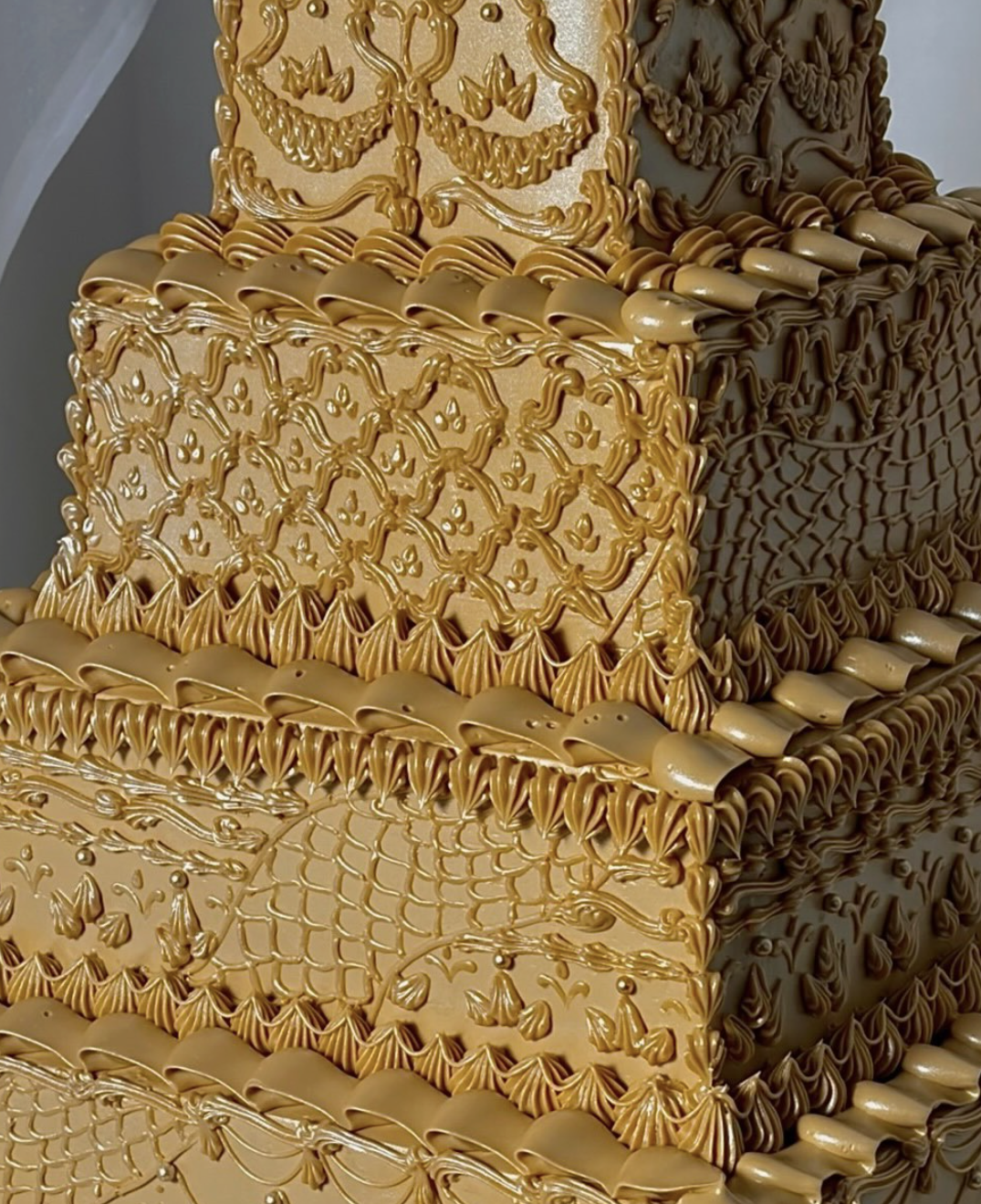
Bangkok cake, 2026.
Image courtesy of April’s Baker London Instagram (@aprilsbakerlondon).
Bangkok’s visual essence is often associated with vertical density and ornate temple architecture, reflecting its profound Buddhist influence. The city’s skyline juxtaposes modern high-rises with elaborately decorated Buddhist temples, whose gilded surfaces and tiered, pagoda-like roofs produce shimmering textural effects. Confectioned entirely in gold, the cake features tiering reminiscent of stacked tapering layers and ornate monochrome patterns, translating the symbolically rich ornamentation of temple architecture into edible form. Rather than recreating individual monuments, the design evokes the ornamental density characteristic of the Thai capital’s visual culture.
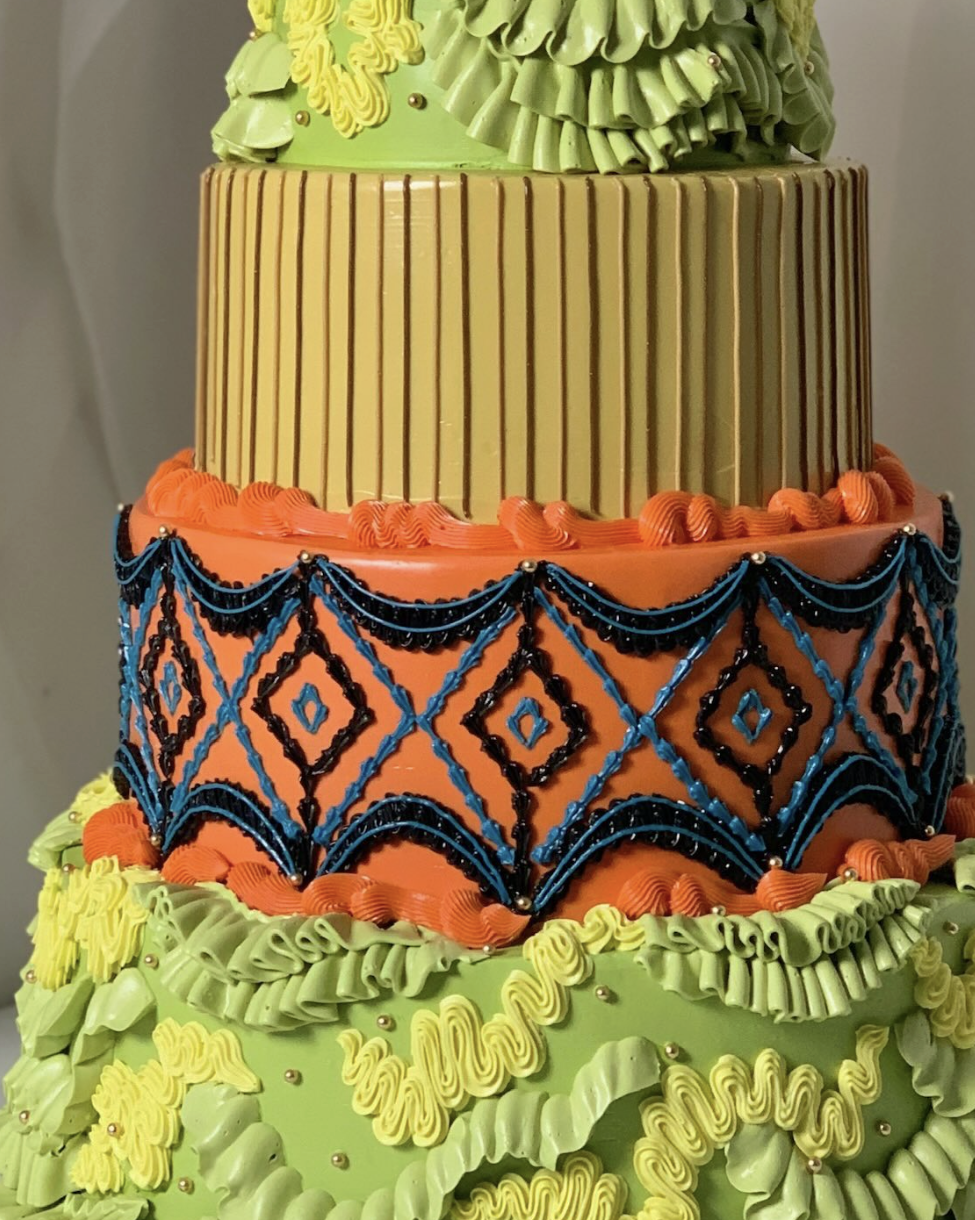
Lagos cake, 2026.
Image courtesy of April’s Baker London Instagram (@aprilsbakerlondon).
The Lagos cake shifts again toward a robustly vibrant composition blending multichrome with multi-patterned tiers. As one of Africa’s largest megacities, Lagos is often associated with rapid urban expansion: bridges arching over the lagoon, compact clusters of high-rise towers, and the infrastructure linking the island districts to the mainland. Landmarks such as the Third Mainland Bridge have become emblematic of the city’s sprawling ambition. Here, the aesthetic emphasis lies in bold geometry, saturated color, and a sense of movement that echoes the visual energy of Lagosian street culture, markets, and contemporary architecture. The cake’s blend of sharp lines and organic frills contrasts the atmosphere of vertical growth and metropolitan dynamism, translating the city’s layered infrastructures and vibrant urban rhythms into a compact decorative form.
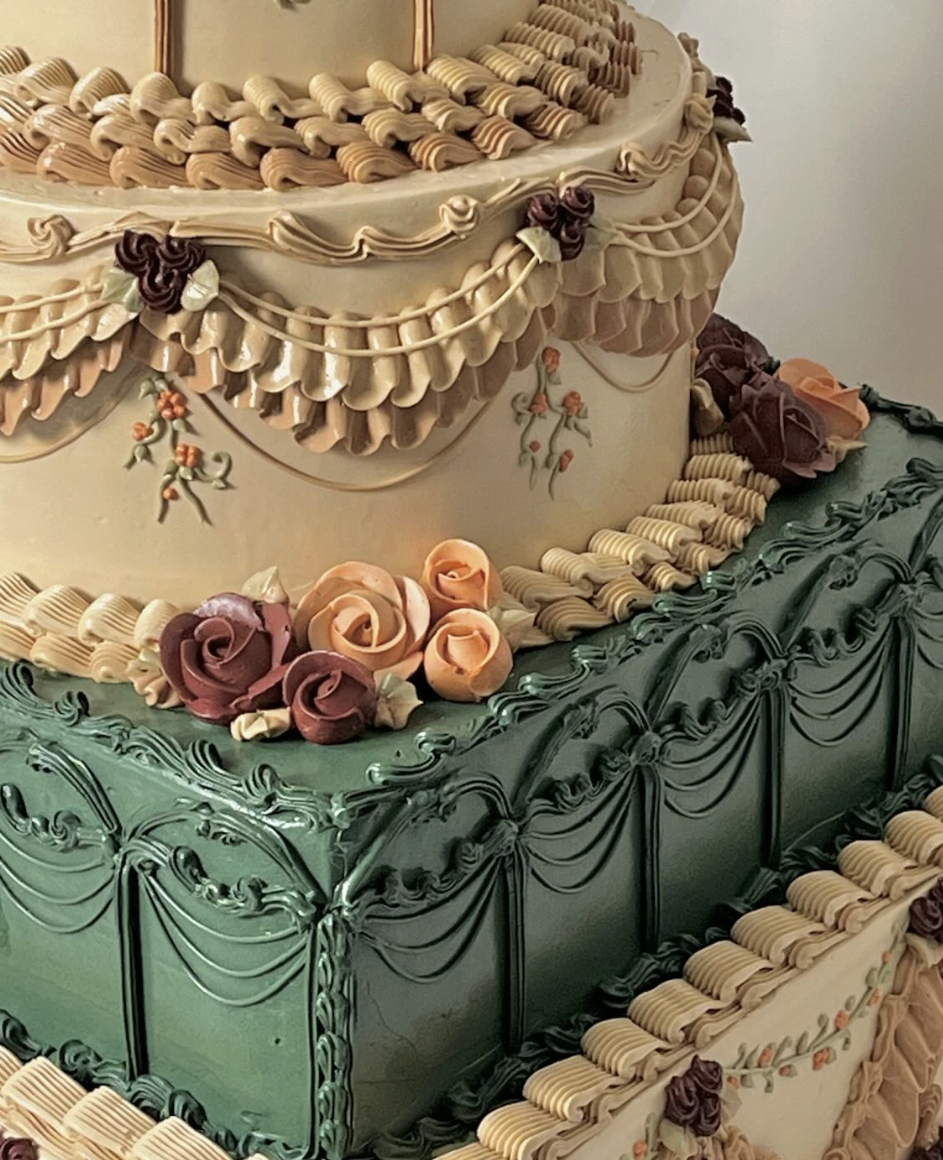
Edinburgh cake, 2025.
Image courtesy of April’s Baker London Instagram (@aprilsbakerlondon).
Finally, the Edinburgh cake calls to the starkly Gothic architectural drama of the Scottish capital. Edinburgh’s historic skyline features dark-stone buildings, Gothic spires, and the medieval Edinburgh Castle perched atop the city. The vertical silhouettes of church towers and medieval tenements coalesce into a vehemently recognizable urban profile. In confectionery form, this identity is conveyed through façade-mimicking icing that reveres the city’s ornate stone architecture, as well as subdued hues that celebrate Edinburgh’s autumnal atmosphere, thus translating the sharply Gothic into something soft and, quite literally, palatable.
Throughout these examples, April’s Baker’s cakes offer insight into how cities often circulate globally as visual condensations. Architectural forms, color schemes, and skyline silhouettes become symbolic elements through which places are recognized, remembered, and revered. The cakes do not attempt to represent or replicate entire urban environments; rather, they isolate the features most legible to a global audience.
This process resonates with ideas from contemporary art theory concerning the circulation of images across multiple locations. Visual representations of cities rarely remain confined to the places they depict. Rather, they voyage through media, tourism, design culture, and semiotic association. These cakes participate in this multilocal circulation; created in London yet depicting cities across the world, they assemble historically and globally circulating images into an ephemeral edible format.
Here, food exists as both medium and metaphor. As Borsato notes, confectionery frequently blurs the boundary between contemplation and consumption, inviting viewers to admire its visual qualities despite its destined dissipation. The city cakes intensify this tension, presenting the global visual ecosystem as something to be tasted, shared, readapted, and ultimately consumed. As a result, they offer a playful and illuminating insight into how cities themselves circulate in contemporary imagination: as fragments of architecture, color, and form that can be assembled, reproduced, and, quite literally, digested.
Bibliography
Andrzejewski, Adam. “How to Frame Edible Art.” Nordic Journal of Aesthetics 27, no. 55 (2018): 67–82.
Borsato, Maddalena. “Edible Aesthetics: Blurring Boundaries between Pastry and Art.” Arts 12, no. 5 (2023).
Bottinelli, Silvia, and Margherita D’Ayala Valva, eds. The Taste of Art: Cooking, Food, and Counterculture in Contemporary Practices. Fayetteville: University of Arkansas Press, 2017.
Scarpaci, Joseph L., Roberto Segre, and Mario Coyula. Havana: Two Faces of the Antillean Metropolis. Chapel Hill: University of North Carolina Press, 2002.
Vale, Lawrence J. Architecture, Power, and National Identity. New Haven: Yale University Press, 2008.
Raymond, Andre. Cairo. Cambridge, MA: Harvard University Press, 2000.
Peleggi, Maurizio. Thailand: The Worldly Kingdom. London: Reaktion Books, 2007.
Fourchard, Laurent. Lagos: Urban Expansion and Social Transformation in a Megacity. London: Zed Books, 2021.
Youngson, A. J. The Making of Classical Edinburgh, 1750–1840. Edinburgh: Edinburgh University Press, 1993.