National Symbols and Contested Heritage: An Insight into Artists’ Activism in Southeast Asia
By Alix Ramillon
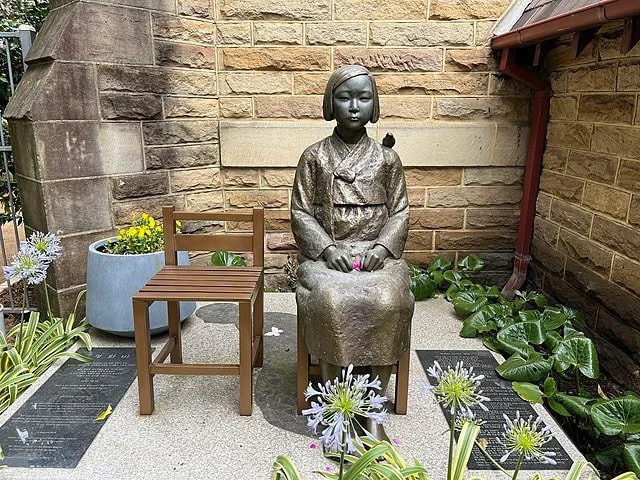
Kim Seo-kyung and Kim Eun-sung, The Sonyosang Statue and the Symbolism of Pubic, 2011.
Image courtesy of the Pacific Atrocities Education.
State management of national symbols through flags, monuments, official languages, and heritage sites is a perennial arena of cultural governance and resistance across Pacific Asia. In South Korea, the politics of historical memory around the colonial period, the Korean War, and the authoritarian developmental state of Park Chung-hee and his successors have generated, sustained, and sophisticated contestation between state memory institutions and civil society historians, artists, and activists. The "comfort women" memorial statues (pyeonghwa ui sonyeo-sang: "statues of peace"), installed by civic groups across South Korea and in Korean diaspora communities globally, represent one of the most striking examples of grassroots counter-monument practice: a deliberate effort by non-state actors to inscribe into public space a historical memory that official South Korean-Japanese diplomatic relations have repeatedly attempted to suppress or negotiate away.
In Aotearoa New Zealand, a Pacific nation with substantial cultural and political connections to Pacific Asia, the politics of Māori cultural governance clarifies the dynamics of indigenous resistance to settler-colonial state cultural institutions. The Waitangi Tribunal process, the mainstreaming of te reo Māori, and the growing incorporation of Māori cultural protocols into official state ceremony represent a partially successful campaign by indigenous communities to transform state cultural governance from within. Although critics, including Moana Jackson, argue that these gains remain fundamentally constrained by the settler state's unwillingness to address land sovereignty.
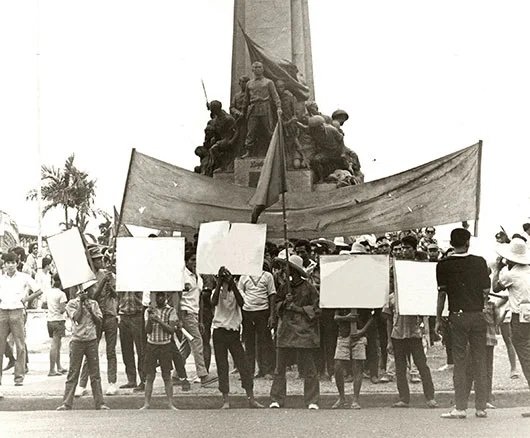
Kiri Dalena, Erased Slogans, 2014, Durst Lambda metallic print, Edition 3, 89.97cm x 108.97cm.
Image courtesy of Art World Image Reviews.
Perhaps the most dynamic arena of cultural resistance in Pacific Asia is contemporary art practice, where artists working across visual art, film, literature, performance, and digital media have developed sophisticated strategies for contesting state cultural narratives while navigating censorship, commercial pressure, and the complex relationship between critique and cooptation.
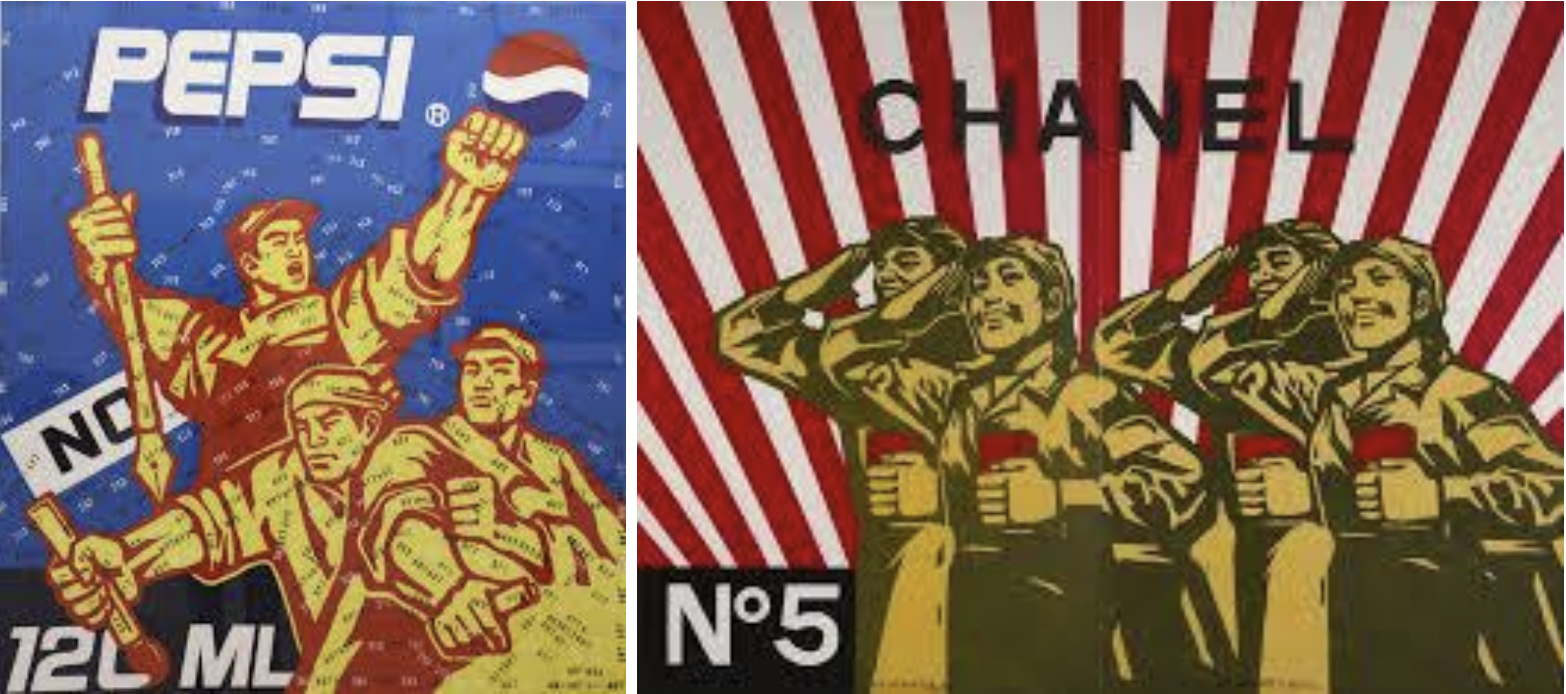
Right: Wang Guangyi, Great Criticism - Chanel, 2001, Oil on canvas, 300cm × 400cm.
Left: Wang Guangyi, Great Criticism - Pop, 1992, Oil on canvas, 200 cm × 340 cm.
Image courtesy of M+ and Tate.
In China, the generation of artists associated with the Political Pop and Cynical Realism movements of the 1990s, including Wang Guangyi, Fang Lijun, and Yue Minjin, developed visual languages that embedded subtle and not-so-subtle critiques of party ideology within forms and idioms that were simultaneously marketable internationally. Wang Guangyi's Great Criticism series, which juxtaposed Cultural Revolution propaganda imagery with Western consumer brand logos, operated as a critique on multiple levels of party ideology, Western commodity culture, and the collusion between the two in post-Tiananmen China's political economy. The subsequent absorption of much of this work into international art markets created genuine ambiguities about the relationship between artistic resistance and commodity spectacle - ambiguities that Chinese art critics, including Wu Hung, have analysed with considerable sophistication.
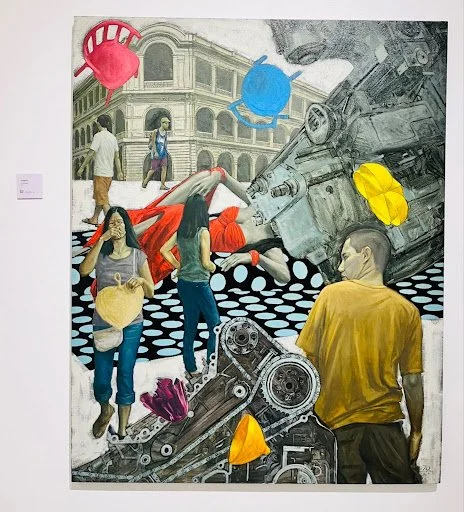
Antipas Delotavo, Kombustyon, 2014, Oil on canvas, 85.09 cm × 55.88 cm.
Image courtesy of Iloilo Art Life.
In the Philippines, the tradition of protest art (sining panlaban) associated with the national democratic movement has deep roots in the anti-Marcos struggle and continues to animate contemporary cultural politics. Collectives such as UGAT-Lahi and individual artists, including Antipas Delotavo, have maintained a tradition of politically engaged visual art that speaks directly to working-class and peasant communities, deliberately rejecting the gallery system's insulation of art from political life. In the Duterte era (2016-2022), this tradition renewed itself in response to the drug war, with visual artists, performance groups, and street muralists producing work that bore witness to extrajudicial killings and contested the official narrative of necessary security operations. Community festivals represent another crucial site of cultural resistance, one that operates in a more ambiguous relationship with official cultural governance, as they are simultaneously spaces the state attempts to appropriate and spaces where grassroots communities assert their own cultural authority. The Ati-Atihan festival in Kalibo, Aklan, originally a ritual celebration of the Ati indigenous people, has been transformed over decades by the Philippine tourism apparatus into a colourful spectacle marketed to international visitors, a transformation that many Ati community members and advocates describe as cultural appropriation and erasure. Yet the Ati community's ongoing insistence on maintaining their own distinct ceremonial practices, separate from the tourist festival, represents a form of quiet cultural sovereignty as a refusal to allow state and market appropriation to fully displace the living cultural practice from which the festival originated.
Across Pacific Asia, digital platforms have dramatically expanded both the reach of state cultural governance and the repertoire of grassroots cultural resistance. China's state cultural apparatus has invested massively in digital content, state media's YouTube channels, WeChat nationalist content, and TikTok/Douyin's algorithmic promotion of patriotic material, while simultaneously deploying sophisticated censorship systems to contain counter-narratives. The result is not simple suppression but a complex informational landscape in which pro-state cultural content and critical counter-narratives coexist in a constant dynamic tension, with the state holding enormous structural advantages in reach and resource but never achieving complete hegemonic closure.
In smaller Pacific island states in Fiji, Tonga, Vanuatu, and the Solomon Islands, the intersection of Chinese diplomatic soft power, indigenous cultural revitalisation movements, and new media creates particularly complex cultural governance dynamics. Chinese state media investment in Pacific media infrastructure, documented by scholars at the Pacific Media Centre, including Jemima Garrett, creates new vectors for state cultural influence that interact unevenly with indigenous Pacific cultural frameworks, which have their own sophisticated traditions of hierarchical authority, communal solidarity, and resistance to external imposition.
The fundamental tension in Pacific Asian cultural governance between state attempts to produce compliant, nationally integrated cultural subjects and the irreducible diversity, creativity, and political energy of grassroots cultural practice shows no sign of resolution. What changes across contexts and periods is the specific form of the contest: the tools available to states for cultural control, the spaces available to communities for cultural resistance, and the degree to which the two interpenetrate in forms that defy simple categorisation as domination or liberation.
Bibliography
Clavé-Mercier, Valentin. 2024. “Politics of Sovereignty: Settler Resonance and Māori Resistance in Aotearoa/New Zealand.” Ethnopolitics 23 (1): 1–19. doi:10.1080/17449057.2022.2096767.
Keane, Fung, Digital Platforms: Exerting China’s New Cultural Power in the Asia-Pacific, Media Industries, June 2018
Lee, Ji-Young. 2021. “Memorials’ Politics: Exploring the Material Rhetoric of the Statue of Peace.” Memory Studies 16 (2). https://doi.org/10.1177/17506980211024328.