The Works of Betsabeé Romero: Reconsidering Colonial Mexican Biombos as Kinetic Objects
By Natalia Ramirez
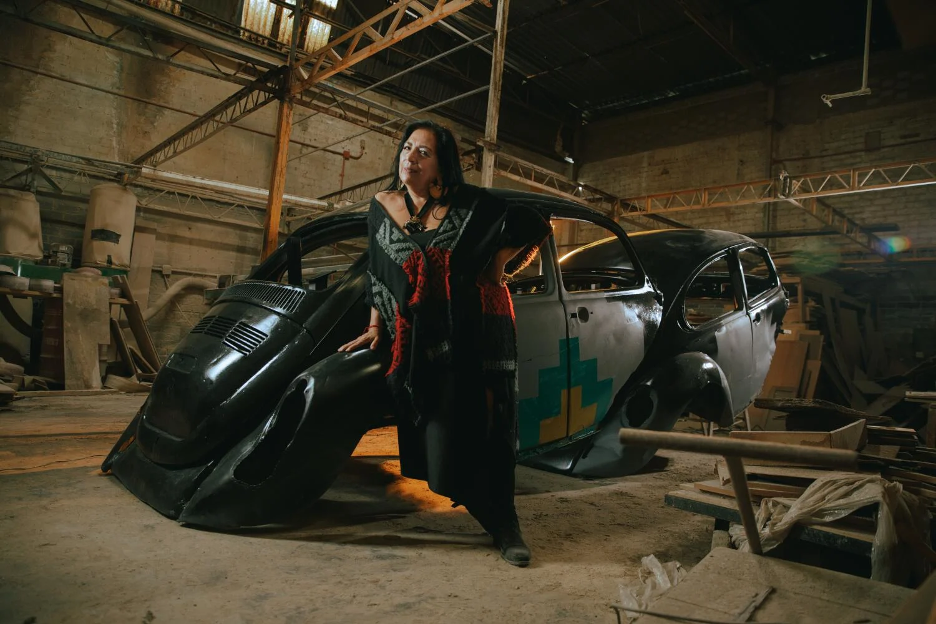
Romero sourced parts for her art in California junkyards.
Image courtesy of Brigitte Diez/For The Times.
Biombos, or Colonial Mexican folding screens, derive from the Japanese byobū and feature a variety of imagery on multipanel partitions that expand and contract to suit spatial needs. These screens, although originating in China, bear a vibrant lineage over centuries in Japan, eventually transported across the Pacific and found new value and reimaginations in colonial New Spain during the sixteenth century. The biombos have come to represent the synthesis of East Asian, Indigenous Mesoamerican, and Colonial European relations, thus embodying a simultaneous movement through heritage and literal spatial movement. Although anachronistic, twentieth-century kinetic art practices and theories offer a new view of these objects, reconsidering their myriad movements more dynamically and holistically, thus deconstructing the static tendencies in viewing early modern works.
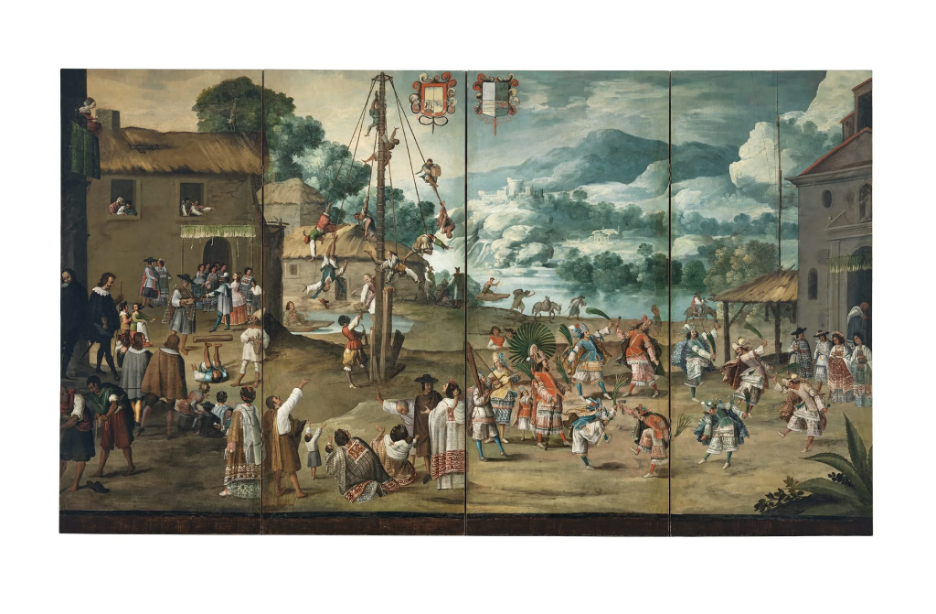
Unidentified artist, Folding Screen with Indian Wedding, Mitote, and Flying Pole (Biombo con desposorio indígena, mitote y palo volador), Mexico, c. 1660–1690, Oil on canvas, 167.6 × 304.8 cm.
Image courtesy of the Los Angeles County Museum of Art, accession no. M.90.108.1.
Twentieth-century Modernist kinetic practices brought to life the animative qualities of the artwork, encouraging a bond between material and viewer to establish a mutually mobile environment. Modern kinetic art tends toward literal mechanical motion or perceptual engagement, though biombos already feature a quieter yet no less significant design of movement, expanding or contracting within space and time in relation to the body to frame, segregate, or elevate the persons who interact with them. Turning to the contemporary work of Betsabeé Romero (Mexican, b. 1963), whose emphasis on circulation, transformation, and mobile materials offers a contemporary, though significantly related, model for rethinking the biombo as a kinetic object.
Romero’s work comments on and imagines circulations of materials, bodies, and histories as intentional, imperative, and far from incidental, making it a multifaceted canon for understanding mobility. Using materials such as tires to represent migratory routes, she produces large, dynamic, and ubiquitous modern objects that create and retain their meaning through a variety of movements. Despite being centuries apart, this emphasis offers a contemporary, understandable lens for reconsidering biombos beyond their initial appearance as static painted surfaces, often created by limiting museum displays. Rather than imposing contemporary ideas onto early modern objects, this view makes visible the kinetic conditions already present in the objects, as well as their original uses and contexts. This kinetic logic operates through two interconnected components: spatially (through the folding and unfolding of the screen in relation to the viewer and physical space), and interculturally (through the circulation of materials, compositions, and ideas that move between peoples and their contexts).
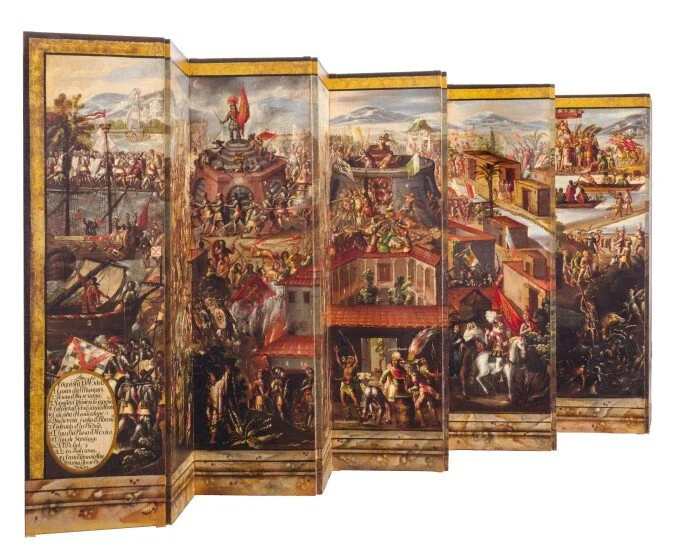
Unidentified artist, Biombo de la Conquista de México y Vista de la Ciudad de México, circa late 17th century, Oil on canvas, in ten adjoined double-sided panels, in wooden frame, 201.8 by 560 cm.
Image courtesy of Sotheby’s.
An illuminating case study is the dynamic Biombo de la Conquista de México y Vista de la Ciudad de México (seventeenth century), now widely known through Sotheby's. Comprising ten panels stretching over five meters, the screen paints two contrasting yet interrelated narratives: the violently saturated conquest of Tenochtitlan on one side, and a conversely empty, ordered cartographic view of colonial Mexico City on the other.
What is striking goes beyond the historiographic content, but the way that content unfolds through two differing visualizations of movement. The conquest scene literally unfolds from screen to screen, painting a chronological narrative that requires the viewer to move laterally across the screen to follow the sequence: from Cortés’s arrival to the fall of Tenochtitlan. This spatial fragmentation produces a temporal experience in which history is conveyed and comprehended through bodily movement. The screen thus depicts both physical and chronological movement while also requiring motion for immersive comprehension.
On the reverse, the panoramic view of Mexico City involves both history and the viewer differently, whilst remaining equally kinetic. Based on a seventeenth-century map, the city is shown completely visible in a bird's-eye view, yet only as a whole, as the screen remains open and the viewer is positioned frontally to avoid cartographic distortion. The physical act of unfolding becomes analogous to surveying the city itself. Here, kinetic experience enables viewing a space that represents colonial mobility itself, thereby embodying both physical and metaphorical mobility.
This spatial dynamism aligns closely with Sofía Sanabrais’ arguments, which emphasise that folding screens were inherently mobile objects, particularly in their role in trans-Pacific diplomatic and commercial exchange. Japanese byōbu, she notes, circulated widely as diplomatic gifts, serving as “ambassadors” of culture and bridging cross-oceanic distances. In New Spain, this mobility was enveloped and proliferated. Biombos themselves, being products of the Manila Galleon trade, which transported Asian goods to Mexico City, began a new journey of mobility through artisanal reimagination of their compositions, as well as literal mobile trade with the Viceroy of Peru, wherein they continued to reimagine. Thus, the biombo is kinetic beyond its physical manipulation, retaining movement in its material genealogy. It remained an object constituted through movement in its style, location, use, and heritage. Romero’s emphasis on circulation helps articulate this sense of movement through object heritage, reframing the biombo as a product of syncretic motion.
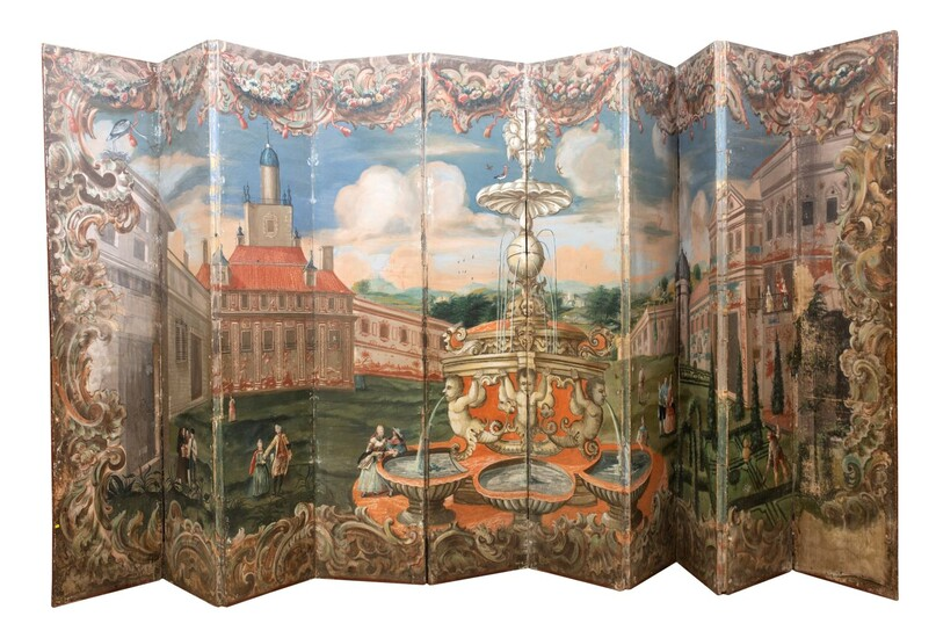
Unidentified artist, Colonial School (Viceroyalty of Peru), late 18th c.
Image courtesy of LOT Art.
Romero’s work reestablishes movement beyond just historical or political context. In projects such as Al reverso de la pista (On the Other Side of the Track), 2022, featuring carved tire installations that reference migration routes, materials are visualised as transit media (worn, cut, reworked, and re-inscribed). Movement is thus not a byproduct of the object; it is rather the very element that gives the object its form and meaning. Through the logic of Betsabeé Romero, the biombo’s hinges and panels begin to look less like structural supports and more like components in which motion is built into the object itself. Although the folding structure allows the screen to be stored and transported, it also enables and encourages shifts in scale, alignment, and visibility each time it is handled. In that sense, the biombo’s form is subject to rearticulation through the orientation of the object and the viewer.
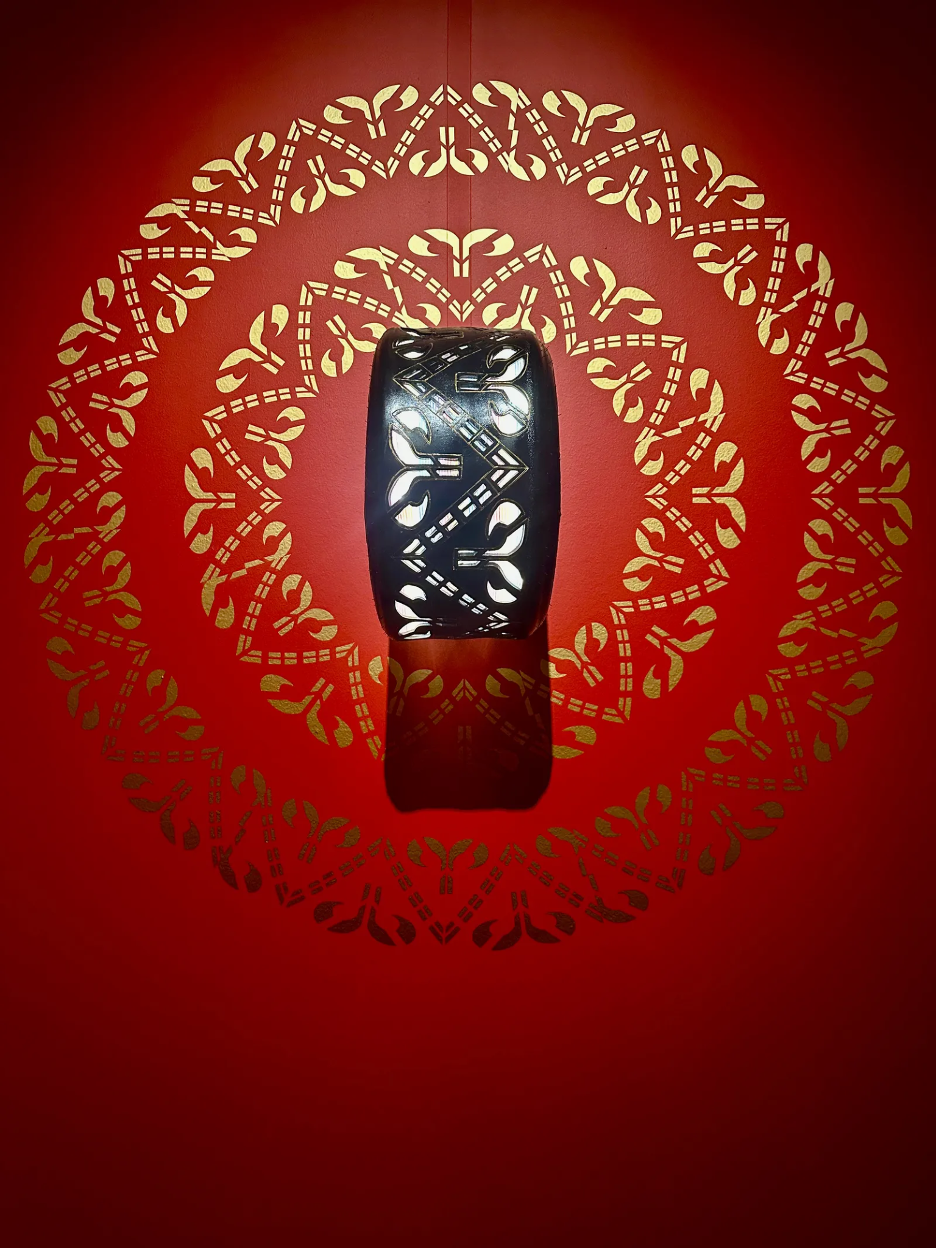
Betsabeé Romero, On the Other Side of the Track (Al reverso de la pista), 2022, Cut and engraved NASCAR tires, painted with gold leaf and traditional rebozos, vinyl on wall.
Image courtesy of the artist.
This is especially clear in how biombos function within interiors, being used to divide space, redirect traffic, and mediate what is in or out of view. A slight change in angle may open or close a room, reveal or conceal a scene, operating both with control and fluidity. Romero’s installations often work similarly, using repeated elements to guide a viewer's movement through space or interaction with an object. Bringing that sensibility to the biombo clarifies how its panels display images and how they structure spatial experience.
Thinking this way also shifts the understanding of how images are depicted, as they can be either limiting or versatile depending on the given orientation. The segmented surface means that scenes are scarcely fully available at once, having to be pieced together as the viewer moves, interacting with light, shadow, visibility, and invisibility. That accordion-like motion has a rhythm to it, resembling walking a route rather than scanning a single image. Romero’s emphasis on routes and circulation proposes a useful parallel here, not because the biombo depicts movement in the same way, but because both depend on the notion that meaning emerges through passage, repositioning, and spatial curiosity.
Using Romero as a reference point, then, is less about drawing a direct line between contemporary practice and colonial production; it proposes a contemporary through-line to articulate how objects can be shaped by movement at multiple levels (material, spatial, and perceptual). In the case of the biombo, this entails recognising that its folding structure, portability, and role in global trade are not secondary details but primary aspects of movement. These components are what allow it to function beyond imagery, actively unfolding, shifting, and reorganising both space and meaning depending on its encounter. This interpretive framework considers deeper recognition of movement as a fundamental component of art history, connecting pasts and presents through the shared logic of active material.
Bibliography
Germaná, Gabriela. “El mueble en el Perú́ en el siglo XVIII: estilos, gustos y costumbres de la elite colonial.” Anales del Museo de América 16 (2008): 189–206.
“Betsabeé Romero en el Blanton Museum of Art.” Architectural Digest México y Latinoamérica. Accessed April 20, 2026. https://www.admagazine.com/articulos/betsabee-romero-en-el-blanton-museum-of-art.
Barbara E. Mundy. The Death of Aztec Tenochtitlan, the Life of Mexico City. Austin: University of Texas Press, 2015.
———. “Indigenous Image Theory.” Word & Image 39, no. 2 (2023): 260–282.
———. “National Cartography and Indigenous Space in Mexico.” In Early American Cartographies, edited by Martin Brückner, 363–88. Chapel Hill: University of North Carolina Press, 2011.
Sofía Sanabrais. The Biombo or Folding Screen: Examining the Impact of Japan on Artistic Production and the Globalization of Taste in Seventeenth-Century New Spain. PhD diss., New York University, 2005.
———. “From Byōbu to Biombo: The Transformation of the Japanese Folding Screen in Colonial Mexico.” Art History 38, no. 4 (2015): 778–791.
———. “A World Somewhere between the New World and Asia.” In Japanese Art: Transcultural Perspectives, 419–447. Leiden: Brill, 2024.
“How This Monumental Folding Screen Chronicles the Birth of Mexico City.” Sotheby’s. Accessed April 20, 2026. https://www.sothebys.com/en/videos/how-this-monumental-folding-screen-chronicles-the-birth-of-mexico-city.