Destruction of the Past: The Importance of Cultural Heritage Sites and Protecting Them from War and Politics
By Ian Ziegler
War and destruction dominate the headlines, and rightly so. The levelling of villages, towns and cities, and the killing of the people who lived in them, should be reported on until it stops happening. But the erasure of a people is not only a matter of graves and body counts. It also happens to what they built; the mosques, palaces, libraries and archaeological sites that hold a community’s history in stone, many of them older than the states now fighting over them.
Tareq Abu Dayyeh sells craftwork, souvenirs and antiquities in Gaza, and the Great Omari Mosque appears on many of the things he sells. It is the obvious emblem. The site has been a pagan temple, a Byzantine church, a seventh-century mosque and a Crusader cathedral before becoming a mosque again; its walls chart the whole history of the city. In 2023 it was all but destroyed in an Israeli strike, which the Israeli military said was targeting Hamas. “When your past is destroyed, you have no present,” Abu Dayyeh told the BBC.
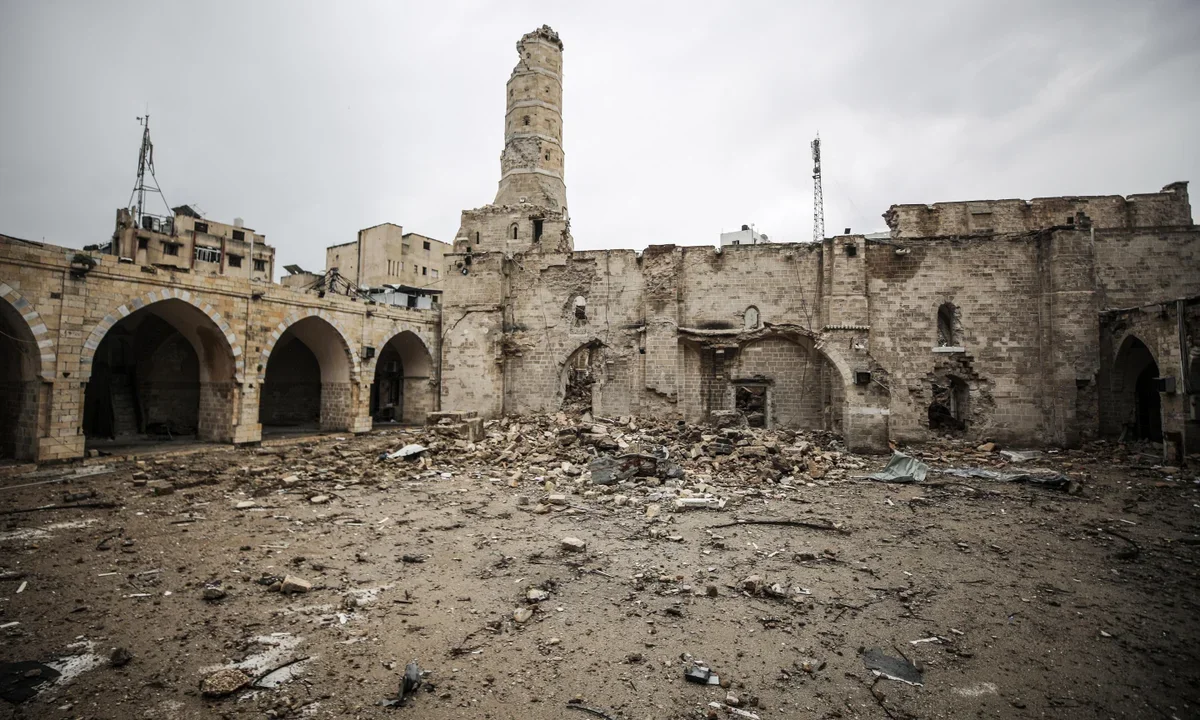
The Great Mosque of Gaza as it looked on 27 January, after months of Israeli bombardment of the region. Courtesy of Getty Images
Those ruins stand for generations of Palestinians who worshipped there, and for a resilience that had already outlasted a great deal. Now they are rubble: a place that was, and that may never be again.
On paper, none of this is permitted. The destruction of European monuments in the Second World War produced the first international treaty devoted solely to cultural heritage in wartime; the 1954 Hague Convention for the Protection of Cultural Property in the Event of Armed Conflict. It covers monuments and architecture as well as works of art and books, and it requires states both to safeguard their own heritage and to refrain from acts of hostility against anyone else’s. A Second Protocol in 1999 went further: a site granted enhanced protection must not be attacked even if it has been turned into a military objective, unless there is no other feasible way of ending that use. When the International Criminal Court was established in The Hague in 2002, deliberate attacks on historic monuments and on buildings dedicated to religion, art, science and education were already defined as war crimes in its founding statute.
In the 24 years since, exactly one such case has been successfully prosecuted at the ICC. Ahmad al-Faqi al-Mahdi, a jihadist commander in Mali, pleaded guilty and was convicted in September 2016 of directing the destruction of mausoleums and a mosque in Timbuktu, and was sentenced to nine years. One conviction, in almost a quarter of a century, across every conflict of that period.
The failure is not evidentiary. Bijan Rouhani, a senior researcher on the Endangered Archaeology in the Middle East and North Africa project, told the BBC: “No state actor has ever been tried for this offence. The obstacle is no longer evidence. We have satellite imagery, remote sensing and monitoring teams. The obstacle is jurisdiction and political will.”
The aerial war launched by the United States and Israel in Iran on 28 February 2026 ran for close to forty days before a ceasefire paused it on 8 April, and it did not spare the country’s monuments. On 2 March, UNESCO reported that Tehran’s Golestan Palace, a 400-year-old World Heritage complex begun under the Safavids and expanded under the Qajars, had been damaged by debris and the shockwave from an airstrike on Arag Square, inside the site’s buffer zone. UNESCO noted that it had already circulated to all parties the coordinates of World Heritage sites and sites of national significance, precisely so that this would not happen. The United States, Israel and Iran are all signatories to the 1954 Convention.
The counting has not stopped since. By early April, Iran’s ministry of cultural heritage had recorded damage to at least 56 museums and historical monuments; on 5 April the minister, Seyyed Reza Salehi-Amiri, put the national figure at 131 historical sites. By September the ministry’s tally had reached 149 monuments across 18 provinces and 29 cities, among them Isfahan’s seventeenth-century Chehel Sotoun Palace, part of the Persian Gardens inscription, and a section of the Trans-Iranian Railway. UNESCO has confirmed damage to at least four World Heritage sites. Preliminary estimates put the cost to Iran’s heritage sector at around 7.5 trillion tomans, roughly $40m.
What is striking is not only the number. A Reuters investigation in June found no examples of damage to UNESCO-listed sites across two decades of American and allied campaigns in Iraq, Syria, Libya and Afghanistan. Forty days in Iran produced what twenty years elsewhere had not. “We are not talking about stone and mortar,” Salehi-Amiri said, standing among the damaged interiors of Golestan Palace. “We are talking about the memory and history of a people.” He called the strikes a deliberate attack on Iran’s cultural identity, and the international response “a total collapse of the moral and legal rules”.
Iranian conservators have not waited for anyone. Teams at Golestan are collecting, sorting and coding shattered wooden and decorative fragments, racing to repair roofs before autumn rain compounds the damage; Chehel Sotoun has been stabilised and made safe while funding for full restoration is sought. Iran has been in what Farhad Azizi Zelani, the ministry’s director general of national and world heritage sites, calls “extensive correspondence” with UNESCO’s World Heritage Centre and the secretariat of the 1954 Convention. No financial support has so far materialised. “The mere existence of international instruments, including the 1954 Hague Convention, is not by itself sufficient to protect cultural heritage,” he says. “What matters is the effective implementation of these commitments and a swift, decisive response from the international community when threats arise.”
The register keeps growing elsewhere. At its 48th session in Busan in July, UNESCO’s World Heritage Committee added three sites under Israeli attack to its List of World Heritage in Danger: the newly inscribed Mount Amel Castles in southern Lebanon and the archaeological site of Sebastia in the occupied West Bank, together with the ancient Phoenician city of Tyre, where strikes in May and June hit Roman columns at the Al-Bass site and damaged the Lebanese antiquities directorate’s offices and storage. Israel’s foreign ministry rejected the findings as baseless, and its heritage minister, Amichay Eliyahu, answered the Sebastia decision with: “UNESCO can say whatever it wants … it won’t change the facts: this is the capital of ancient Israel.” In Ukraine, the culture ministry recorded 148 heritage sites damaged or destroyed in the space of a single month, with six UNESCO-protected sites damaged in Odesa alone. Ukrainian groups have lodged complaints with the ICC over cultural destruction and looting. No indictments have followed.
Destruction of this kind is usually delivered by ordnance. It can also be delivered by paperwork.
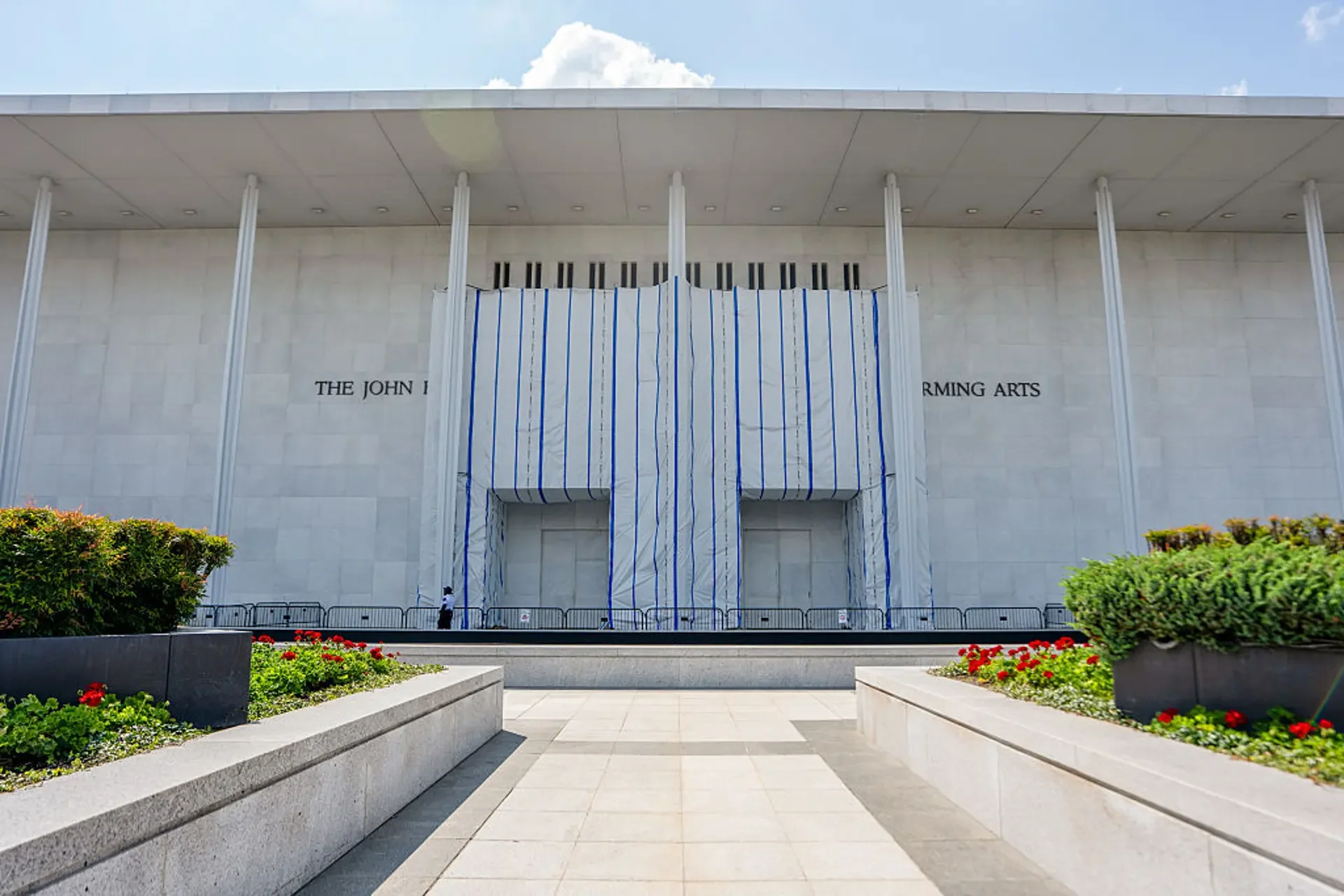
A tarp covers the facade of the Kennedy Center in Washington, D.C., on Aug. 28, 2026. Courtesy of Daniel Heuer—Bloomberg/Getty Images
The John F. Kennedy Centre for the Performing Arts is a living memorial to a murdered president and the nearest thing the United States has to a national stage. This year it has become the object of a slower kind of demolition. In August, a board now stocked with Trump appointees voted to rename the venue “The John F. Kennedy Centre for the Performing Arts, Restored and Renovated by President Donald J. Trump”, in recognition of what the board characterised as the president’s philanthropic contributions. On 15 September, Judge Cooper ruled that the Centre could not inscribe “renovated and restored by President Donald J. Trump” on its facade. The same day, management shut the main building, attributing the closure first to a pulled fire alarm and then to “imminent life-safety risks,” an explanation campaigners were disinclined to believe, the group Hands Off the Arts having earlier dismissed a video purporting to show rain damage at the Centre as “propaganda”.
The following day Trump said: “For me to go and fix it and subsidise it, I think the Trump administration should have recognition. If we don’t do that, it’s going to close and get ripped down.” That night the Getty photographer Brendan Smialowski photographed him on the tarmac at Joint Base Andrews, in a red baseball cap, reading a placard that appeared to say “Kennedy Centre DEMOLISHED”. On 17 September, Joyce Beatty, a Democratic representative for Ohio’s third district, filed an emergency request asking the court to state plainly what its injunction already implies. “It goes without saying that demolishing the Kennedy Centre’s main building would violate the Court’s preliminary injunction,” the filing reads. “But out of an abundance of caution, Plaintiff also respectfully requests the Court to make crystal clear that its order prohibits demolishing the structure.” Eight preservation groups have separately called for the Centre’s leadership to stand aside, or for the court to place the institution into receivership.
That a member of Congress has had to ask a judge to confirm that an order against closing a building also covers knocking it down is its own comment on the moment. No shell has landed on the Kennedy Centre, and the comparison with Golestan Palace or the Great Omari Mosque should not be pushed far. But the logic rhymes. A building is valued for whose name is on it; when the name cannot be secured, the building’s survival becomes negotiable. The Centre memorialises a president whose name still carries the prestige this one would like attached to his own, and the terms are explicit: recognition, or it gets ripped down.
What connects Timbuktu, Gaza, Tehran, Tyre, Odesa and Washington is not equivalence of scale. It is the absence of cost. Rouhani’s prescription is deliberately unglamorous: “What would change the calculation is not harsher sentences, but a real prospect of being named, arrest warrants for the commanders who authorise these strikes, prosecutions in national courts under universal jurisdiction, and targeted sanctions on named individuals. Those measures don’t require a new treaty. They require states to be willing to use the instruments they already have, against allies as well as adversaries.”
Against allies as well as adversaries, it fails precisely. Wars end, and regimes change; the past does not get another chance. Whether it survives is decided now, by people who currently have every reason to believe that destroying it costs them nothing.
Bibliography
Bahar, Zen. “UNESCO Issues Warning as 56 Historic Sites Are Hit in Iran.” AD Middle East, April 8, 2026. https://www.admiddleeast.com/story/unesco-issues-warning-as-56-historic-sites-are-hit-in-iran.
Boucher, Brian. “Rep. Joyce Beatty Asks Judge to Make ‘Crystal Clear’ Trump Cannot Demolish Kennedy Center in Wake of Viral Photo.” ARTnews, September 18, 2026. https://www.artnews.com/art-news/news/beatty-trump-cannot-demolish-kennedy-center-viral-photo-1234798919/.
English, Sandy. “UNESCO Adds Sites in Palestine and Lebanon under Assault from IDF to List of World Heritage in Danger.” World Socialist Web Site, August 6, 2026. https://www.wsws.org/en/articles/2026/08/07/xkou-a07.html.
Geranpayeh, Sarvy. “Iran's Heritage Experts Race to Repair Damaged Sites as Negotiations Stall.” The Art Newspaper, September 4, 2026. https://www.theartnewspaper.com/2026/09/04/irans-heritage-experts-race-to-repair-damaged-sites-as-negotiations-stall.
UNESCO. “UNESCO Expresses Concern over the Protection of Cultural Heritage Sites amidst Escalating Violence in the Middle East.” March 2, 2026. Last modified July 2, 2026.
Usher, Sebastian. “Cultural Treasures Are Being Destroyed by War, and People Want Justice.” BBC News, September 20, 2026. https://www.bbc.co.uk/news/articles/cvgy1q2k2z0o.