
Gwen John: Strange Beauties. An important and beautiful, yet limited exhibition
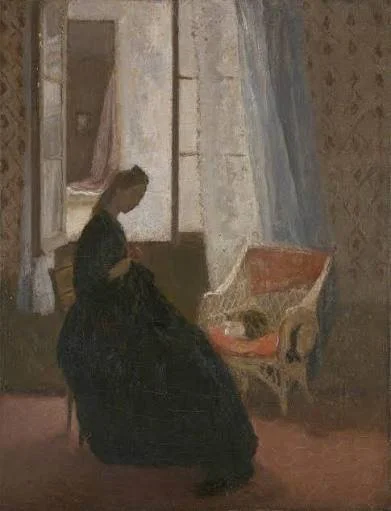
Gwen John, La Chambre sur la Cour, 1906, Image courtesy of Art UK
By Sam Dickinson
As I walked into the new Gwen John exhibition at Modern Two in Edinburgh on a sunny Wednesday afternoon, I wasn't sure what to expect. She was an artist who, to my own shame, I had never heard of. Yet I left with a deep enamour for the artists hauntingly beautiful works. Importantly, I also had a much greater understanding of what kind of a person she was – something which, in the case of as intriguing and withdrawn a person as Gwen John, will often leave you with more questions than answers.
As the exhibition's website states, this is "the first major retrospective in over forty years" of John's work. It focuses on chronologically tracking the development of the artists style, from her early works (which have been compared to her "predecessor" John Singer-Sargent) all the way to her later, far more impressionistic, modernist works. The exhibition also aims to place John within the context of the French Modernists, many of whom she knew well - the artist famously had a long-standing affair with Rodin. Notably, the exhibition is in honour of the 150th anniversary of the artist's birth, making it all the more pertinent for a new exhibition to showcase these fantastic works.
The first work which you see as you walk into the exhibition is one of John's finest: her self portrait of 1902. She is seated, wearing a fashionable red blouse and necktie with a broach. The background of the composition is plain, directing the viewers gaze on to the artist. Her face is inexpressive, focused on the viewer. She is positioned with her arms to her side and facing outwards confidently. The portrait conveys confidence, and, for an early work, a definite feeling of self-assurance. As the gallery description says, this work demonstrates John’s “early commitment to realism.”
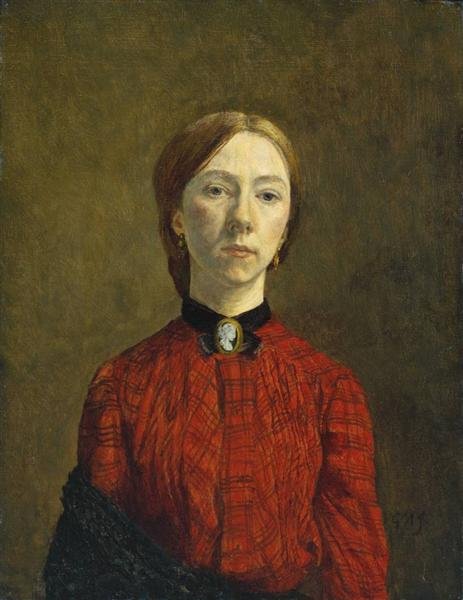
Gwen John, Self Portrait, 1902, 1902, Tate Britain, London. Image courtesy of Wiki Art
As the exhibition moves forward in time, we begin to see John’s growing predilection for portraying interior settings with lone women. Her La Chambre sur la Cour of 1906 neatly shows this growing trend in her work. Newly moved to France, John shows, in this painting, an observation on day-to-day life and the mundane, in which the curators noted the influence of Dutch painting of the Seventeenth-Century. I was greatly impressed by the willingness of the curators to show the broad range of John’s work, from portraits to interior views, indicating an attention to detail and a genuine love for her as an artist.
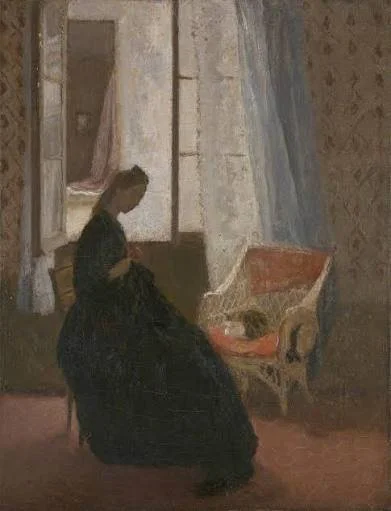
Gwen John, La Chambre sur la Cour, 1906, 31.8 x 21.6cm, Yale Center for British Art, New Haven, Connecticut. Image courtesy of Art UK
Aside from showing such a wide variety, the exhibitions display choices also had a deep impact for me. In a recent Talk Art podcast about the exhibition, curator Lucy Wood mentioned that she chose the wall colours to be specifically “harmonious” for the works in each room. One work in which I found this choice to be particularly was her Seated Nude of 1925. The work showcases John’s later, much more reserved and impressionistic style. The muted grey chosen for this room perfectly matches this mature development in John’s work. The exhibition does a great job of showing John’s development as an artist, both through atmosphere and work selection.
While the exhibition was a fantastic and holistic overview of Gwen John's artistic journey, I did find that it fell short in reading into the meanings of her works. In the wall text for the Seated nude, it notes how it "emphasises her sitter's self-possession". However, there is little to no thought given to what that could mean. It left me with the question – was this a feminist approach to this genre? Was John attempting to portray an almost triumphant female body removed from the trappings of the society in which she lived? I think this would have been a highly interesting angle which would have provided far greater understanding for visitors.
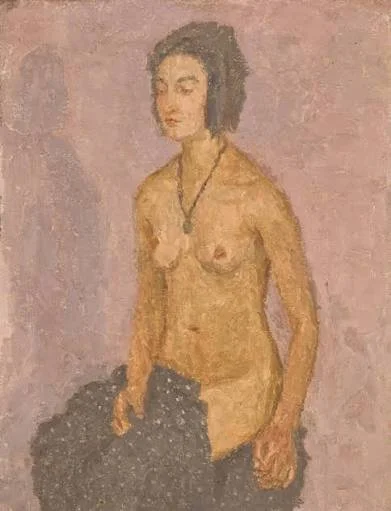
Gwen John, Seated Nude, 1925. Image courtesy of Sotheby's
Critics have also noted how many works similar to John's interior depictions of solitary women attempted to subvert societal ideas at this time. Yet, in the overview for the room dedicated to these works, there is no mention of any potentially rebellious motives behind them. It is entirely possible that the curators didn't wish to cloud the exhibition with politics and to instead keep it purely about the art, but I was disappointed by the choice to omit these readings. Not only would this have allowed for a deeper understanding of John's works and the world in which she lived, it would also have provided the visitor an opportunity for self-reflection, a moment of deeper engagement with the art, which I felt was missing.
While this small omission bothered me a little, overall, I was still highly impressed with Gwen John: Strange Beauties. The exhibition introduced me to an artist, importantly a female artist who I would never have heard of otherwise. In depth and selection, the exhibition is unmatched. I would highly recommend anyone to go and see it.
Bibliography:
Denney, Colleen, '"A View of the Open Sky": Gwen John's Early Modern Portraits and Interiors', Woman's Art Journal 43, no.1 (2022): 31-40. https://www.jstor.org/stable/27218691?seq=1
National Galleries Scotland. "Gwen John: Strange Beauties" Accessed October 9th, 2025. https://www.nationalgalleries.org/exhibition/gwen-john-strange-beauties#digital-guide
Robert Diamont, host, Talk Art, "Lucy Wood on Gwen John", Spiritland Creative, April 9th, 2026, 59 min., 24 sec., https://open.spotify.com/episode/3fVgBdSmQhoeR4KPfXUSyg?si=8a8e863a592e4ef9