Visualizing the History in Our Bones at the McManus
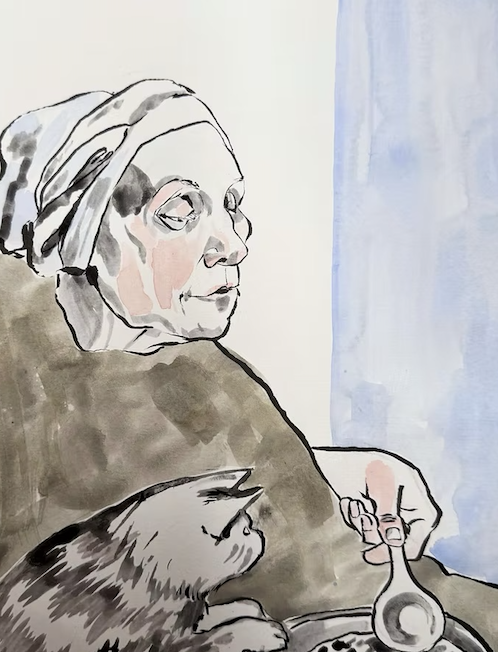
Detail of an imagined story and illustration by Sigrid Koerner.
Image courtesy of the History in our Bones study.
By Hana Naughton
Her eyes might be the first part of her face your gaze falls upon. They are soft, and her face is wrinkled in the way one might be from a lifetime of expression. Standing in front of her portrait on the informational panel, one might forget for a moment that she is an act of informed imagination layered over a skull that has lain in the ground for fifteen hundred years. She is one of the four individuals whose lives are explored in the exhibition titled History In Our Bones currently running at the McManus in Dundee, which uncovers stories of disability throughout the Medieval period in Scotland and England.
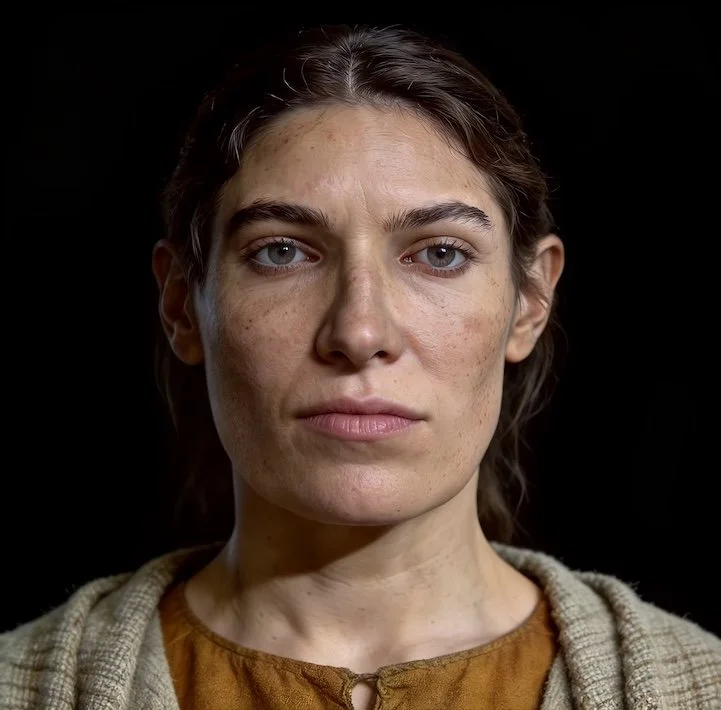
Reconstructed face of LL11 by Dr. Tobias Houlton.
Image courtesy of History in Our Bones project.
She is called LL11 and is an early medieval woman who was buried at Lundin Links in Scotland between 450 and 700 CE. She lived with hemiplegia, meaning one side of her body was paralyzed. While the exact cause of her paralysis (stroke, polio, or cerebral palsy) may never be known, osteologists can tell that the impairment started in childhood and that she lived to be anywhere from thirty-five to fifty-five years old. The informational panel also notes that she was buried with care, signaling that she was loved and valued in her community and challenging the commonly held assumption that disability was viewed negatively in the past.
Similarly, ELS215, another of the exhibition's four individuals, was a woman buried at a monastery in Bedfordshire between 1100 and 1200 CE. Her remains show evidence of paralysis from the waist down. Samples taken from her dental calculus show that despite her reduced mobility, she was a craftswoman, perhaps even an artist in her own right, as traces of dye and flax fibres stayed with her for nearly a thousand years. The textile she wove, caught in her teeth, would have benefitted her community, and there is something wholesome in the thought that her creative contribution stayed with her for so long. The facial reconstructions of these four individuals were created by forensic artist and facial anthropologist, Dr. Tobias Houlton. He details the scientific work that goes into his process in explaining, “People don’t realize the amount of measurements you have to take. I’m taking all these different metrics to estimate all the different components of the face, and then artistically trying to bring this different information together.” When asked why he believes it is important to display the faces of the exhibition’s individuals, he says, “The face is such a critical component to all communication. People just know how to engage with a face. People can get a better sense of the people, the past, and realize that they’re really not that different.” He emphasizes, “It brings in more of a personality. You get a better sense of the people at the time. Dr. Houlton believes the wider use of art in the exhibition boosts visitor engagement. “The visual arts have always done something dynamic to bring people in,” he explains. “If you hit someone hard with science or history, you can lose some people, while visual media brings them in and makes the information accessible.”
Beyond the facial reconstructions, the exhibition incorporates art in other ways, including free colouring books for kids (or adults; I am guilty of taking a few). Beautifully illustrated by Oxford-based artist Sigrid Koerner, the book pairs easily digestible scientific and historical information with drawings of Pictish stones, medieval mobility aids, styles of dress, animals, and even the scientists and historians that worked on the project including St. Andrews professor Dr. Alison Beach and research fellow Dr. Nora Farber. The book highlights the interdisciplinary nature of the project and will hopefully inspire young future artists, scientists, and historians.
Another artistic element of the exhibition is the set of historically accurate mobility aids created by the University College Dublin’s Experimental Archaeology Lab using medieval methods and locally harvested wood. The panel describing the aids includes images from medieval manuscripts and paintings that feature the aid in question, in this case hand trestles. These images, a seemingly small detail, show how artwork can provide important context for how disability was interpreted in the past.
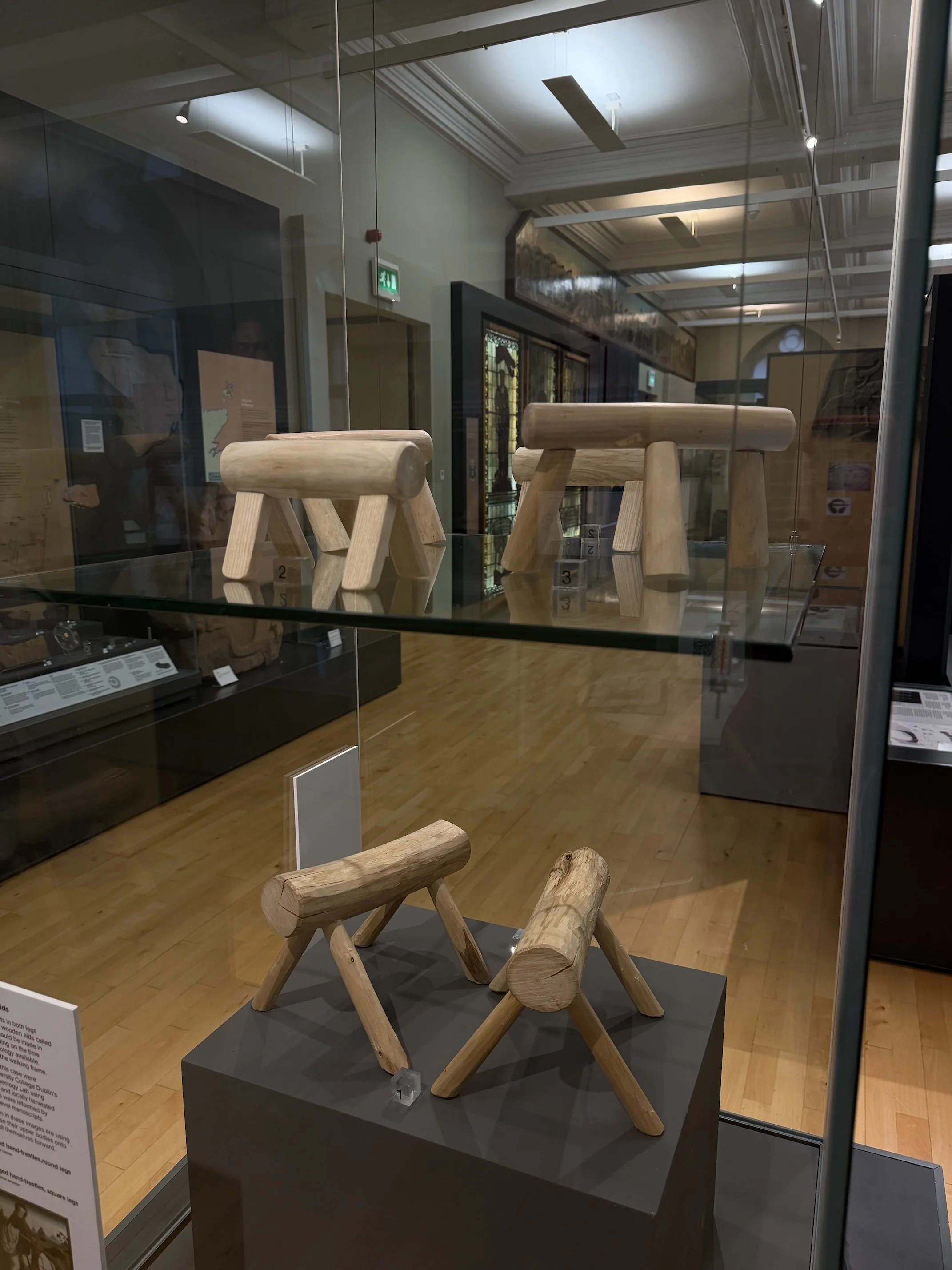
Hand Trestles.
Image courtesy of Hana Naughton.
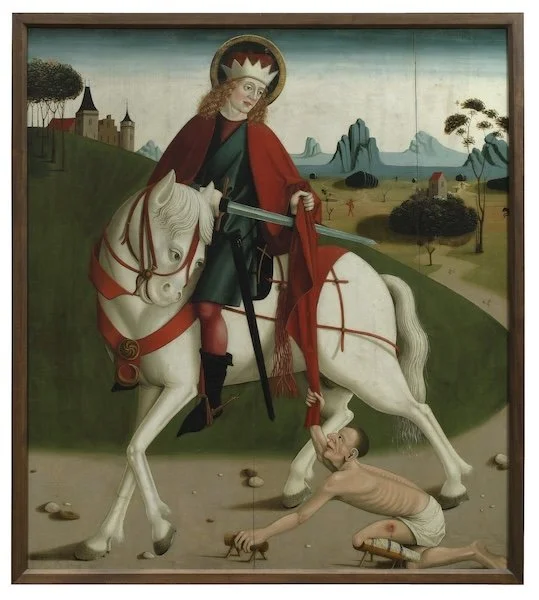
Unknown, St Martin and the Beggar, ca. 1490, tempera and gilt on pinewood, 101.5 × 89.5 cm, Hungarian National Gallery, Budapest.
On the interactive touchscreen in the centre of the exhibition, more artistic elements can be found, including a little comic strip by Sigrid Koerner imagining a scene from the life of ELS215. In it she is a cat lover, her cheeks flushed with rosy brushstrokes as she sneaks her cat, painted with adorable heart shaped paw pads, a spoonful of her meal. It reinforces a sense of individuality and personhood that can be lost when human remains are studied scientifically and put on display.
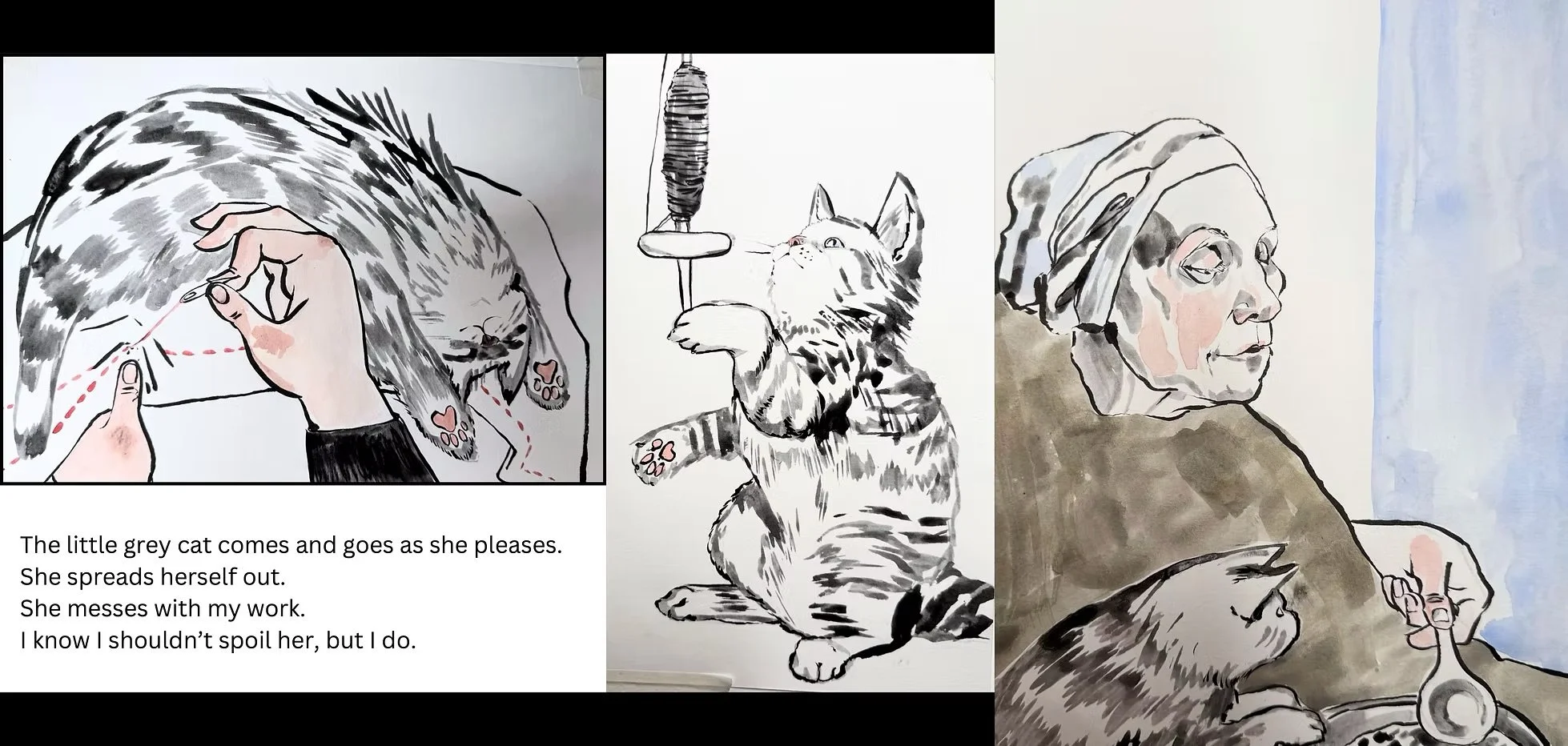
An imagined story and illustration by Sigrid Koerner.
Image courtesy of the History in our Bones study.
As Christina Donald, curator of Early History at The McManus notes, “By thinking about the full personhood of individuals with disabilities in the past, we can also create pathways to greater empathy and understanding for individuals with disabilities in the present.” This sums up the exhibition, which was created with a sense of love and sensitivity that echoes the care with which the individuals displayed were buried. The exhibition’s various creative outputs remind us to put dignity and empathy first in the study of human remains and their stories.
History in Our Bones will run until the end of January 24th, 2027. It is worth exploring, especially since it features passionate work from the University of St Andrews students and faculty.
Bibliography
Donald, Christina. E-mail message to the author, September 2026.
History In Our Bones. “History in Our Bones: Explore Past Lives.” Accessed at: https://www.historyinourbones.info/history-in-our-bones-banners-2
Houlton, Tobias. Interview with the author, St. Andrews, September 2026.