Dear Earth at the St Andrews Museum
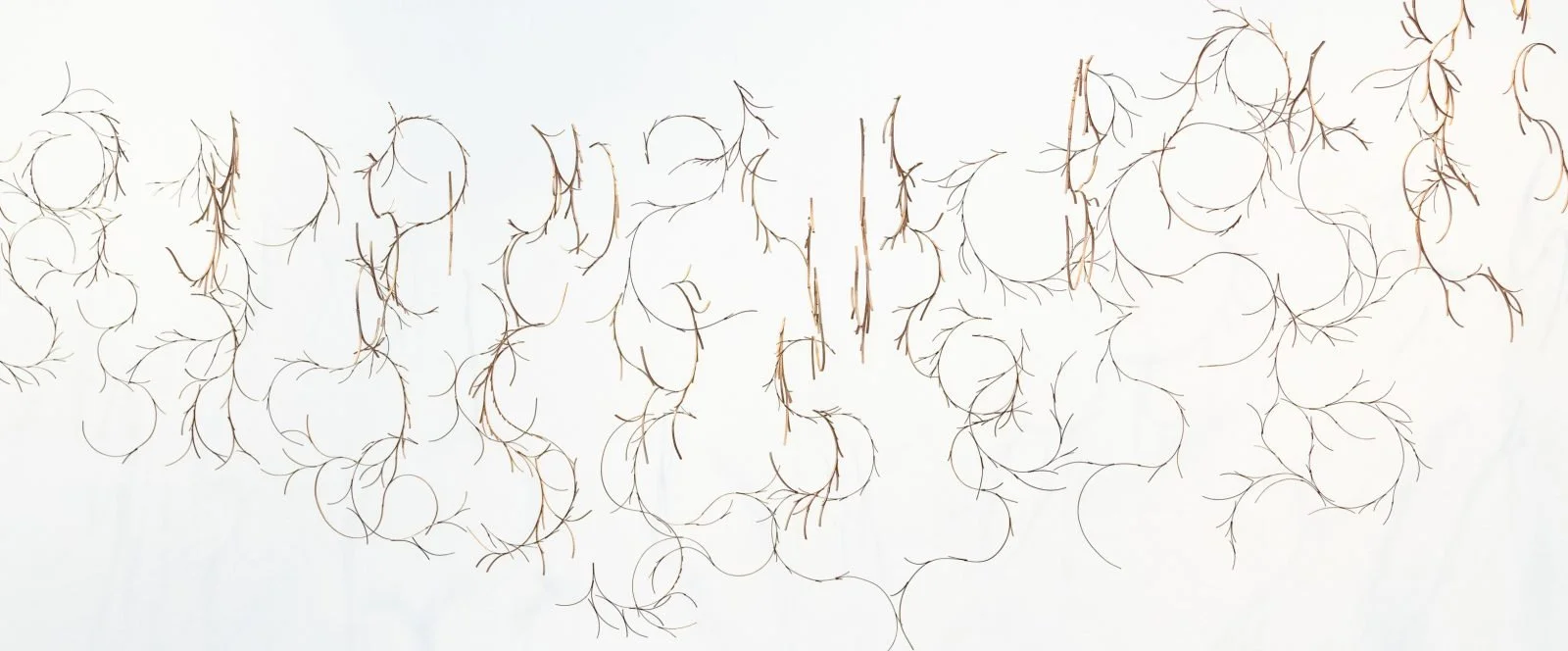
Naomi Mcintosh, Scarcity of Song, 2025. Image courtesy of Fife Contemporary.
By Honey Greenley
Mounted across three sides of wall in the St Andrews Museum are a medley of colourful objects that resist any obvious understanding. A curling, coral length of wire stuffed into a nozzle for a hosepipe; a metallic trinket suspended from a yellow ring, which in turn hangs from the studs of an oversized LEGO brick; a bath lily of which its attaching cord has been threaded through the strap of… something. They appear as a mishmash of parts sans any apparent logic. Mercifully, name cards for each of the dozens of items adorning the wall explain exactly what I see before me, sparing the viewer the brain-twister that would be decoding the display. These objects are, in fact, gadgets, prescribed the functions of “inner-voice releaser”, “ideas generator” and “unique moment of joy finder” respectively.
These curious gadgets all form the basis of Jenny Pope's ongoing mixed media work, tools for the optimistically challenged (2022-26 ongoing), which features in St Andrews Museum's current Dear Earth exhibition. Its label informs that tools for the optimistically challenged recycles litter collected from the beaches of Scotland into instruments of “emotional reassurance.”
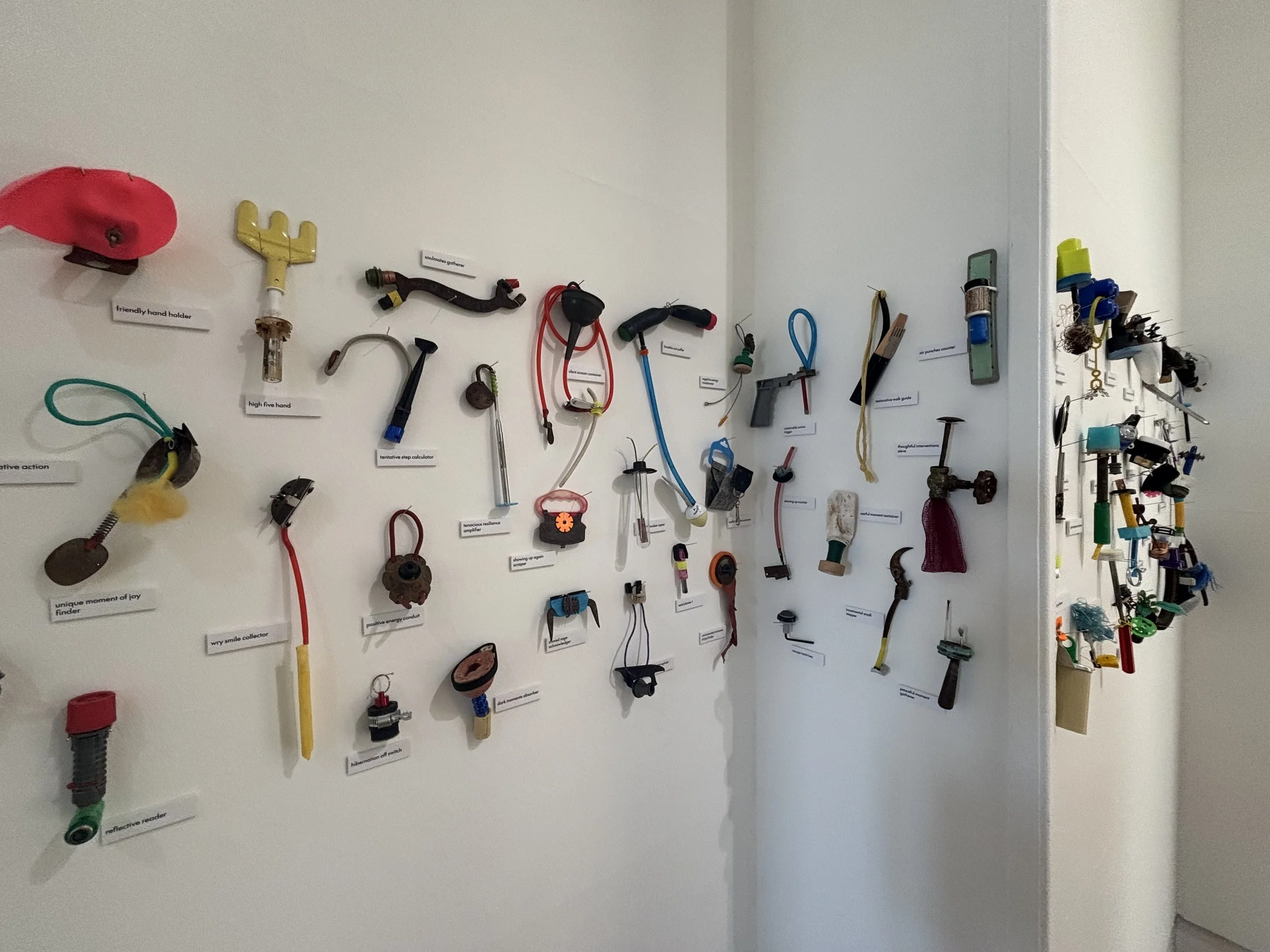
Jeni Pope, tools for the optimistically challenged, 2022-26 (ongoing). Image courtesy of the author.
In the face of Scotland’s changing climate, with warmer winters, drier summers and the impact of mass production leaving a superfluity of non-biodegradable waste on our beaches, Pope strikes a chord between sincerity and irony as the very instruments of eco-anxiety are fashioned into its soothers. Her distortion of familiar parts such as shower heads and spools of string into uncanny wholes reflect current readings of our climate reality as humanity accelerates into an increasingly unrecognisable future.
Ecological anxiety stands out as a key theme in Dear Earth, an exhibition which marks the 20th anniversary of Fife Contemporary and features works from Ade Adesina, Helen O’Brien, Jeni Reid, Jenny Pope, Naomi Mcintosh, Scott Hunter, Susie Johnston, Will Carey and Zoe Hamill. Arriving in town after spending six months at Kirkcaldy Galleries, the exhibition will stay in St Andrews until March 2027. Upon my arrival at the museum, an employee at the welcome desk spoke praise of the venue, citing the intimacy of the space as facilitating a natural rhythm about the works, and to the effect of the tall windows which allow for light to spill beautifully across the displays. This effect was certainly achieved during my visit on a sunny October afternoon, the gentle sounds of birdsong filling the rooms as I moved across the exhibit.
Dear Earth is wrought with a sense of fragility as it reckons with continuously unfolding environmental loss. From Helen O'Brien's Fruiting Body (2022) and Muster of Fungi (2022-23), preserving the fleeting fallen bodies of fungi in bronze, to Jeni Reid's Microplastics (2025), which consists of digitally manipulated images of plastic waste made to resemble microorganisms in Petri dishes, the enduring impact of plastic pollution stands in stark contrast to nature’s active decline. Reid's decision to background her print in a vivid shade of cobalt blue elevates her narrative: mined in the hopes of creating sustainable, rechargeable batteries, cobalt batteries often end up in landfill. Through interrogating the current flaws in contemporary sustainability practices, Reid urges a search for solutions that move beyond the constant creation of new consumables.
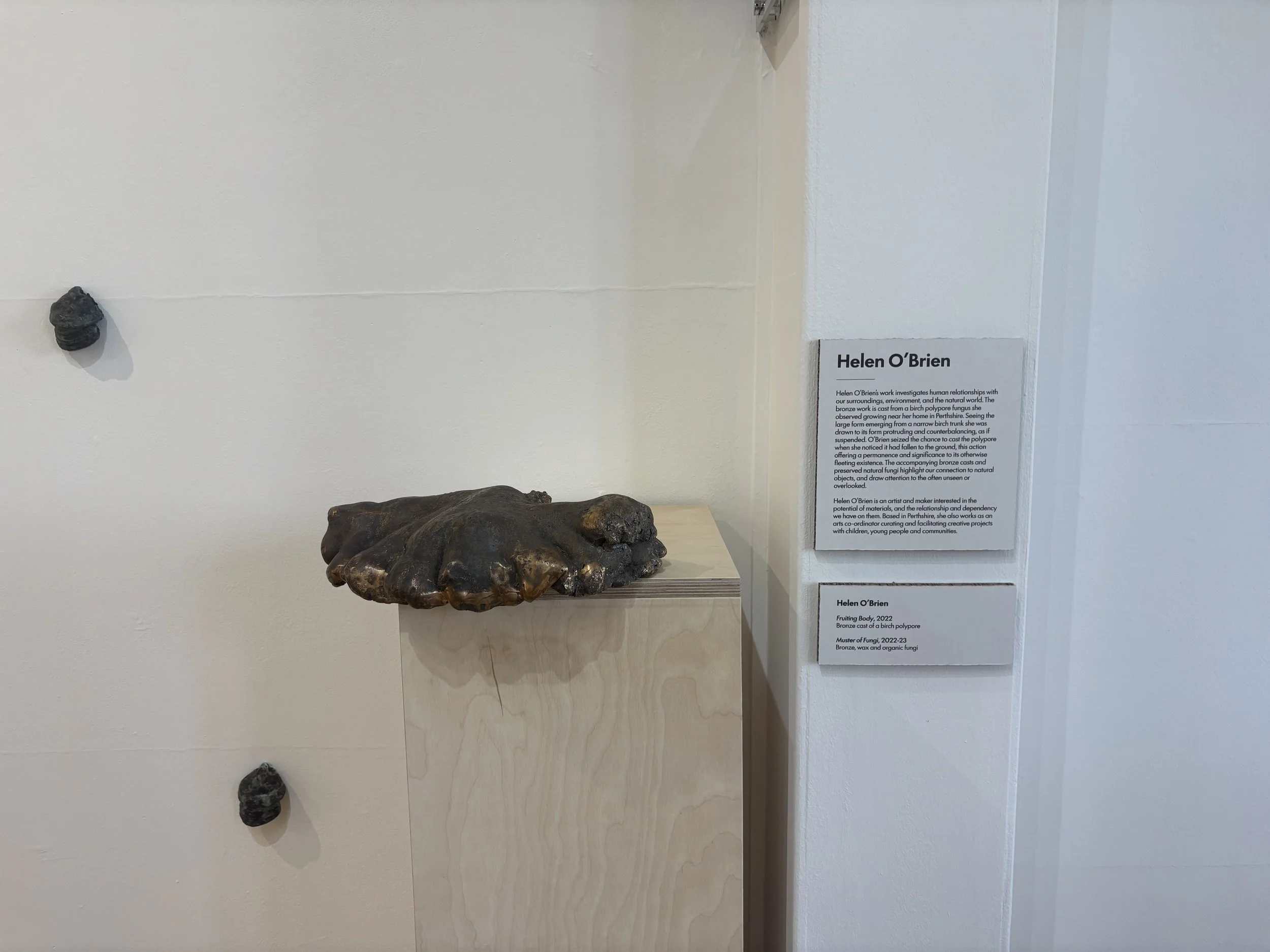
Helen O’Brien, Fruiting Body, 2022 and Muster of Fungi, 2022-23. Image courtesy of the author.
Despite the sober reflections induced by the exhibition, Fife Contemporary highlights that Dear Earth represents a productive “discomfort” rather than abject “despair”. By encouraging a stronger relationship to the natural world, a recognition of the damage inflicted by the climate crisis can be appreciated whilst simultaneously allowing the seeds of “hope” to be sewn. This sentiment is served well by the gentle flow of the curation, allowing the works to invite, not impose upon, the viewer. Looking closer is rewarded. This was a sentiment that carries out of the exhibition, in which fostering a more attentive relationship to the natural world can facilitate its healing.
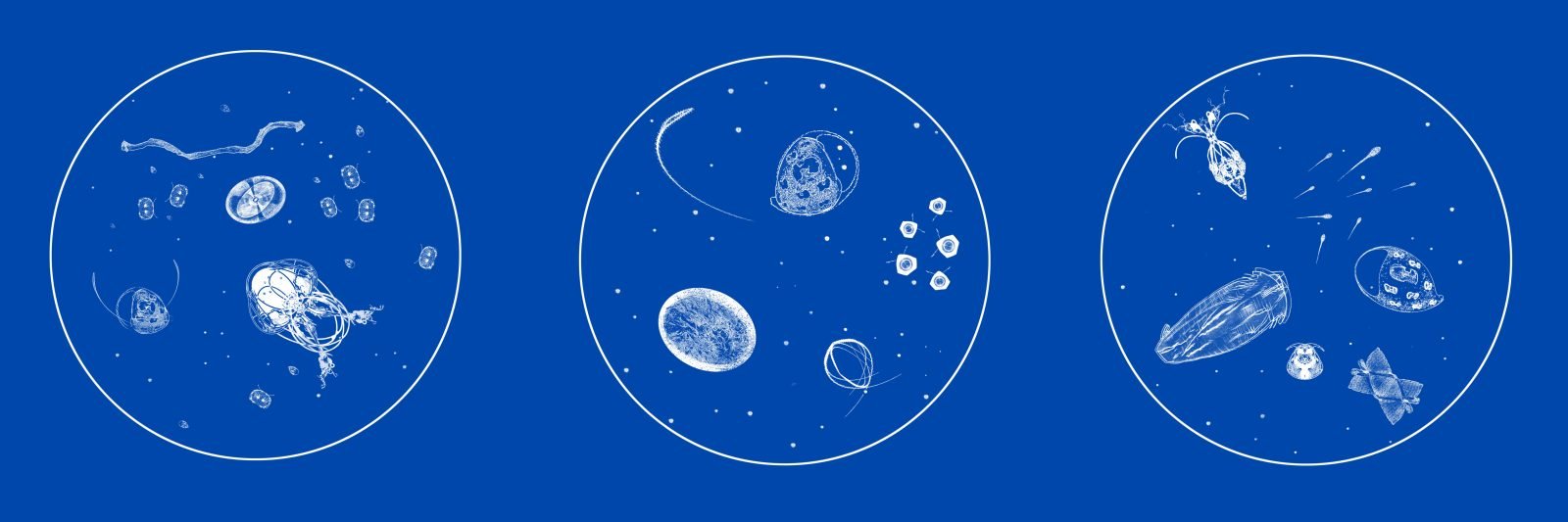
Jeni Reid, Microplastics, 2025. Image courtesy of Fife Contemporary.
Naomi Mcintosh’s Scarcity of Song (2025) exemplifies the need to look closer at the natural world. The installation consists of seventy fine pieces of beech wood steam-bent into S-curves, with each branch representing a different species of endangered bird. Each of their lengths correspond to a particular species’ wingspan and their shapes draw from how their songs appear on an oscillogram. It makes for an impressively detailed piece that achieves a striking ephemerality and daintiness, all the while confronting salient fears regarding Scotland's natural landscape. It is from here that the sounds of bird song filling the room are realised to be artificial, emanating from a speaker placed below the work. As Scotland becomes a “refuge” for some bird species as temperatures increase, other native upland birds face decline as their living conditions are destabilised. Mcintosh's decision to loop the sounds of these endangered birds via an artificial sound system probes an appreciation for the birdsongs of today whilst raising unsettling questions about their fates, hinting at a future in which there are no birds left to sing with their songs persevered only through digital recordings.
Dear Earth runs until 6 March 2027 at St Andrews Museum and is open Wednesday through Sunday from 10:30am to 4:00pm. Free entry.
Bibliography:
Fife Contemporary. “Dear Earth.” Accessed October 17 2026. https://www.fcac.co.uk/event/dearearth/.
NaturScot. “Our changing climate.” Accessed October 17 2026. https://www.nature.scot/climate-change/our-changing-climate.
NaturScot. “Scotland's terrestrial breeding bird numbers show effects of climate change.” Published January 11 2024. https://www.nature.scot/scotlands-terrestrial-breeding-bird-numbers-show-effects-climate-change.