A Reflection on The Story of Art by E.H. Gombrich
By Virginia Carlier

Fig 1. Front cover of E.H. Gombrich, The Story of Art (1950), Luxury edition (London: Phaidon Press, 2024) – Image courtesy of Virginia Carlier & Elise Young
The Story of Art by E.H. Gombrich is considered by many to be an essential starting point for any art history student worthy of the name. This hefty book has undeniably become a dependable source of knowledge and inspiration for a multi-generational readership of artists, academics and enthusiasts alike. Since first being published in 1950, an impressive eight million copies have been sold in over 30 translations. These numbers far surpass the author’s original ambitions, who expressed “amazement and gratitude” for its international success in the 1994 Preface of the book’s most widely read 16th edition.
From the pen of an Austrian émigré to Britain in the years leading up to WWII, this book seeks ambitiously to recount the origins of Western art from prehistoric times into the 20th Century, capturing the reader in an enthralling narrative of perpetual renewal and innovation. What is presented within its pages is much more than a simple guide to the discipline, but rather a truly groundbreaking product of its time. Although written over 75 years ago, its legacy significantly surpasses its intended purpose of educating young adults on the fundamentals of art history. By explaining complex concepts in an accessible format and conversational style free of specialised jargon, Gombrich democratises and demystifies an opaque field of study for all to appreciate.

Fig 2. Portrait of E. H. Gombrich at his desk. Photograph by Pino Guidolotti – Image courtesy of Artnet News, January 2, 2024. https://news.artnet.com/art-world/story-of-art-book-excerpt-2405552.
Another noteworthy reason for this volume’s enduring popularity can be explained by its functional and aesthetic presentation of full-page illustrations alongside the text’s descriptions, rather than traditionally at the end of a book. Gombrich’s approach of combining visual and textual material within each chapter invites both novices and experts to deeply appreciate an artwork’s details, symbols and meanings through this interactive format. Yet, since the rise of social art history in the 1970’s, many scholars have called for an abandonment of this text due to its purported cultural biases, teleological assumptions and dismissal of women artists. This review therefore poses the important question: Are classics still relevant despite their intrinsic limitations?
One of the most disputable claims is found in this book’s Introduction, where Gombrich boldly states that “There really is no such thing as Art. There are only artists. Art with a capital A has no existence.”. This initial judgement cleverly foreshadows this book’s sweeping method, as the author focuses the following 620 pages on the linear progression of great art through the lens of artists’ technical skills and creative ingenuity. This academic practice has come to be widely known as “Gombrichian art history” where the individual is upheld as the dominant engine of meaning within the development of art history. Although this approach may be thoroughly compelling, it is not original to Gombrich but rather the consequence of 400 years earlier. It was originated by the eminent painter, architect and scholar, Giorgio Vasari, who compiled a visual history of art in the 1550’s within his two-edition volume The Lives of the Most Excellent Painters, Sculptors and Architects. Gombrich’s comparable approach of recounting artistic achievements as being distinctly individual endeavours allows him to tell a singular story of perpetual artistic innovation across centuries.

Fig 3. Interior double-page spread of E. H. Gombrich, The Story of Art (1950), Luxury edition (Phaidon Press, 2024) – Image courtesy of Virginia Carlier & Elise Young
These assumptions may be detrimental as they tend to permeate readers’ minds with biased historical interpretations of artists from ancient times to the modern era. Hence, one of the main critiques of The Story of Art relates to its omission of women artists within its extensive survey of art history. Having first been denounced by acclaimed feminist scholars, Rozsika Parker and Griselda Pollock, almost 30 years ago for its alleged gender shortcomings, Gombrich’s book still faces severe scrutiny to this day. These claims were most recently reiterated by British art historian Katy Hessel in her 2022 best-selling book The Story of Art Without Men which serves as a critical response to Gombrich’s canonical narrative of art history. By completely omitting women artists until retroactively adding a single woman artist in its 16th edition, German painter and printmaker Käthe Kollwitz (1867-1945), it can be argued that this book puts forward a disproportionately patriarchal account of the discipline.
Thus, whilst The Story of Art by E.H. Gombrich may be viewed as an essential resource, it should be critically interrogated for its weaknesses yet still praised for its strengths. Such a viewpoint invites readers to move beyond the idea of an all-knowing text, by supplementing an understanding of art history with diverse voices and alternative interpretations. However, for those who are beginning their journey within this thrilling field of study, it is still important to recognise this book’s unique qualities of depth and breadth. To adopt this book in the 21st Century as a companion to learning, it should be viewed as one of the many pieces of a puzzle rather than its entire picture. As compellingly stated by Gombrich in this book’s Introduction, “[...] to look at a picture with fresh eyes and to venture on a voyage of discovery into it is a far more difficult but also a much more rewarding task.”. Hence, by reading The Story of Art and by understanding that it is not a prescriptive account but rather a compass, artists, academics and enthusiasts will be well equipped to navigate through the complex and beautiful world of art history.
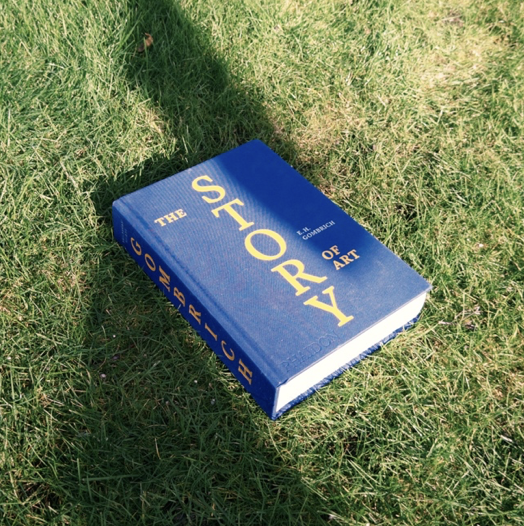
Fig 4. E. H. Gombrich, The Story of Art (1950), Luxury edition (London: Phaidon Press, 2024) shown in an outdoor setting – Image courtesy of Virginia Carlier & Elise Young
Bibliography
Gombrich, E.H. The Story of Art. Luxury Edition. 1950. Reprint, London: Phaidon Press, 2024.
Gombrich, Leonie. “Why Gombrich’s ‘the Story of Art’ Has Stood the Test of Time.” Artnet News, January 2, 2024. https://news.artnet.com/art-world/story-of-art-book-excerpt-2405552.
Harris, Jonathan. The New Art History: A Critical Introduction. London: Routledge, 2001.
Hessel, Katy. The Story of Art without Men. W. W. Norton & Company, 2023.
Newall, Diana. “Sir Ernst Gombrich, the Story of Art (1950).” In Fifty Key Texts in Art History, 99-105. London: Routledge, 2012.
Pollock, Griselda. Differencing the Canon: Feminist Desire and the Writing of Art’s Histories. London ; New York: Routledge, 1999.
Rose, Sam. Interpreting Art. London: UCL Press, 2022.
Thomas, Ben. “Giorgio Vasari.” In Fifty Key Texts in Art History, 32-35. London: Routledge, 2012.