Eileen Agar and Edwin G. Lucas: Engaging with the Surreal
By Natascha Watt
Although Surrealism was an art movement that developed internationally, it did not really develop here in Scotland. Indeed, it seems the country’s rather conservative art market hindered this, and artists would have struggled to find any buyers for their works. However, this does not mean that some Scots, like Eileen Agar and Edwin G. Lucas, did not get involved.
Though born to an American mother on 1 December 1899 in Buenos Aires, Argentina, Agar’s father was Scottish. Closer to home, Lucas was born on 11 March 1911 in Leith. Agar studied at the Slade School of Fine Art in London, whereas Lucas graduated with a Law degree from the University of Edinburgh, subsequently working for the Civil Service in the Scottish capital. Despite having shown talent from a young age for both painting and drawing, his parents discouraged him from becoming an artist for fear of financial instability. Agar became one of the leading figures of British Surrealism in the 1930s (although she did separate herself from the movement’s political and theoretical aspects), whereas Lucas painted his Surrealist works over the course of only a few years (1939-1941), after which he no longer considered himself a Surrealist painter. Nevertheless, he still included Surrealist elements in his later works.
Surrealism came about after World War One in response to the horrors of the conflict and developed collectively and internationally. Originally a poetic movement, Surrealism was defined by French poet Louis Aragon as that which one cannot grasp. André Breton wrote the Surrealist Manifesto in 1924, emphasising the importance of philosophy to the movement. Following this line of thought, scholar Michael Richardson has noted that an artist cannot simply define themselves as Surrealist in style, for it is an entire philosophy that one must follow. Surrealist artists are constantly looking to create and to expand Surrealism beyond what it may be in its present form: “surrealism is not what is but rather what will be.”
Thus, Agar and Lucas cannot be defined as strictly Surrealists, which is not something either artist thought they were. Agar wrote that she found herself between abstraction and Surrealism. Having rebelled against her family and moved to Paris in 1929 (where she met key Surrealists André Breton and Paul Éluard), she started experimenting with abstraction, using overlapping patterns and blocks of colours in her works that included birds, other animals and collaged forms. She went on walks to beachcomb, nature often being the starting point of her work. Agar believed one had to reflect on one’s paintings before making them, and thus disagreed with the Surrealist practice of automatism, saying: “A painting is not automatic, you have to think about it.” Alongside painting she also created collages and other objects, as well as having an interest in photography. She was the only professional British female artist to show her work at the 1936 International Surrealist Exhibition in London. Agar herself was surprised by the movement’s acceptance of her: “I was astonished they let me in – they only ever thought of women as muses,” highlighting the movement’s misogyny.
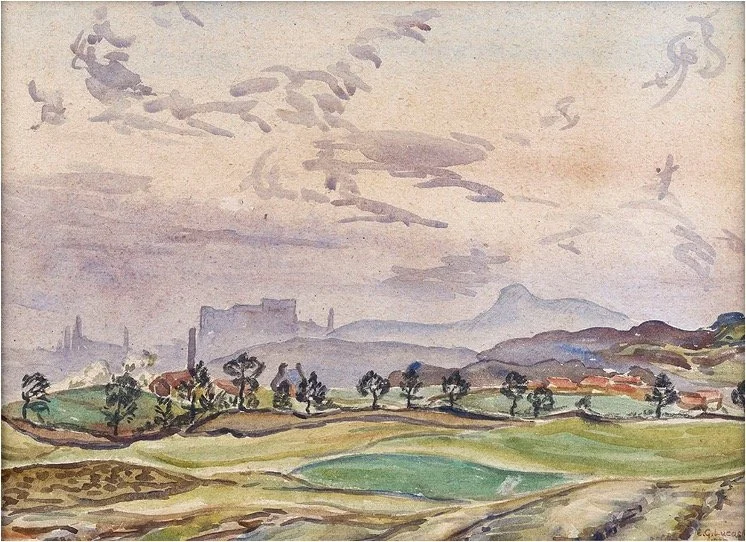
Edwin G. Lucas, Edinburgh from Barberton, 1932. Watercolour, 27 x 37 cm. Image courtesy of edwinglucas.com.
In contrast to Agar, Lucas was, for the most part, an autodidact, as the only artistic education he followed were evening life-drawing classes at Edinburgh College of Art. Throughout the 1930s he had mostly worked with watercolours (as seen in Edinburgh from Barberton, 1932) but by the end of the decade he had embraced oil painting and was growing increasingly interested in and influenced by Surrealism, although eventually shifting away from it. Nevertheless, he did submit some of his Surrealist works to exhibitions at the Royal Scottish Academy but these were usually rejected. Instead, he held two solo shows at the New Gallery in Edinburgh in 1950 and 1951 in which he showed all of his Surrealist artworks, but to no real institutional acclaim. However, after marrying in 1952 he stopped painting, only taking it up again in the early 1980s before his death in 1990. His work is virtually unknown.
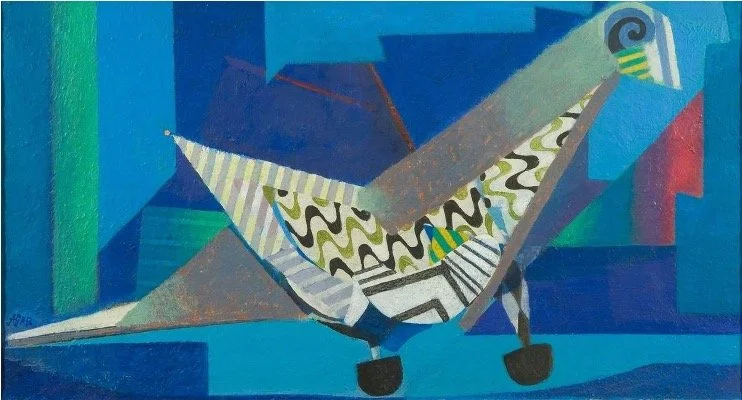
Eileen Agar, Pigeon Post, 1969. Pencil and gouache laid on canvas, 51 x 91.5 cm, Jerwood Collection. Image courtesy of Art UK.
Many Surrealist artists, including René Magritte and Max Ernst, explored avian imagery in their art, something both Agar and Lucas did. Agar’s 1969 painting Pigeon Post is from a group of paintings she did of birds using vibrant and rich patterns. Many of these were shown at London’s Commonwealth Art Gallery in a 1971 retrospective. After briefly giving up painting during WWII she started again following several trips she made to Tenerife. The island’s light and tropical colours stimulated and enriched her imagination, which can be seen through her use of bold colours and patterns in Pigeon Post.
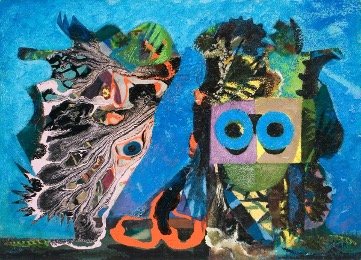
Eileen Agar, An Exceptional Occurrence, 1950. Oil on canvas on board, 50 x 70 cm, National Museum Cardiff. Image courtesy of Art UK.
In An Exceptional Occurrence (1939), Surrealist influences can be seen in the shape on the left in its marbled effect. It looks as though it has been obtained through decalcomania, a process closely associated with Surrealists Max Ernst and Oscar Dominguez in which paint is squeezed in between two surfaces so that a mirror image can be obtained. Pigeon Post stands in contrast to this with its more angular nature, highlighting that Agar also found inspiration beyond the realm of Surrealism. The way the different patterns are layered and placed in relation to one another hint at collage, another practice which she engaged with.
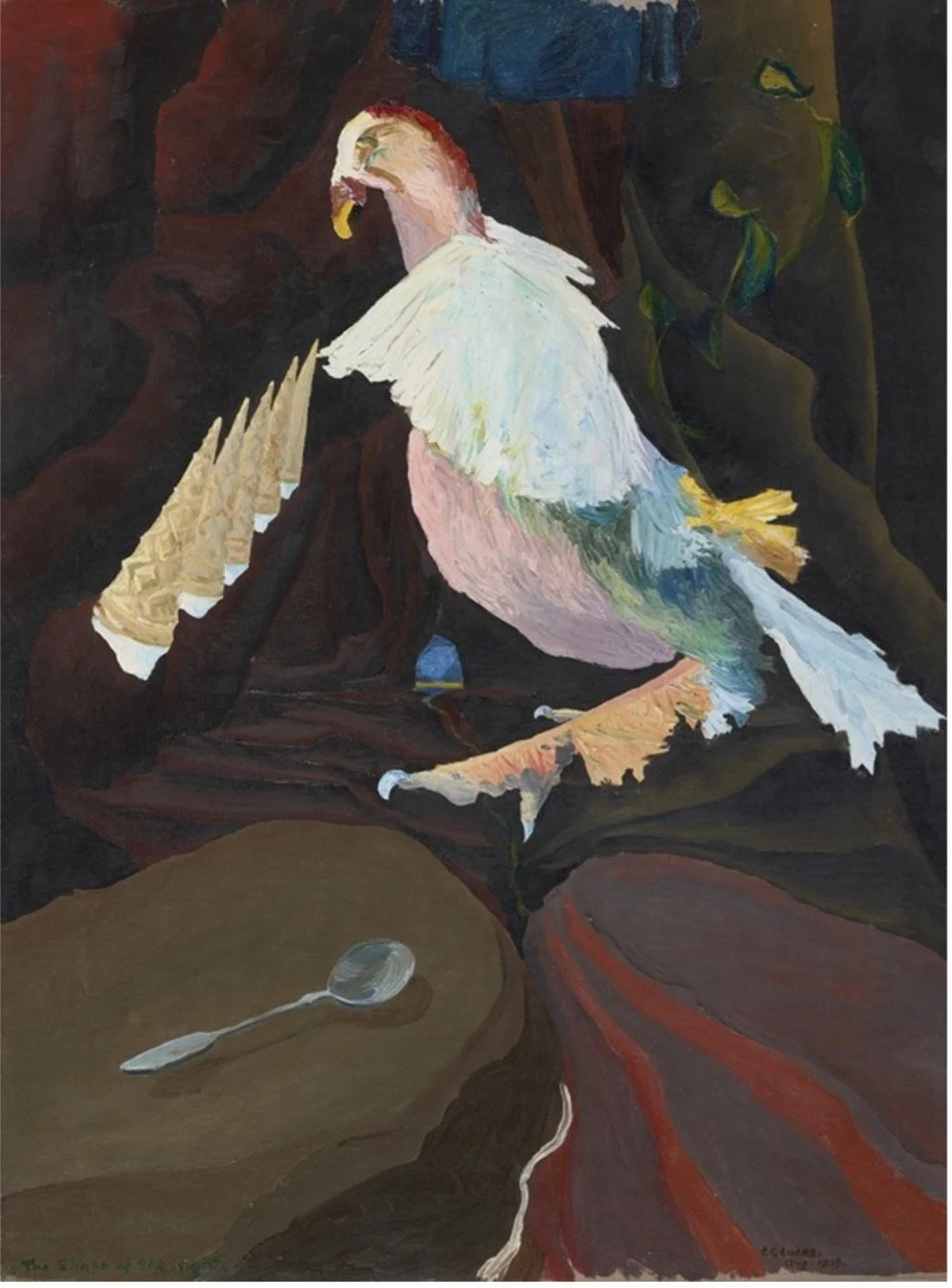
Edwin G. Lucas, The Shape of the Night, 1939. Oil on canvas, 61.4 x 46 cm. Image courtesy of edwinglucas.com.
A different take on the bird is Lucas’s 1939 The Shape of the Night. As in Agar’s composition the bird is shown to the viewer from one side. Whereas Agar’s bird takes up most of the canvas, Lucas’ is depicted with other elements (a spoon and upside-down ice cream cones) and sits at a higher level within the composition. There appears to be some foliage emanating from behind the bird in the right-hand side of the painting and the viewer’s eye is led to the patch of blue in the centre of the painting which looks like an opening onto another world. This would be in line with the Surrealist belief that through our dreams we can gain access to another reality, one that lies beyond the one we know. The Surrealist emphasis on dreams is hinted at in the title, as they occur when one sleeps which is usually during the night. This may be what Lucas was taking inspiration from while painting this portal-like element. As noted by curator Patrick Ellis, the title resembles those of Magritte, but the work itself is entirely Lucas’s.
Birds can be symbols for many different things in art. For Magritte they represented freedom, imagination and perception, thus taking on a poetic meaning as the birds move beyond nature, becoming a metaphor. They have also been seen as metaphors for the soul. Although they may not have a clear meaning in these paintings, that is exactly what makes these works Surrealist (to some extent at least), in that one cannot grasp what they are. Although Surrealism may not have truly developed within Scotland, some of its artists (both at home and abroad) were inspired by it, incorporating some of its elements into their works.
Bibliography
Art UK. “Pigeon Post.” Accessed January 27, 2025. https://artuk.org/discover/artworks/pigeon-post-232785/search/actor:agar-eileen-18991991/page/1/view_as/grid.
Christie’s. “Eileen Agar: the woman who infiltrated the male world of the Surrealists.” Published February 6, 2023. https://www.christies.com/en/stories/the-life-and-work-of-eileen-agar-28aaeebd3f1b44f9be9b3a477c1afe63.
Fleming Collection. “The Surreal Case of Edwin Lucas.” Published May 1, 2016. https://www.flemingcollection.com/scottish_art_news/news-press/The-Surreal-Case-of-Edwin-Lucas#:~:text=A%20small%20number%20of%20others,did%20not%20need%20to%20sell.
Masterworks Fine Art. “René Magritte Birds.” Accessed January 27, 2025. https://en.masterworksfineart.com/artists/rene-magritte/birds.
National Galleries of Scotland. “Eileen Agar.” Accessed January 27, 2025. https://www.nationalgalleries.org/art-and-artists/artists/eileen-agar.
Richardson, Michael. “Introduction.” In The International Encyclopedia of Surrealism, vol.1, xiii-xxv.
Tate. “Decalcomania.” Accessed January 29, 2025. https://www.tate.org.uk/art/art-terms/d/decalcomania.
The Arts Society. “Understand These Surrealist Symbols.” Published February 18, 2022. https://theartssociety.org/arts-news-features/understand-these-surrealist-symbols.