By Annabel Van Grenen
Charged with extraterrestrial imagery, Roberto Matta’s anachronistic work seems to evoke the experience of falling down a rabbit hole through an abstract, futuristic landscape. Born on 11 November 1911 in Santiago as Roberto Sebastián Matta Echaurren, this Chilean artist was to become one of the most influential figures on the New York art scene. After studying architecture at the Pontificia Universidad Católica de Chile, he moved to Paris in 1934 and worked in the studio of Le Corbusier, a trailblazer of the International Style, until 1937. Paris exposed him to the thriving Surrealist movement and provided him with key ideas that would drive his work for the rest of his career, most notably psychic automatism: a pillar of Surrealist theory concerned with revealing and connecting the conscious and unconscious mind. Guardian writer Michael McNay even described Matta as the crème de la crème of the Surrealists, noting how his ‘apocalyptic explosions of light came closer to the surrealist ideal than any other’.
The expulsion of émigrés from Europe at the outbreak of the Second World War created a buzzing cultural hub of artistic exchange and collaboration in the Big Apple, in which Roberto Matta bloomed at the centre. Operating as a creative network, Matta acted as a bridge between Americans and European refugees. He also became the mentor of fellow painter Robert Motherwell, with whom he exchanged theories of the unconscious, and even travelled to Mexico with a group of artists in 1941.
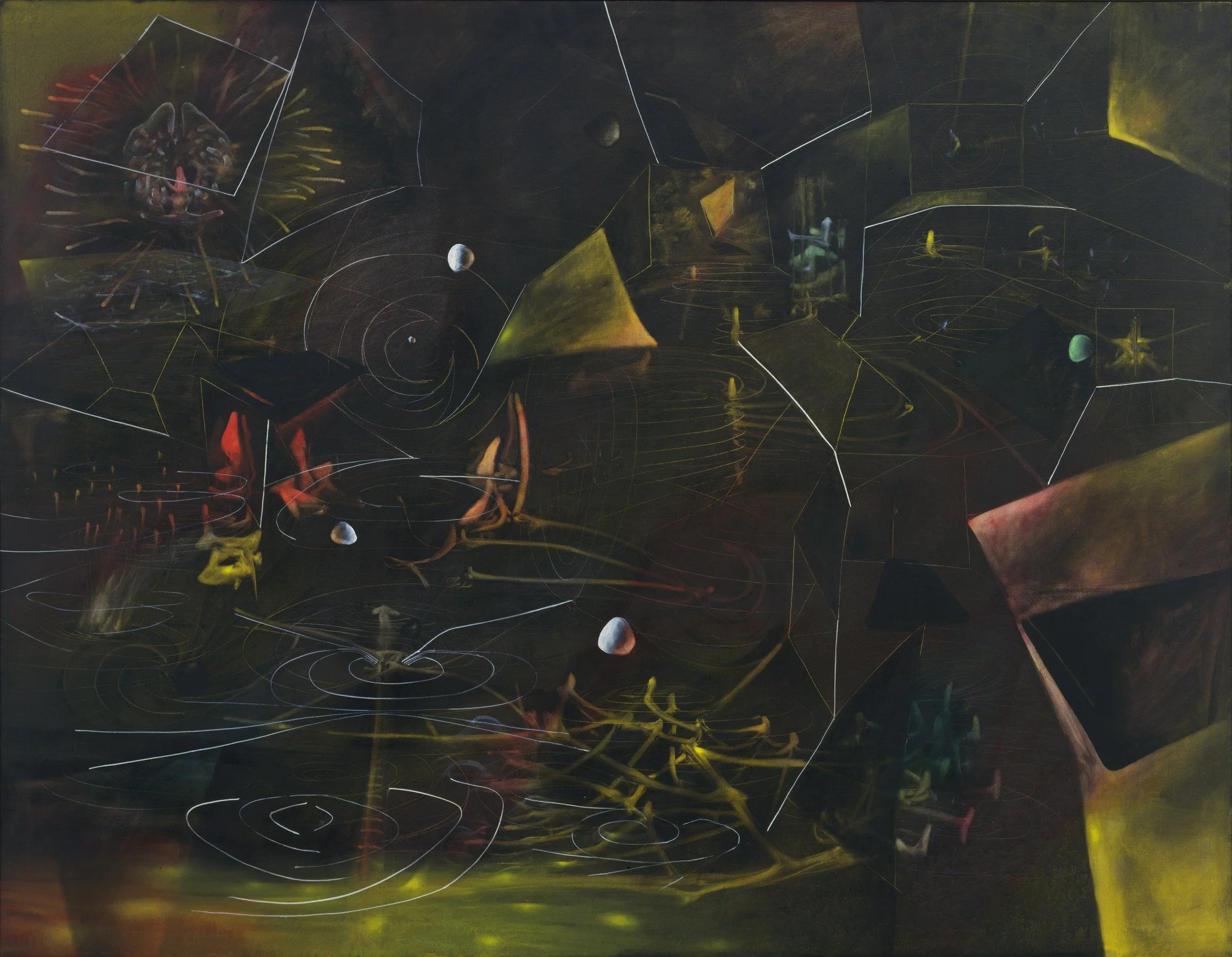
Roberto Matta, The Vertigo of Eros (1944) Oil on canvas, MoMA.
To achieve these astrally biomorphic forms, Matta would tip thin layers of paint onto a canvas before wiping and scratching the surface, producing varying degrees of transparency. The intention behind what he called his ‘psychological morphologies’ and ‘inscapes’ was not only to integrate colours but also to blend our interior mind with the exterior universe, thereby producing these otherworldly scenes. Matta was heavily inspired by Salvador Dalí’s work of the 1920s, which is evident in the uncanny nature of his own. In his 1944 painting The Vertigo of Eros, for example, we seem perpetually on the verge of detecting something recognisable, on the cusp of form. Instead, we are greeted with pseudo-arachnid limbs, ripples in a dark abyss, and blurred fireworks amid darkness and yellowish glowing shapes, which Matta himself compared to the impression of light on closed eyelids. The intricate layering of diverse textures creates an allure and curiosity that compels the viewer to examine his works. Here, shards of glass seem to guide our eyes around the unknown space. Drawing on Marcel Duchamp’s The Large Glass, among other works, Matta used transparency and glass as another device to blur the boundary between the internal and the external.
Wishing to form an entirely new movement focused primarily on psychic automatism, Matta and Motherwell, alongside others, gathered like-minded artists such as Jackson Pollock to pursue such a revolution. Despite Matta’s departure from the group before their identity was fully realised, they later became the Abstract Expressionists, whose profound impact irrevocably altered the New York art scene.
In his later life, Matta participated in the social movements of the 1960s and 1970s, and he died aged 91 on 23 November 2002. To return to The Vertigo of Eros, the work seems to encapsulate both the beginning and the end at once: the Big Bang and Armageddon together. To look at his work is to be transported, and despite not knowing where we are heading, isn’t the journey simply mesmerising?
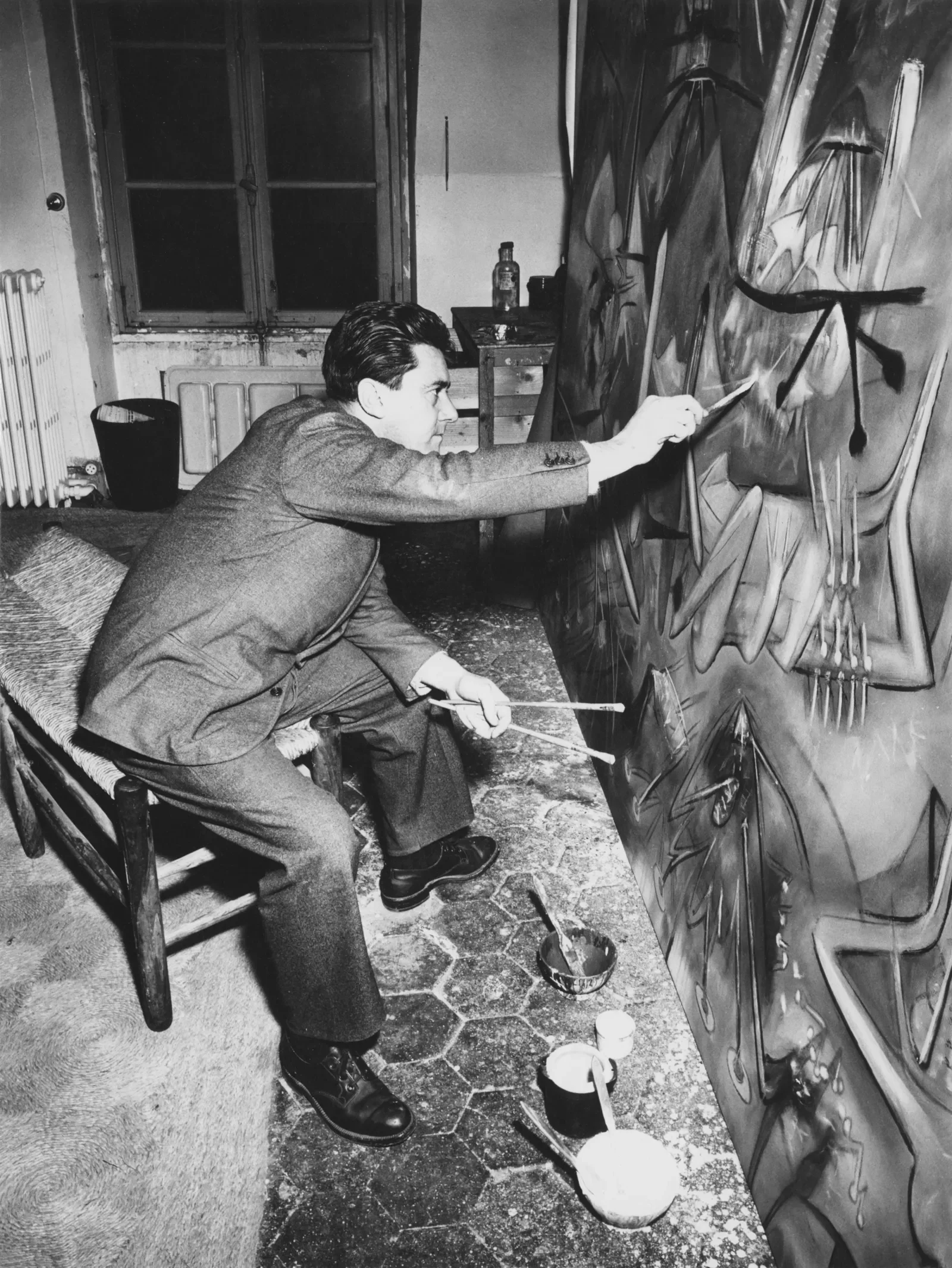
Roberto Matta dans son atelier, Paris, 1954. Image courtesy of Diane de Polignac Galerie.
Bibliography
McNay, Michael. Obituary, The Guardian, November 25,2002.https://www.theguardian.com/news/2002/nov/25/guardianobituaries.artsobituaries
Rogers, Katy. ‘To Transform the World: Matta and Motherwell in New York and Mexico.’ In Nexus New York:Latin/American Artists in the Modern Metropolis, edited by Deborah Cullen. New York: Museo del Barrio, 2009.
Sims, Lowery Stokes. ‘Wilfredo Lam and Roberto Matta: Surrealism in the New World.’ In In the Mind’s Eye: Dada and Surrealism, edited by Terry Ann Neff. Chicago and New York: Museum of Contemporary Art and Abbeville Press, 1985.