Paula Modersohn-Becker (1876-1907)
By Annabel van Grenen
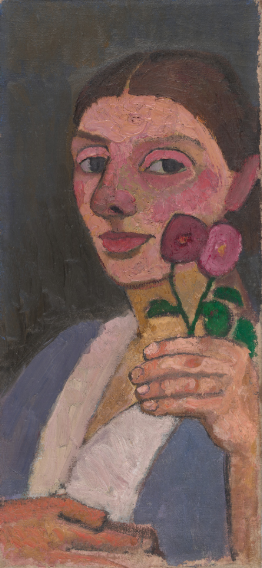
Paula Modersohn-Becker, Self Portrait with Two Flowers in Her Raised Left Hand, 1907, oil on canvas, Museum of Modern Art, New York City.
Image courtesy of the Museum of Modern Art and the Neue Galerie.
Born 8 February 1876 in Dresden, Germany, Paula Modersohn-Becker has become one of the most prominent figures in German Expressionism. Despite her untimely death, aged thirty-one, and her lack of commercial success during her lifetime, she produced over 700 paintings across her four-year career. During her time at Worpswede, an artist colony, she drew influence from Cézanne, Gaugin, and Van Gogh, but did not shy away from curating a uniquely textured style.
Her husband, Otto Modersohn, was her mentor at Worpswede and said that her artworks were unfeminine; the unequivocal honesty with which she determined herself and her female subjects contradicts this remark. In her painting Self Portrait with Two Flowers in Her Raised Left Hand (1907), she was unafraid to employ rough and tactile brushwork, as well as bold, audacious colours - blemishes and all. Modersohn-Becker was frequently drawn to the image of mother and child, hardly a new subject matter, but the unflinchingly raw portrayal of this traditional pair made her work so profound.
Her painting Self Portrait at 6th Wedding Anniversary (1906) marked her as the first woman to paint a nude self-portrait; she is visibly pregnant, hands placed beneath a swollen stomach. Yet, she only fell pregnant in 1907. Going a step further than Elisabeth Louise Vigée Le Brun’s Self Portrait in a Straw Hat (1782), Modersohn-Becker doesn’t hold a palette, branding herself a painter, but rather merges her identity as a woman and artist. In doing so, she claimed creative agency and broke long-established patriarchal rules of the female nude, laying the foundation for the brilliant work of future women artists that embody their art, such as Ana Mendieta.
In 1902, the artist wrote to her mother, ‘I am going to become somebody.’ This was five years before the heart attack which prematurely ended her life and occurred whilst walking towards her daughter’s crib despite being instructed to bed rest for eighteen days following childbirth. Almost in defiance of her early death, Modherson-Becker is now recognised as a leading figure of modernism, with works collected by the Museum of Modern Art in New York and numerous large-scale exhibitions, as well as a whole museum dedicated to her work in Bremen, Germany.
Pressured by marriage and children, yet driven by passion and determination, resulting in a brief absence from her husband in 1906 when she fled to Paris, she proved to be an exceptional talent. She fulfilled the wish to her mother and became somebody that we celebrate more than a century after her tragic death.
Bibliography
Hershberg, Sandra G. “A Female Gaze in/on the Female Body in Art and Psychoanalysis: Paula Modersohn-Becker.” Psychoanalysis, Self and Context 15, no. 1 (2020): 76–86.
Lang, Olivia. “Being Here: The Life of Paula Modersohn-Becker review – the story of women’s art.” The Guardian, 4th November 2017, https://www.theguardian.com/books/2017/nov/04/being-here-life-paula-modersohn-becker-marie-darrieussecq-review.
Piccoli, Giorgina B., and Scott L. Karakas. “Paula Modersohn-Becker, the Challenges of Pregnancy and the Weight of Tradition.” Philosophy, Ethics, and Humanities in Medicine 6, no. 1 (2011): 1-7.
Stamm, Rainer. “Paula Modersohn-Becker and the Body in Art.” Woman’s Art Journal 30, no. 2 (2009): 22–25.