Film clip from Michael Mann, Heat, 1995.
Video courtesy of Genery.
In Michael Mann’s modern crime epic Heat (1995), the stark, blue-toned scene in which Niel McCauley (Robert De Niro) returns to his oceanfront apartment, setting his pistol on the glass coffee table before gazing out at the Pacific Ocean functions as a direct visual homage to Canadian Painter Alex Colville’s 1967 work Pacific. The visual comparison is explicit, with the oppressive blue space beyond the window, the raised left arm, and the gun on the table. Colville’s strict mathematical style and angsty tone, rooted in his experiences as a World War II military artist, find a striking cinematic counterpart in Mann’s controlled neo-noir film. Beyond the explicit reference, both creators use a shared visual language to explore themes of professional detachment, spatial isolation, and modernist stoicism.
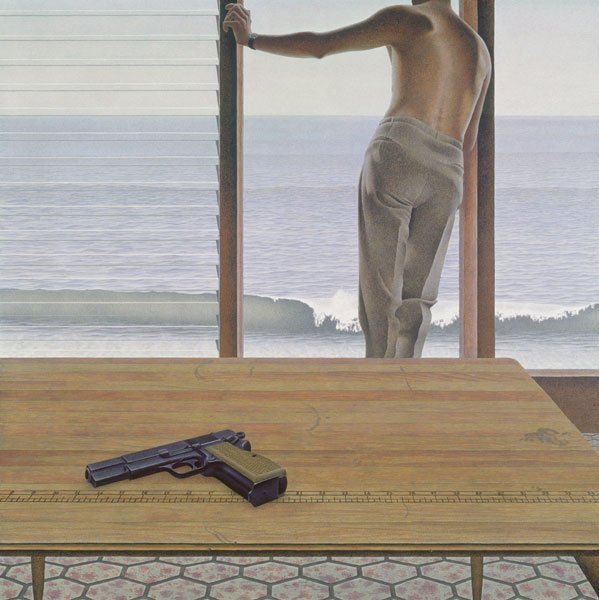
Alex Colville, Pacific, 1967, Acrylic polymer emulsion on hardboard, 53.3 x 53.5 cm.
Image Courtesy of Alex Colville Fine Art Inc.
Colville’s Pacific depicts a man from behind, clad only in a watch and a pair of tailored trousers. The headless figure leans to the right, with his left arm braced against a window mullion. In the foreground, a handgun is systematically placed on a wooden table with a ruler detail. This demonstrates Colville’s reliance on geometrical grids, horizontal baselines, and architectural proportions to construct measured artificially ordered spaces. Mann’s rendition of the composition is executed in a rich, twilight blue tone. The windows of Niel McCauley’s Malibu apartment are larger and the textures become sleeker and harder. Gone are the wooden accents of Colville’s table and gun, replaced by cold glass and steel. The figure himself now appears fully dressed, removing yet another semblance of ease and relaxation. Mann translates Colville’s proclivity for an underlying geometry through his use of stark horizontal framing to accentuate the clean lines of the barren apartment. In both compositions, the inclusion of the gun contributes to a sense of quiet but persistent angst. In the preceding scene, heist mastermind McCauley attempts to murder a rogue crewmember who had ruined the calculated routine of their last score, but is interrupted by patrolling police. McCauley returns home and surrenders his weapon, but it remains on the coffee table as a reminder of the loose ends that threaten to bring the ‘heat’ from the Los Angeles Police Department. In the context of Mann’s high octane, bullet ridden film, the pistol that McCauley sets down is no longer an instrument of action or pulp violence, but an emblem of fatalism and vulnerability set against an infinite expanse. Even in his home, McCauley finds no comfort or respite as he remains haunted by the violence of his profession.
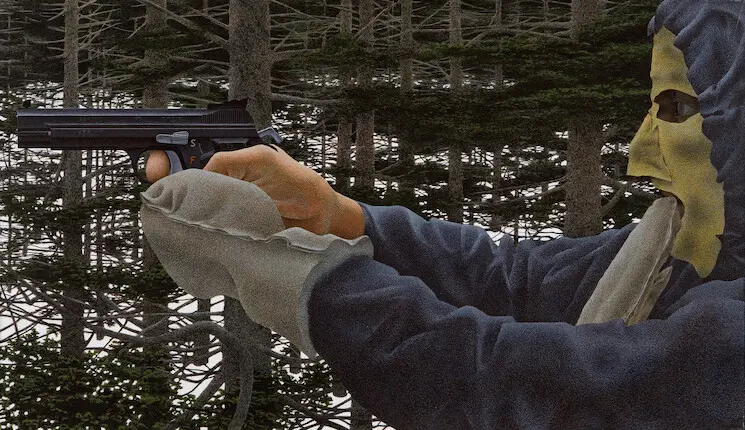
Alex Colville, In the Woods, 1976, acrylic polymer emulsion on board, 59.3 x 34.3 cm
Image courtesy of Bonhams.
Colville was appointed by the Canadian military to be a war artist during WWII, where he was confronted by the horrors of trench warfare and the Bergen-Belsen Nazi concentration camp. His experiences as a war artist shaped his belief that external existence is fundamentally chaotic. In response, Colville embraced a regimented inner order, achieved through a repetitive daily routine in his quiet home in Nova Scotia. The mathematical structure and geometric balance that anchor his paintings serve as his defense against human disorder and mortality. This discipline is central to both Niel McCauley and his LAPD foil Vincent Hanna (Al Pacino), both of whom share a singular, obsessive dedication to their craft. During his coffee with Hanna, McCauley describes his strict credo of keeping nothing in his life that cannot be abandoned in 30 seconds. The men establish a tentative understanding and respect for each other based on their monkish commitment at the expense of domestic comfort. The extreme discipline of Mann’s characters along with Pacific’s stripped environment converge to create a sterile perfection that highlights the alienation and loneliness of hyper-control.
Film clip from Michael Mann, Heat, 1995.
Video courtesy of Genery.
As art dealers and critics note, Colville’s seemingly routine scenes consistently contain an element of threat or dread beneath the surface. This sense of angst contributes to what art historian Helen Dow describes as Colville’s style of magical realism. Mann translates magical realism into his neo-noir film by surrounding his characters in cool, steely colour palettes, sharp shadows, and an eerie sense of destiny. Much of the artist and filmmaker’s shared angst lies in the exploration of the domestic sphere and the professional void. Where Colville presents routine residential life and the family unit as a fragile shield against a dangerous and chaotic world, Mann’s characters actively sacrifice homely stability. Hanna, McCauley, and his crew pursue heists and gunfights which leave them vulnerable to violence and the intervention of fate.
Colville’s Pacific figure and his film counterpart are solitary men in a seemingly endless space. This stoic isolation mirrors Colville’s deliberate choice of small town life in rural Nova Scotia. Despite 17 years of teaching at Mount Allison University, Colville left his position, insulating himself from external artistic influences to pursue the perfection of his vision. Similarly, Mann acted as writer, director, and producer for Heat, taking charge over nearly every aspect of the production. According to prominent film critic Richard Combs, this complete control often becomes “the most fascinating story he has to tell, making it the underlying metaphor of all his films,” which manifests in McCauley’s meticulous planning and the near flawless execution of his heists.
Ultimately, Michael Mann’s direct reference to Alex Colville’s Pacific demonstrates more than a mere aesthetic nod, but a fundamental thematic alignment with the painter’s modernist philosophy. By imbuing a heist film with Colville’s spatial discipline and existential weight, Mann perfects the pulpy cops-and-robbers genre, elevating Heat to a modern epic. Both Colville and Mann demonstrate that modern stoicism is defined by the quest for precision and order in a world mired in violence and chaos.
Bibliography
Alexcolville.Ca. “Alex Colville | Official Site of Canadian Artist Alex Colville.” 2025. https://alexcolville.ca.
Beame, Abe. “The Heat 2 Cast Is Confirmed. Here’s Who’s Playing Who.” British GQ, March 20, 2026. https://www.gq-magazine.co.uk/article/the-heat-2-cast-is-shaping-up-heres-everything-we-know.
Bonhams. “David Alexander Colville, O.C..” https://www.bonhams.com/auction/17469/lot/73/david-alexander-colville-oc-canadian-born-1920-in-the-woods/.
Combs, Richard. “Michael Mann: Becoming.” Film Comment 32, no. 2 (1996): 10–17. JSTOR. https://www.jstor.org/stable/43455156.
Hutchison, Don, dir. Alex Colville: The Splendour of Order. National Film Board of Canada , 1984.
Mann, Michael. “Heat.” Genery. Accessed November 5, 2026. https://genery.io/title/heat-1995.